AMR26 2026: 5 Ultimate Tech Shifts in Newey’s First Aston Martin
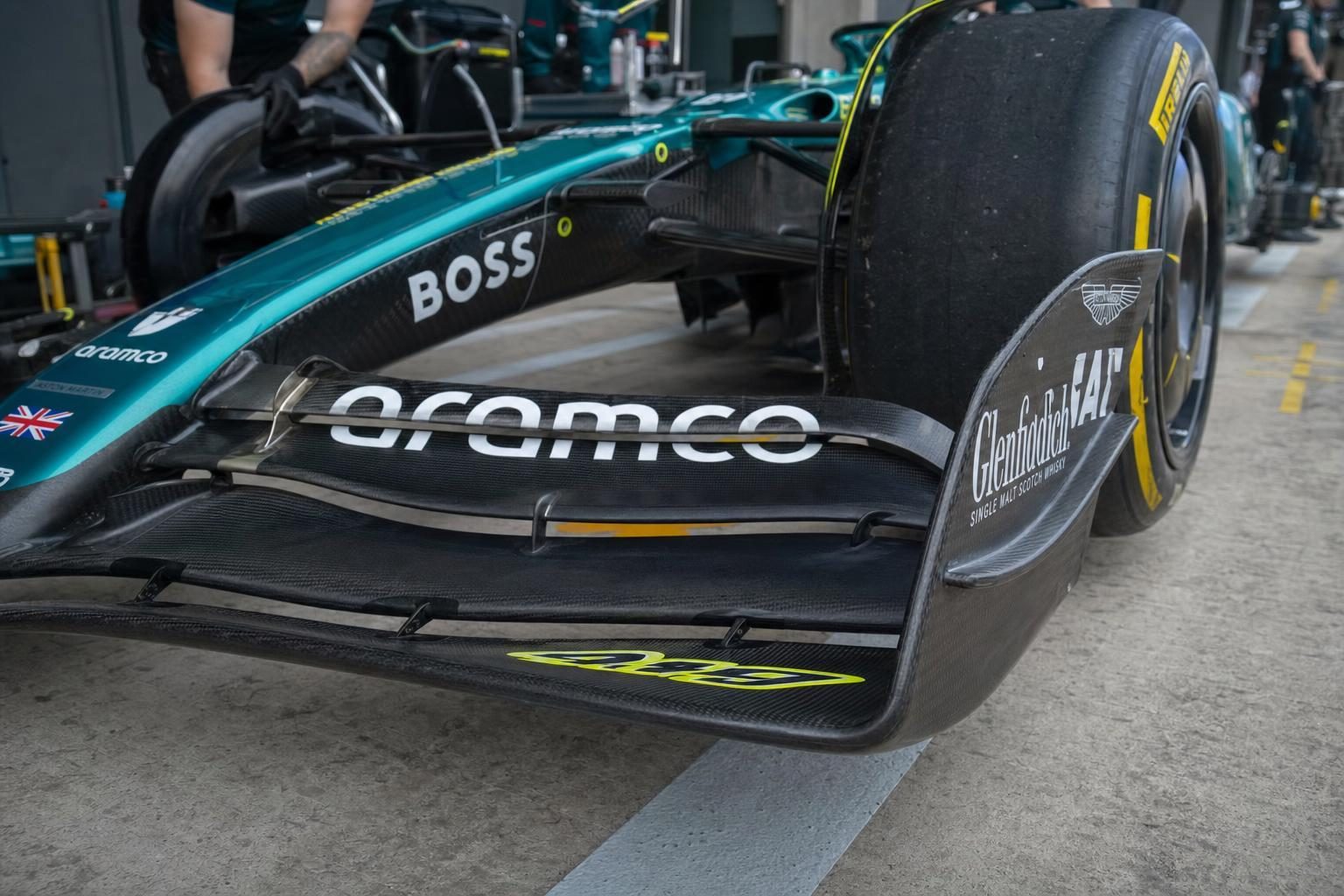
AMR26 is the name of the first Aston Martin designed by Adrian Newey and the rolling laboratory where the 2026 regulations take very concrete shape. Beyond the slogans, this single-seater stands out for five technical breaks that redraw the engineering scope of the Silverstone team: an in-house designed gearbox, Honda power, active aerodynamics without DRS, Aramco sustainable fuel and sometimes bruising learning on track. Here is what changes, and why it matters.
The AMR26’s in-house gearbox: a first at Silverstone since 2004
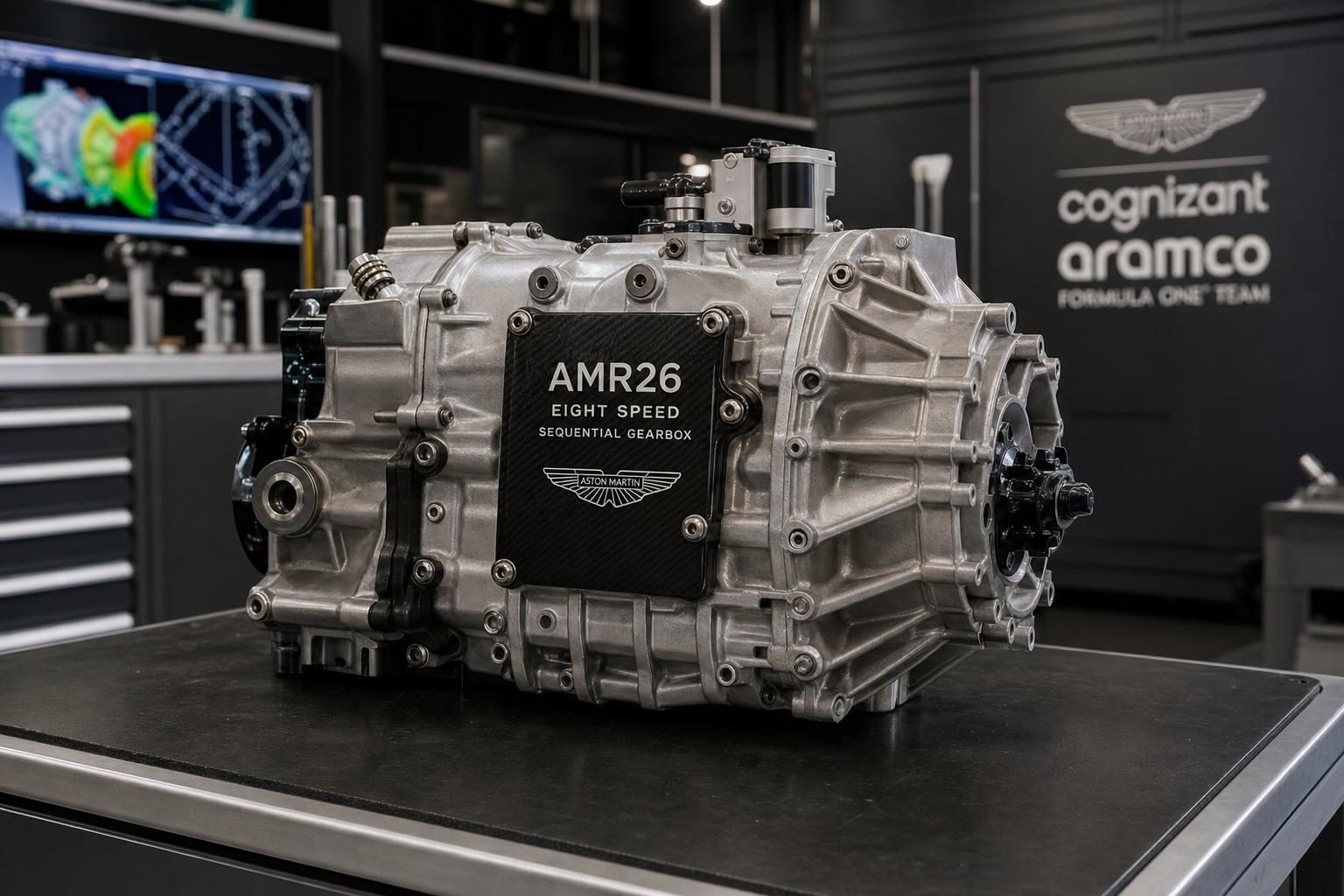
It is a discreet but structuring fact: the AMR26’s 8-speed semi-automatic gearbox is the first transmission developed in-house at Silverstone since 2004, according to Aston Martin. In short, the team is repatriating a critical organ to the heart of its chassis architecture, with control over the design, materials and packaging around the rear suspension.
This homecoming also means a shorter iteration loop between aerodynamicists, designers and the track. A tightly sized casing offers gains in aerodynamic efficiency and local rigidity, while the 2026 era demands finer management of the flows towards the diffuser. By making its transmission both compact and integrated, the AMR26 gives itself extra levers of balance.
The choice has cultural weight: after two decades of more outsourced approaches, Silverstone is once again taking charge of a sub-assembly where reliability and shift precision dictate performance. The risk is real, the potential reward too, especially in combination with the new power unit.
The Honda RA626H engine: a first-of-its-kind partnership for Aston Martin
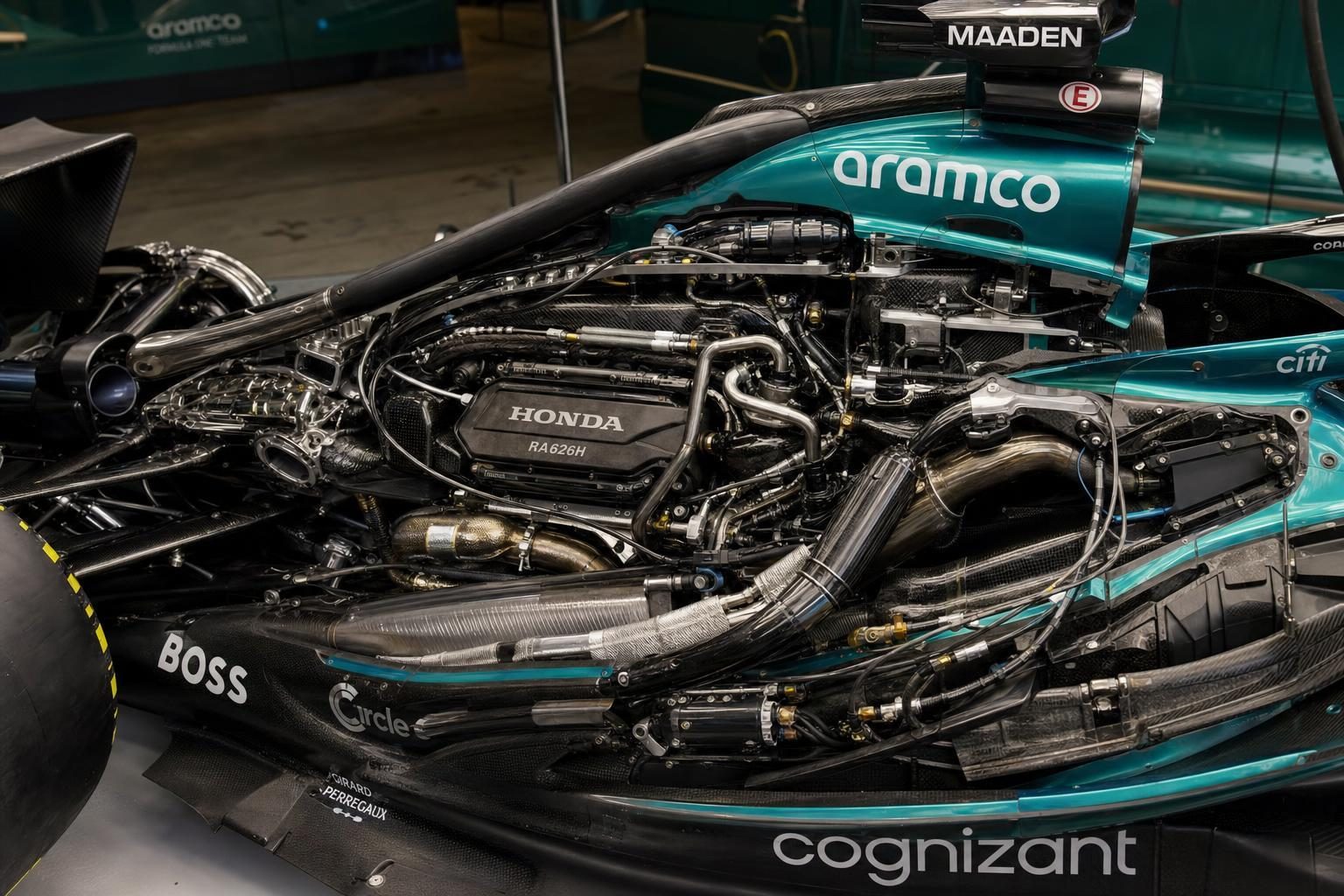
For the first time, a Grand Prix Aston Martin is powered by a Honda engine: the RA626H equips the AMR26, as Wikipedia notes. It is also the first Japanese-engined single-seater from Silverstone since the Toyota-powered Midland M16 in 2006. One page turns, another opens, with chassis–power unit integration conceived from the outset.
This partnership is not a simple badge swap: it requires aligning packaging, cooling and energy management with the balances of 2026. The in-house gearbox mentioned above makes full sense here: by tightening the rear, the team seeks to exploit the RA626H’s compactness and cooling requirements while preserving accessibility for track operations.
The duo of Adrian Newey at the drawing board and Honda on the test bench imposes an overall discipline: CFD–wind tunnel correlations, maps and hybrid strategies must speak the same language. Fernando Alonso and Lance Stroll, in their fourth and sixth seasons with the team respectively, embody continuity at the wheel, while the technology scales up.
Active wings in 2026: Corner Mode, Straight Mode and the end of DRS
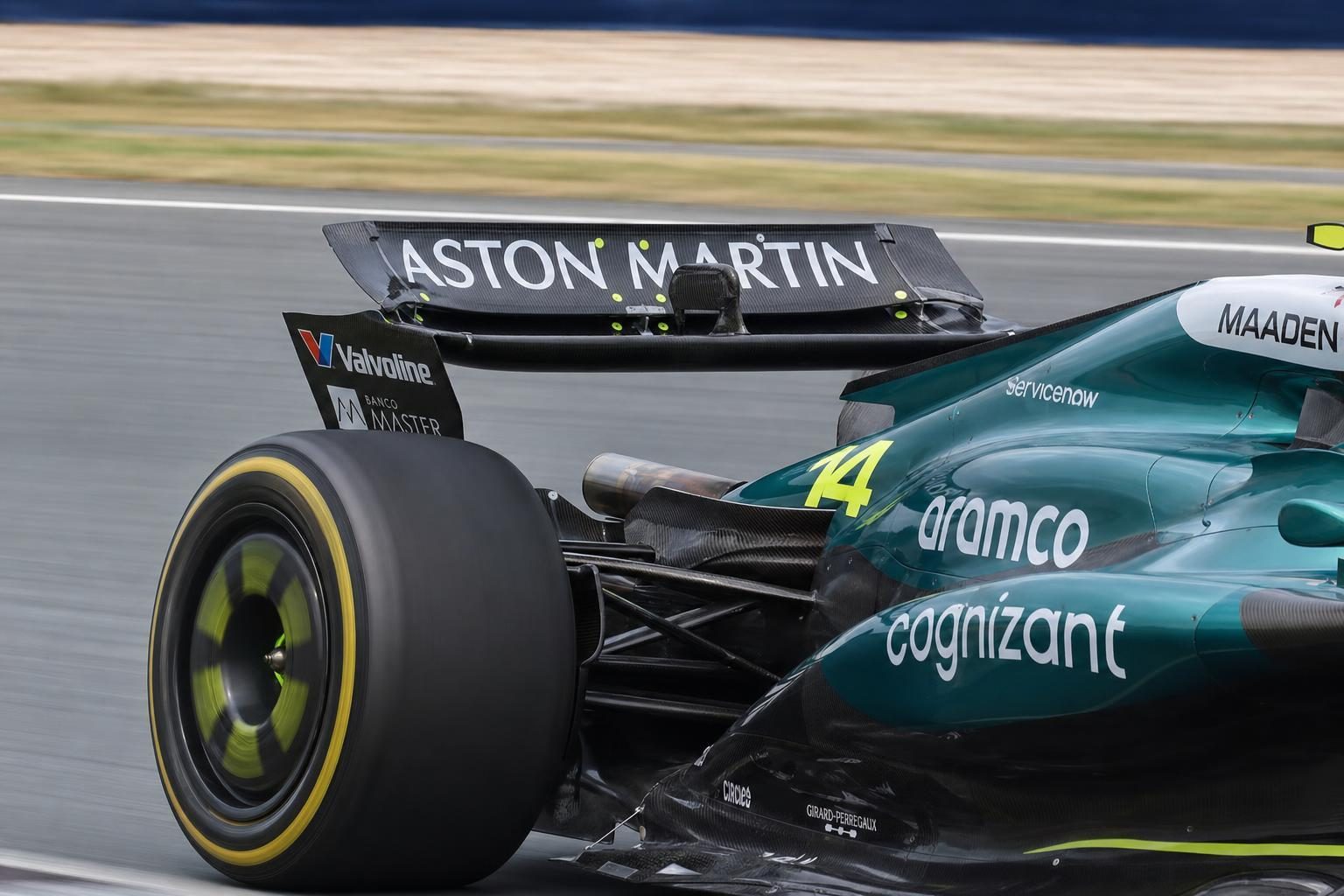
The 2026 regulations introduce active wings that operate continuously in two states: Corner Mode and Straight Mode, with no DRS zones, around an entire lap, according to Aston Martin. The AMR26 therefore adopts a logic of downforce and drag variation that is no longer occasional but systemic, serving overall efficiency.
In practice, the car modulates its aero elements to generate more downforce in corners and reduce drag on the straights, without zone triggers. This redefines balance management and the tyre operating window, with a chassis that “breathes” differently over the lap. The driver’s role also evolves: anticipation and confidence in transitions become essential.
For aerodynamicists, removing DRS zones shifts the optimisation focus towards a “living” aero package coordinated with the mechanics. The AMR26 expresses this philosophy through tight integration of actuators and the pursuit of a cleaner wake, in line with the pack-racing objectives set by the regulations.
Aramco ProForce+ sustainable fuel: regulatory constraint or competitive edge
The Aramco ProForce+ fuel used by the AMR26 is billed as 100% sustainable, derived from non-food sources and compliant with FIA 2026 standards, supplied exclusively to Aston Martin Aramco, according to Aston Martin. The stakes go beyond symbolism: the chemistry of this fuel and its lot-to-lot consistency influence combustion strategies, calibration and reliability.
Such a fuel imposes specific ignition and mixture windows. For the RA626H, it is an opportunity to optimise the synergy between compressor, injection and mappings, provided the chassis accepts cooling and weight adjustments. The AMR26 serves here as a full-scale test bench, with potential gains in efficiency.
Advantage or constraint? In the short term, the uniqueness of ProForce+ can increase the correlation workload on the dyno and on track. In the medium term, a stable formulation and a fine-tuned understanding between Honda, Aramco and the design office can generate cumulative benefits. A calculated technical bet.
Tough beginnings: vibrations, test failures and the season’s opening races
The track laid down its law. During pre-season testing in Bahrain, the team suffered three engine failures, and vibration issues marred the first runs, according to Wikipedia. The vibrations were declared resolved at the Japanese Grand Prix, a first reassuring milestone in a demanding development phase.
In Japan, Fernando Alonso recorded the team’s first finish of 2026, 18th, again per Wikipedia. The raw result is nothing spectacular, but it marks a step: making the AMR26 reliable while learning to exploit its active systems, in-house gearbox and new energy chain. The foundations are laid in silence, far from the podiums.
In this context, it makes sense to set the season within a broader cycle. The switch to Honda and ProForce+ fuel, combined with active wings, is not just about “parts”: it is an architectural change. Teams that capitalise on it fastest reap dividends later in the year. Patience is often part of the brief.
Conclusion: why the AMR26 already matters to Aston Martin
The AMR26 concentrates five breaks that redefine Silverstone: an in-house developed gearbox, Honda RA626H engine, continuous active aero, Aramco ProForce+ fuel and real-world learning. Together they sketch a clear intention: to take back control of strategic components and synchronise chassis, power unit and aerodynamics through the lens of 2026.
Quietly, this Aston is sowing the seeds of a more integrated technical identity. The bruising start does not cancel the project’s scope; it reveals its level of ambition. To read further, our season file gathers the context and first images of the Newey-signed AMR26 with Honda, while our endurance section puts into perspective the transfer of know-how from road to race with Valkyrie in the WEC and tracks the Aston Martin programmes at Le Mans and in the World Championship. As the 2026 regulations bed in, the trajectory set by the AMR26 could well be a landmark.
James Bond V8: 3 Films, 3 Cars, 1 Ultimate Icon Recognised
James Bond V8, or how a calmly elegant Aston wrote a discreet yet persistent chapter of the 007 saga. From Timothy Dalton in 1987 to Daniel Craig in 2021, the V8 spans three decades, two eras of the character and, above all, a healthy confusion between production series. Here’s why we often think we recognise three cars… when only one configuration truly stands as canon on screen.
The Living Daylights, 1987: Timothy Dalton and the V8 Series 4
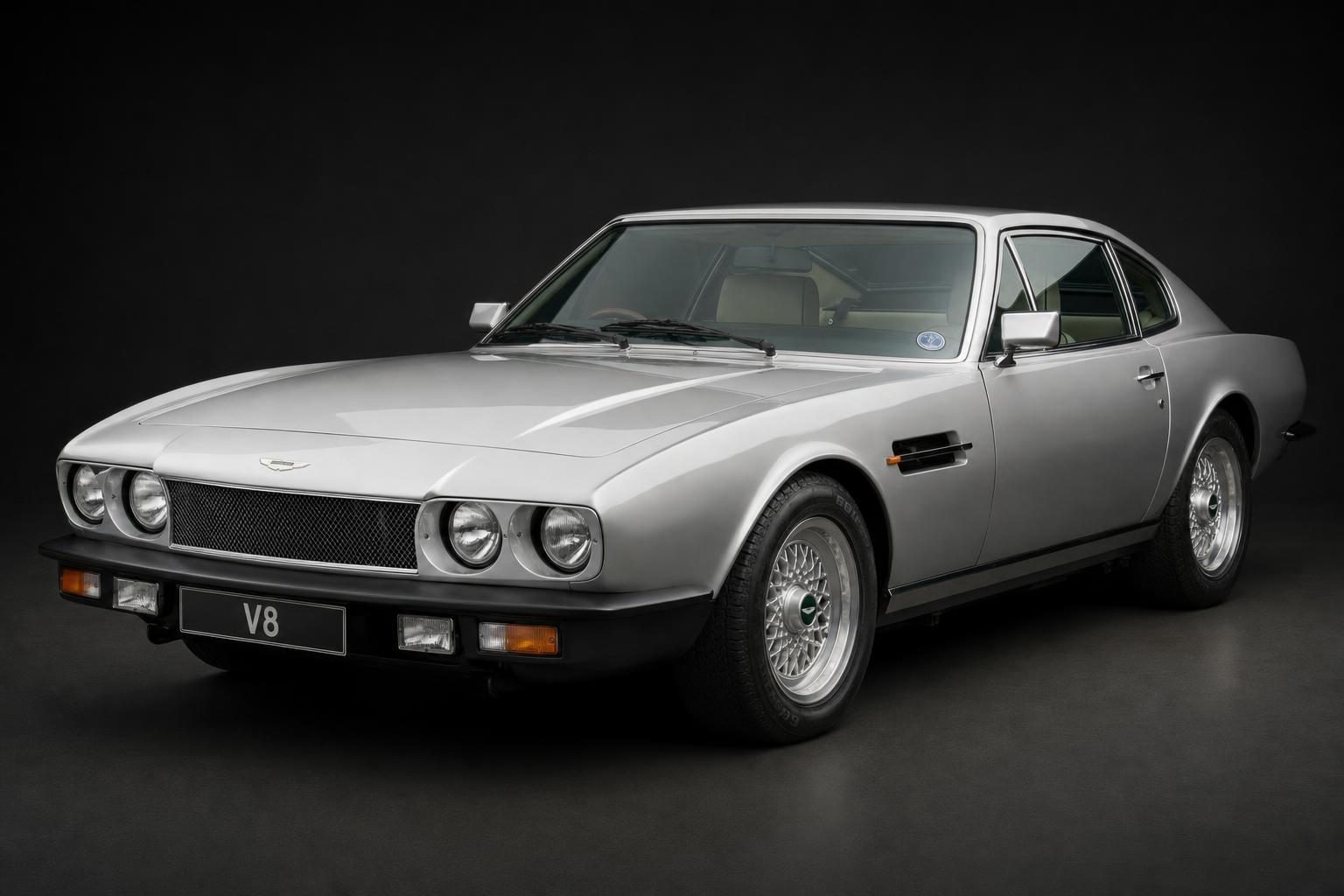
In 1986, EON Productions decided to bring Aston Martin back into the Bond universe for Timothy Dalton’s debut, and to equip the Series 4 with gadgets as a nod to the DB5. According to the Wikipedia page Aston Martin V8, it is indeed a Series 4 V8 that appears in The Living Daylights (1987). The tone is set: a muscular yet restrained silhouette, British Grand Tourer spirit, and a technological veneer calibrated for the Cold War.
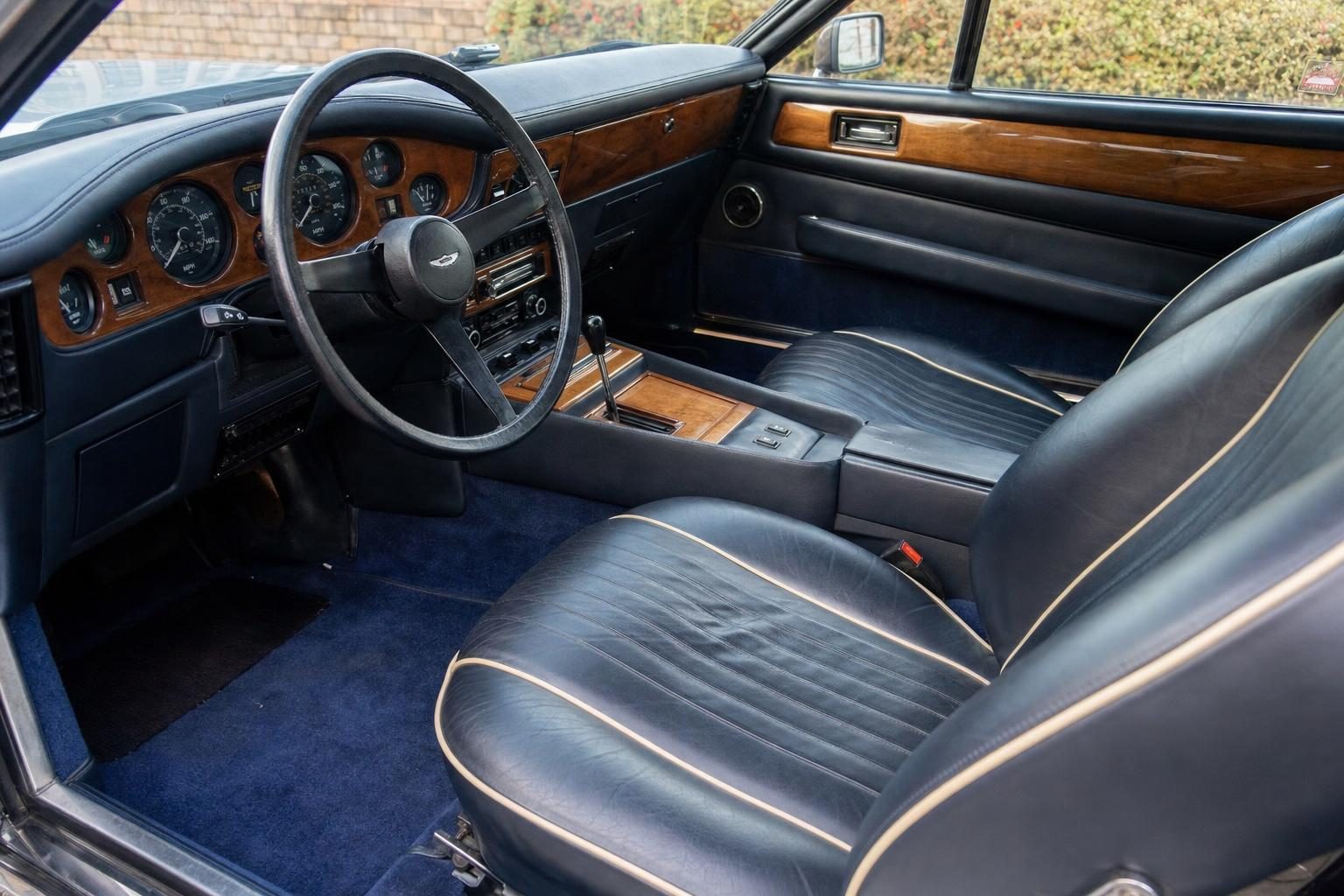
William Towns’ design gives the car its taut profile, with rear quarters he himself acknowledged having “borrowed” from the first Ford Mustang. This subtle American kinship, set on a very “Newport Pagnell” chassis, serves its on-screen presence perfectly: virile without swagger. The 5.3-litre V8 engine, produced without fundamental displacement change from 1969 to 1989, provides the apt soundtrack and the stamina needed for the action scenes.
For purists, The Living Daylights thus marks the return of a “contemporary” Aston – and not just the gilded memory of the DB5. The same source further indicates that the V8 Series 4 was explicitly chosen, anchoring the film in Aston Martin’s industrial present of the latter half of the 1980s.
Series confusion: why viewers struggle to identify the exact car
If we often think we see several different “versions”, it’s because the AM V8 family evolved by incremental steps. From a distance, a Series 3, 4 or 5 can seem like twins on screen: the same overall Towns-penned line, unchanged proportions, the same 5.3-litre V8 architecture. This stylistic and mechanical continuum muddles things for anyone not hunting for details.
Another source of ambiguity is timing. Series 5 (1986–1989) would total 405 coupés before replacement by the Virage in 1989. Yet The Living Daylights was released in 1987, precisely when the final series in the lineage coexisted in recent production. To the untrained eye, a filmed Series 4 and a Series 5 registered in the same year can be confused.
Add to this the James Bond V8 effect in popular culture: we recall the “Bond V8” as a monolithic block, and collective memory erases the series suffixes. The result is that many believe they recognise three different car(s) where the screen really authenticates only one precise configuration in The Living Daylights, then a late return of the same stylistic genes in 2021.
No Time to Die, 2021: the V8 Coupé makes a discreet return 34 years on
Thirty-four years after Dalton, the V8 Coupé reappears in No Time to Die (2021). Again, the choice doesn’t tip into noisy nostalgia: the car appears with the reserve that defines it, as a rougher counterpoint to the DB5. Wikipedia explicitly records this model’s return in 2021 within 007’s filmography.
This callback places the James Bond V8 in a generational continuum. The same crisply cut silhouette, the same engine with unchanged displacement across the model’s history – which reinforces the idea of an intangible technical signature. The public sees the same Aston; experts spot the incremental updates: it is precisely this subtle gap that still fuels a healthy debate among enthusiasts today.
To gauge the handover, remember that the V8 lineage would officially give way to the Virage from 1989. Aston Martin’s past models page documents this transition and the Virage’s pivotal role after the V8.
The 1987 gadgets: between a DB5 homage and Cold War autonomy
The brief set by EON in 1986 was clear: bring Aston Martin back and, in The Living Daylights, sprinkle the V8 with gadgets in homage to the DB5. But unlike the silver icon of the 1960s, the Series 4 does not try to hijack the plot. It remains a field tool, aligned with a tale of defections, borders and East–West tensions.
This restraint serves the story. The viewer recognises the James Bond V8 lineage through the nods, without losing sight that the car is neither a high-tech capsule nor a museum relic. The understated elegance of Towns’ design, combined with the robustness of a V8 proven over two decades, does the rest.
It also reads as an image strategy: let the DB5 keep its mythic charge, while the V8 embodies the Bond of the 1980s, more realistic and less gadget-happy. A discreet yet effective way to signal that 007 is changing era – without losing his crest.
Current values of the AM V8: what Bond exposure has (or hasn’t) done at auction
It’s hard to isolate, figures in hand, the 007 effect on AM V8 auction results. What we do know is that media exposure shapes perception. Between the imprint of The Living Daylights (1987) and the reminder of No Time to Die (2021), the James Bond V8 has stayed on the radar, without becoming a frozen totem like the DB5.
Two tangible markers help frame value. First, Series 5 production limited to 405 coupés (1986–1989): relative rarity, especially compared with later decades. Second, the continuity of the 5.3-litre unit from 1969 to 1989: a continuous technical thread prized by fans of coherent engineering. Within these bounds, the Bond effect acts mostly as an amplifier of attention.
As for series confusion, it feeds an aesthetic hierarchy rather than a rigid price table. Savvy collectors discriminate; the wider public rallies under the “Bond V8” label. In both cases, the car gains in notoriety without losing its complexity – which, in the long run, is often healthier than a passing frenzy.
Conclusion: what the James Bond V8 says beyond the credits
In the end, the James Bond V8 links two key moments of the saga without seeking the limelight. In 1987, Series 4, measured gadgets, a tilt toward plausibility. In 2021, the return of a familiar profile, like a bridge between heritage and present. In between, William Towns’ design, the longevity of the 5.3-litre V8 and the transition to the Virage compose a continuous story, of which the series confusion is almost the signature.
So we’ll keep this simple idea in mind: three decades, several very similar cars, and an identity recognised at a glance. It’s the quiet strength of the James Bond V8 – more a line that endures than an appearance that eclipses. For enthusiasts, that is precisely where the pleasure lies.
To explore the variants and the model’s history in detail, see our feature on the AM V8: all AM V8 generations decoded.
Vantage S 2026 Ultimate Upgrade: 680 PS, Chassis Secrets and a 70‑Year Badge
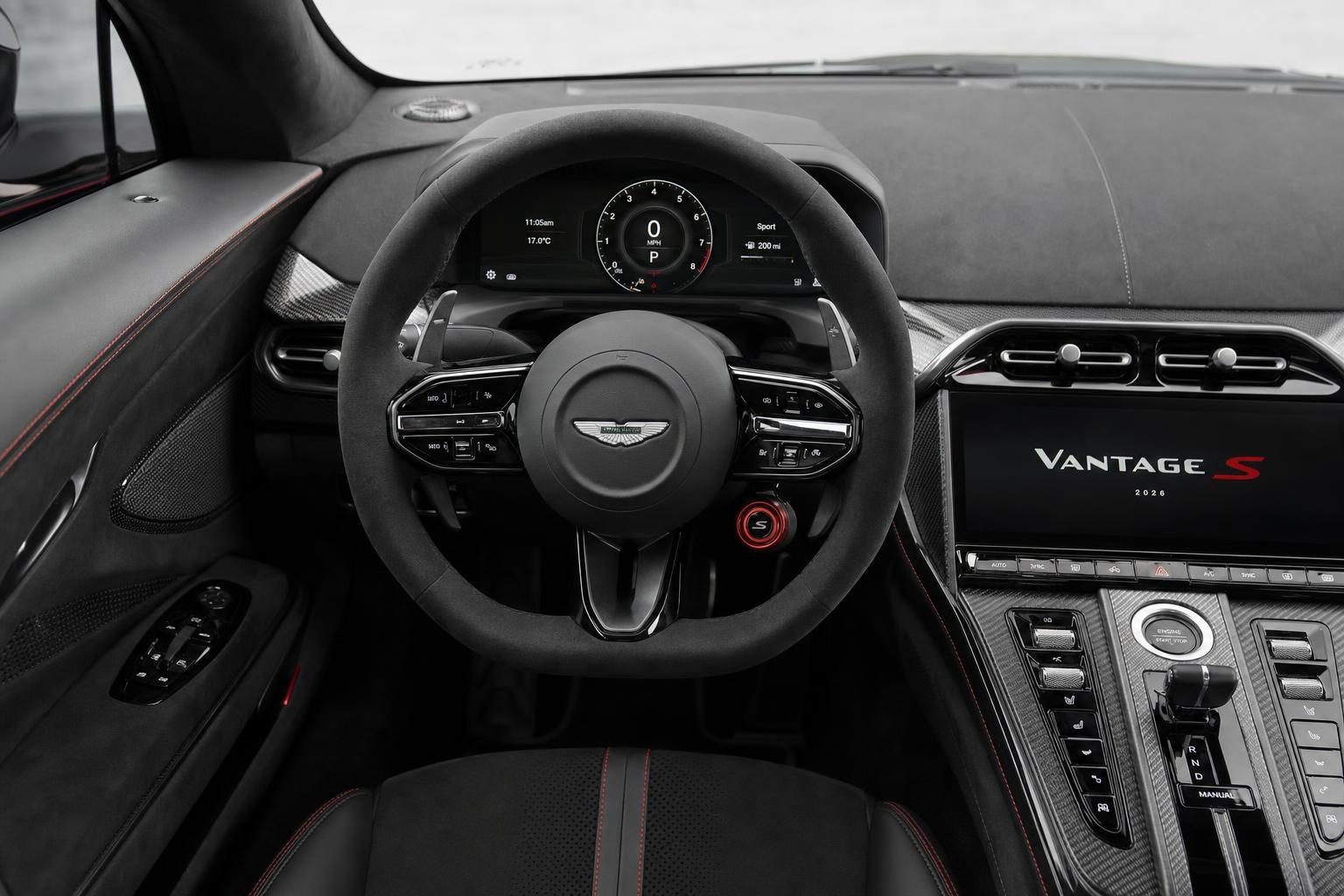
The Vantage S arrives in 2026 with a clear ambition to position the Vantage S a step above the standard Vantage: more power, a stiffened chassis and refined aerodynamics. Announced on 9 July 2025 with a dynamic debut at Goodwood, it brings back a badge first seen more than 70 years ago. Here is what has concretely changed, what this “S” has meant in the brand’s history, and what the buyer truly gains.
The S badge at Aston Martin: from the 1953 DB3S to today
The “S” is not just another letter on the tailgate. According to Aston Martin’s press office, the lineage goes back to the DB3S of 1953, which finished second twice in succession at the 24 Hours of Le Mans. The intention, even then, was to signal a sharper version, honed for performance and endurance. A simple grammar: same spirit, more bite.
With the Vantage S 2026, the marque claims this continuity: a targeted power jump, dedicated chassis tuning and specific aerodynamic addenda. No range revolution, but measurable refinement in the areas that matter at the wheel.
The 9 July 2025 announcement and the dynamic debut at the Goodwood Festival of Speed fit the house tradition: major sporting announcements go via the Sussex hill. A pointed nod to the competition heritage of this badge.
680 PS versus 665 PS: what 15 extra horses really change
The twin‑turbo V8 in the Vantage S rises to 680 PS at 6,000 rpm, with 800 Nm from 3,000 to 6,000 rpm, versus 665 PS for the standard Vantage. According to Aston Martin, these 15 PS are not just brochure padding: 0–60 mph drops to 3.3 s (0–62 mph: 3.4 s) and 0–200 km/h to 10.1 s, netting a tenth off the sprint and a stronger showing in the longer haul.
On road and track, the benefit shows most in in‑gear thrust and the mid‑range. The 800 Nm available across a broad plateau favours overtakes without downshifting as much. The day‑to‑day gain is discreet but real: a car that feels fuller at mid revs and more responsive to the throttle.
At the top end, top speed rises to 202 mph (325 km/h) according to HiConsumption. Again, the gap lives in the margins, but it confirms the intent: the Vantage S positions itself as the sharpest take on the coupé.
Reworked chassis: rigid subframe, recalibrated Bilstein dampers and new geometry
The most striking structural change is at the rear: the subframe is now mounted rigidly to the aluminium structure, without rubber bushings. According to Aston Martin, this is a major evolution that increases attitude precision and suspension fidelity to the driver’s inputs by reducing parasitic filtering.
The marque also highlights recalibrated Bilstein dampers and revised geometry to complement this stiffening. Taken together, these elements aim to deliver a more connected rear axle and a clearer read of grip. In practice: tighter body control and better‑contained traction as you roll back on the throttle.
This sort of setup speaks on a fast sequence: the body settles quicker and stays better controlled, while retaining enough compliance to work the tyre. The Vantage S thus promises a broader operating window, from imperfect roads to track days.
New aerodynamics: bonnet blades, rear spoiler and downforce balance
The specific bonnet blades and a full‑width rear spoiler define the Vantage S identity. Beyond style, the spoiler generates 97 pounds of aerodynamic load at maximum speed, according to HiConsumption. A welcome aid to stabilise the rear at the high speeds mentioned above.
The philosophy remains subtle: tidy up rake and stability without tipping into ostentation. The package usefully complements the rigidly mounted subframe and suspension tuning, with a car that works its tyre more cleanly at high speed.
One engineering point remains: the distribution of this load and its effects on balance. Without official front/rear figures, we note the intent: more downforce where the most powerful Vantage needs it most, at the rear, to free up traction on exit and calm micro‑corrections on the German autobahn.
Pricing position: the Vantage S against its direct rivals in 2026
Aston Martin had not published an official price for the Vantage S at the time of the announcement. The message is therefore primarily technical: add measurable substance — power, chassis, aero — above the Vantage. From a customer’s perspective, you are buying a coherent update where the experience is most felt, without tipping into a radical version.
Against like‑minded coupés in 2026 — front‑engined V8, rear‑drive and outputs beyond 650 PS — the positioning aims for a balance between exploitable performance and daily use. The 0.1 s gain to 60 mph and the 10.1 s to 200 km/h do not transform the car, but they polish response and performance progression which, in this segment, counts as much as the raw figure.
In the absence of a stated price, the reasoning leans on the technical contribution: a more precise rear end, dedicated aerodynamics and 15 extra PS. So many rational arguments to favour the Vantage S if you want a Vantage that is crisper in its reactions and more stable at high speed.
Conclusion: why the Vantage S deserves its badge
True to the spirit initiated by the 1953 DB3S, the Vantage S adds rigour and a dash of vigour. The extra 15 PS are chiefly accompanied by a rigidly mounted subframe, recalibrated suspension and a spoiler that generates useful high‑speed load. The result: a coupé that is more precise, more composed and, at the margins, faster.
For the buyer, the Vantage S label translates into tangible benefits at the wheel rather than mere range positioning. A rational “S”, serving pleasure and consistency, announced at Goodwood and ready to write a new chapter in a lineage born more than 70 years ago.
Continuation Triumph: 4,500-Hour Ultimate DB4 GT Zagato for 19 Cars
Continuation, or how Aston Martin shines a light on an icon without betraying its spirit. In 2019, Aston Martin Works revived the DB4 GT Zagato as a series of 19 hand-built barchettas, a deliberate mirror of the 19 originals from 1960–1963. Our angle today: the method, the 4,500 hours per car, and the heritage context of this rebirth, with the DBZ Centenary Collection as a backdrop, sold exclusively in pairs.
Three waves in sixty years: originals, Sanction II and Sanction III
The first wave is known and documented: 19 DB4 GT Zagatos built between 1960 and 1963, out of an initial plan for 25, at a list price of £5,157 including taxes, according to Aston Martin. This generation, intended for road and track, built the myth. One example fetched £10.1 million at auction in July 2018, the brand magazine recalls. Rarity here is no artifice: it is original.
The third wave bears a very contemporary name at Aston Martin Works: DB4 GT Zagato Continuation. Launched in April 2019, it targets 19 additional chassis, assembled at Newport Pagnell by the marque’s heritage teams. The aim is not to reissue the car by the mile, but to reproduce its stance, processes and experience, in a non-road-legal framework and with deliberate mechanical choices.
Between these two extremes, later series, often grouped in collectors’ conversations under the labels Sanction II and Sanction III, extended the story. What matters here, without multiplying off-topic details, is the logic of successive “waves”: the period original, limited-number complements, then the modern Continuation overseen by Aston Martin Works. This layering explains both the valuation and the technical curiosity the model arouses.
4,500 hours per car: what that means in concrete terms at Newport Pagnell
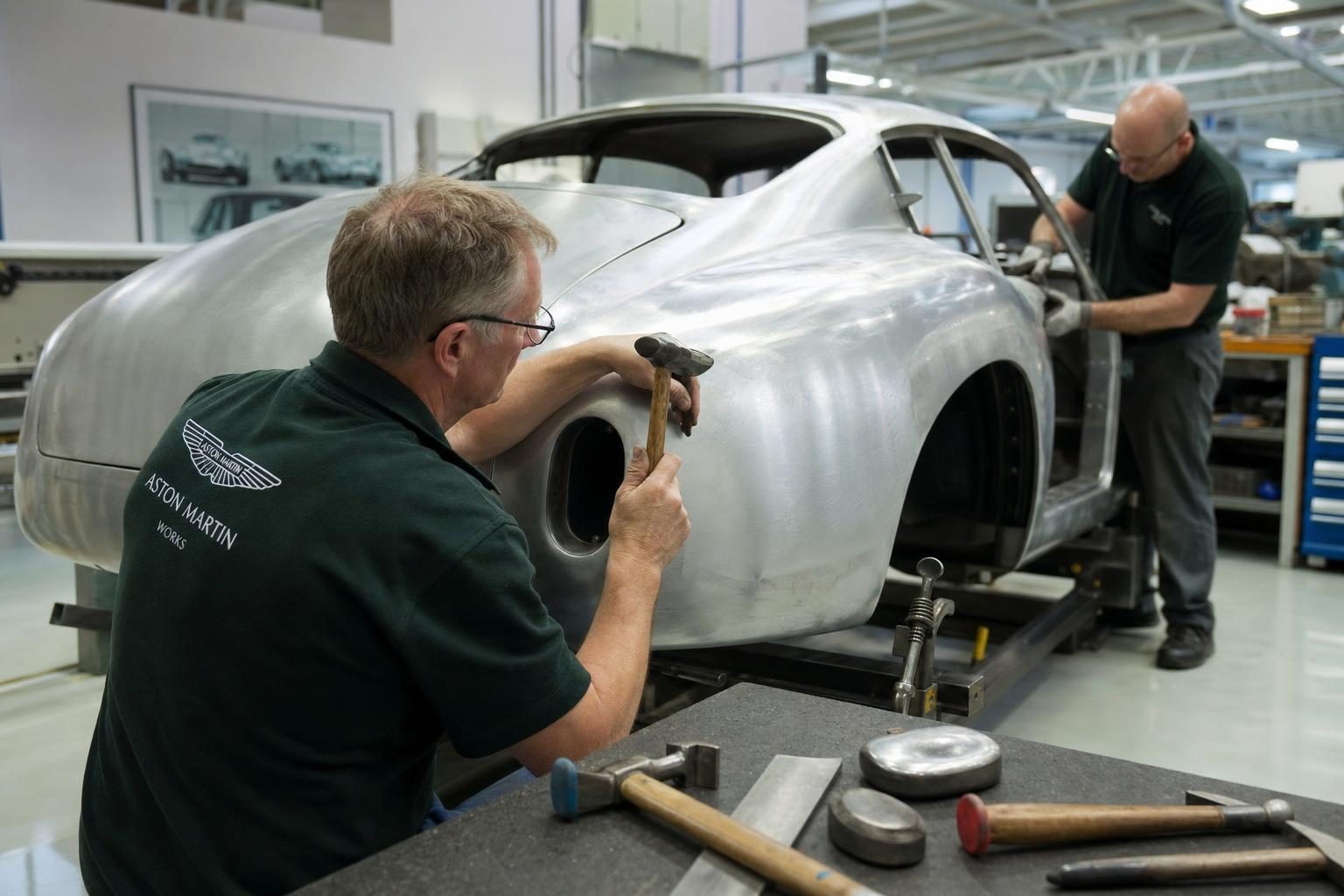
According to Aston Martin Works, each Continuation requires around 4,500 hours of artisanal work. In calendar terms, that’s the equivalent of several workshop-months for a small dedicated team, a pace far closer to an automotive haute couture studio than a line. The aluminium panels are formed by hand, the accuracy of the fits is honed over time, and the human eye remains the ultimate arbiter of surface and line.
The body, originally designed for the wind above all, here demands a sensitive reading of the volumes. The aluminium is beaten, offered up, reworked, until it regains the tension of the initial pencil stroke. The tubular chassis is adjusted to the shell’s dimensions, not the other way round. Another way of saying the geometry is sculpted, not printed.
On the mechanical assembly side, the approach follows suit: engines, running gear and auxiliaries are installed in stages, then partially removed for checks and fine-tuning. Traditional tooling coexists with modern measuring methods, but the hand takes precedence over the algorithm. This dialysis between heritage and contemporary precision is the very spirit of the programme.
The Continuation’s 4.7-litre engine versus the original 3.7: same genes, different reality
The spec sheet poses a simple question: same lineage, same character? The Continuation receives an inline-six enlarged to 4.7 litres, for around 400 bhp according to Aston Martin. The original claimed 3.7 litres and 314 bhp. The gap reflects both a pursuit of reliable circuit performance and a different regulatory context, the modern car not being road homologated. The genes remain, the mechanical response is fuller.
In practice, the increase in displacement and power changes how the car “breathes”. Torque arrives earlier, pick-up is denser, and the useful band broadens. This is not a betrayal; it’s a period-correct set-up: recomposing the initial sporting intent with today’s means, respecting noble materials and an analogue design.
The original data and contemporary details are consistent in order of magnitude, as the page dedicated to the DB4 GT Zagato on Wikipedia in English and Aston Martin’s technical releases recall. Again, the interest of the series lies in the dialogue between authentic sensations and measured updating.
The DBZ Collection: why Aston Martin chose to sell only in pairs
The DBZ Centenary Collection paired each DB4 GT Zagato Continuation with a modern DBS GT Zagato. The announced price was £6 million before taxes for the indivisible pair. Industrially, that ensured the coordinated sell-through of a very costly artisanal programme. Symbolically, it was a deliberate bridge between 1960 and Zagato’s centenary, between original arrow and contemporary interpretation.
This choice of pairing also avoided scatter. By coupling a resurrected legend with a current GT inspired by the same formal vocabulary, Aston Martin staged the transmission. Owners weren’t just buying a car: they were entering a two-chapter narrative, linked by a name and a silhouette. It’s a collector’s logic, not a simple options basket.
The brand detailed this positioning and sales framework in its official announcements, which can be found on the page dedicated to the DBZ Centenary Collection. Market-wise, the valuation of the originals, illustrated by the £10.1 million sale in 2018, gives a measure of the appetite for coherent heritage ensembles.
Ercole Spada at 23: revisiting the man behind the original body
Ercole Spada was just 23 when he designed the DB4 GT Zagato. Arriving as an apprentice at Zagato in February 1960, he penned one of those curves that seem obvious in hindsight. The car eliminates the superfluous, reduces frontal area, erases cavities. Nothing gaudy, everything taut. Sobriety here is both an aerodynamic strategy and an aesthetic, in equal parts.
Rereading the bodywork in light of its author’s age means measuring the project’s quiet audacity. The tucked tail, the long bonnet, the ruler-straight haunches: elements that, transposed, already served performance on track. This economy of line explains how the silhouette crossed the decades without seeming dated.
The modern programme feeds on this base. The Continuation teams don’t try to add an extra layer of spirit; they focus on rediscovering it. Hence the obsession with tolerances, the light on raw aluminium, the edges that must “fall right”. Spada’s youth at the moment of design adds a note: what seems classical was in fact born of a fresh, almost irreverent eye.
Conclusion: what the Continuation reveals about Aston Martin’s heritage
In the end, the Continuation DB4 GT Zagato is no easy reissue. It’s a balancing act: 19 hand-built cars, 4,500 hours each, a 4.7-litre engine that respects the DNA of the original 3.7 while updating it, and sales in pairs within the DBZ Centenary Collection to tell the lineage. The whole sheds light on how Aston Martin treats its heritage: with method, measure and a sharp sense of storytelling.
For those who have followed the line since the DB4, this opus is another coherent, controlled milestone. It reminds us that between the originals, the later series and this Continuation, value is not decreed: it is crafted, patiently, at Newport Pagnell and beyond. And that may be the true luxury in motoring.
To delve into the genesis and specifications, Aston Martin’s official resources and the summary on Wikipedia offer a useful complement to our features. The programme’s behind-the-scenes are detailed in the Making History release, which documents the approach and methods used.
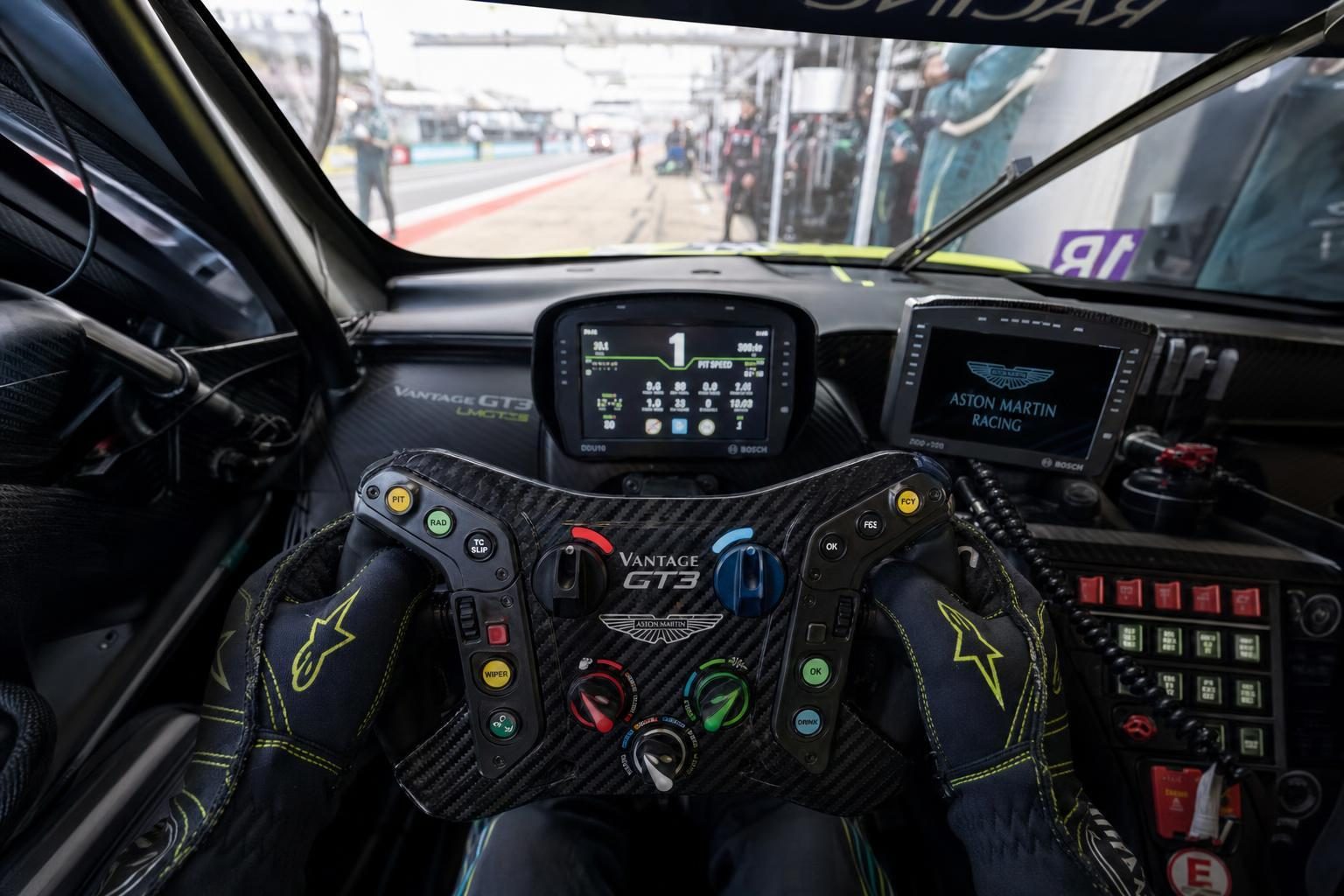
Vantage GT3 in the crosshairs: starting from car No.23’s onboard stream, this analysis breaks down strategy, the role of team-mates and the weight of a WEC second round at Spa that counts for more than it seems. We place what you see – and above all what you don’t – in the context of Aston Martin’s heritage on the Ardennes rollercoaster, and the 2026 LMGT3 dynamic.
The Vantage GT3 in the 2026 World Championship: two cars, one team, one objective
In 2026, the Vantage GT3 embarks on its fourteenth consecutive season of representation in the WEC, as the LMGT3 class, introduced in 2024 to replace LMGTE Am, beds in. For Heart of Racing Team (THOR), the objective is crystal clear: build on the accumulated experience of the Vantage platform while mastering the tactical learning curve specific to global GT3 regulations.
The American outfit has entered two Vantage GT3s in LMGT3 for the 2026 campaign, a step up after a single car in 2025. The second chassis, numbered 23, passed through Racing Spirit of Léman before joining the THOR roster, signalling an optimised rolling-stock strategy. This expansion clearly targets depth across stints and pit windows, the heart of Endurance performance.
On the calendar, Spa-Francorchamps is set from 7 to 9 May 2026 as the second of eight rounds of the FIA World Endurance Championship. A pivotal stage to probe the Vantage GT3 on a high-energy track before the ultimate exam that is Le Mans.
Spa-Francorchamps, familiar ground for Aston Martin in GT
The Spa circuit is an old acquaintance for Aston Martin in GT. In 2012, the marque clinched the first-ever global GTE win for a manufacturer during the inaugural WEC season. That milestone sets the bar: at Spa, the Aston knows expectations are high.
Since 2012, the Vantage in the WEC has amassed 11 world titles, 69 pole positions and 5 class victories at the 24 Hours of Le Mans. A record that is no exercise in nostalgia: it shapes daily decisions, from set-up to tyre strategies, on a track whose range – elevation, speeds, often playful weather – highlights chassis stability and stint consistency.
Technically, the Vantage GT3 entered at Spa is built on a bonded aluminium chassis derived from the road-going Vantage, powered by a 4.0-litre twin-turbo V8. This base lets it absorb the long full-throttle phases between La Source and Les Combes, while guaranteeing the agility needed through the Eau Rouge and Raidillon sequence, where margins are measured as much in confidence as in downforce.
No.23 up close: Barrichello, Newell, Adam and the onboard camera
The No.23 THOR Vantage brings together Eduardo “Dudu” Barrichello, Gray Newell and Jonny Adam. The trio makes sense: an IMSA GTD points leader in 2026 returning to the WEC, an in-house driver seasoned in GT formats, and a double Le Mans class winner. This diversity of profiles shows on screen… but not entirely.
No.23’s onboard stream, immersive as it is, doesn’t tell the whole story. What it often hides is the elbows-out management in LMGT3, decided more on the engineering stand than at the wheel: choosing undercut or overcut, the length of double-stints, refuelling timing versus neutralisations. All crucial calls, invisible on camera, that prove decisive for the Vantage GT3 when traffic thickens with the prototypes.
Another blind spot of the camera: the distribution of effort within the crew. Barrichello, buoyed by his IMSA momentum, can launch an attacking stint to bring the car back into the window, while Adam, the in-house benchmark, sets the base pace and tyre management. Newell contributes continuity and clean laps in key sequences. The overlay shows only the line; it leaves out the collective score.
Finally, what you barely perceive is the information exchange. The Vantage GT3 runs to the radio’s tempo: tyre temperatures, fuel use, lift-and-coast targets. Instructions that don’t appear in the picture but shape how to tackle Blanchimont at the end of a stint. To grasp this “off-camera” layer, No.23’s integrated live feed is a useful entry point, to be completed with the team’s run plan.
LMGT3 2026: the season, the tactics and the Belgian outcome
The 2026 LMGT3 season plays out over eight acts, Spa included. Within this frame, THOR deploys a two-car team logic. The No.27 Vantage, entrusted to Ian James, Zach Robichon and Mattia Drudi, sat fourth after four hours at Spa, a reminder that reading the mid-race order is often more instructive for strategy than an isolated camera.
On the tactical mixing desk, the Vantage GT3 leans on the rigidity of its bonded aluminium chassis and the usable flexibility of the 4.0-litre twin-turbo V8. In practice, that opens the door to long double-stints as the track comes in and allows responses to Full Course Yellows without derailing the tyre sequence. These parameters, managed from the pit wall, explain why two Vantages under one banner beat one: you spread risk and attempts.
As for the “Belgian outcome”, it’s taken here to mean the bundle of learnings from Spa more than a raw number. The second round, held from 7 to 9 May 2026, serves as a full-scale test before Le Mans: traffic management, pit window calibration, and gauging relative pace against the LMGT3 field. The intermediate positions – including No.27’s after four hours, reported by the WEC – frame the calls that No.23 executes behind the scenes, beyond the camera’s frame.
To relive the cockpit experience, No.23’s onboard stream sheds light on these choices, without exhausting them. It’s a good complement to the weekend’s official information and technical releases, helpful in seeing how the Vantage GT3 turns strategic intent into measured lines.
From Spa to Le Mans: the Vantage GT3 on the road to the next step
Spa, second stop of an eight-round season, serves as a springboard. For the Vantage GT3, the aim is to convert the marque’s history into operational levers: the 2012 lesson in razor-sharp race control, the legacy of 11 world titles since 2012, and the know-how accumulated at Le Mans with five class wins. Nothing ostentatious, but a culture of execution that runs through the programmes.
With Le Mans in sight, No.23 advances in the wake of a No.27 capable of putting the car at the sharp end at mid-distance, according to WEC information. The Barrichello–Newell–Adam trio hones its shared grammar: where to attack, where to conserve, when to extend a stint. This thread, started at Spa, sets the Vantage GT3 on a credible trajectory towards the Sarthe.
Then there’s Aston Martin’s customary discretion: let the car do the talking. The Vantage GT3, derived from the road Vantage and armed with its 4.0-litre twin-turbo V8, doesn’t look for showmanship. It rewards being watched over time, between neutralisations, when the bonded aluminium chassis showcases its consistency and the strategy unrolls. Those are the moments the camera hints at, and the team orchestrates.
Conclusion – what the Vantage GT3 shows… and what it implies
No.23’s onboard is a fine gateway into Spa 2026, but it doesn’t tell the whole Vantage GT3 story. Behind the images are a team expanded to two cars, a Spa history dating back to the first GTE triumph in 2012, and a 2026 programme designed for LMGT3. It’s in this blend – experience, method, and collective execution – that the Aston charts its course, from the Ardennes to the Sarthe.
To dig deeper, you can explore the reference road lineage underpinning this approach, revisit the WEC trophy trail and follow the 2026 IMSA tempo to set today’s momentum in context. And keep this in mind: beyond the frame, the Vantage GT3 chiefly tells a way of racing. Spa gives the key; Le Mans offers the development.
Virage 1988: 3 Design Secrets That Saved Aston Martin – Ultimate Insight
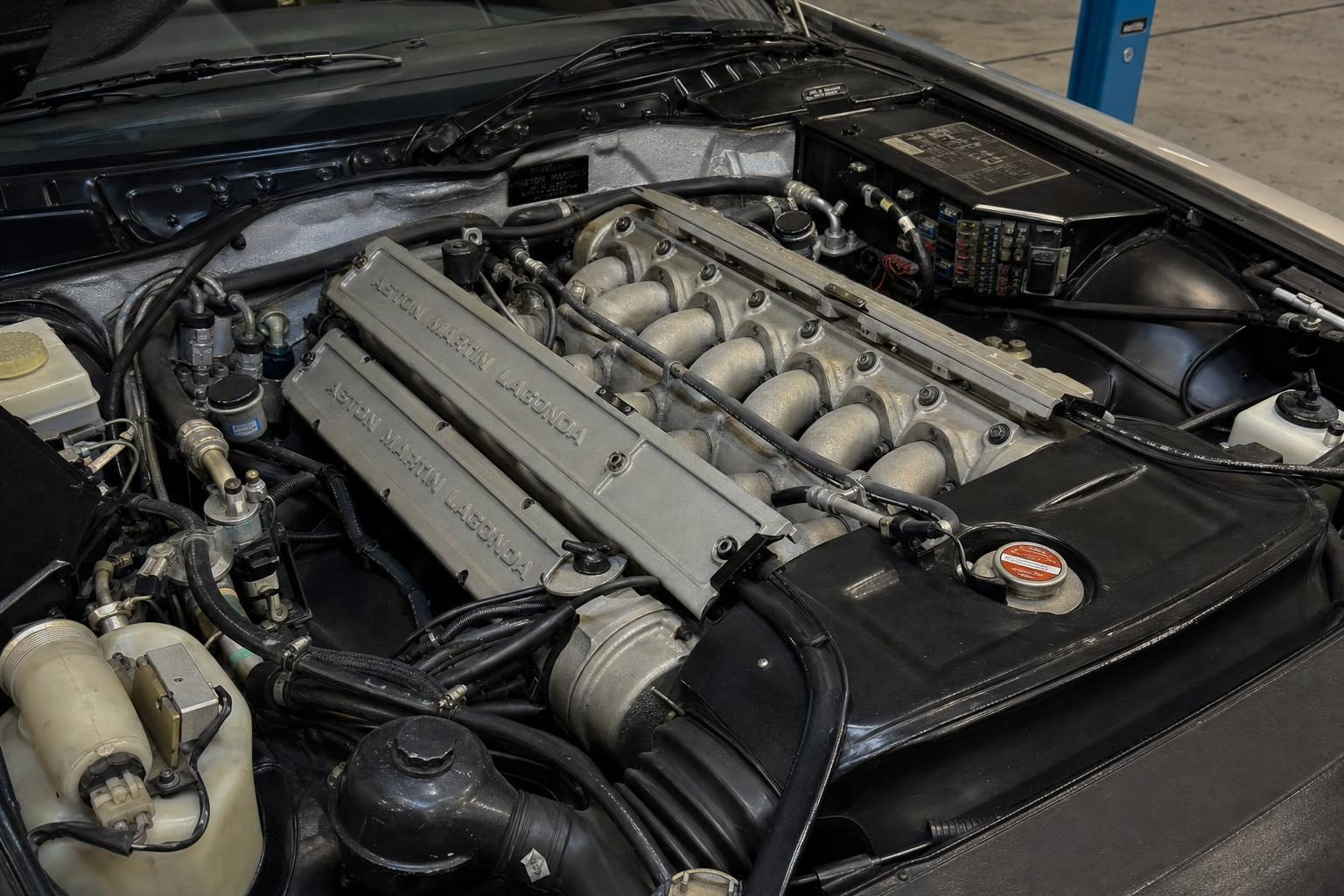
Virage is the name of a wager met against the clock, of a design chosen by competition, and of a V8 brought up to date for the era of catalytic converters. Unveiled on 18 October 1988 at the British International Motor Show in Birmingham, the new Aston marked a measured break and a conscious continuity. We look back at its origins, its 5.3-litre 32-valve mechanics, the shift under Ford ownership and those lesser-known variants – 6.3-litre and Shooting Brake – that make it, today, a more subtle heritage pivot than many think.
A three-month design contest: the origins of the Virage
The model’s genesis was a creative sprint. According to Aston Martin’s official press pack, the design resulted from a competition won by two young British stylists, John Heffernan and Ken Greenley, tasked with delivering a proposal in just a few months. Their approach broke with the muscular angularity of the 1970s V8s while retaining a grand touring stance. The chosen line – high shoulder, clean surfaces, sharpened nose – established a restrained modernity, exactly what the marque was seeking at that pivotal moment.
Shown in Birmingham on 18 October 1988, the coupé was, by Aston Martin’s own admission, the first “truly” new model in nearly twenty years. The deliberately sober silhouette placed the Aston in a more international timeframe without denying Newport Pagnell. This choice of understatement, born of a competition rather than an internal evolution, fixed an immediately legible identity: a stately GT coupé, without unnecessary flamboyance.
This context explains the measured yet respectful reception the public gave the project. The car arrived at just the right time, with contemporary volumes and a crisp lighting signature, as an elegant transition between the old guard and the era to come.
The 5.3-litre 32-valve: a V8 reworked for the catalytic era
Under the bonnet, the Virage introduced a major evolution of the marque’s iconic V8. According to Aston Martin, the base engine is a 5.3-litre 32-valve developing 330 bhp. This configuration met tightening emissions constraints and the smoothness demands imposed by catalytic converters, while preserving the nobility of the British cross-plane. The output may not be thunderous, but the promise lay elsewhere: freer breathing, improved efficiency and availability at low and mid revs.
This V8 is more than a number. It signalled a return to in-depth development after a long period of iterations. The four-valve-per-cylinder layout brought a genuine gain in cylinder filling and better compatibility with regulations, without betraying character. The marque emphasised the importance of this base for the next, more muscular step, which would take the form of 6.3 evolutions and later supercharged Vantages.
In use, this 5.3-litre’s mission was chiefly to put Aston back into the long-distance GT conversation. Supple, broad-shouldered and sonorous, it put Newport Pagnell back in technical step with the late 1980s.
The Ford transition: what the new owner changed (and what it didn’t dare touch)
Shortly before this launch, Ford took control of Aston Martin. According to Wikipedia, the Virage was the first Aston presented under this new ownership. The message was clear: capital and industrial processes would evolve; British singularity must remain. In practice, the influence first showed in development rigour and range structuring, not in stylistic homogenisation.
What Ford changed was the scale of resources. The arrival of a major group supported measured industrialisation, quality control and access to a broader network. What Ford didn’t dare touch was the soul of the Newport Pagnell workshop: meticulous build, an artisanal cadence, and latitude for bespoke versions. The Virage embodied this balance: a cleaner, more coherent product, yet still crafted on a human scale.
This dosage, perceptible from 1988, prepared the technical evolutions of the early 1990s and the ramp-up of derivatives, without breaking the thread of a GT tradition unique to the marque.
The 6.3-litre variant and the Shooting Brake: two Newport Pagnell curiosities
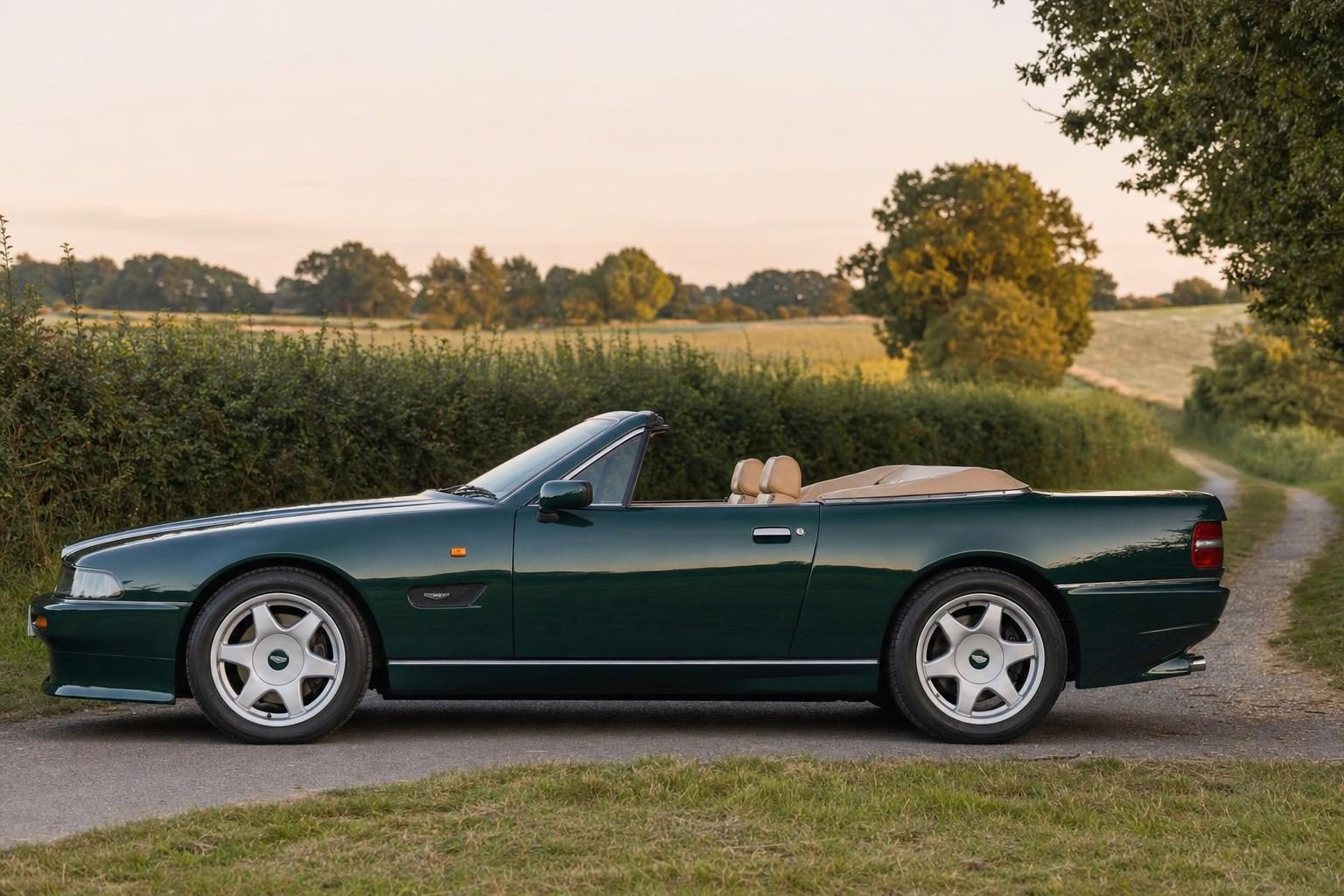
In January 1992, Aston Martin offered a 6.3-litre conversion derived from the AMR1’s engine. Figures vary by source: Wikipedia mentions between 456 and 500 hp, while Aston Martin Magazine places the distinct twin-supercharged Vantage at “around 550 bhp”. The key here is the philosophy: a workshop capable of extracting spectacular vigour from an in-house V8 and clothing it with a widened bodykit as required. The existence of only 19 Virage Volante in 6.3 wide-body specification, reported by Nicholas Mee, speaks to the rarity of these preparations.
In this vein of “curiosities” shaped to order, the Shooting Brake silhouette holds a special place in the Virage imagination. Without venturing into numbers, the guiding idea stands out: Newport Pagnell long cultivated a know-how in singular transformations, exploring other uses of grand touring. The shooting brake harks back to this living-room craftsmanship, typically British, that many associate with this generation.
Whether the 6.3-litre with racing lineage or the shooting brake styling exercise, the constant remains: personalisation, low volumes and technical coherence in service of a specific client. That’s also what makes the Virage so interesting to collect today.
Values and today’s market: why the Virage remains undervalued among classics
Modest production contributes to its singularity. According to Wikipedia, the Virage Coupé was assembled in only 224 or 233 examples – figures differ by source – for an overall production, all variants combined, of around 1,050 units. Such rarity could justify higher values. Yet the market has long favoured either earlier 1970s-charmer V8s or the more spectacular supercharged Vantages.
Why the relative discount? First, because the car sits in a transition: first under Ford, the first “truly” new model in nearly 20 years, it lacks both the retro nostalgia of the 1970s and the power shock of mid-1990s Vantages. Then because its design, born of a competition, chose restraint over showmanship. Good news in use, less effective for auction-room theatre.
For the informed enthusiast, this opens a window. The coupé combines Newport Pagnell construction, a 32-valve V8 adapted to catalysts, and the possibility – for a few examples – of an AMR1-inspired 6.3 pedigree. Tangible, verifiable, durable arguments. In the Aston hierarchy, the Virage asserts itself as a value to rediscover, with fundamentals that stand the test of time.
Conclusion: why the Virage deserves better than a mere “transition” label
As noted: the Virage was born of a competition, adopted a 5.3-litre 32-valve tailored to its era, and inaugurated the Ford period without denying Newport Pagnell. The 6.3 derivatives and workshop curiosities complete the picture of a coherent GT, technically grounded and culturally important for the marque. For those seeking measured poise, meticulous build and genuinely low production numbers, the Virage today offers a shrewd entry point into Aston Martin heritage.
Vulcan 10 years: the perfect moment to revisit what this track hypercar, limited to 24 examples and delivered in 2016, changed in Aston Martin’s recent history. Beyond the headline number, a naturally aspirated 7.0‑litre V12 pushed to 820 PS, a highly exclusive client programme and an AMR Pro evolution that reset the markers. Underneath, a simple question: why does this model remain, a decade on, such a one‑off?
Why exactly 24: the Vulcan’s number and its nod to Le Mans
Why 24 examples? Because the allusion to the 24 Hours of Le Mans is no accident. According to Aston Martin’s pressroom and Wikipedia, Vulcan production was strictly limited to 24 units, delivered throughout 2016. This short run, conceived as a pointed nod to endurance racing, immediately frames the Vulcan 10 years as an insider’s object: rare enough to create tension, visible enough to influence the brand image.
This micro‑series strategy curbed speculation and validated a precisely run track support programme. By setting the gauge at 24, the marque could ensure intensive technical follow‑up and a coherent calendar of private events, while each owner became, in a way, the ambassador of an experimental chapter. The Vulcan 10 years thus sits within the lineage of modern track‑only machines, but with an avowed cultural anchor.
The number also has a concrete consequence: fleet homogeneity. With 24 cars, technical evolution (notably the subsequently offered AMR Pro kit) remained controlled, easing updates and preserving on‑track use value. In practice, the Vulcan 10 years owes as much to this calculated rationing as to its spec sheet.
The naturally aspirated 7.0‑litre V12: an engine philosophy in decline
At the heart of the package, a naturally aspirated 7.0‑litre V12 delivering 820 PS (source: Wikipedia Aston Martin Vulcan). In a world already won over by turbocharging and now hybridisation, this architecture champions a mechanical purity grown rare. Throttle response, an unfiltered surge through the revs and the soundtrack gain what forced induction can sometimes subtract in character. The Vulcan 10 years is also this: a manifesto for high‑flow natural breathing.
The choice of NA here is no footnote. It dictates driving dynamics, traction management and the learning curve of torque delivery on track. It also recalls that the brand’s DNA can blend refinement with measured brutality. The whole, coupled to a 6‑speed gearbox that remains unchanged even with the AMR Pro kit, embodies a form of sporting orthodoxy seldom seen today. The Vulcan 10 years thus capitalises on a signature sound and long‑range progressivity, two qualities that age well.
On the aerodynamic front, the car already generates spectacular downforce: 1,362 kg at its maximum speed, thanks to the front splitter, rear diffuser and adjustable rear wing (source: Wikipedia). This technical bedrock, paired with the V12, explains why the Vulcan 10 years remains formidable on track, even against more recent GT3s.
The 2017 AMR Pro kit: when Goodwood rewrites the aero rulebook
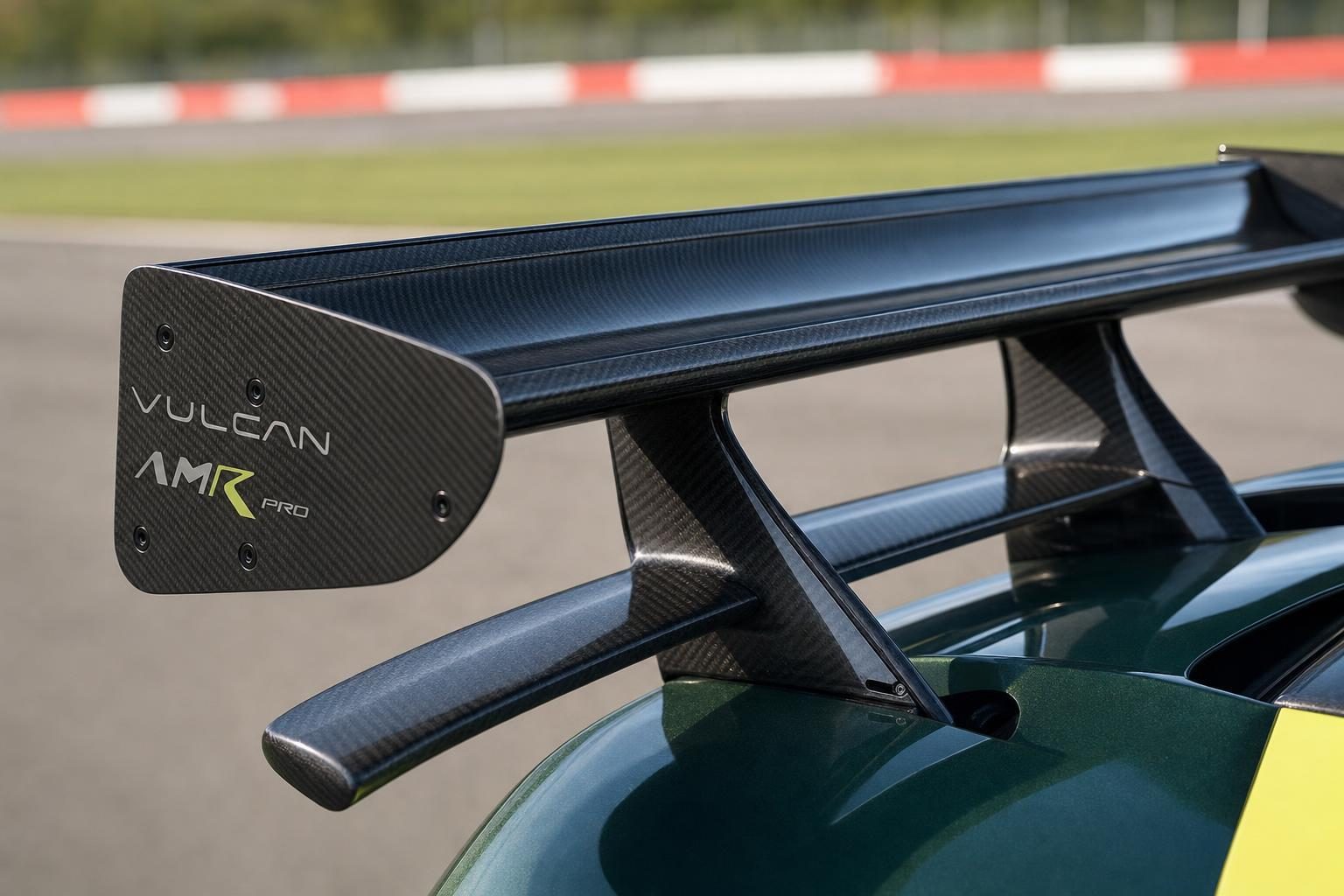
Unveiled on 29 June 2017 at the Goodwood Festival of Speed, the AMR Pro kit tipped the Vulcan into another aerodynamic dimension (source: media.astonmartin.com). Downforce rises by 27%, the load increasing from 3,150 N to 4,000 N at 160 km/h. Above all, aero balance shifts from 41.5% to 47% forwards, moving the centre of pressure closer to the middle of the car. In short: a more heavily “loaded” front axle, sharper turn‑in and a feeling of serenity at high speed. The Vulcan 10 years gains margin and, at the wheel, a granularity of feedback that matters.
The detail of the additions is eloquent and… simple: a bi‑plane rear wing topped by a 20 mm Gurney flap, large front dive planes, and channels carved into the wheel arches (sources: media.astonmartin.com / Wikipedia). No change to power or gearbox. Everything happens in the air, not the engine figures. The result, on a fast circuit, is felt immediately: more attack possible without waking surprises. Armed with its AMR Pro, the Vulcan 10 years receives a dynamic second youth without sacrificing its mechanical personality.
Important point: the AMR Pro kit is available on request via the Q department for the 24 owners (sources: media.astonmartin.com / Wikipedia). This measured retro‑compatibility has fostered unity across the Vulcan “grid” over the years. It also explains the consistency of performance seen during public demonstrations, as you can glean from an onboard track video.
A road‑legal one‑off, 18 months’ work, zero compromise
There is only one. A single Vulcan has been homologated for the road, converted by the very British RML Group after 18 months of work (source: Wikipedia). The feat owes as much to painstaking engineering as to regulatory negotiation. The Vulcan 10 years gains elements essential for road use, but yields nothing on intent: neither power nor the distilled “track‑only” spirit. A balancing act.
The paradox is deliberate: to bring a car conceived for extreme aerodynamics and track‑day logistics into common road law without betraying it. This textbook case remains isolated. To date, it is the only street‑legal example according to Wikipedia. And by contrast, it helps measure what the Vulcan 10 years represents for the marque: an experimental manifesto not to be diluted.
The fact that one owner pushed this logic to the end also says something about attachment to the object. For the rest of the fleet, the DNA remains that of a closed‑cockpit track barchetta, to be lived within the framework for which it was designed. A connoisseur’s luxury, owned as such.
Ten years on: where are the 24 Vulcans and what future for the track hypercar at Aston Martin
Ten years later, most of the 24 cars remain in active collections, often seen at private events or public demonstrations. One example was even entered in 2022 and 2023 in the British Endurance Championship in Class A against GT3s (source: Wikipedia). The Vulcan 10 years is therefore not just a boudoir piece: on track, it remains relevant, thanks to massive downforce and transparent dynamics.
The question of legacy naturally points to today’s road and track hypercars. Genetically, the cultural kinship can be read between the lines in the approach to aerodynamics and continuous updates via technical packs. To illuminate the lineage, our guide dedicated to the Vulcan model reviews its genesis and positioning, while the feature Aston Martin Vulcan, 820 PS track hypercar gathers key markers.
The discussion about the future of track‑only models at Aston Martin also feeds on the contrast with road‑going hypercar projects, more focused on hybridisation and stratospheric efficiency. For context, see our page on the Valkyrie and its radical approach. The Vulcan 10 years, with its big NA engine and aero fine‑tuning honed at Goodwood, maps a parallel path: pure pleasure, without road ties, where the stopwatch is not the only judge.
Finally, for those who want to go back to the source, the Wikipedia page dedicated to the Aston Martin Vulcan summarises the key data, and the official release Aston Martin Vulcan AMR Pro details the increased downforce, the bi‑plane wing and the shift in centre of pressure. All elements that explain why the Vulcan 10 years resists ageing: its technical coherence remains current.
Conclusion — Vulcan 10 years, a track manifesto that doesn’t age
In ten years, the Vulcan 10 years has kept the essentials: a symbolic run of 24, a naturally aspirated V12 at the top of its art, and an AMR Pro kit that magnifies aerodynamics without betraying the mechanics. Add the unique road conversion by RML and an occasional competition presence, and you have a singular milestone in the Aston Martin galaxy. The Vulcan 10 years is not a relic: it’s a performance grammar still spoken in the present tense.
AMR26 2026 Ultimate Tech: 3 Breakthroughs With In‑House Gearbox, Sustainable Fuel, Active Wings
AMR26 writes a three-part technical chapter: a gearbox developed in-house for the first time since 2004, active wings around the entire lap via Corner Mode and Straight Mode, and the exclusive use of 100% sustainable Aramco ProForce+ fuel. Here is what these choices — regulatory and in-house — tangibly change, and why they matter for the team as much as for the brand.
The in-house gearbox: 22 years away and a bet on the AMR Campus
Returning to a transmission designed internally, after 22 years away, signals the ambition of the AMR Campus. The car adopts a sequential 8-speed gearbox developed within the team, a milestone announced for the AMR26. According to Aston Martin, it is the first gearbox fully developed on campus since 2004, a leap in technical sovereignty that reshuffles responsibilities and headroom for gains.
An “in-house” transmission is not judged only on the dyno. It dictates the overall packaging of the rear end, from the differential to the suspension, including the power unit packaging. By integrating this strategic module, the team gains in overall coherence and in-season update responsiveness. It’s a measured gamble: more control, but also the burden of industrialising every evolution.
Beyond the symbolism, this 8-speed gearbox becomes the key interface between the ICU and the hybrid system, precisely as energy and torque flows change scale. AMR26 makes it a component for performance, but also for efficiency, because traction management is no longer solely the remit of the internal combustion engine.
The 2026 regulations and active wings: what Corner Mode and Straight Mode change in practice
The 2026 regulations introduce fully active wings usable over the entire lap, with two states: Corner Mode for maximum downforce in corners and Straight Mode to reduce drag on the straights. Unlike DRS, this is no longer a one-off overtaking tool, but a continuously adjustable aerodynamic balance.
Practically, Straight Mode must trim drag to turn more power into top speed, while protecting energy consumption. Corner Mode restores support under load to preserve minimum speed and braking stability. The operating window widens: a less constrained set-up, gear ratio and wing choices that are less “compromised”, and strategic management that will involve engineering as much as the driver.
This shift, made official by the presentation of the AMR26 on the brand’s site, aligns with the AMR26 specifications and opens a new field of optimisation between aerodynamics and energy deployment. Teams will have to learn to “pace” a lap differently than with a DRS button: the tempo will now be written to measure.
Aramco ProForce+: 100 per cent sustainable fuel, a first in F1
The AMR26 will run with Aramco ProForce+, a 100% sustainable fuel compliant with FIA requirements, for which Aston Martin Aramco will be the first exclusive user in Formula 1. The challenge is not cosmetic: energy density, volatility, octane rating and materials compatibility directly affect the power unit’s efficiency and reliability.
In this context, track-to-dyno correlation will take on added importance. Understanding how this fuel aligns with injection and ignition strategies will make the difference in transient phases — restarts, overtakes, corner exits — where every thousandth counts. It’s new ground to explore, framed by the 2026 rules and illuminated by the technical partnership.
Strengthened MGU-K: why two-way torque management redefines the transmission
The 2026 MGU-K delivers and recuperates significantly more power than the previous generation. This requires two-way torque management — traction and regeneration — which reshuffles the cards for chassis–power unit calibration. The transmission is no longer unidirectional: it must absorb and modulate higher, sometimes opposing, energy flows without harming stability.
Over a lap, this will translate into sharper transitions between “push” and “harvest”. Throttle, differential and electric engine braking maps will need to harmonise to preserve the grip window, limit tyre wear and maximise recovery in the right zones. In this context, the in-house 8-speed gearbox of the AMR26 becomes the device that orchestrates the whole: precision downshifts, torque smoothing, and mechanical endurance under unprecedented load regimes.
According to Aston Martin, the AMR26 architecture has been conceived for this rise in hybrid power. Reliability will depend on the quality of integration: cooling, casing stiffness and machining tolerances — parameters now written on the same line as aerodynamics.
AMR26 in Aston Martin context: between expected sporting results and brand value
These three breaks — in-house transmission, active aero, sustainable fuel — are not just technical promises. They form part of a corporate trajectory, where track and road speak to each other. The proposed sale of naming rights to AMR GP for £50m, mentioned in the brand’s FY 2025 results, sheds light on this financial and strategic alignment between manufacturer and team. A way to align interests, from paddock to showroom.
AMR26 thus becomes a storytelling vehicle: restored technological independence with the gearbox, regulatory modernity embraced with active wings, environmental credibility with Aramco ProForce+. For enthusiasts, it confirms a philosophy in which engineering first serves coherence. For the brand, perceived value feeds on this technical seriousness more than on slogans.
With AMR26, in-house transmission, active wings throughout the lap and 100% sustainable ProForce+ fuel form a clear triptych: more control, more integration, more efficiency. The in-house 8-speed gearbox reappears at the right moment, the strengthened MGU-K redefines how power is delivered, and active aerodynamics reconcile top speed and downforce. Together they sketch a 2026 car that doesn’t promise; it organises. That is often the best base for performance.
Collection Aston Martin: 6 Ultimate Questions Before Buying Your First Example
Aston Martin collection: before you commit a cheque and a dream, you need to frame the project. This practical guide reviews the total cost of ownership, parts availability — notably via the Newport Pagnell Works Service — values and resale, as well as documentary checks and insurance. The goal: to help you calmly choose your first example, from “classic” DBs to coupés of the VH era.
What total budget to plan: purchase price, insurance, maintenance and storage
The purchase price is only one chapter of a well‑thought‑out Aston Martin collection. You must add insurance (often on an “agreed value” basis), routine maintenance, time‑bound operations (clutch, running gear, cooling), and suitable storage. Spreading this envelope over 12 to 24 months avoids nasty surprises, especially with a car that has seen little recent use.
The “maintenance” line varies greatly by era. On a “classic” DB, the simpler but older mechanicals require regular attention and preventive refreshes. On VH‑era DB9s and V8 Vantages, access to extensive documentation and shared components eases routine work, but demands scrupulous adherence to service intervals. In all cases, a thorough initial service right after purchase is a wise move.
Storage is not optional. A dry, ventilated shelter, a maintained battery, periodic drives and fresh fluids protect value — and enjoyment. Failing a private garage, consider specialist storage. The quality of battery conditioning, tyres and fuel has more long‑term impact than many invoice lines.
Classic or modern era: DB Mark III/DB4 versus DB9/V8 Vantage, two different worlds
Two approaches coexist in an Aston Martin collection. The DB Mark III and DB4 embody the craftsmanship of Newport Pagnell: charm, vivid mechanical sensations, and a direct link to the brand’s origins. In return, they require an ongoing relationship with a competent workshop and driving that respects warm‑up times and mileages.
Opposite them, the 2005 to 2018 DB9 and V8 Vantage are built on the VH platform. According to factory documentation and specialist publications, this base is well known to workshops, and certain parts shared with Jaguar or AMG simplify routine servicing. As such, you’ll find coupés that are more usable day‑to‑day while remaining fully in the house spirit.
Finally, the DB7 (1994–2003) occupies a pivotal position. According to Wikipedia, more than 7,000 examples were produced, making it the most widely built model in Aston Martin’s history until the arrival of the DB11/DB12. Broad production eases access to wear parts and specialists, while offering a relevant entry point for a first purchase.
Parts availability: what the Newport Pagnell Works Service still offers
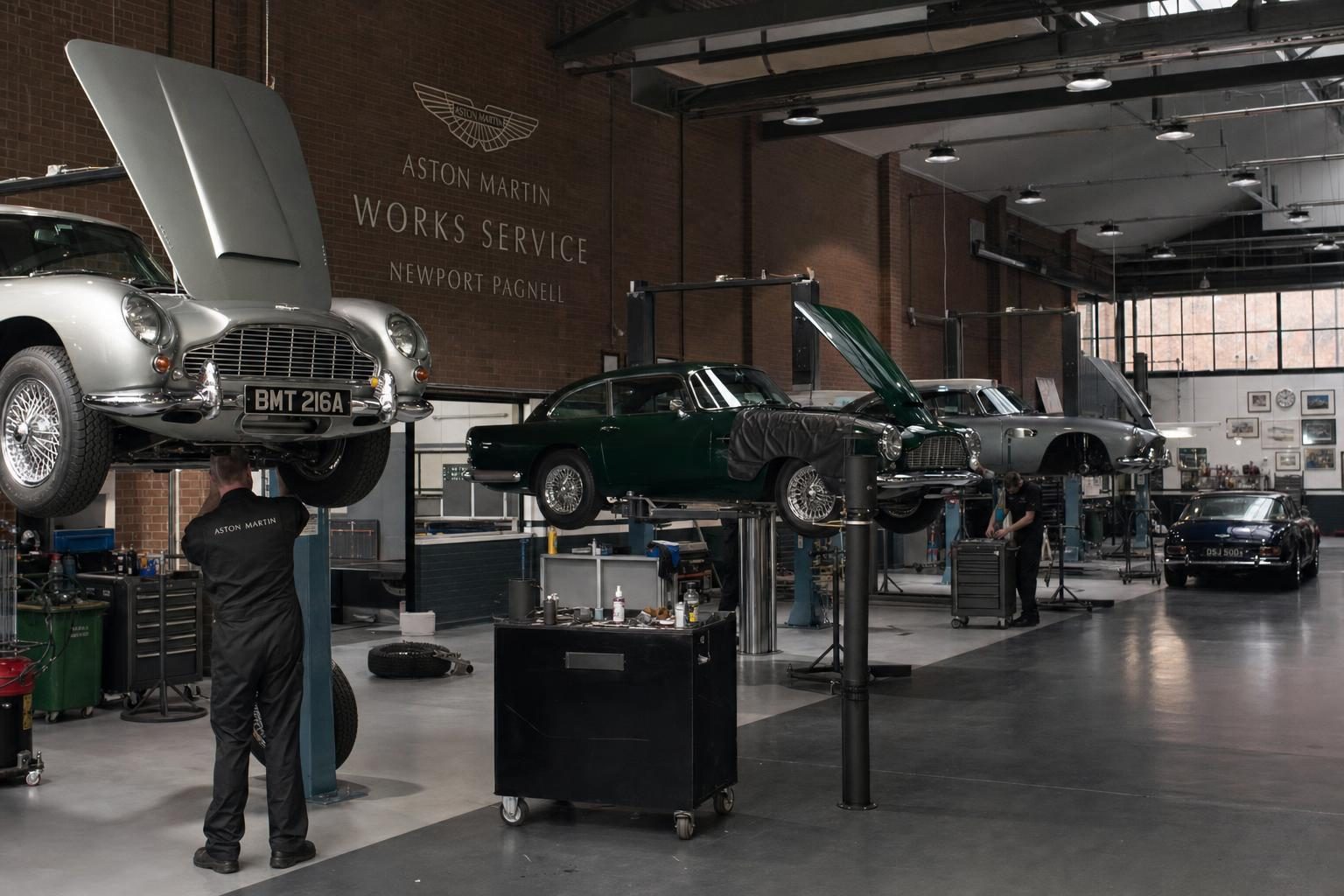
A key point for a successful Aston Martin collection: parts access. The Newport Pagnell Works Service still operates for classic models. According to Aston Martin, the entity provides restoration, maintenance and the supply of specific components, with the continuity of expertise implied by the historic address.
The Newport Pagnell programme was in fact revived in 2017, after a decade without production on the site, as Wikipedia notes. This return to activity came with renewed availability for certain references and an ability to remanufacture critical parts — an asset for DBs predating the VH era.
On DB9s and V8 Vantages, the VH platform and the use of shared components facilitate the supply chain for routine servicing. While not solving everything, it helps shorten lead times for consumables and certain peripheral assemblies — a welcome plus for regular driving.
To prepare a first purchase, take time to sound out the network: recognised independent workshops, delivery times for key parts, and the Works’ ability to document an intervention. The technical mesh is as reassuring as the best evaluation expertise.
Values and liquidity: which models resell most easily
The liquidity of an Aston Martin collection varies with model notoriety, production volume and current desirability. The DB7, with more than 7,000 units according to Wikipedia, offers a broad market and relatively fluid transactions, especially for examples with clean histories and sought‑after specifications.
The DB9 and V8 Vantage benefit from a solid base of buyers, driven by usability and the availability of technical information. Their wider diffusion than “classic” DBs generally enables reasonable resale times when the car is properly maintained and presented.
At the opposite end of the spectrum, the One‑77 hypercar, produced in 77 examples, targets a micro international market. According to the major auction houses cited by our editorial team, it regularly achieves several million euros. Such an icon changes hands within a restricted circle, but its ultra‑rare positioning creates captive demand quite unlike that of core‑range models.
Pre‑purchase checks: service book, Heritage Certificate and matching numbers
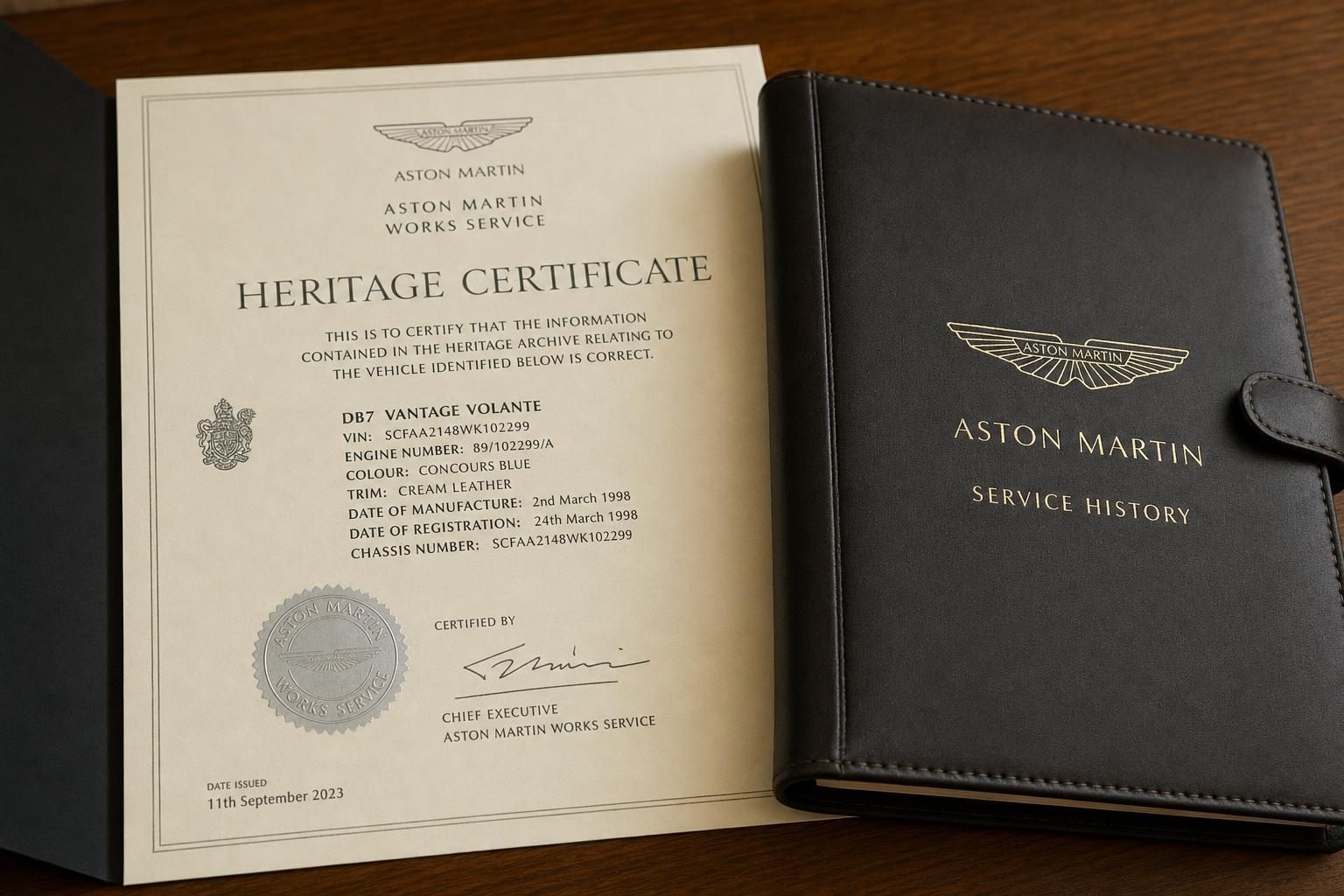
The seriousness of an Aston Martin collection is played out in the paperwork. Aim for a coherent service book, detailed invoices and, ideally, oversight by recognised specialists. A recent, by‑the‑book service is worth more than a stack of older work.
Heritage Certificates, issued by the Heritage Trust, are the authoritative tool to confirm matching numbers and original specification. They provide hard‑to‑dispute documentary proof, valuable for long‑term worth and liquidity. Verify the alignment between the certificate, manufacturer plates and stampings.
Inspect generation‑specific weak points. On classic DBs: structural corrosion, panel alignment, interior integrity and component correctness. On VH models: condition of running gear, electrical peripherals and update history. An independent inspection remains a rational investment.
Finally, cross‑check the road test against the documents: cold behaviour, oil pressure, braking stability and absence of parasitic vibrations. A sound car tells the same story on the road and on paper.
Insuring a classic Aston Martin: specifics of agreed value policies
The right policy protects an Aston Martin collection against uncertainty. “Agreed value” policies set, in advance, a compensation basis agreed between insurer and insured. This is the right tool for cars whose values change and whose uniqueness doesn’t always fit traditional schedules.
To obtain this value, prepare a file: inspection, detailed photos, a copy of the Heritage Certificate and service history. Update it periodically, especially after significant work or a market shift. Specialist insurers appreciate transparency and regular updates.
Match cover to real‑world use: limited annual mileage, events, occasional trips. The excess, breakdown cover and damage options specific to a collector vehicle should be calibrated as precisely as possible. Well‑designed insurance supports preservation and enjoyment of the car — not the reverse.
Conclusion — starting an Aston Martin collection without missteps
Entering an Aston Martin collection means combining desire and method. Frame the overall budget, choose your era with eyes open, secure parts supply via Works Service where relevant, and target models with liquidity aligned to your horizon. Heritage Certificates and a rigorous service file cement value, while an agreed value policy protects both investment and pleasure.
DB4 Newport Pagnell 1958: 5 Ultimate Breakthroughs Over the Mark III
DB4 Newport Pagnell marks the moment Aston Martin made a clean break with the DB Mark III and opened a new era. Far from a simple facelift, the DB4 rebuilt the house from the ground up: chassis, engine, body, production site and industrial logic. Here, point by point, are the five technical breaks that seal this change of generation and explain why the DB4 is not the direct heir to the Mark III, but its philosophical replacement.
On the menu: a new platform chassis, a completely rethought straight-six, Touring of Italy joining the workshop, the move to Newport Pagnell and production in five series. Enough to recontextualise this DB4 Newport Pagnell, unveiled at the 1958 London Motor Show, where its silhouette and modernity caused a sensation, according to the page dedicated to the DB4.
To place the subject, recall that the DB Mark III was still leaving Feltham, from what was already a classic mechanical era. The DB4 Newport Pagnell, by contrast, redefined the brand’s grammar. The reference sources, notably Wikipedia, clearly establish this technological shift.
A new platform chassis: the end of the Claude Hill tube-frame
The first break is structural. The DB Mark III still rested on the tubular architecture inspired by the work of Claude Hill. With the DB4, Aston Martin adopted a new platform chassis, turning the page on the tube-frame. This change is no detail: it redefined the mounting points, rigidity and the way the car was clothed.
According to the historical synthesis dedicated to the DB4, this move to a platform allowed better integration of the bodywork and a rationalisation of assemblies. The DB4 Newport Pagnell thus became more modern in its processes, less dependent on an artisanal tubular framework. It’s a different production language, aligned with the rest of the project.
In practice, this chassis facilitated the adoption of the Superleggera body and laid the foundations for sharper variants. The architecture would serve as the base for the future DB4 GT and, by extension, the famous DB4 GT Zagato, two sporting derivatives we detail in our dedicated feature.
To gauge the gap with the old school, a look at the period presentation of the DB Mark III illustrates what the DB4 deliberately abandoned: the persistence of tubular construction and post-war solutions.
The Tadek Marek 3.7-litre engine: clean slate over the Lagonda straight-six
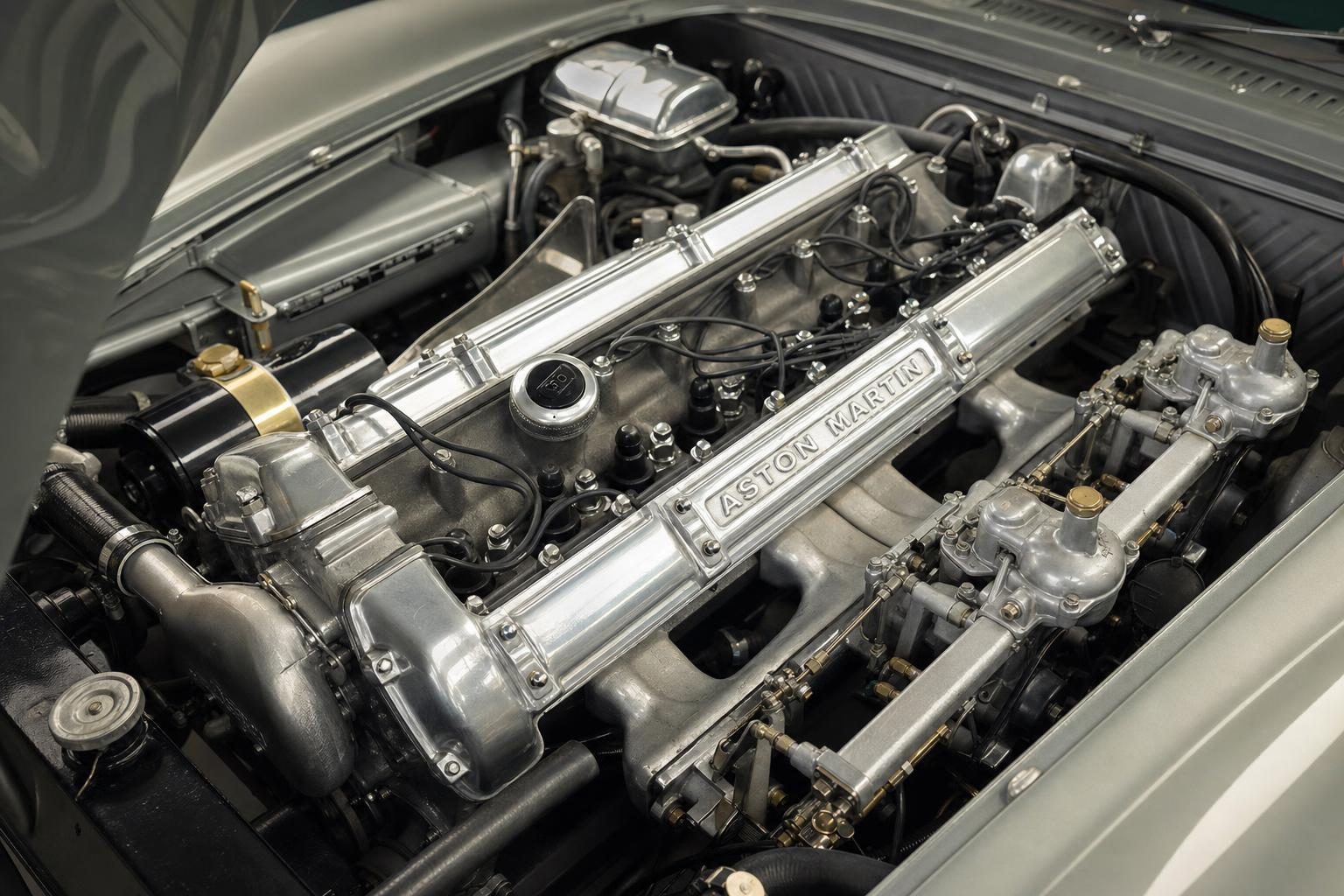
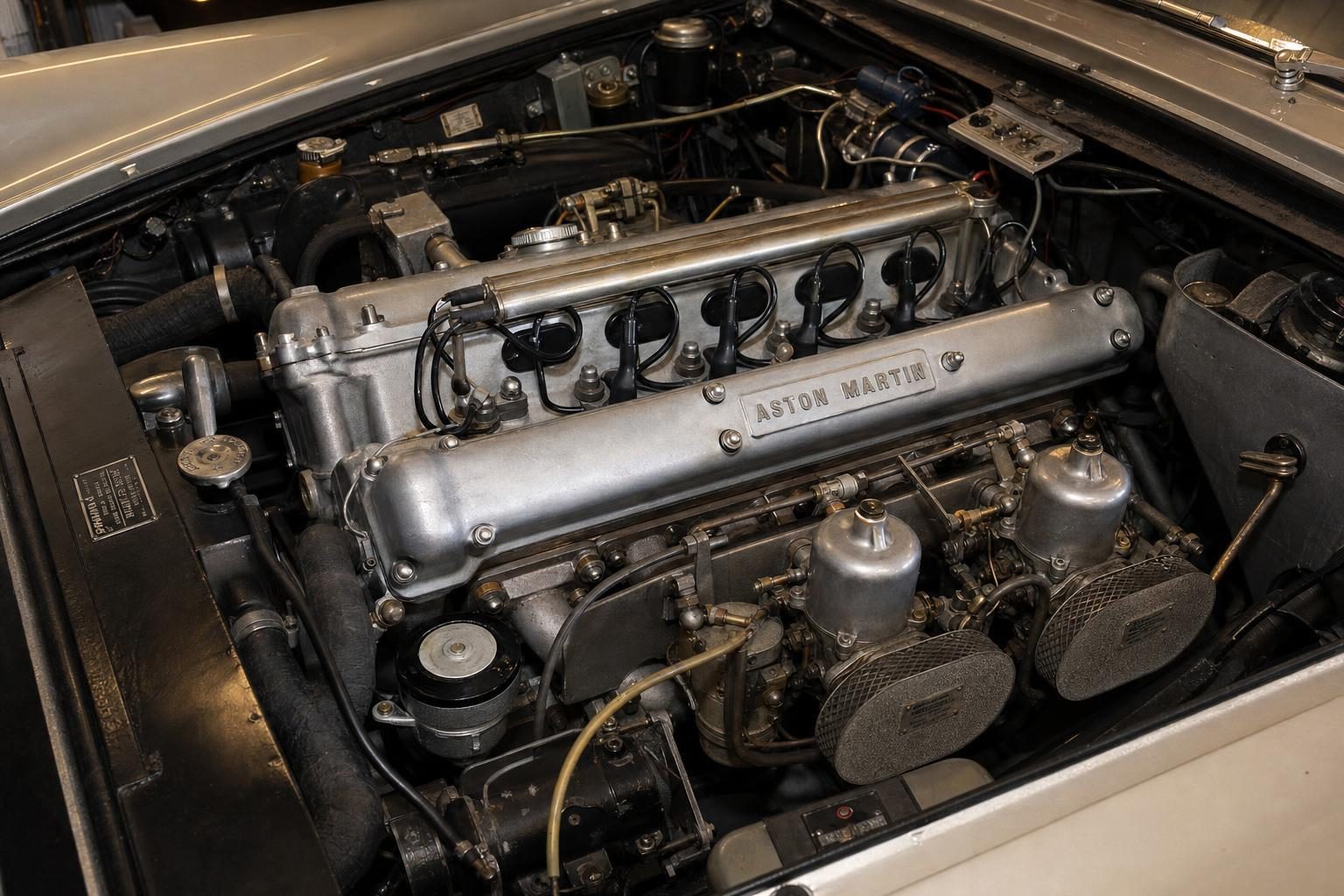
Second line of fracture: the mechanical heart. The DB4 inaugurated a 3.7-litre DOHC straight-six designed by Tadek Marek. Block and head in R.R.50 aluminium alloy, twin-cam valvegear, markedly improved breathing and efficiency: everything opposed it to the Lagonda six of the Mark II/III. This was not an evolution; it was a new chapter.
The technical literature on the DB4 underlines this strategic choice: modernise the power unit and reduce mass, thanks to the light alloy. The DB4 Newport Pagnell thus ushered the engine into the Marek era, a name that would leave a lasting mark on Aston Martin’s straight-six dynasty.
This more ambitious design also prepared the sporting versions. The potential of the 3.7-litre would be exploited in the DB4 GT, then pushed further still with the sleeker GT Zagato body. Proof that the mechanical break was no engineer’s whim, but the bedrock of a range.
Compared with the Mark III, whose engine remained an evolution of the Lagonda six, the DB4 stood out through its materials approach and valvegear kinematics. A deliberate clean slate, and rarely better executed in British industry at the turn of the 1950s and 1960s.
Carrozzeria Touring’s Superleggera body: Italy arrives at Newport Pagnell
Third break: the clothing. The DB4 introduced at Aston Martin the Superleggera method by Carrozzeria Touring, Milan. Fine tubes, aluminium panels, and that line both pure and muscular, which made an impression at the 1958 London Motor Show, according to the DB4’s dedicated notice. The coupé imposed a new aesthetic as much as an unprecedented manufacturing process at Feltham… then at Newport Pagnell.
The DB4 Newport Pagnell owes much to this transalpine collaboration. Superleggera dictated the curves, the visual balance and the management of masses. It also strengthened the industrial proposition, as the Italian method dovetailed perfectly with the platform chassis, ensuring a more coherent whole than the old tubular frame.
The result is a silhouette that would become a template for the following decade. The Series V, lengthened, prefigures the DB5, attesting to the initial rightness of the volumes. Italy didn’t just draw a pretty coupé; it defined Aston Martin’s formal language for years.
To reposition the Mark III in this picture, its bodywork retained classic proportions and less lightweight assembly solutions. The DB4, by contrast, shifted to a more international approach, where technique and style advanced together.
Newport Pagnell: why the DB4 inaugurates the site that still builds Astons today
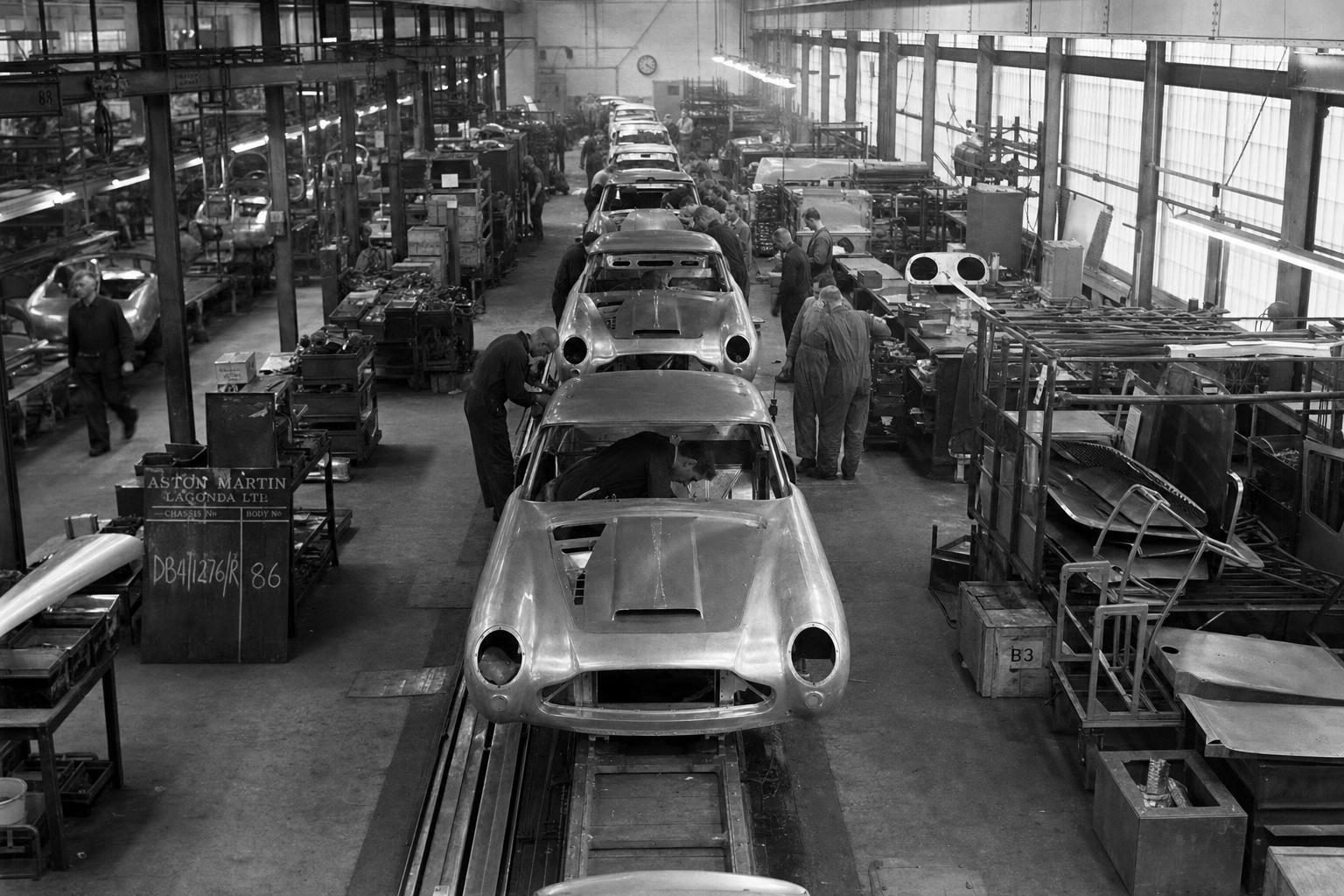
Fourth break, geographical and strategic. The DB4 was the first model assembled at Newport Pagnell while the DB Mark III was still produced at Feltham. This move was no anecdote: it accompanied a rise in industrial maturity. At Newport Pagnell, the marque anchored a production organisation that would shape its identity for decades.
The DB4 Newport Pagnell crystallised this transfer. It linked Milanese-inspired bodywork, a modern chassis and a Marek engine to a site capable of marrying them properly. The address became a symbol; it would remain so, right up to the heritage programmes run today.
In practice, moving production allowed know-how to be internalised, flows to be optimised and quality control to be introduced in line with the model’s ambition. It was also the condition for industrialising sharper derivatives, whether future GTs or evolutionary series.
It becomes clearer, then, why the DB4 is not the unofficial “Mark IV”. It is the starting point of a cycle, and Newport Pagnell is its instrument. This combination of place and technique explains the symbolic power of the name DB4 Newport Pagnell in the marque’s history.
Five series, 1,110 examples: anatomy of production from 1958 to 1963
Final break: the product logic. The DB4 was offered in five series between 1958 and 1963, totalling “around 1,110 examples” according to the reference page. Other secondary sources vary on the precise figure; what matters is the order of magnitude and cadence, signalling controlled output for a hand-built grand tourer.
Each series brought targeted evolutions, culminating with Series V, longer, which traced the line of the DB5. This series-led management speaks to more rigorous industrial steering than in the past, aligned with feedback and continuous improvement. Here the DB4 Newport Pagnell shows its maturity: even the lifecycle reflects the break.
On this base, Aston Martin developed the sportiest pieces of the puzzle: the DB4 GT, then the DB4 GT Zagato. These derivatives exploited the chassis base, the Marek engine and the Superleggera lightness to aim at competition and image. A performance-led demonstration, entirely born of the logic introduced by the DB4.
To delve deeper into the genealogy, our model guide places the DB4 among its contemporaries and direct descendants, while the Mark III profile reminds us where we came from. The overall coherence confirms the thesis: the DB4 is not an evolution; it’s a restart.
Conclusion – DB4 Newport Pagnell, five breaks for a new era
At the end of this journey, the case is clear: DB4 Newport Pagnell marks a methodical break with the DB Mark III. New platform chassis, light-alloy Marek engine, Superleggera body, the shift to Newport Pagnell, and production in five series – five keys that close the door on the old world and open that of the Astons of the sixties.
This coupé changed the way an Aston Martin was conceived, built and clothed. The DB4 Newport Pagnell is thus the matrix from which the DB4 GT, GT Zagato and, in filigree, the DB5 would be born. A measured revolution, perhaps; but a revolution all the same.
For enthusiasts, placing DB4 Newport Pagnell in this context is to better understand the brand’s evolution: not a simple continuity of the Mark III, but a carefully orchestrated generational leap, the traces of which are still visible today.