Valkyrie AMR-LMH: Aston Martin's first LMH Hypercar, competing in WEC and IMSA in 2025 with the 6.5 L Cosworth V12. Overview of the inaugural season.
The Valkyrie AMR-LMH embodies Aston Martin’s most ambitious bet in modern endurance, combining the extreme character of a road hypercar with the demands of the top category. Unique in the field, it symbolises a return to the summit focused on pure technique, endurance, and consistency, with a singular approach that refuses artifice in favour of overall coherence. In the following lines, we detail what the Valkyrie AMR-LMH represents, how it has been transformed for racing, why its atmospheric V12 has been retained without hybridisation, and how the programme structured between WEC and IMSA underpins Aston Martin’s sporting ambitions.
From Road Valkyrie to Race Car: A Unique Conversion to LMH
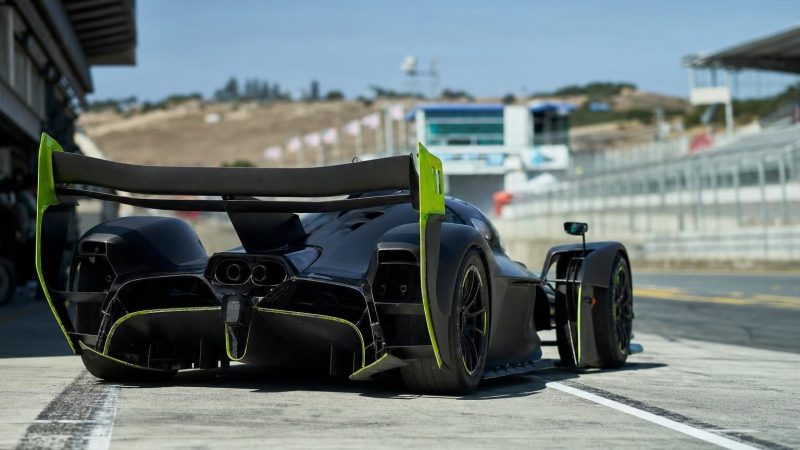
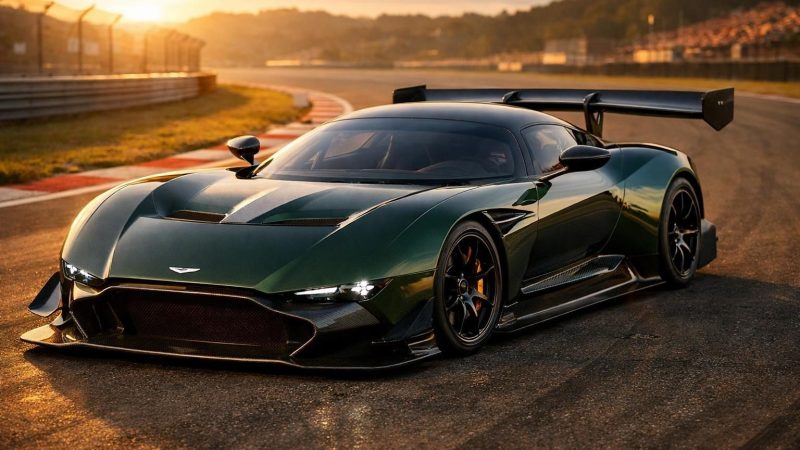
The Valkyrie AMR-LMH is the first LMH Hypercar produced by Aston Martin and, importantly, the only car in the WEC directly derived from a road-legal hypercar. This lineage influences everything: proportions, aerodynamic philosophy, and mechanical packaging logic. While many competitors are born as prototypes without road anchoring, the Valkyrie AMR-LMH capitalises on an extreme base derived from the series and then transposes it to endurance, aiming to preserve the DNA of the Valkyrie while meeting the demands of a 24-hour race. This uniqueness gives it an immediately recognisable identity and a clear link to the original hypercar, which enthusiasts can explore in detail via our dedicated page on the Road Valkyrie.
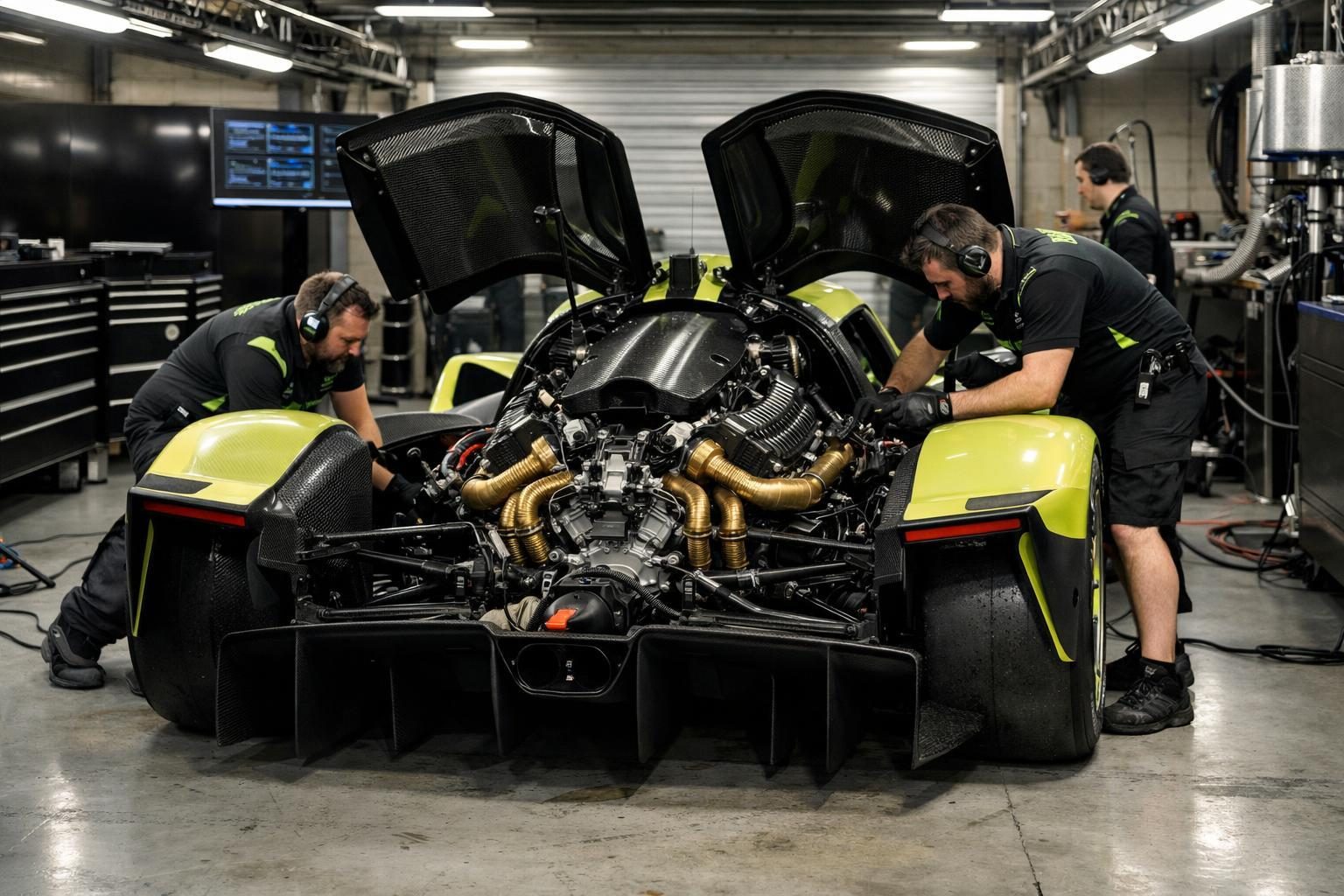
In practical terms, the race car retains the 6.5-litre atmospheric Cosworth RA V12 from the production Valkyrie, reconfigured for the reliability and consistency required in endurance racing. The transmission is handled by a 7-speed Xtrac sequential gearbox, designed to withstand the demands of a dual global programme. The Valkyrie AMR-LMH also incorporates a “starternator” system that allows for starting without dedicated engine power, a practical choice in endurance conditions to limit auxiliaries and optimise operational management in the pits. Together, these elements form a powertrain with a strong character, yet adapted for long and repeated stints.
The Hypercar regulations limit competition power to 500 kW (680 PS), which frames the raw performance of the Valkyrie AMR-LMH. Rather than relying on electronic or hybrid sophistication, Aston Martin has prioritised the exploitation of a coherent mechanical package, naturally expressive and very directly connected to the road-going Valkyrie, while accepting the discipline imposed by the regulations. It is this blend of authenticity and rigour that gives the race car its distinctive identity in the LMH landscape.
The 6.5 L Cosworth V12 Without Hybrid: A Deliberate Technical Choice
At the heart of the project, the 6.5-litre atmospheric Cosworth RA V12 embodies the backbone of the Valkyrie AMR-LMH. Reusing this iconic engine from the road version and then adapting it for endurance reflects a desire for technical continuity. With power capped at 500 kW (680 PS) in Hypercar, the pursuit of performance hinges as much on drivability, reliability, and consistency over time as on peak value. The V12 atmospheric architecture contributes to a linear and predictable response, which is advantageous for stints and traffic management, key elements in both WEC and IMSA.
Aston Martin has made the conscious choice not to use a hybrid system, citing its complexity and excess weight, particularly the need to move a rear system forward within this regulatory framework. According to reports, this renunciation of hybridisation stems from a logic of compromise: rather than adding components and thermal and packaging constraints, the Valkyrie AMR-LMH focuses on refining the V12 engine and the Xtrac 7-speed transmission, supported by the “starternator”. For a clear synthesis of the structural choices (including the Xtrac gearbox and the “starternator”), the dedicated Wikipedia page for the Valkyrie AMR-LMH provides a useful summary.
This technical stance, which contrasts with the hybrid solutions of some competitors, gives the Valkyrie AMR-LMH a unique mechanical personality. In an environment where the Balance of Performance sets boundaries, the challenge becomes fine optimisation: cooling, fuel management, mappings, durability of components, and efficiency of pit stops. The absence of hybridisation does not preclude innovation; it shifts it towards robustness, operational simplicity, and the ability to repeat performance over very long durations, at the heart of the endurance spirit.
Team THOR and WEC-IMSA Programme: A Two-Series Strategy
Aston Martin is the first LMH brand to compete simultaneously in WEC and IMSA, a uniqueness that structures the sporting season of the Valkyrie AMR-LMH. This dual presence multiplies learning environments – race formats, track profiles, types of traffic and sequences – and increases logistical, human, and technical demands. By placing the Valkyrie AMR-LMH at the centre of a two-speed programme with a common goal, the brand accelerates data collection and understanding of the chassis and powertrain behaviours in varied contexts.
Operationally, running WEC and IMSA concurrently allows for quicker validation of developments and broader reliability of processes: pit stop procedures, wear of consumables, driving comfort adjustments, grip gap management. To officially measure this and follow the ambition surrounding the dual commitment, the media release on the return to Le Mans with two Valkyrie LMH sheds light on the approach. The Valkyrie AMR-LMH thus fits into a comprehensive endurance strategy, where each race feeds into the next.
To place this dynamic within the continuity of Aston Martin’s presence at Le Mans and in the championship, our thematic dossier Aston Martin at Le Mans and in the World Championship gathers and contextualises the major milestones. Ahead of the 24 Hours, the technical and sporting orientation around the Valkyrie AMR-LMH is also detailed in the official announcement before the 24 Hours of Le Mans, which outlines the objectives and framework of the programme.
2025 Review: Challenging Debuts, Rising Power, and First Podium
The first tangible milestone in 2025 for the Valkyrie AMR-LMH occurs at the 24 Hours of Le Mans, where both cars, #007 and #009, complete the race without mechanical issues. They finish 12th and 14th respectively, marking Aston Martin’s first points in the Hypercar class. For such a unique machine, derived from a road hypercar, crossing the line after 24 hours represents a marker of solidity and an accelerator of learning, beyond just the finishing position.
These validated finishes highlight the relevance of the technical choice: a controlled atmospheric V12 within its performance range (limited to 500 kW/680 PS by regulations), a robust Xtrac 7-speed transmission, and simplified auxiliaries thanks to the “starternator”. The goal now is to transform the endurance born from consistency into pure pace over distance, capitalising on the dual WEC-IMSA exposure. In this light, every stint, every pit stop, and every series of laps in traffic becomes a building block for the Valkyrie AMR-LMH’s progress.
As for the prospect of a first podium, it naturally fits within the trajectory of rising power. The first points scored at Le Mans testify to a solid foundation, while the two-championship strategy creates opportunities for rapid adjustments. Following the Valkyrie AMR-LMH in this phase means observing how a concept born from the road gradually integrates into the Hypercar ecosystem, with increasingly consistent results on the horizon, step by step.
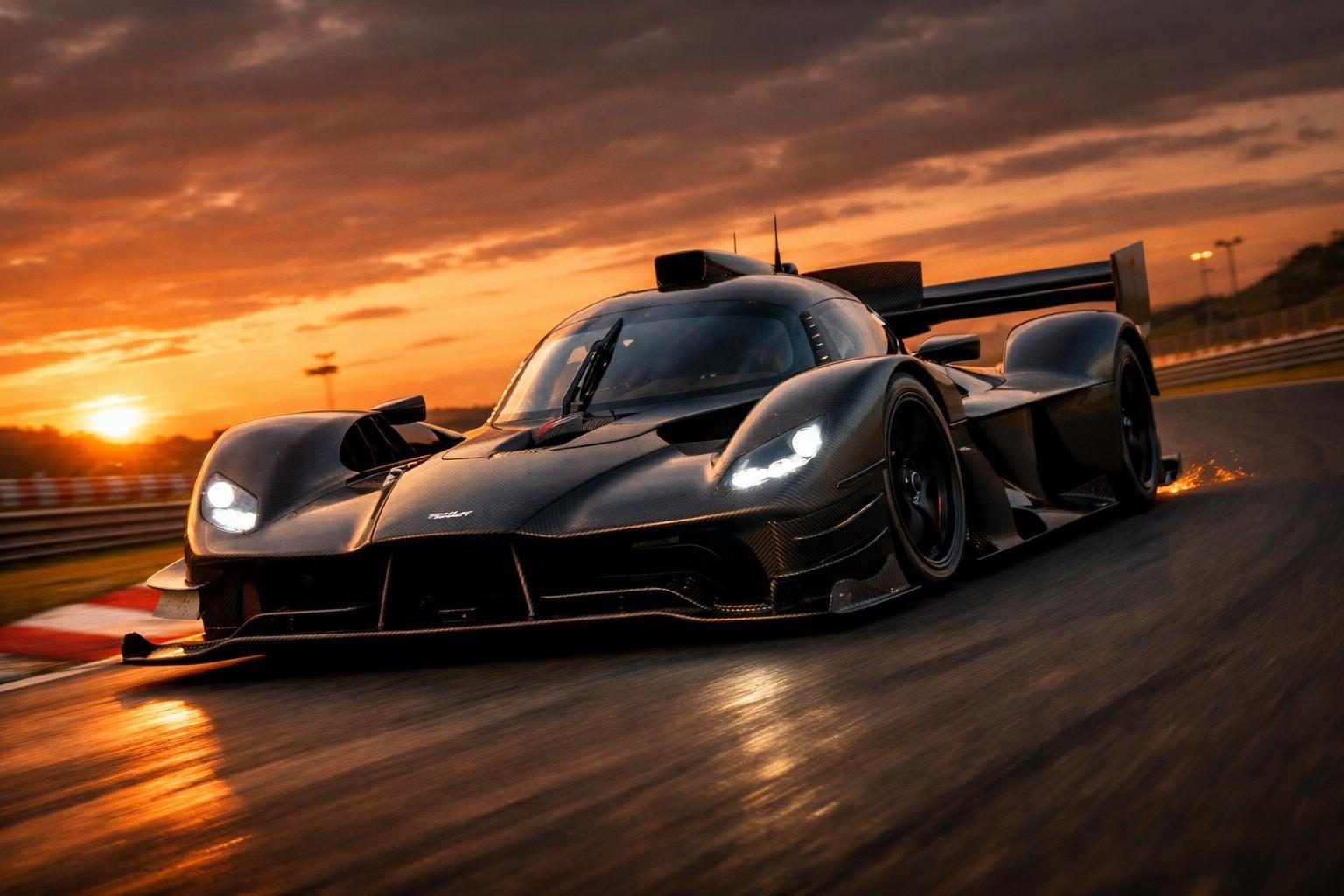
Valkyrie LM: The Track Version Limited to 10 Units for Owners
In June 2025, Aston Martin unveils the Valkyrie LM, a track version limited to 10 units, directly derived from the race car. This initiative extends the philosophy of the programme beyond the strict confines of competition, offering a select circle of owners an interpretation closely aligned with the Valkyrie AMR-LMH. This variant strengthens the link between the paddock and customers, helping to spread the spirit of the project to the most engaged community.
This Valkyrie LM retains the technical and stylistic DNA shaped by endurance, with the ambition of delivering a track experience faithful to the LMH reference. It continues the legacy of the road-going Valkyrie – the context and specifics of which you can find on our Valkyrie models page – while embodying a concrete bridge between competition and a reserved, very limited use. By extension, the Valkyrie AMR-LMH benefits from a coherent ecosystem that enhances its technology and sporting aura.
Conclusion – Valkyrie AMR-LMH, A Unique Ambition That Affirms Itself
Unique in its kind, the Valkyrie AMR-LMH embraces a clear technical path: the 6.5-litre atmospheric Cosworth V12, the 7-speed Xtrac gearbox, the “starternator”, and the absence of hybridisation by deliberate choice. As Aston Martin’s first LMH Hypercar and the only one in the WEC derived from a road hypercar, it unites a vision where effective simplicity and road lineage become assets in endurance. The finishes of #007 and #009 at Le Mans 2025, with the first points for Aston Martin in Hypercar, lay a concrete foundation for the future, while the concurrently run programme in WEC and IMSA accelerates learning.
As this architecture refines, the Valkyrie AMR-LMH expands its footprint: on the track, through continuous improvement of pace and consistency; around the track, with the limited series Valkyrie LM, which extends the spirit of racing. To delve into Aston Martin’s genealogy at Le Mans, our page on the DBR1 saga at Le Mans offers useful historical insight, while the official announcement before Le Mans and the media release allow you to follow the latest news. The course is set: to make the Valkyrie AMR-LMH a benchmark in endurance, at the intersection of road and racing.