DBR1: Aston Martin's only outright victory at Le Mans in 1959, the world title snatched from Ferrari, and the story of the chassis. Complete account and sources.
The DBR1 is the culmination of a quiet obsession: to see Aston Martin triumph at Le Mans and in the world championship in the same year. This article revisits, with supporting sources, the context that made the DBR1 possible, the night of 1959 and its strategy, the world title wrested from Ferrari, the power figures that differ according to authors, and the fate of the five DBR1 chassis, along with their current value.
Why David Brown Wanted to Win Le Mans Since 1949
If the DBR1 embodies Aston Martin’s only outright victory at the 24 Hours of Le Mans, achieved in 1959, it is because it synthesises years of effort to cross this symbolic threshold. Sources agree that the DBR1, designed by Ted Cutting from 1956, was developed with a clear vision: to triumph in the Sarthe event and at the world summit in the same season, a historically rare objective. According to Wikipedia (Aston Martin DBR1) and communications from Aston Martin, the 1959 edition realised this quest and remains, to this day, the only total success of the brand at Le Mans.
The DBR1 is part of an era where only a few models have achieved the Le Mans + world championship double in the same year. Wikipedia notes that only the Ferrari 375 Plus (1954), the Ferrari 250 TR (1958), and the DBR1 (1959) managed this feat in the 1950s. This rarity highlights the magnitude of the challenge and the historical value of the DBR1 in Aston Martin’s record. In this sense, the car was conceived as a total victory tool, rather than just a mere prototype of circumstance.
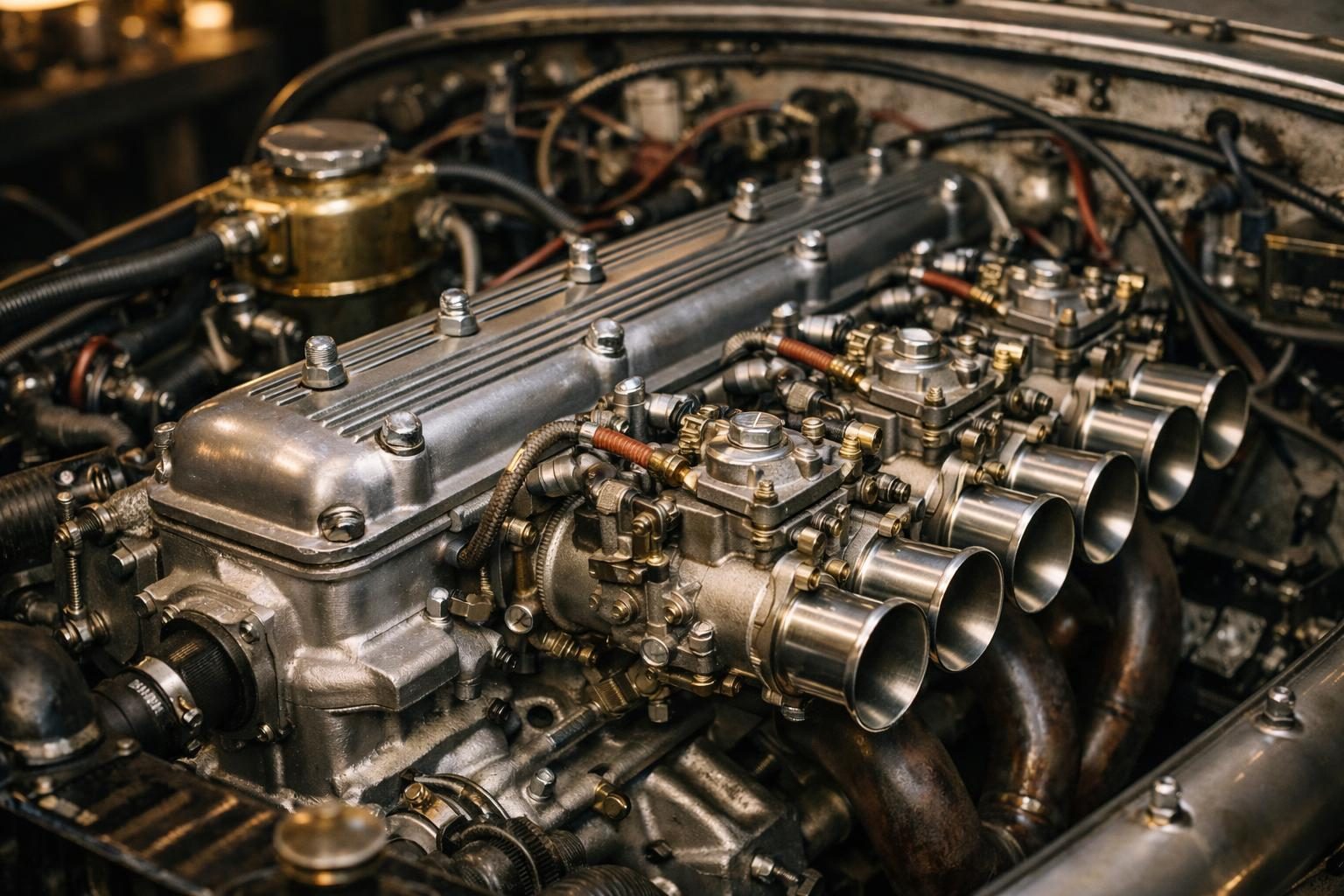
Technically, Cutting opted for a tubular chassis and a transverse gearbox, aiming to optimise compactness, weight distribution, and reliability. Sources such as Roarington and HWM (Aston Martin) indicate a weight of around 800 kg, a key figure that, combined with the development of the 3-litre six-cylinder engine, positions the DBR1 among the sharpest prototypes of its time. Thus, the DBR1 was born from a clear roadmap: reduce weight, ensure reliable transmission, and unleash enough power to dominate over 24 hours.
For readers wishing to place the DBR1 within the lineage of post-war models, our dossier on the DB2 and the Genesis of Post-War Aston Martins offers useful references. As for the recurring theme of “Le Mans and championships” dear to the brand, it is treated in detail in our dedicated section Aston Martin in Competition, from Le Mans to World Titles.
The 1959 Race: The Shelby-Salvadori Double and Moss’s Strategy
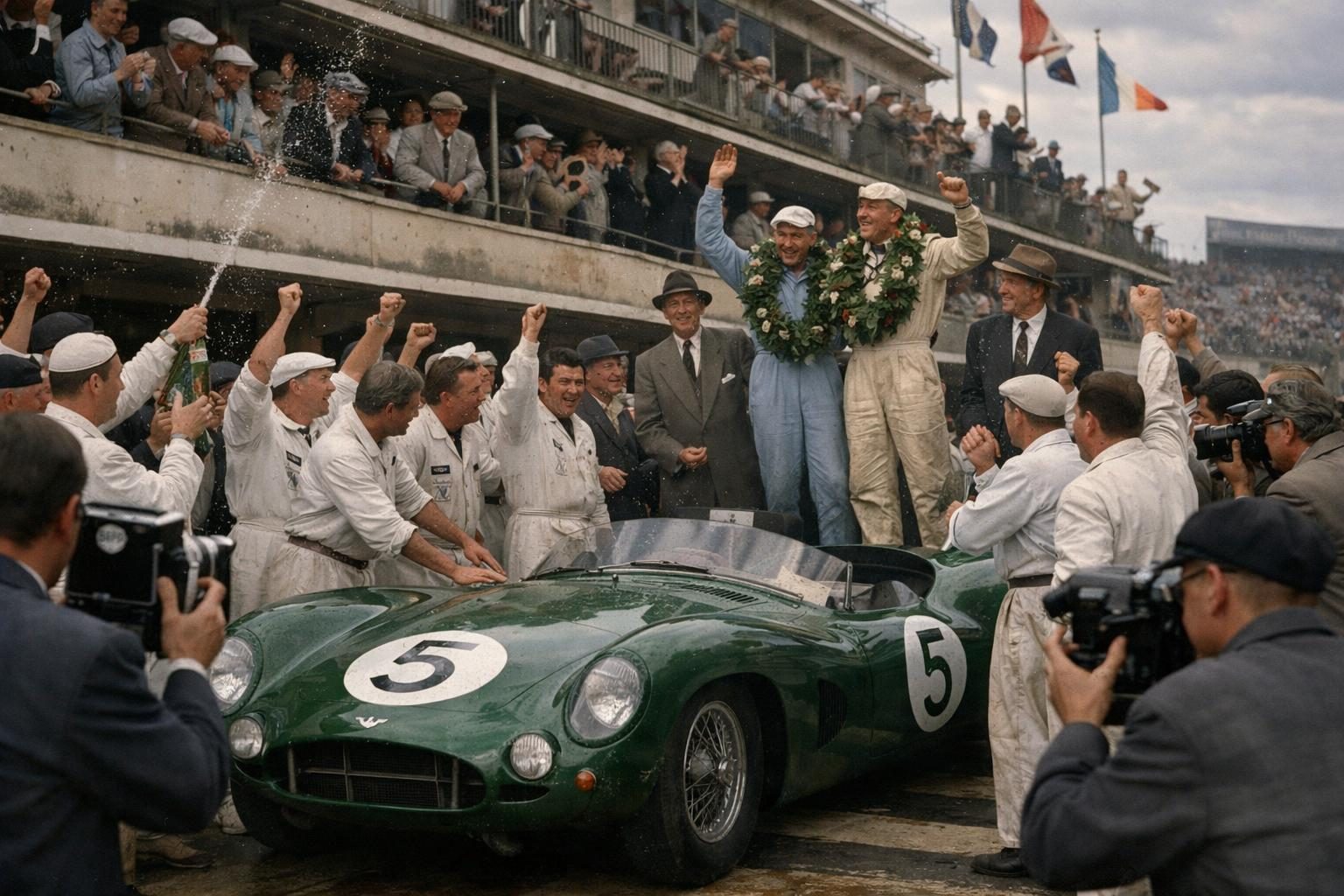
The 1959 edition of the 24 Hours remains the moment of truth for the DBR1: Carroll Shelby and Roy Salvadori gave Aston Martin its only outright victory at Le Mans. Official sources from Aston Martin and Wikipedia converge on this crucial fact. Beyond the chequered flag, this victory reflects the coherence of a technical and sporting project matured over several seasons, and the execution of a team strategy adapted to endurance.
The presence of Stirling Moss plays a strategic role. Information from Wikipedia (Aston Martin DBR1) and the “1959 Le Mans” dossier highlights the specification of Moss’s car, credited with around 255 PS that year. Without extrapolating, this figure can be read as an indicator of the pursuit of absolute performance to control the race pace, protect the reliability of the other DBR1s lined up, and exert pressure on the competition. The DBR1 did not just win on the track; it set a tempo.
The strength of the DBR1 in 1959 lies as much in its technical balance as in crew management. The Shelby–Salvadori tandem, referenced by Wikipedia and Aston Martin media, transformed meticulous preparation into a full result. This ability to convert a platform designed as early as 1956 into a prestigious victory illustrates the robustness of the tubular chassis, the relevance of the transverse gearbox, and the tuning of the 3-litre six-cylinder for long races.
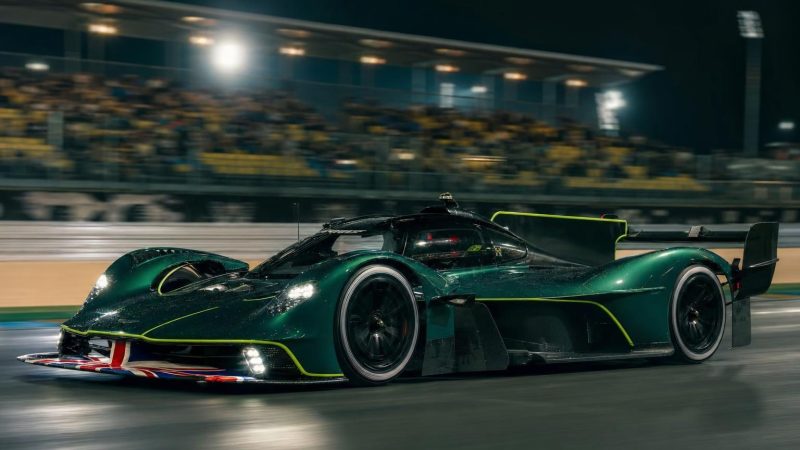
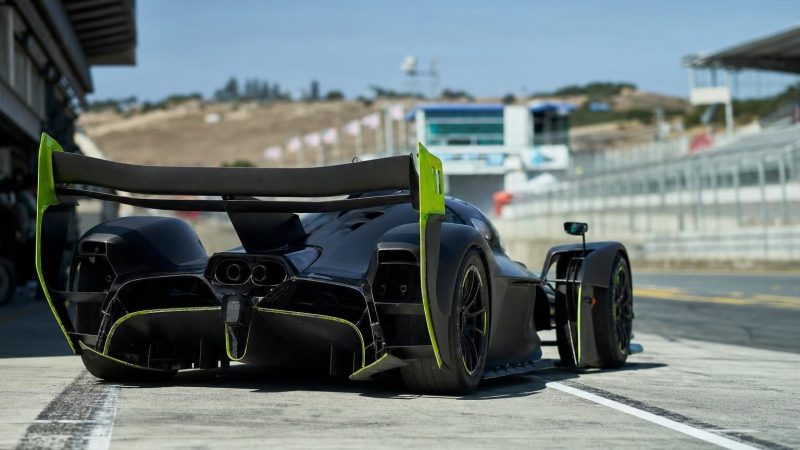
Even today, the 1959 DBR1 remains a foundational milestone. It shaped the perception of Aston Martin as a manufacturer capable of reaching the pinnacle of endurance with its own technical means. Our follow-up on modern ambitions, including the in-house hypercar, can be discovered in the dedicated analysis of the Valkyrie AMR LMH engaged at Le Mans, which reactivates the echo of the DBR1 in the current era.
The 1959 World Championship Snatched from Ferrari at the Tourist Trophy
The 1959 season is not limited to the victorious DBR1 at Le Mans. It culminates at the Goodwood Tourist Trophy, the final stone in a world title snatched from Ferrari. The account from Goodwood GRR and Wikipedia (DBR1) highlights a key episode: a fire in the pits nearly jeopardised everything, before the privateer Graham Whitehead lent his pit to the official team. This decisive gesture allowed Aston Martin to continue and ultimately secure the title.
This world championship of 1959, coupled with the victory at Le Mans, places the DBR1 in a very select circle of cars from the 1950s to achieve this double, alongside the Ferrari 375 Plus (1954) and 250 TR (1958) mentioned by Wikipedia. The DBR1 thus earns its status as a reference: the pinnacle of a programme initiated in 1956 around a lightweight architecture, a compact transmission, and a six-cylinder engine calibrated for endurance.
The seasonal dynamics recounted by Goodwood GRR underline a reality of sports prototypes: the title is contested as much in the workshops as on the track. The 1959 DBR1 converted its technical cohesion into points capital, and it was by surviving the unexpected that the campaign concluded at the summit. The example of the Tourist Trophy is, in this respect, inseparable from the legend of the DBR1.
To place this triumph in the broader history of the brand and championships, our thematic dossier Aston Martin in Competition draws parallels between eras, from the DBR1 to contemporary challenges. It shows how the lessons of 1959 still inform the brand’s racing philosophy.
How Much Power for the Six-Cylinder: Diverging Figures
The DBR1 is also a case study in technical literature where figures vary according to sources. Several reputable authors propose different values for the 3.0-litre six-cylinder. According to HWM (Aston Martin), the DBR1 1957 evolves around 250 PS. The 1959 Le Mans dossier on Wikipedia credits Moss’s car with around 255 PS in 1959. Finally, Sports Car Digest suggests a figure of “up to 268 PS”. Taken together, these references illustrate the variability of measurements and configurations, without a definitive conclusion.
Why these discrepancies? The sources do not detail the test benches, fuels, or exact stages of evolution here. But the body of evidence remains coherent: a DBR1 around 250–268 PS, backed by a weight of approximately 800 kg (Roarington, HWM). The mass/power equation, combined with the tubular chassis and transverse gearbox, explains competitiveness over 24 hours. In endurance, the reliability margin counts as much as peak power, and the 1959 DBR1 exemplifies this.
To sort the information, it is important to attribute the figures precisely. We therefore retain: 250 PS (HWM, 1957), 255 PS (Wikipedia, Moss’s car 1959), up to 268 PS (Sports Car Digest). This transparency is an editorial strength: acknowledging divergences, rather than concealing them, does justice to the living character of the technical history of the DBR1.
Beyond the watts, the coherence of the platform matters. Designed by Ted Cutting from 1956, the DBR1 relies on a clear architectural principle. The 1959 results (Le Mans + championship) confirm that, regardless of the exact value retained, the DBR1 delivered the “sufficient” power where it matters: over time, in race.
The Fate of the Five DBR1 Chassis and Their Current Value
The DBR1 does not exist in singular: five chassis have borne this name and design, each with its own trajectory. The sources gathered here do not detail, chassis by chassis, their careers or changes of hands, but they allow for a clear line to be drawn: the DBR1 occupies, in the market and in the imagination, a rare place for a British endurance car from the 1950s.
A valuation milestone stands as proof. In 2017, a DBR1 became the most expensive British car sold at auction, at 22.55 million dollars, according to Roarington. This figure situates the heritage value of the DBR1 at the summit, among competition icons. It reflects the dual sporting capital (Le Mans + world championship 1959) and the technical pedigree (tubular chassis, transverse gearbox, around 800 kg) that fuel demand.
Rarity plays a central role: with five DBR1 chassis, the supply is inherently narrow. Aston Martin’s only outright victory at Le Mans in 1959, recalled by Wikipedia and the media from Aston Martin, confers upon these cars a status of “rolling pieces of history”. The DBR1 thus concentrates a legacy that enthusiasts and collectors perceive as irreplaceable.
Through these five DBR1s, an entire Aston Martin philosophy endures: to triumph through engineering, balance, and consistency, rather than through sheer brute force. For readers wishing to broaden the perspective towards the foundational road models of the post-war era, our study on the DB2 and its derivatives draws a connection between the technical thread linking road and track at Aston Martin.
Conclusion: What the DBR1 Changed
The DBR1 set a compass: that of a manufacturer capable of aiming for and achieving a rare double, Le Mans 1959 + World Championship 1959. The concordant sources from Wikipedia and Aston Martin establish this fact, which the account from Goodwood GRR illuminates through the episode of the Tourist Trophy and the fire overcome. At the scale of Aston Martin, the DBR1 remains a matrix reference: unique outright victory at Le Mans, but above all a model of strategy and technical coherence.
On a mechanical level, the DBR1 serves as a useful reminder: figures can diverge, and it is in the rigorous attribution of sources that understanding is built. Between 250 PS (HWM, 1957), 255 PS (Wikipedia, Moss’s car 1959), and up to 268 PS (Sports Car Digest), the DBR1 remains credible because it proves, in race, that the sum of tubular chassis + transverse gearbox + approx. 800 kg outweighs the mere technical specification.
Finally, the DBR1 lives in the present through its market: only five chassis, and a record value of 22.55 M$ (2017) according to Roarington, which consecrate the icon. It also resonates in the current affairs of Aston Martin, between heritage and ambition. The trajectory towards Le Mans remains relevant, as shown by the official communication surrounding the brand’s hypercar; read in light of the lessons from the DBR1, this ambition is part of a continuity. To follow this lineage and its modern stakes, our dossier Valkyrie AMR LMH at Le Mans reminds us how the DBR1 remains a technical and strategic beacon.
In conclusion, the DBR1 is not just a line in the record books: it is a manual. It reminds us that Le Mans is won by aligning a clear architecture, flawless execution, and the ability to overcome the unexpected. In this respect, the DBR1 remains the threshold to cross — and the inspiration — for every future Aston Martin in competition.