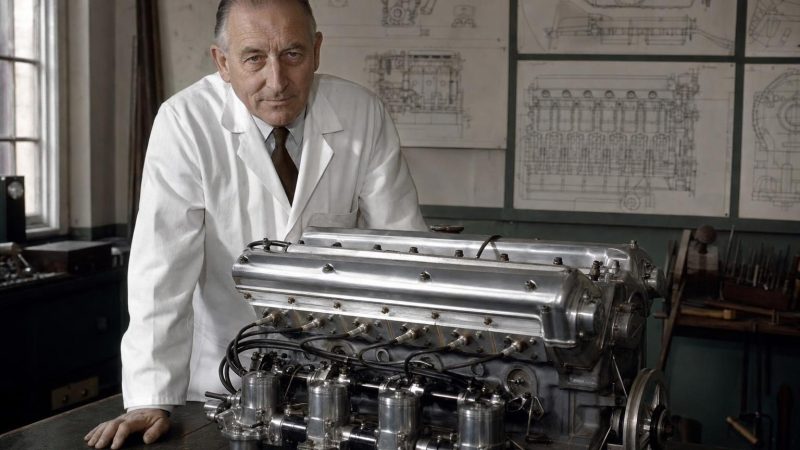
Aston Martin Newport Pagnell, the artisanal heart of the brand: from the DB4 to the Continuations, history, Touring know-how and the current role of Aston Martin Works.
Aston Martin Newport Pagnell is not just a dot on the map: it is where the DB4 ushered in, from 1958, a new era for the marque, and where artisanal know-how continues to thrive. In this portrait of a place, we retrace the move to Buckinghamshire, the decisive role of Touring in Milan, the long production run through to the Vanquish Mk1, then the activity of Aston Martin Works between restoration and Continuation, before concluding with the handover to Gaydon. The idea is not to mythologise: simply to observe, chronologically, how Aston Martin Newport Pagnell shaped the identity of a very British sports car house.
1958: why Aston Martin left Feltham for Newport Pagnell
The established fact, first: the DB4 is the first Aston Martin assembled at Newport Pagnell, from 1958, in Buckinghamshire. This is the tipping point, documented by Wikipedia dedicated to the DB4. From then on, the village became synonymous with hand-shaped bodywork and chassis tuned for both road and track.
As for the precise reasons for leaving Feltham, the sources cited here do not detail them. What can be stated, according to the available information, is that Aston Martin Newport Pagnell established itself from the DB4 onwards as the industrial and artisanal heart of the marque. The site became the address where Astons were designed, assembled and serviced with a workshop mindset rather than a factory in the strict sense.
Implicitly, this geographical shift marked a rise in ambition. The DB4, first-born of the Newport Pagnell era, inaugurated a technical and stylistic language that would infuse the following ranges. Place and car reflect each other, as often at Aston Martin: the quality of the artisanal gesture here found a lasting home.
Hand-built bodywork: superleggera, beaten aluminium and the role of Touring Milan
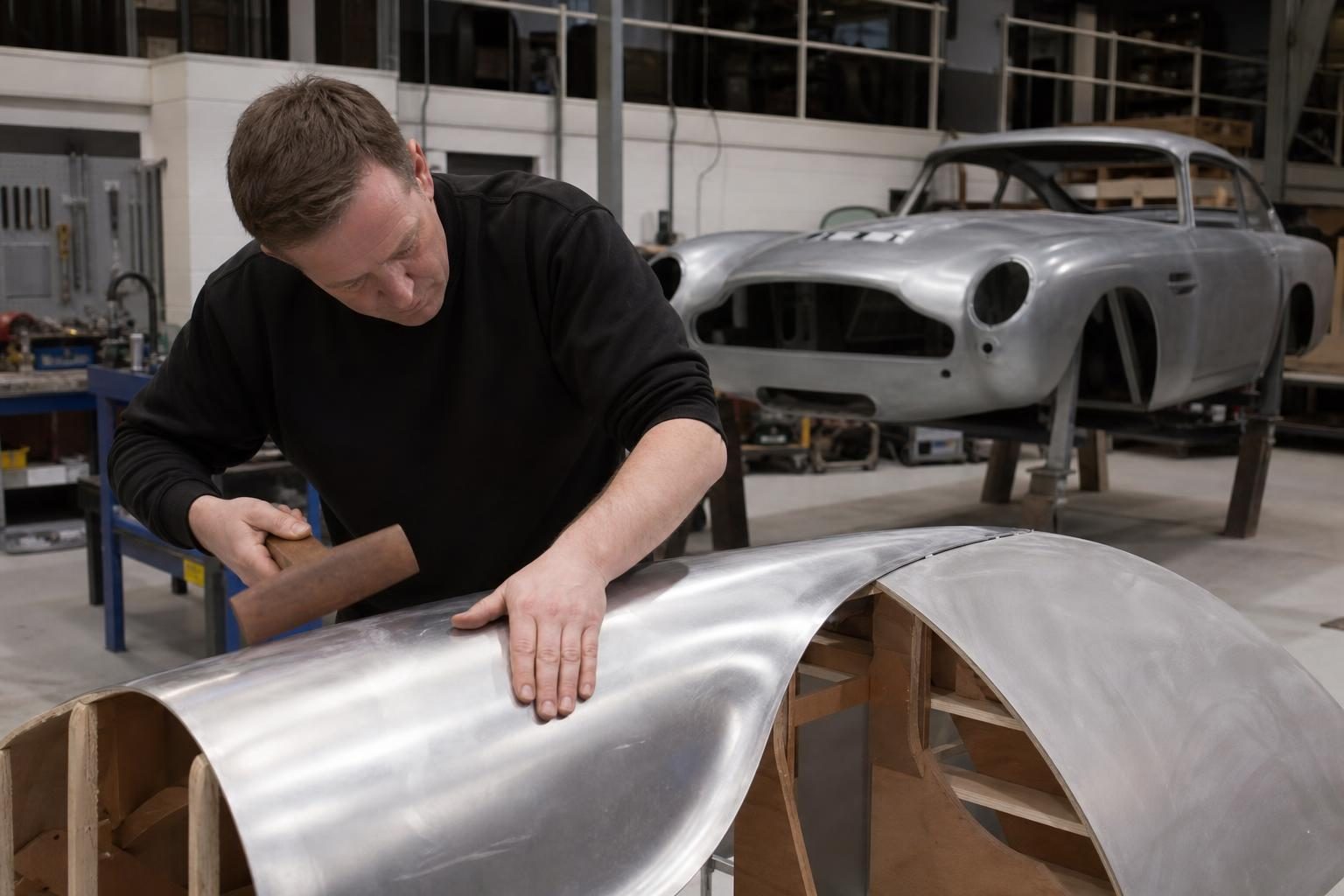
From the DB4 onwards, the superleggera technique signed by Carrozzeria Touring (Milan) set the tone. According to the DB4’s Wikipedia page, this architecture relies on a light tubular frame onto which manually crafted body panels are fixed. The approach targets rigidity and lightness, in the service of performance and steering precision.
This scheme, initiated with Touring, strongly contributed to the visual and technical DNA of the British coupé. In Newport Pagnell, people speak of gestures more than processes: shaping components, fitting to gauges, meticulous alignments. In other words, a car conceived as an assembly of parts adjusted to perfection, with patience and method.
This “superleggera” signature is not just a badge. It anchors Aston Martin Newport Pagnell in a European coachbuilding tradition, blending Italian exacting standards of line with British rigour in assembly. The result: proportioned, taut bodies that age well because they were born of a clear design and careful hand execution.
From DB4 to Vanquish Mk1: over forty years of production on the same site
The continuum between the DB4 and the Vanquish Mk1 tells the story of production rooted on the same site. The former inaugurated Newport Pagnell in 1958; the last examples of the Vanquish Mk1 would still leave these workshops, a chapter already covered in our feature on end-of-line anecdotes, to which we refer for model-specific details.
For those wishing to go back to the origins of the lineage, our page dedicated to the DB4 and its pivotal role offers useful perspective. It sheds light on the driving forces of the period: style, engineering and a controlled ramp-up within Aston Martin Newport Pagnell. In parallel, for the earlier historical bedrock, the article on the DB2, foundational on the technical front, completes the picture.
What stands out, beyond the model years, is the constancy of the craft. The same address, the same workshops, a gradual evolution of methods but an unchanged course: building Astons with an unabashed artisanal density. Here, place is not decorative: it is constitutive of the perceived quality and the reputation for longevity of the bodywork and fit.
Aston Martin Works: restoration, Continuation and today’s Zagato projects
Based in Newport Pagnell, Aston Martin Works is described by the marque as “the largest and best equipped Aston Martin restoration centre in the world”. This position, recalled in the context of the DBZ Centenary Collection (2018) on media.astonmartin.com, speaks to the breadth of expertise on site: evaluation, faithful reconstruction, and turnkey delivery of historic examples.
The site has also distinguished itself with its Continuation cars. In 2017, 25 examples of the DB4 GT Continuation were allocated to collectors, according to the official communication repeated by media.astonmartin.com. Then, in 2019, the DB4 GT Zagato Continuation required around 4,500 hours of work per car at Aston Martin Newport Pagnell, again per the same source.
This programme, led by Works, embraces a dual objective: preserving original correctness and ensuring roadgoing ability to current standards of reliability. For readers wishing to dive into the DB4 GT Zagato odyssey, our feature on the iconic collaboration is available here: history and examples of the DB4 GT Zagato.
To grasp the entity’s offer and philosophy, the official Aston Martin Works page provides a clear overview: restoration, service, parts, and limited production of Continuations. A seamless link between history and the present, materialised by the very address of Aston Martin Newport Pagnell.
The move to Gaydon and what Newport Pagnell still retains
The company’s centre of gravity shifted to Gaydon, opened as the new global headquarters after Newport Pagnell, according to Aston Martin’s corporate information. The Gaydon site today concentrates the executive management and main R&D, while Newport Pagnell remains the home of heritage and service activities.
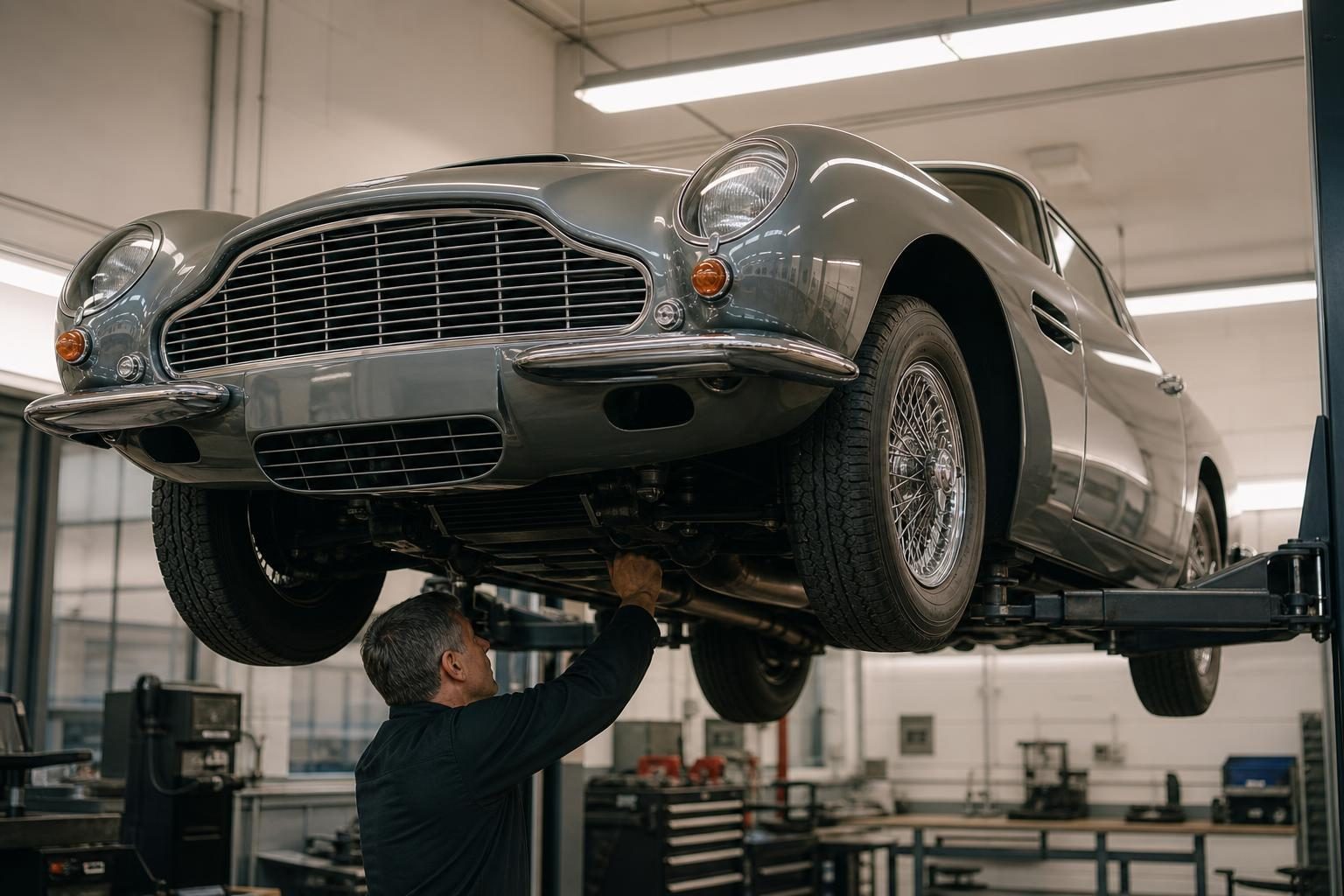
What remains in Newport Pagnell is, first and foremost, Aston Martin Works and its mission: restore, maintain and, occasionally, recreate. In other words, extend the life of historic models and guarantee their correctness, with the incomparable advantage of factory expertise. A speciality that confirms the unique place of Aston Martin Newport Pagnell within the marque’s ecosystem.
This division of roles has a virtue: the historic address can focus on the cultural and technical value of the classics, while Gaydon steers contemporary projects. To grasp the overall architecture, the corporate Aston Martin site presents the company strategy and site organisation.
Result: heritage is not frozen in a museum; it lives in the workshops, in the measured body tolerances, in engines tuned methodically. And the name Aston Martin Newport Pagnell continues to be associated, in modern releases, with exceptional cars delivered to highly knowledgeable clients.
Conclusion — Aston Martin Newport Pagnell, an address that made history
At the scale of a marque, few places sign the identity as strongly as Aston Martin Newport Pagnell. The facts are stubborn: the DB4 was born there in 1958, under the technical aegis of Touring and its superleggera; the site supported decades of production before handing the industrial torch to Gaydon; today, via Aston Martin Works, it concentrates restoration, service and Continuations as rigorous as they are spectacular in execution.
Put another way, Aston Martin Newport Pagnell is less a factory than a living heritage. A place where one verifies that precision has lost nothing in being passed down from one generation to the next, and where one understands why a well-born British coupé remains desirable sixty years later. That’s the whole idea: let the place speak, and observe that, decidedly, it has a great deal to say.