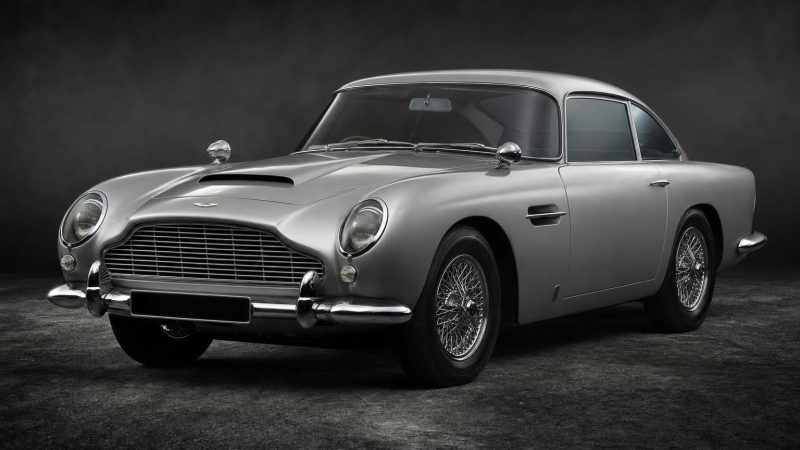
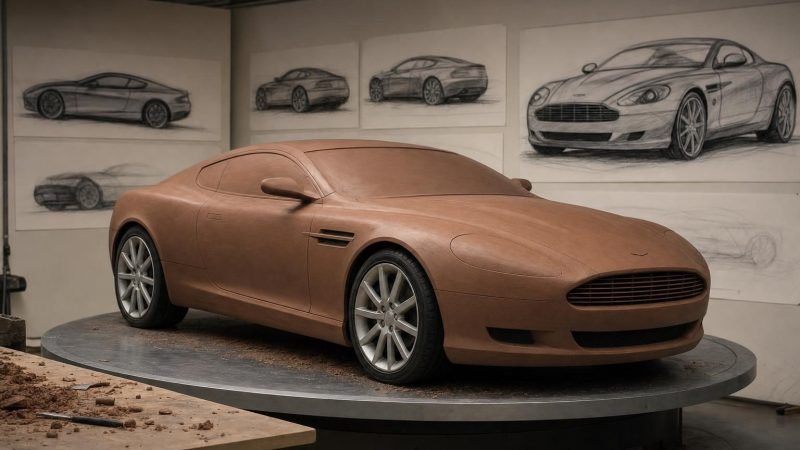
William Towns at Aston Martin, from the DBS to the Lagonda and the Bulldog: three case studies to understand the self‑taught designer who shook Newport Pagnell.
William Towns is not a name that springs to mind immediately when one mentions Aston Martin, and that is precisely what makes him fascinating. In three pivotal projects — DBS 1967, Lagonda 1976, Bulldog 1980 — William Towns established, without school or dogma, a way of drawing against the tide. Here is how this self‑taught designer brought the Newport Pagnell marque into the modern era, refusing to imitate the DB tradition.
This portrait is not hagiography. It sets three concrete cases in perspective, with their technical gambles and edges sharper than average. All placed back into the industrial choices of a time when Aston Martin was reinventing itself, often under constraint, sometimes with panache.
Self‑taught at Newport Pagnell: how William Towns got the job without academic training
With no industrial design degree, William Towns first joined Rover, then moved to Aston Martin in the late 1960s. According to Wikipedia (William Towns), he trained himself, between workshop and drawing board, far from the schools that then formed most British stylists. At Newport Pagnell, this singularity was no obstacle: it forged a freedom of outlook.
His arrival coincided with a sensitive period for the marque: constrained finances, DB heritage to preserve, a need to freshen the line. Towns was entrusted with early responsibility. His method was pragmatic: start from the mechanical brief, adopt clean volumes, then cut with a few taut lines that give the coupé instant stature.
The result did not seek easy quotation. On the contrary, William Towns embraced a more geometric vocabulary. This approach, sometimes judged dry, nevertheless anticipated the 1970s and their edges, without denying Aston Martin’s presence.
The 1967 DBS: a body designed to house a V8 that did not yet exist
Launched in 1967 with the DB6 straight‑six, the DBS was conceived from the outset for an engine that was not ready. The chassis and bodywork had been sized for Tadek Marek’s future V8, which arrived only in 1969. As Wikipedia (Aston Martin) notes, this technical lag dictated stylistic choices unusual for Aston Martin at that date.
Indeed, the broad silhouette, the flatter nose and the visually stretched wheelbase answered this mechanical anticipation. And there is the now‑famous admission: according to Wikipedia (Lagonda 1976) and the page devoted to the Aston Martin V8, William Towns acknowledged that the rear quarters of the DBS/V8 borrowed from the early Ford Mustang. The discreet American nod did nothing to diminish the ensemble’s very British presence.
With the DBS, Towns set a stance: elegance, yes, but structured, almost architectural. In this, the car draws a red thread between the David Brown heritage and the modernity of the V8, even if the latter would only reach the engine bay after two years.
The 1976 Lagonda: right angles in the land of curves and the early onboard computer
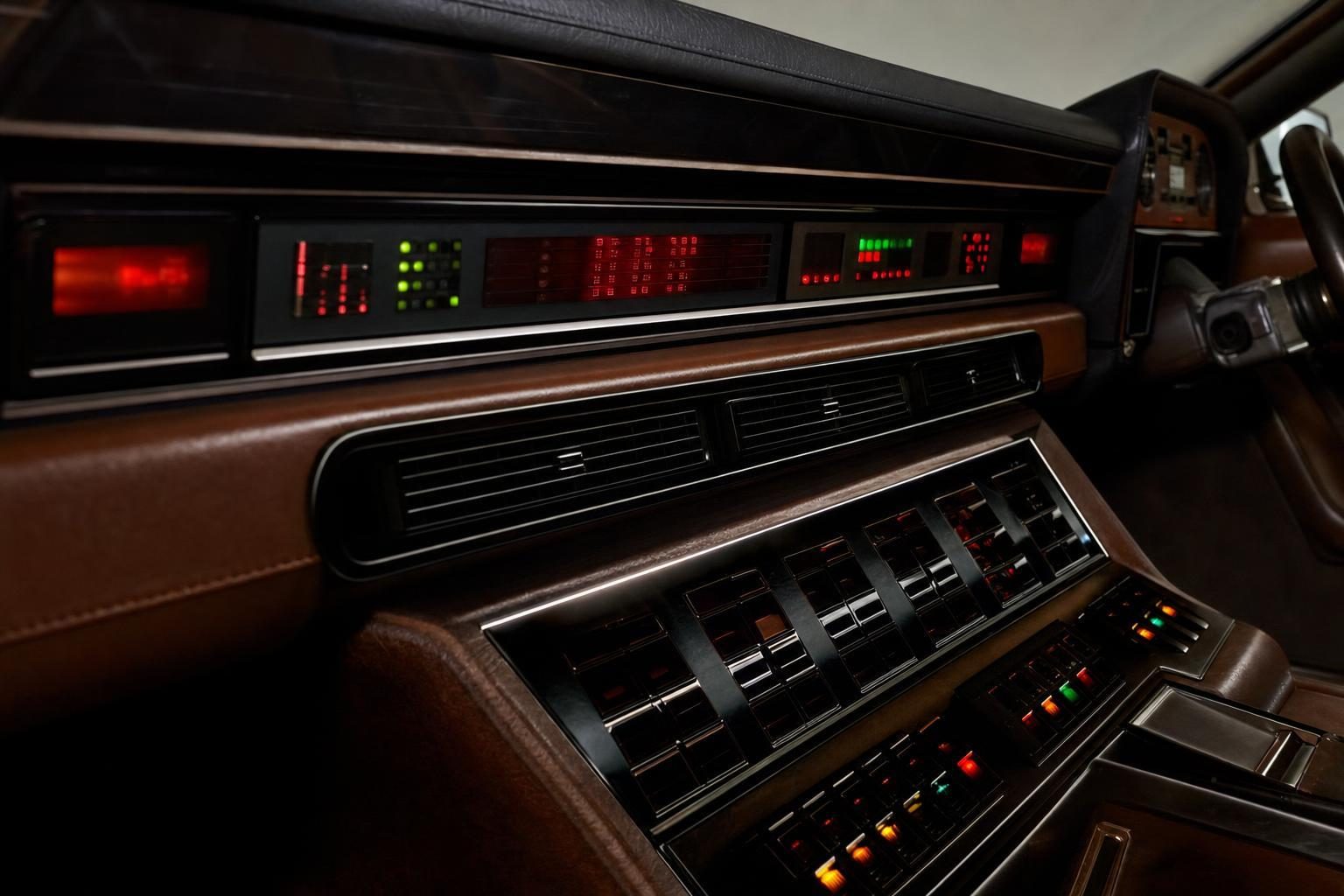
In 1976, the Lagonda Series 2 felt like a landing from the future. Bodywork with right angles, an endless bonnet, the proportions of a very low saloon: here Towns pushed his geometric language to the extreme. According to Wikipedia (Lagonda Series 2), the dashboard introduced LED digital displays on a production car — a first at the time, as much conceptual as ergonomic.
This technological choice, ambitious and capricious, would become his hallmark, as famous as it was controversial. The car embodies William Towns’s fixed idea: to make an architecture of clean volumes converse with a breakaway instrumentation. Beneath the classicism of the V8, the Lagonda tells of a fascination with nascent computing.
The saloon, radical in the land of curves, proves that a 4‑door Aston can exist without aping the GT. One can see it as a useful counterpoint to the DB story: same crest, different spelling. And a friendly warning to today’s Gaydon contemporaries about the power of simple lines when carried through to the end.
The 1980 Bulldog: a 700 PS concept that never found its way to series production
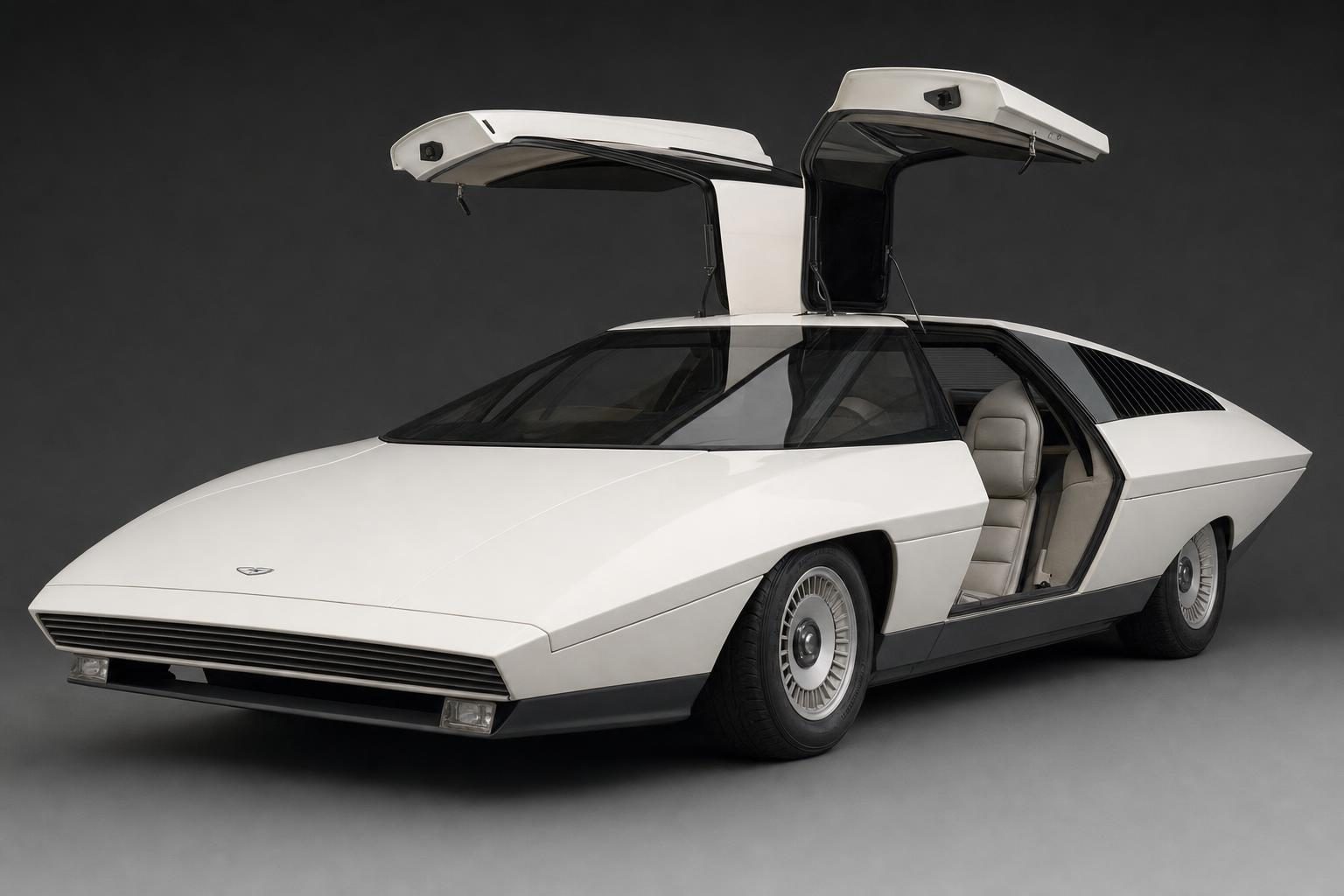
Climax — and cul‑de‑sac — of this trajectory, the 1980 Bulldog. An extreme prototype, gullwing doors, ultra‑low architecture, it received a twin‑turbo V8 quoted at around 700 PS. According to Wikipedia (Aston Martin Bulldog), the targeted top speed was 320 km/h, and only a single example was built.
The message, more than the spec sheet, matters here. The Bulldog serves as both aerodynamic and symbolic demonstrator: if the company so decides, it can measure itself against the era’s wildest. Goodwood also recalls the iconoclastic status of this British “hero” of car design, able to dare without any guarantee of industrial follow‑through.
- Engine : twin‑turbo V8 (concept)
- Target : 320 km/h top speed
- Production : 1 example
Even if production did not follow, the core idea remains: push geometry to its paroxysm, in the service of theoretical speed. One more demonstration of William Towns’s consistency in his formal vocabulary.
The Towns legacy: what Gaydon’s designers take from his breaks with tradition
What remains of William Towns in the Gaydon era? A method rather than a style. First, start from mechanical and industrial constraints to sculpt forthright volumes. Then, accept dissonance in a house of tradition, provided the execution is rigorous. Finally, consider the interface — instruments, graphics — as a field of expression as strategic as the metal.
This grammar can be read in filigree in several recent Astons: a crispness of line, a refusal of gratuitous ornament, and a cockpit conceived as a system. On this point, the Lagonda precedent is useful, including as a counter‑example when the technology is not mature. The autodidact reminds us that innovation is worth what it solves, not merely its effect.
One should also retain a human thread. Towns, who passed away in 1993 (source: Wikipedia, William Towns), upheld the idea that an Aston can be very Aston without looking like a DB. A freedom that opened the way to other readings of the marque, from GTs to singular saloons.
Conclusion: what William Towns changed, in three clean‑cut chapters
The best portrait of William Towns fits into three lines of force: a DBS conceived for a V8 ahead of its time, a Lagonda that computerises luxury with bold angles, a manifesto Bulldog. Together, they tell how a self‑taught designer gave Newport Pagnell a plausible future, sometimes rugged, never lukewarm.
When writing the history of Aston Martin design, William Towns deserves his place: not as a stylist breaking rules for the sake of it, but as a practitioner of structured elegance. Suffice it to say, we owe him some of the marque’s most formative audacities.
To explore on AstonLegacy.fr: