ultimate british supercar, performance, real power, X-Pack and Volante evolutions, cross-referenced figures and sources to understand the 1977 V8 Vantage
Upon its launch in 1977, the V8 Vantage was hailed as the ultimate British supercar, and it is this claim that we examine in detail, supported by figures and sources. We clarify the performance data, explain the discrepancies in reported power, trace the evolution to the X-Pack, and revisit the very rare Vantage Volante, including the Sovereign of Wales specification. The aim is to convey why this pivotal model remains too often underestimated.
Why is the V8 Vantage called the ultimate British supercar?
At its launch, the V8 Vantage boasted a top speed of 170 mph, a milestone proudly highlighted by Autopolis and HotCars. At this level of stratospheric performance in the late 1970s, Aston Martin’s coupe ranked among the fastest road cars of the time — a status that justifies the label of ultimate British supercar in both contemporary press and current retrospectives.
In terms of the 0-60 mph sprint, sources Model-Universe and HotCars report a time of around 5.3 seconds, which is one-tenth quicker than the Ferrari Daytona. In the minds of enthusiasts, surpassing the Maranello benchmark on this sprint was an immediate endorsement. This context sheds light on why the V8 Vantage was perceived as a national pioneer in the very exclusive club of supercars.
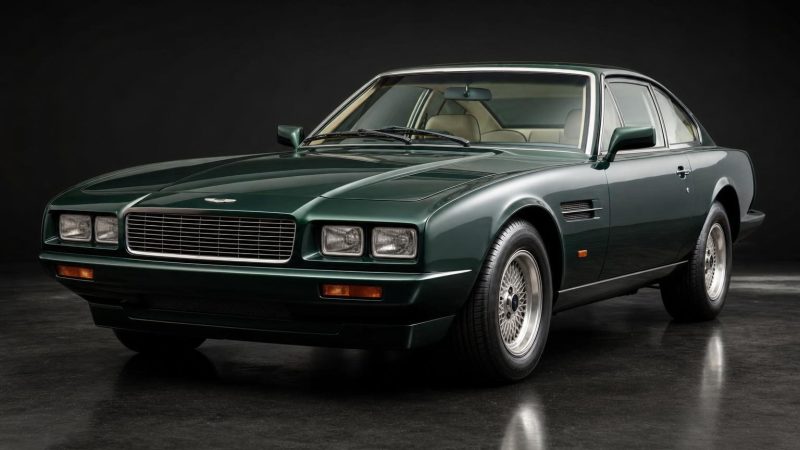
Beyond the numbers, the symbolic importance lies in its entirely British positioning: an in-house designed engine, styling by William Towns, and limited yet ambitious production. This synthesis of engineering and aesthetics has shaped the model’s aura and reinforced its unofficial title.
What engine and real power lie beneath the bonnet?
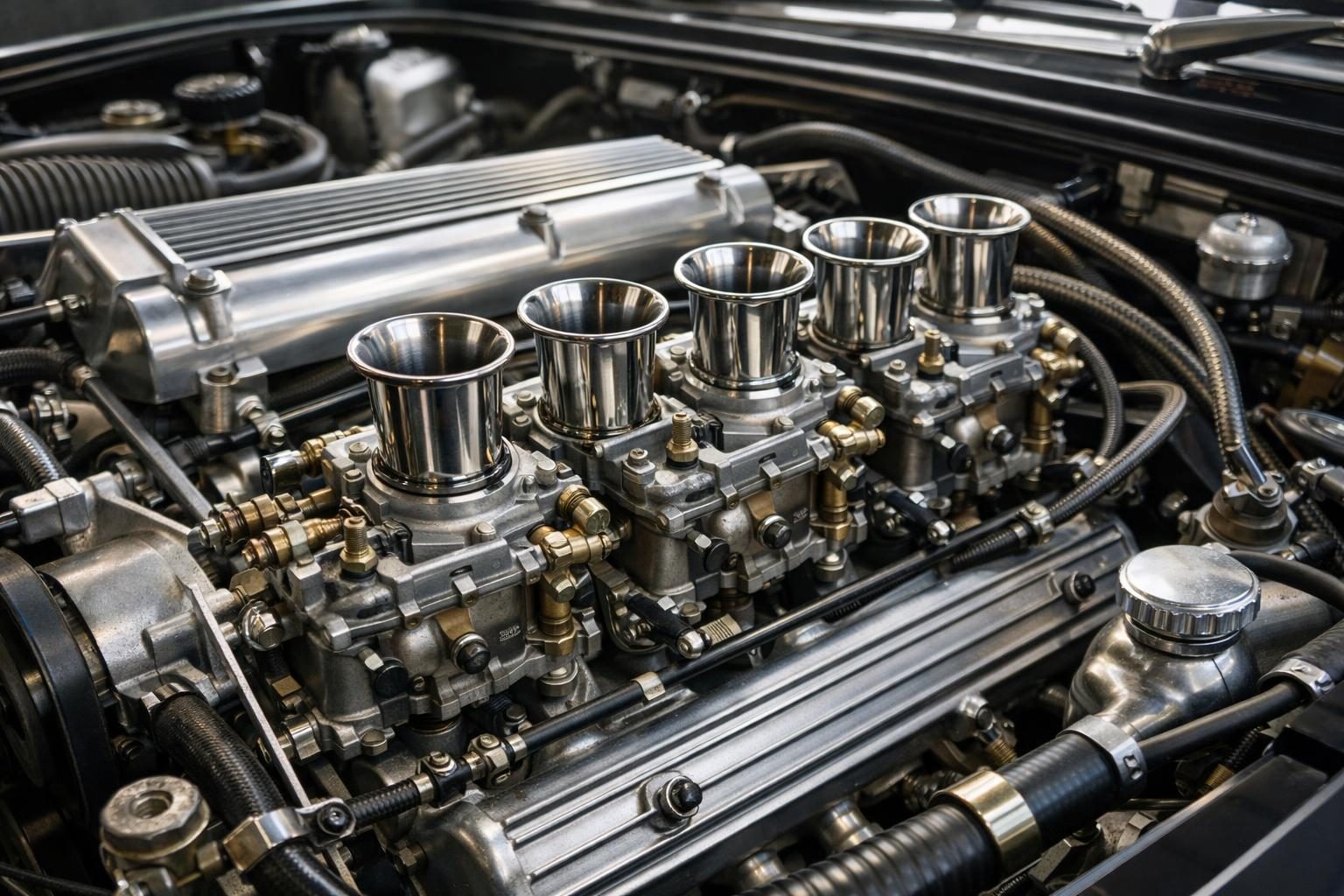
The technical specifications feature the 5.3-litre quad-cam V8 developed in-house in the 1960s, a block shared with the Lagonda according to HotCars. This mechanical community expressed Aston Martin’s philosophy: a high-performing, adaptable, in-house heart. In terms of style, William Towns’ signature combined taut lines with an athletic presence, creating an iconic design.
Power figures vary according to sources, and it is important to cite them accurately. Autopolis states 375 bhp for the initial V8 Vantage. Model-Universe and HotCars indicate 390 bhp at 5,800 rpm. This range likely reflects specification differences, measurement protocols, or model years. However, all agree on an X-Pack variant rated at 403 bhp (Model-Universe; HotCars), the pinnacle of the lineage.
Interpreting these discrepancies means recognising that Aston Martin refined its V8 over the years and across markets. The values reported by contemporary media, sometimes conservative or, conversely, optimistic, explain reasonable variances. What does not vary is the performance/use alignment: a top speed of 170 mph and a 0-60 mph time of 5.3 seconds place the V8 Vantage at the summit of its segment by the late 1970s.
From Bolt-on to X-Pack: the evolution over thirteen years
The career spans over a decade, with significant technical milestones. The initial “bolt-on” evolutions aimed to optimise airflow and fuel delivery while refining aerodynamics and chassis, in line with user feedback and regulatory requirements. The goal was to maintain the balance between grand touring and supercar performance.
The technical peak occurs in 1986 with the X-Pack, confirmed at 403 bhp by Model-Universe and HotCars. This version adopts Cosworth pistons and Nimrod-type cylinder heads, according to these same sources, embodying race expertise applied to the road. These choices enhance throttle response and extend the usable range of the V8, without betraying the coupe’s road-going vocation.
Throughout the period, the spirit remains constant: to make the V8 Vantage an ultra-high-performance GT that can be compared with the best Italian cars of its time, without sacrificing comfort and mechanical longevity. This consistency explains why the Vantage name remains a performance label at Aston.
Vantage Volante and Sovereign of Wales version: the rare ones
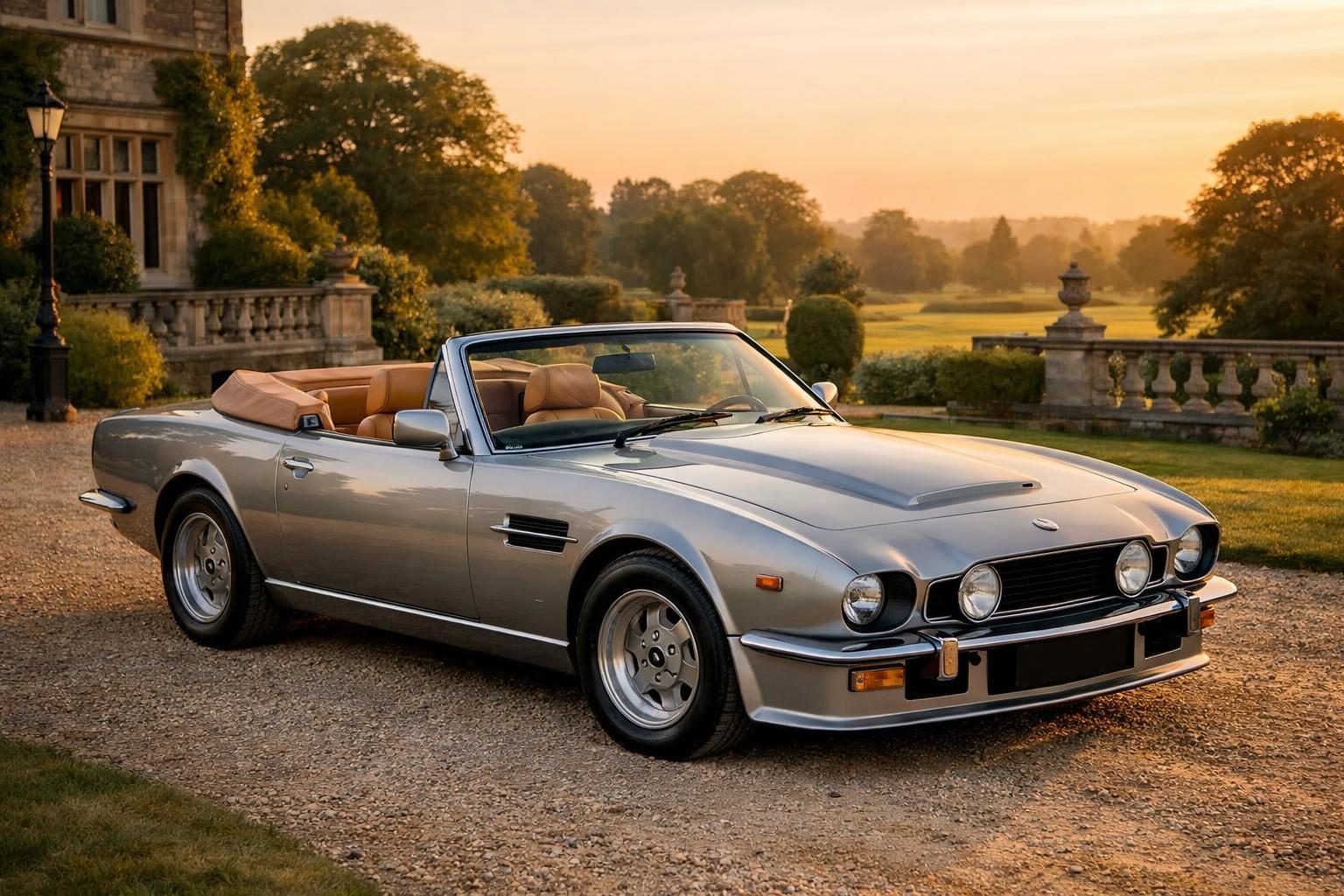
The Vantage Volante adds to the myth the dimension of open-top driving. According to Model-Universe, 192 units of this variant were produced, with the last leaving the factory in December 1989. This limited volume is enough to establish its rarity, further enhanced by a few very specific configurations.
The most famous remains the so-called Sovereign of Wales specification. In 1987, the Prince of Wales received a Vantage Volante without flared arches, a more discreet configuration produced 26 times (source: Model-Universe). This variant, with its refined aesthetics and royal patronage, draws the attention of collectors.
These series demonstrate the platform’s ability to embody multiple characters: the power and allure of a supercar, the elegance of a high-end convertible, and sometimes an assumed visual sobriety. The documented rarity — 192 Volante, 26 Sovereign of Wales — today fuels desirability and heritage value.
What is a V8 Vantage worth today and why it was long undervalued
For a long time, the V8 Vantage suffered from a perception bias. The media omnipresence of Italian supercars may have relegated this Aston to the status of a muscular GT, while its performance data, placed in context, validate its supercar status. The discrepancies in power (375 bhp according to Autopolis, 390 bhp at 5,800 rpm according to Model-Universe and HotCars) have also perpetuated a form of ambiguity, sometimes misinterpreted as a weakness.
Perceptions evolve as documentation improves and collectors value the overall coherence: 5.3 L quad-cam V8 engine designed in-house, William Towns styling, claimed 170 mph and a 0-60 mph time of 5.3 seconds, without sacrificing comfort. Added to this are the appeal of the X-Pack series (403 bhp according to Model-Universe and HotCars) and the rarity of the Volante, including the Sovereign of Wales produced 26 times (Model-Universe).
Within the Aston Martin ecosystem, the 1977 V8 Vantage bridges the tradition of grand touring and very high-level performance. To measure its legacy, one can contextualise its V8 shared with the Lagonda — see our overview on the 1976 Lagonda and its technical audacity — and the stylistic and mechanical evolution towards subsequent generations, notably the Virage and its transition of the 1990s, and then the contemporary Vantage reinterpretations, up to the V12 Vantage and their atmospheric peak.
To place the V8 Vantage in the official history, one can usefully consult the dedicated summary of the Aston Martin V8 on Wikipedia (en) and the Aston Martin Heritage page, valuable for cross-referencing years, variants, and context. Enthusiasts will find complementary milestones to the sources Autopolis, Model-Universe, and HotCars cited in this article.
Conclusion — the V8 Vantage, a milestone of the ultimate British supercar
At the end of this examination, the label of ultimate British supercar is supported by converging facts: 170 mph top speed (Autopolis; HotCars), 0-60 mph in 5.3 seconds (Model-Universe; HotCars), a 5.3 L quad-cam V8 designed in-house, and a design by William Towns. The reported power discrepancies — 375 bhp for Autopolis, 390 bhp at 5,800 rpm for Model-Universe and HotCars, 403 bhp for the X-Pack — reflect distinct specifications and measurements, without undermining the essential: the 1977 V8 Vantage laid the groundwork for Aston Martin for a GT with supercar DNA, rare, demanding, and now fully recognised by history.