DB4 GT racing 1959–1963: 75 built, a proposal by Marcel Blondeau and 4 decisions that convinced David Brown to launch the production competition version.
DB4 GT racing: behind the icon lies a story of influence in which a Paris dealer shakes up the Newport Pagnell establishment. Here is how network pressure, channelled by Marcel Blondeau, won over John Wyer and then David Brown, and how this context dictated the architecture, the mechanical compromises and the on-track trajectory from 1959 to 1963.
Marcel Blondeau and John Wyer: how a French dealer convinced David Brown to produce a GT
The genesis of the DB4 GT did not begin at a design office, but in a showroom. According to Aston Martin’s heritage magazine, Marcel Blondeau, a French dealer, first convinced John Wyer, then David Brown, that a GT version of the standard DB4 was not only viable, but desirable. His key argument was simple and political: this project would not tap the resources allocated to the Formula 1 programmes and to Lagonda. A promise crafted to reassure an industrialist already heavily engaged in competition.
This pressure from the network had two immediate effects. On the one hand, it accelerated the timetable: the first presentation took place at the London Motor Show in October 1959 (Aston Martin source). On the other hand, it constrained the technical scope: to create a DB4 GT for the road and a DB4 GT racing from the existing parts bin, with targeted weight-saving, but without spinning up a heavy, dedicated works-car programme.
The result, validated by Wyer and Brown, followed this optimisation logic. The Touring silhouette was retained, the chassis and mass were trimmed, and the straight-six was strengthened for endurance and sprints. Compromise, in the British sense, became as much a construction philosophy as a commercial strategy.
The shortened chassis and 85 kg weight saving: what the standard DB4 did not have and could not have
To turn an elegant GT into a credible DB4 GT racing car, you need specific foundations. According to Aston Martin and Wikipedia, the chassis was shortened and the whole was lightened by 85 kg compared with the standard DB4. This shortening tightened the wheelbase, refined weight distribution and made the car more incisive on turn-in. Faired-in headlamps and a tighter tail signalled intent without sacrificing Touring style.
What the production DB4 could not reasonably offer was this level of structural commitment without upending its grand touring vocation. The GT embraced specialisation: less superfluous comfort, more perceived rigidity, and lightweight versions intended for racing produced in very small numbers. The initial constraint (act quickly and smartly) produced a car that prioritised mechanical responsiveness over opulent finishes.
This weight-loss regime was no engineer’s affectation: in the DB4 GT racing, every kilogram shed added to braking reserves and reduced the chronic temperature of components. And if the network carried the project, it was these lightening choices that gave the GT the verve needed to exist against Italian and British rivals.
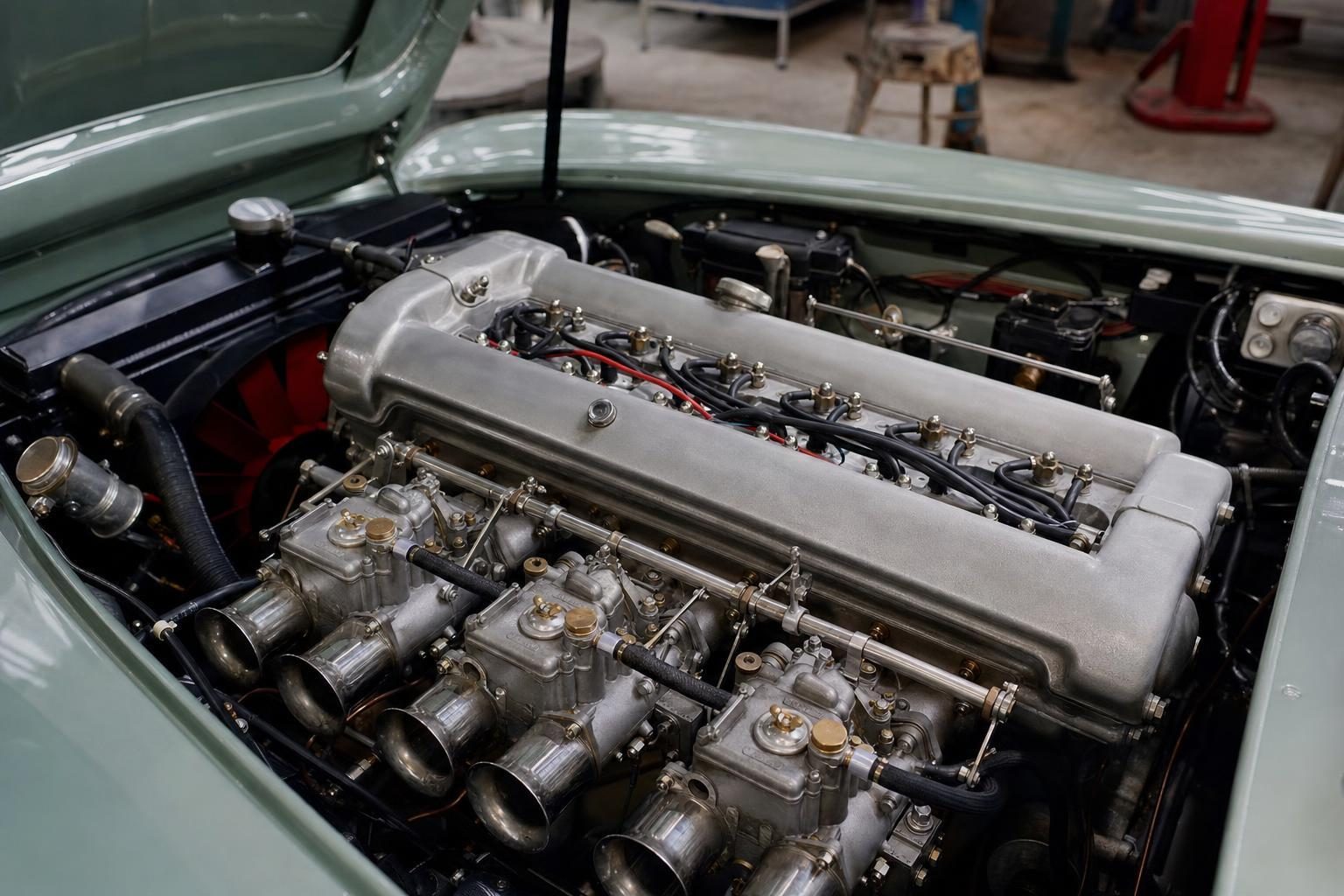
The twin-plug engine with three Weber 45 DCOE: power and its maintenance trade-offs
At the heart of the transformation, the famed inline-six received a twin-plug ignition and fuel delivery via three Weber 45 DCOE (Aston Martin and Wikipedia sources). Breathing was freed up, combustion was more homogeneous at high rpm, and throttle response gained that crisp precision so useful on corner exit. On a DB4 GT racing car, this configuration made the difference over a stint punctuated by blue flags and rising temperatures.
The flip side is familiar to every tuner: twin-plug and triple-choke means more exacting maintenance. Carburettor synchronisation, distributor adjustment, heightened sensitivity to fuel quality and ambient temperature — all tasks demanding skilled hands and workshop time. It is not a weakness; it is the very logic of a performance-oriented engine conceived for track and road.
In line with the original brief — produce quickly without siphoning F1 and Lagonda resources — this technical choice adopted proven components (the Weber 45 DCOE) and a philosophy of immediate gains rather than an entirely new block. The DB4 GT racing thereby gained a strong mechanical character, at the price of maintenance private teams had to anticipate.
Competition 1959–1963: results against Ferrari and Jaguar and the limits of a programme without a dedicated works team
Launched at the 1959 London Motor Show and campaigned until 1963, the DB4 GT racing car encountered rivals as formidable as Ferrari and Jaguar. Official sources underline its purpose and weight-saving, but implicitly recall the framework: no full works programme, a car derived from the series, and lightweight versions prepared for the track in limited quantities (Aston Martin).
Against often more radical Italians and British cars focused on endurance, the GT leaned on its shortened chassis, braking eased by the 85 kg saved, and the flexibility of the twin-plug straight-six. This base delivered consistent performance and respectable reliability, provided meticulous maintenance. It also showed structural limits whenever racing demanded massive works support: development under pressure, a profusion of specific parts, and dedicated racing logistics.
In this context, the decisive contribution of the network — which had birthed the project — could not substitute for an army of race engineers. The DB4 GT racing car displayed elegant execution and very real effectiveness, but remained, by DNA, a sharpened GT rather than a pure-bred prototype. A nuance that explains its decent longevity until 1963, and also its exit when grids became ever more specialised.
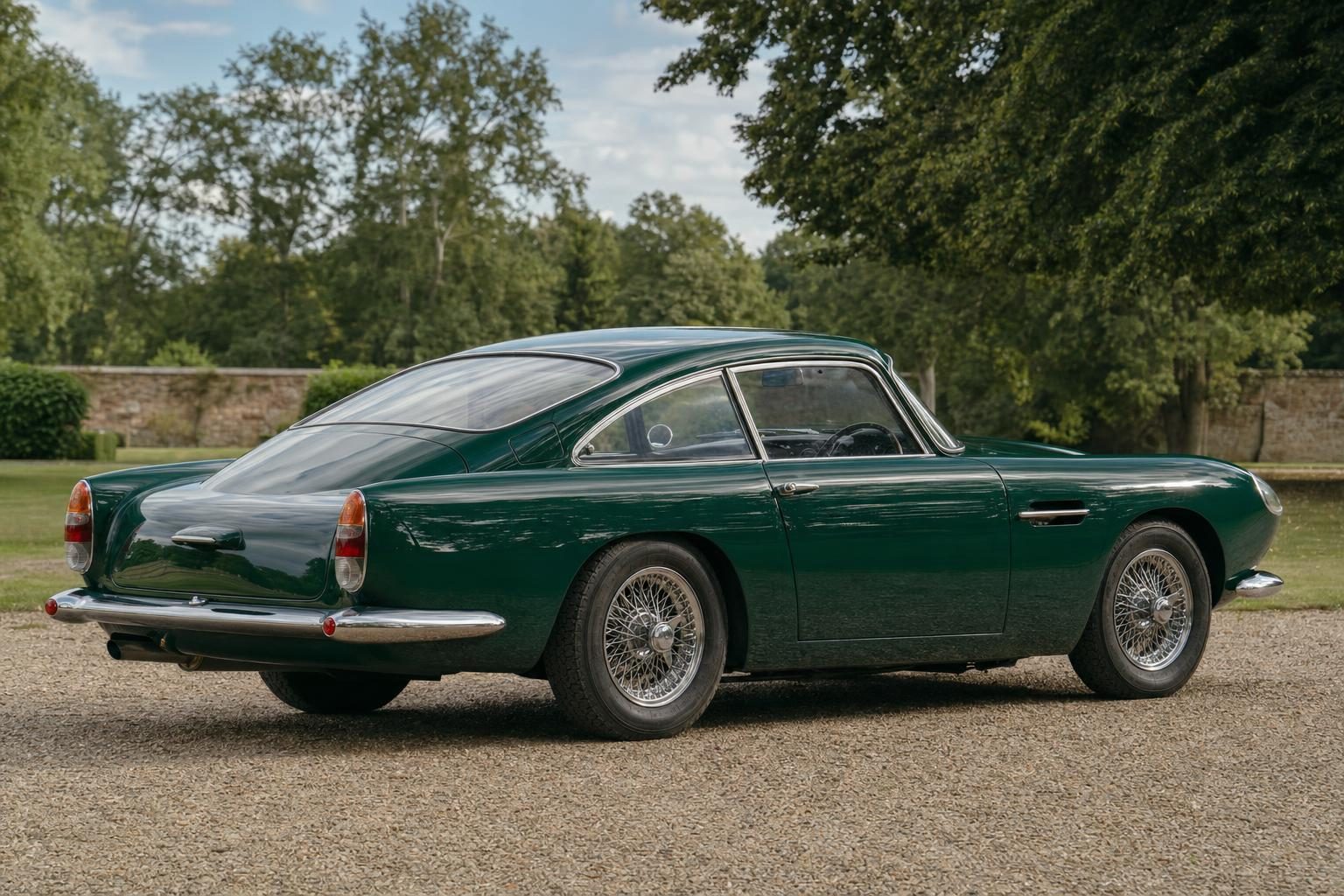
The legacy of 75 examples: the 2017 Continuation and the auction value of 41 DPX
Posterity is sometimes the best judge. 75 Touring-bodied examples were produced between 1959 and 1962 (Aston Martin), including a few lightweight versions dedicated to the track. In 2016, Aston Martin Works announced 25 Continuations based on the 1959 lightweight specification, around £1.5 million each, with deliveries at the end of 2017 (Wikipedia). The company thus methodically revived the founding idea: a road GT honed for racing, executed to period standards.
Market appetite validated the trajectory. The DB4 GT 41 DPX (chassis 0157/R, 1961), seen in the film The Wrong Arm of the Law with Peter Sellers, was estimated at around £3 million at a sale cited in 2018 (Aston Martin heritage magazine). Beyond notoriety, it is the combination of Touring design, shortened chassis and twin-plug ignition that drives bids higher.
This historical and financial value illuminates Marcel Blondeau’s intuition. By catalysing a DB4 GT racing car born of the network, he set the template for an Aston that is both usable and high-performing, exclusive enough to captivate collectors yet technical enough to satisfy privateers. An equation the Continuations reprise as a knowing wink.
Conclusion — DB4 GT racing: when the network writes the spec sheet
From the idea championed by Marcel Blondeau to the validation by John Wyer and David Brown, the DB4 GT racing car is a rare example of an Aston shaped by demand from the field. A shortened chassis and 85 kg saved, twin-plug ignition and three Weber 45 DCOE: choices dictated by the controlled urgency of a project that did not encroach on F1 or Lagonda. Between 1959 and 1963, the GT faced Ferrari and Jaguar with clear-eyed effectiveness, limited by the absence of a full works programme but buoyed by intelligent design. The 75 examples, the 2017 Continuation and the trajectory of 41 DPX confirm the essence: when the network knows what it wants, history often proves it right.
- For a detailed technical perspective, see the DB4 and DB4 GT history on Wikipedia’s dedicated page.
- Official specifications and heritage can be found on Aston Martin’s site dedicated to the DB4 GT and in the brand’s heritage magazine.
Explore on AstonLegacy.fr
- The aerodynamic, Latin interlude in the lineage with our DB4 GT Zagato feature.
- The backdrop to duels with Maranello in the competition history against Ferrari (1959–1963).
- Contemporary artisanal know-how with the DB4 GT Zagato Continuation and its 4,500 hours.