Continuation DB4 GT Zagato, 4 500 heures par voiture, moteur 4.7 l et DBZ Centenary Collection : histoire, fabrication et héritage en trois vagues.
Continuation, or how Aston Martin shines a light on an icon without betraying its spirit. In 2019, Aston Martin Works revived the DB4 GT Zagato as a series of 19 hand-built barchettas, a deliberate mirror of the 19 originals from 1960–1963. Our angle today: the method, the 4,500 hours per car, and the heritage context of this rebirth, with the DBZ Centenary Collection as a backdrop, sold exclusively in pairs.
Three waves in sixty years: originals, Sanction II and Sanction III
The first wave is known and documented: 19 DB4 GT Zagatos built between 1960 and 1963, out of an initial plan for 25, at a list price of £5,157 including taxes, according to Aston Martin. This generation, intended for road and track, built the myth. One example fetched £10.1 million at auction in July 2018, the brand magazine recalls. Rarity here is no artifice: it is original.
The third wave bears a very contemporary name at Aston Martin Works: DB4 GT Zagato Continuation. Launched in April 2019, it targets 19 additional chassis, assembled at Newport Pagnell by the marque’s heritage teams. The aim is not to reissue the car by the mile, but to reproduce its stance, processes and experience, in a non-road-legal framework and with deliberate mechanical choices.
Between these two extremes, later series, often grouped in collectors’ conversations under the labels Sanction II and Sanction III, extended the story. What matters here, without multiplying off-topic details, is the logic of successive “waves”: the period original, limited-number complements, then the modern Continuation overseen by Aston Martin Works. This layering explains both the valuation and the technical curiosity the model arouses.
To place this lineage in the range, see our feature on the base model, the DB4 and its technical filiation, along with our summary dedicated to the DB4 GT Zagato and our overview of the examples and associated series.
4,500 hours per car: what that means in concrete terms at Newport Pagnell
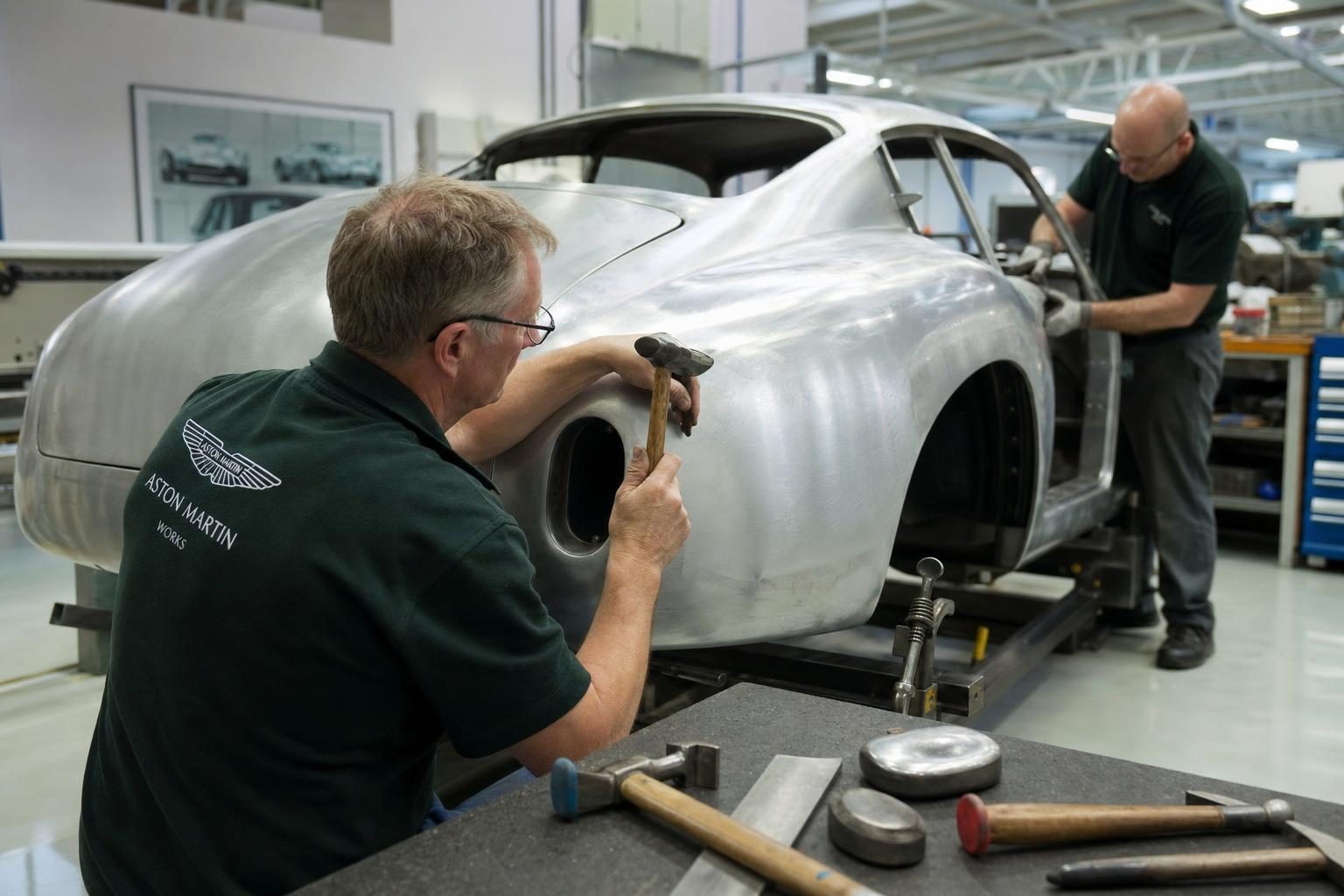
According to Aston Martin Works, each Continuation requires around 4,500 hours of artisanal work. In calendar terms, that’s the equivalent of several workshop-months for a small dedicated team, a pace far closer to an automotive haute couture studio than a line. The aluminium panels are formed by hand, the accuracy of the fits is honed over time, and the human eye remains the ultimate arbiter of surface and line.
The body, originally designed for the wind above all, here demands a sensitive reading of the volumes. The aluminium is beaten, offered up, reworked, until it regains the tension of the initial pencil stroke. The tubular chassis is adjusted to the shell’s dimensions, not the other way round. Another way of saying the geometry is sculpted, not printed.
On the mechanical assembly side, the approach follows suit: engines, running gear and auxiliaries are installed in stages, then partially removed for checks and fine-tuning. Traditional tooling coexists with modern measuring methods, but the hand takes precedence over the algorithm. This dialysis between heritage and contemporary precision is the very spirit of the programme.
To dive behind the scenes, Aston Martin details this artisanal protocol in its official communications, notably here: behind the scenes of the programme at Aston Martin Works, and on the announcement page for the Continuation on the official announcement side.
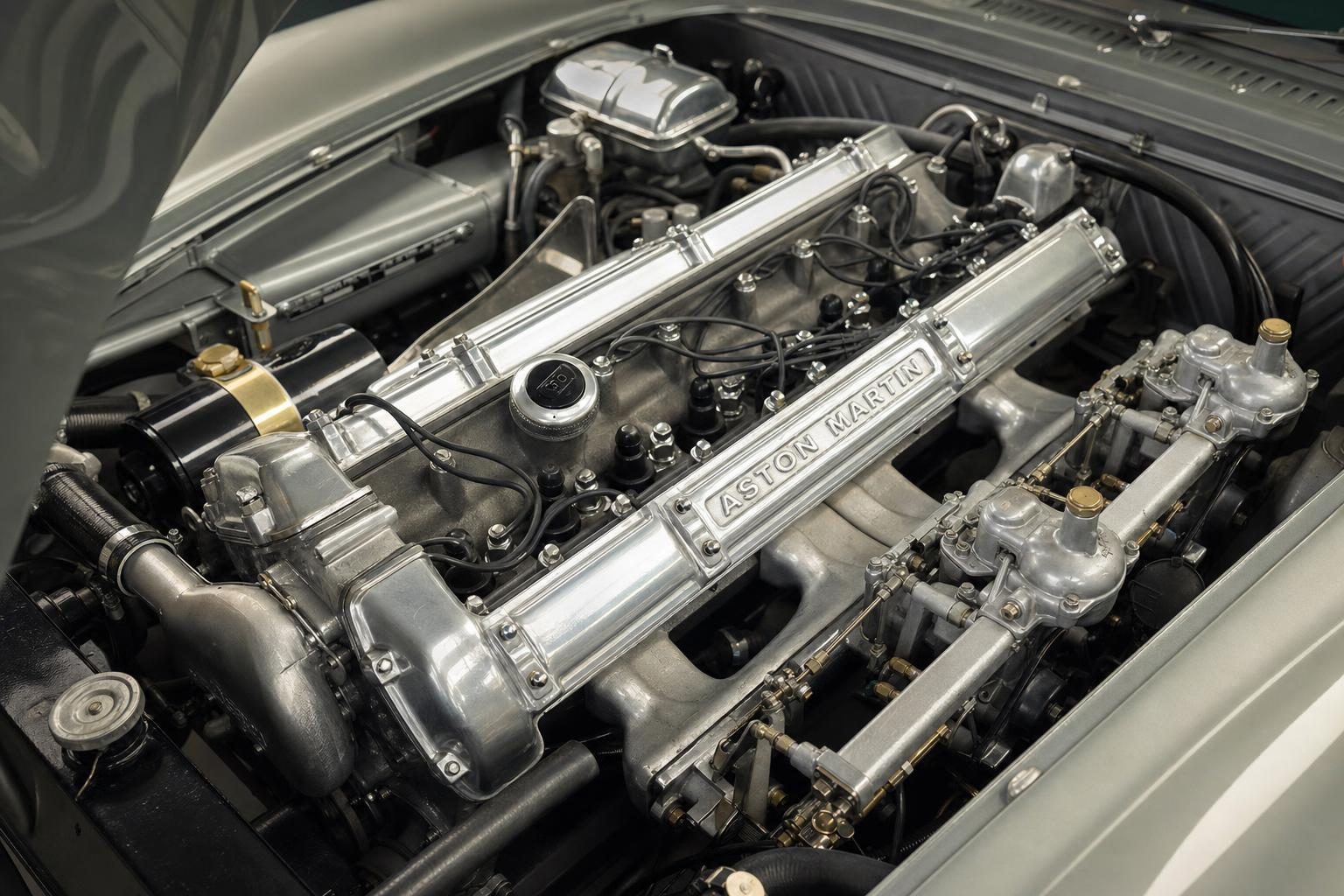
The Continuation’s 4.7-litre engine versus the original 3.7: same genes, different reality
The spec sheet poses a simple question: same lineage, same character? The Continuation receives an inline-six enlarged to 4.7 litres, for around 400 bhp according to Aston Martin. The original claimed 3.7 litres and 314 bhp. The gap reflects both a pursuit of reliable circuit performance and a different regulatory context, the modern car not being road homologated. The genes remain, the mechanical response is fuller.
In practice, the increase in displacement and power changes how the car “breathes”. Torque arrives earlier, pick-up is denser, and the useful band broadens. This is not a betrayal; it’s a period-correct set-up: recomposing the initial sporting intent with today’s means, respecting noble materials and an analogue design.
The original data and contemporary details are consistent in order of magnitude, as the page dedicated to the DB4 GT Zagato on Wikipedia in English and Aston Martin’s technical releases recall. Again, the interest of the series lies in the dialogue between authentic sensations and measured updating.
The DBZ Collection: why Aston Martin chose to sell only in pairs
The DBZ Centenary Collection paired each DB4 GT Zagato Continuation with a modern DBS GT Zagato. The announced price was £6 million before taxes for the indivisible pair. Industrially, that ensured the coordinated sell-through of a very costly artisanal programme. Symbolically, it was a deliberate bridge between 1960 and Zagato’s centenary, between original arrow and contemporary interpretation.
This choice of pairing also avoided scatter. By coupling a resurrected legend with a current GT inspired by the same formal vocabulary, Aston Martin staged the transmission. Owners weren’t just buying a car: they were entering a two-chapter narrative, linked by a name and a silhouette. It’s a collector’s logic, not a simple options basket.
The brand detailed this positioning and sales framework in its official announcements, which can be found on the page dedicated to the DBZ Centenary Collection. Market-wise, the valuation of the originals, illustrated by the £10.1 million sale in 2018, gives a measure of the appetite for coherent heritage ensembles.
Ercole Spada at 23: revisiting the man behind the original body
Ercole Spada was just 23 when he designed the DB4 GT Zagato. Arriving as an apprentice at Zagato in February 1960, he penned one of those curves that seem obvious in hindsight. The car eliminates the superfluous, reduces frontal area, erases cavities. Nothing gaudy, everything taut. Sobriety here is both an aerodynamic strategy and an aesthetic, in equal parts.
Rereading the bodywork in light of its author’s age means measuring the project’s quiet audacity. The tucked tail, the long bonnet, the ruler-straight haunches: elements that, transposed, already served performance on track. This economy of line explains how the silhouette crossed the decades without seeming dated.
The modern programme feeds on this base. The Continuation teams don’t try to add an extra layer of spirit; they focus on rediscovering it. Hence the obsession with tolerances, the light on raw aluminium, the edges that must “fall right”. Spada’s youth at the moment of design adds a note: what seems classical was in fact born of a fresh, almost irreverent eye.
Conclusion: what the Continuation reveals about Aston Martin’s heritage
In the end, the Continuation DB4 GT Zagato is no easy reissue. It’s a balancing act: 19 hand-built cars, 4,500 hours each, a 4.7-litre engine that respects the DNA of the original 3.7 while updating it, and sales in pairs within the DBZ Centenary Collection to tell the lineage. The whole sheds light on how Aston Martin treats its heritage: with method, measure and a sharp sense of storytelling.
For those who have followed the line since the DB4, this opus is another coherent, controlled milestone. It reminds us that between the originals, the later series and this Continuation, value is not decreed: it is crafted, patiently, at Newport Pagnell and beyond. And that may be the true luxury in motoring.
To delve into the genesis and specifications, Aston Martin’s official resources and the summary on Wikipedia offer a useful complement to our features. The programme’s behind-the-scenes are detailed in the Making History release, which documents the approach and methods used.