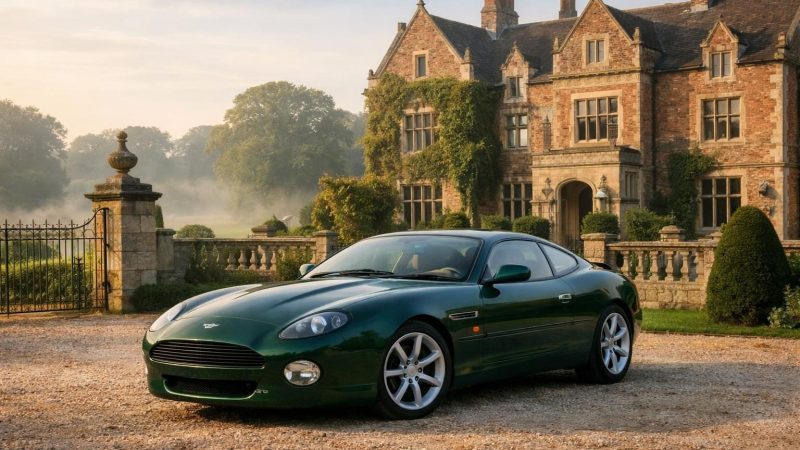
DB7 Vantage V12 1999, moteur Cosworth, endurance 800 000 km, châssis revu et record de production : quatre décisions qui ont reconfiguré Aston Martin.
The DB7 Vantage V12 is more than just another evolution: in 1999 the DB7 Vantage V12 marked a change of course, unveiled at Geneva, that reshaped Aston Martin’s future. Four structural decisions – a V12 designed ex nihilo, an endurance programme worthy of a mainstream manufacturer, a reworked structure to handle the torque, and unprecedented production volume – transformed the brand well before the Gaydon era.
The ambition was clear from its unveiling at the Geneva Motor Show in March 1999, confirmed by official and encyclopaedic sources. We revisit, sources in hand, why and how these shifts happened, and what they changed for the coupé and for Newport Pagnell.
The AML V12 project: why Ford and Cosworth designed this engine from scratch
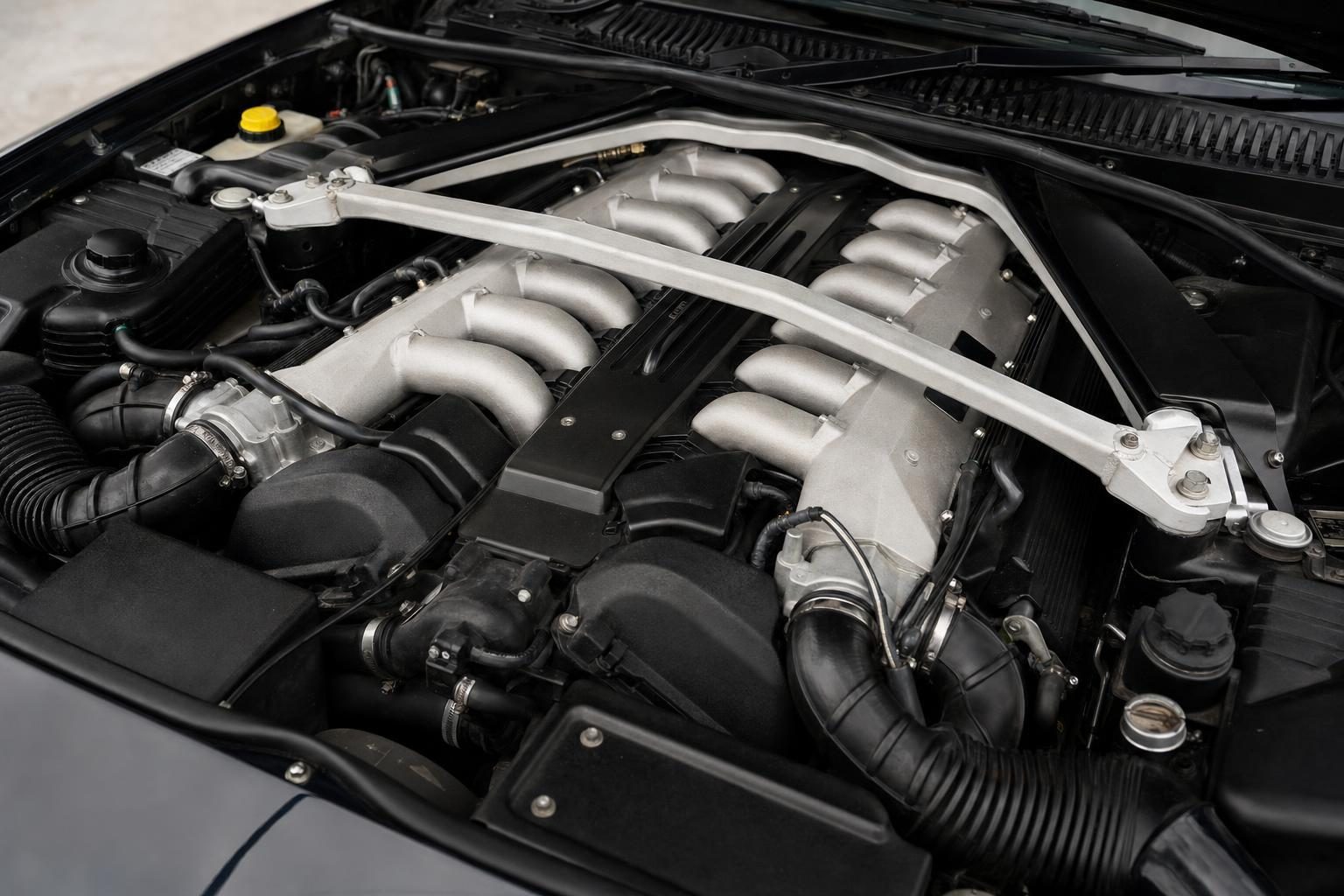
The heart of the DB7 Vantage V12 was born from a blank sheet. According to Wikipedia (Aston Martin V12 engine), the AML V12 project began in 1994 within Ford’s Advanced Powertrain, with a simple and costly idea: give Aston Martin a modern, dedicated V12 without hasty repurposing. This new unit made its production debut in the DB7 Vantage, a tipping point confirmed by the same source.
Industrial execution followed the same pragmatic logic: the DB7 Vantage V12 received an engine assembled by Cosworth in Wellingborough, as per the official press kit (technical and historical Cosworth details). The Aston Martin spec sheet cites an “all new 420bhp, 6.0 litre V12”, while Wikipedia mentions 5.9 litres, 48 valves and 426 PS. A classic divergence between imperial and metric figures: the essence lies elsewhere, in the architecture and the model’s step up in technical stature.
This decision had two consequences. First, it established the DB7 Vantage V12 as the first production Aston to adopt the AML V12 (Wikipedia). Second, it set the brand on a path of a durable mechanical platform that would underpin early-2000s models. The bet was not raw power, but the longevity of a noble component, engineered for endurance and industrialisation.
500,000 miles of testing: a homologation the straight-six never knew
The second shift was methodological. The homologation programme claimed by Aston Martin covered 500,000 miles – around 800,000 km – including 48 hours at 165 mph in Southern Europe (endurance programme and testing). The DB7 Vantage V12 was tested like a demanding high-volume model, not like a niche GT. It was a major cultural change.
The gap to the original straight-six is clear: the DB7 Vantage V12 imposed on itself a durability protocol that went beyond mere performance validation. The objective was thermal consistency, peripheral robustness and reliability under sustained use. In short, this coupé moved from a refined artisanal exercise to a GT calibrated for a broader clientele and more intensive use.
Presented at Geneva in 1999 and documented by both Aston Martin and Wikipedia, the DB7 Vantage V12 made endurance a cardinal value. This approach to homologation prepared the industrial expansion to come and lent credibility to the AML V12 architecture.
Chassis overhaul: what the extra power demanded of the Bloxham structure
The third shift concerned the vehicle’s balance. Installing a more torquey V12 in the DB7 required structural adjustments. Without delving into unpublished detail, the mechanical logic is clear: the DB7 Vantage V12 needed targeted reinforcements, adapted thermal management and corresponding chassis tuning. In other words, the Bloxham platform crossed an engineering threshold.
This ramp-up was no affectation. It dictated drivability, high-speed stability and repeatability of performance – precisely the criteria validated by the 500,000 miles of testing. The DB7 Vantage V12 thus turned a fine base into an endurance GT, able to exploit the AML V12’s resources over the long term, conceived with Ford and industrialised by Cosworth.
It is easy to see why the DB7 Vantage V12 stands as a template. This foundational work on structure and balance prepared the handling of future V12 models: the platform toughened up, methods were tooled, and the testing culture took on a systematic dimension.
2,091 coupés in four and a half years: what this figure meant for Newport Pagnell
The fourth shift was statistical – and very tangible. According to Aston Martin (news, 2020), total production of the DB7 V12 Vantage coupé reached 2,091 units in four and a half years at Bloxham. For a brand still relatively discreet at the time, this volume changed everything: planning, stabilised quality, network, visibility. And above all, industrial learning.
This threshold was no footnote. It meant that the DB7 Vantage V12 not only opened the technical path for the AML V12, it also validated a sustained production tempo. It was the essential step before the ramp-up of the next era. At Newport Pagnell as at Bloxham, this learning curve had value: it infused the way of designing, building and delivering.
The DB7 context is worth recalling. Our dedicated feature on the history of Aston Martin’s most-produced model shows how the lineage structured the brand. Within that thread, the DB7 Vantage V12 gave the programme a technical and industrial maturity that bore fruit in the early 2000s.
Mechanical legacy: how the 1999 V12 prefigured the DB9 and Vanquish engine
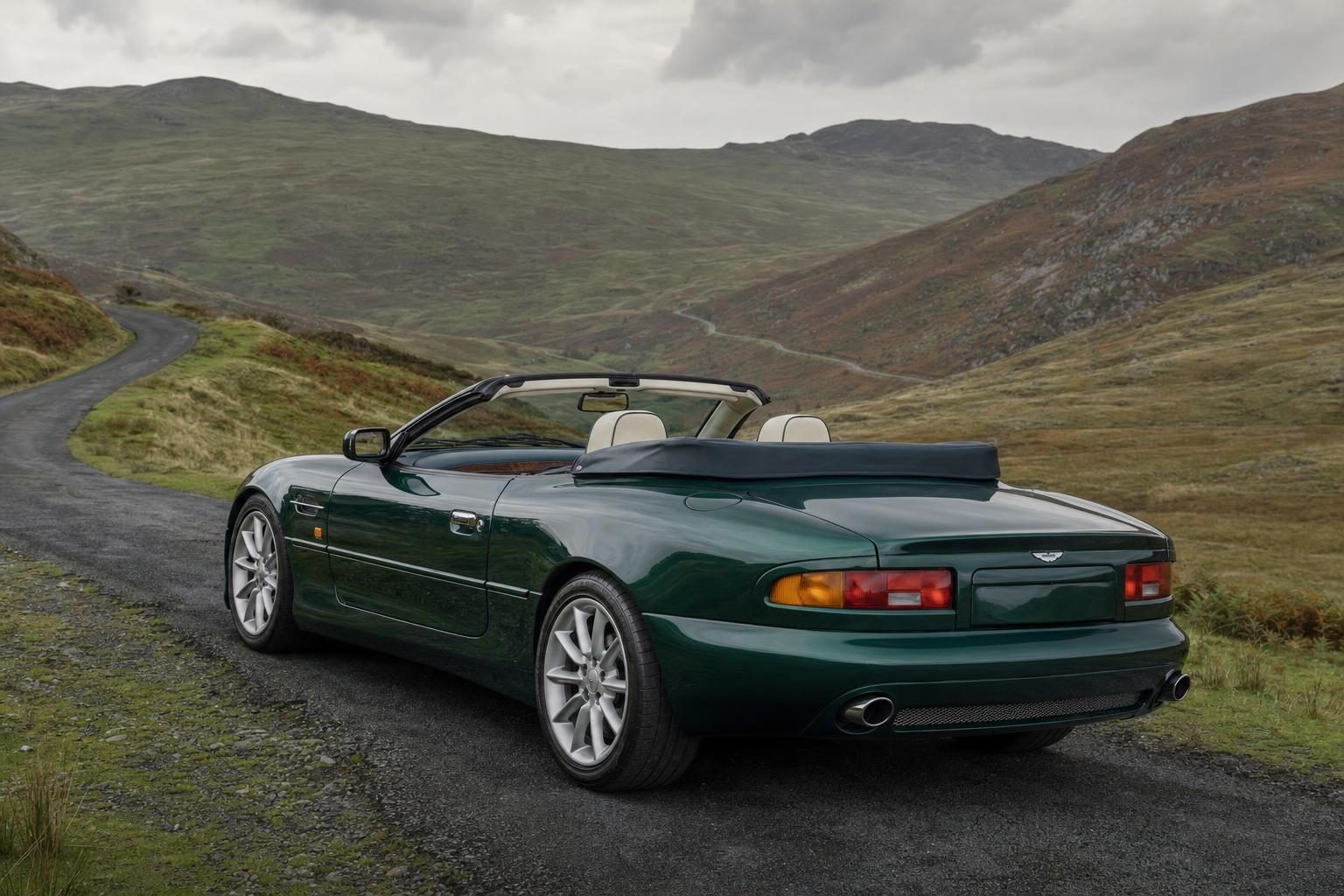
Finally, a decisive point for collectors: the DB7 Vantage V12 was the first series application of the AML V12 (Wikipedia), the future backbone of early-2000s GTs. The architecture’s layout, endurance development and assembly experience at Cosworth formed the base for subsequent developments.
Indeed, the arrival of the DB7 Vantage V12 in 1999 paved the way for later stated displacement changes, engine management evolution and chassis integration. The divergence between 5.9 litres (Wikipedia) and 6.0 litres (official site) also reflects real-world iterations and harmonisations by norms and markets. The essential point is the continuity of the AML unit and its philosophy.
For readers wanting to place the car within its family tree, our page dedicated to the DB7, all versions combined, offers design and evolution context. To gauge what this legacy brought to later models, see also our guide to the DB9 and its V12 powertrain, a direct heir, including in its grand touring positioning.
Conclusion — why the DB7 Vantage V12 remains a foundational shift
At the end of this overview, one thing is clear: the DB7 Vantage V12 changed Aston Martin’s scale and method. An AML V12 conceived from 1994 within Ford’s orbit, industrialised by Cosworth at Wellingborough, homologation endurance pushed to 500,000 miles, a structure adapted to the load, and 2,091 coupés built in four and a half years. This coherent sequence of decisions explains why the DB7 Vantage V12 was not a mere upmarket step, but a true turning point.
Unveiled at Geneva in 1999, the DB7 Vantage V12 laid the mechanical and industrial foundations of the GTs to come. For those interested in the brand’s trajectory, it remains the moment when artisanal elegance found engineering discipline. The facts speak for themselves, and the DB7 Vantage V12 rightly retains that aura of a “first time” that shaped an entire era.