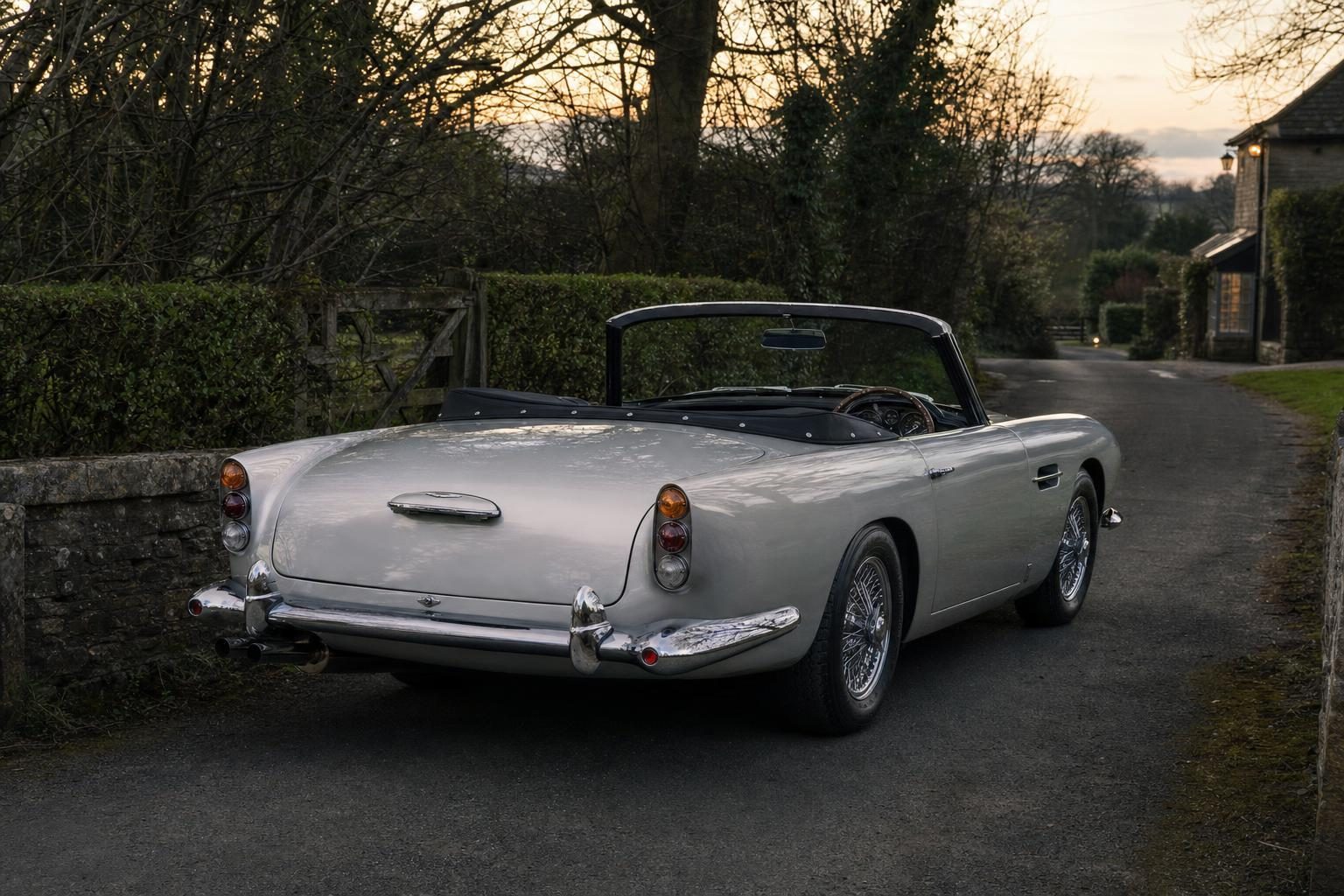
DB5 Convertible: the 1963 cabriolet, 123 examples including 12 Vantage, is worth more than a DB5 coupé. Chassis, launch, engines and bodywork.
DB5 Convertible: here is why the 1963 cabriolet, produced in just 123 examples between 1963 and 1965, forged an identity rarer and more valuable than the coupé. We examine the four defining decisions — launch timing, architecture, specific powertrains and body execution — and their impact on today’s values. Key figures come from Aston Martin’s official communications and recognised sources such as the Aston Martin Heritage Trust, Wikipedia and specialist Nicholas Mee.
Why Newport Pagnell waited six months before offering the cabriolet
Official sources confirm that the DB5 Convertible entered production in 1963 and was built until 1965, alongside the coupé. In total, Aston Martin counts 123 cabriolets over the period, compared with 887 coupés (official figure), while the Aston Martin Heritage Trust, via its registrar Tim Cottingham quoted by Nicholas Mee, mentions 899 coupés. The cabriolet therefore followed the coupé, but accessible documents do not detail a delay precisely calibrated to six months.
This initial lag, even if not quantified by the sources, reinforced the rarity of the DB5 Convertible. The Newport Pagnell factory prioritised the core offering — the coupé — before opening the way for the cabriolet. This sequence is reflected today in market perception: a model launched after the spearhead, in naturally lower volumes, concentrates collectors’ interest.
The naming context confirms the chronology. The term “Volante” appears only in 1965, whereas the DB5 cabriolet had been produced since 1963, according to Wikipedia. In other words, the DB5 Convertible lived most of its career without the label that later became iconic, which says much about its status as a distinct variant, shaped by production realities more than by marketing.
A strengthened chassis and what it cost in dynamic behaviour
Moving from a fixed roof to an open body generally implies structural adaptations. The sources listed here, however, do not detail either the nature or the extent of such reinforcements specific to the DB5 Convertible. It is therefore prudent to stick to tangible effects established by production numbers: 123 units, a very rare subset compared with the coupé, whatever estimate is retained for the latter (887 according to Aston Martin, 899 according to the Aston Martin Heritage Trust).
What we can state is that this rarity stems from a clear industrial trade-off at Newport Pagnell between 1963 and 1965. In image terms, this hierarchy of priorities made the DB5 Convertible a less common piece, sought after precisely because it is not ubiquitous. On-road behaviour remains that of a DB5 with shared mechanicals, with two power variants documented below; perceived refinement and open-air motoring complete the proposition without the sources quantifying the dynamic impact.
This factual framework is enough to grasp a key point of the DB5 Convertible’s positioning: its value lies as much in the upstream selection — few examples — as in the execution, rather than in any measurable on-road advantage for which we have no sourced elements.
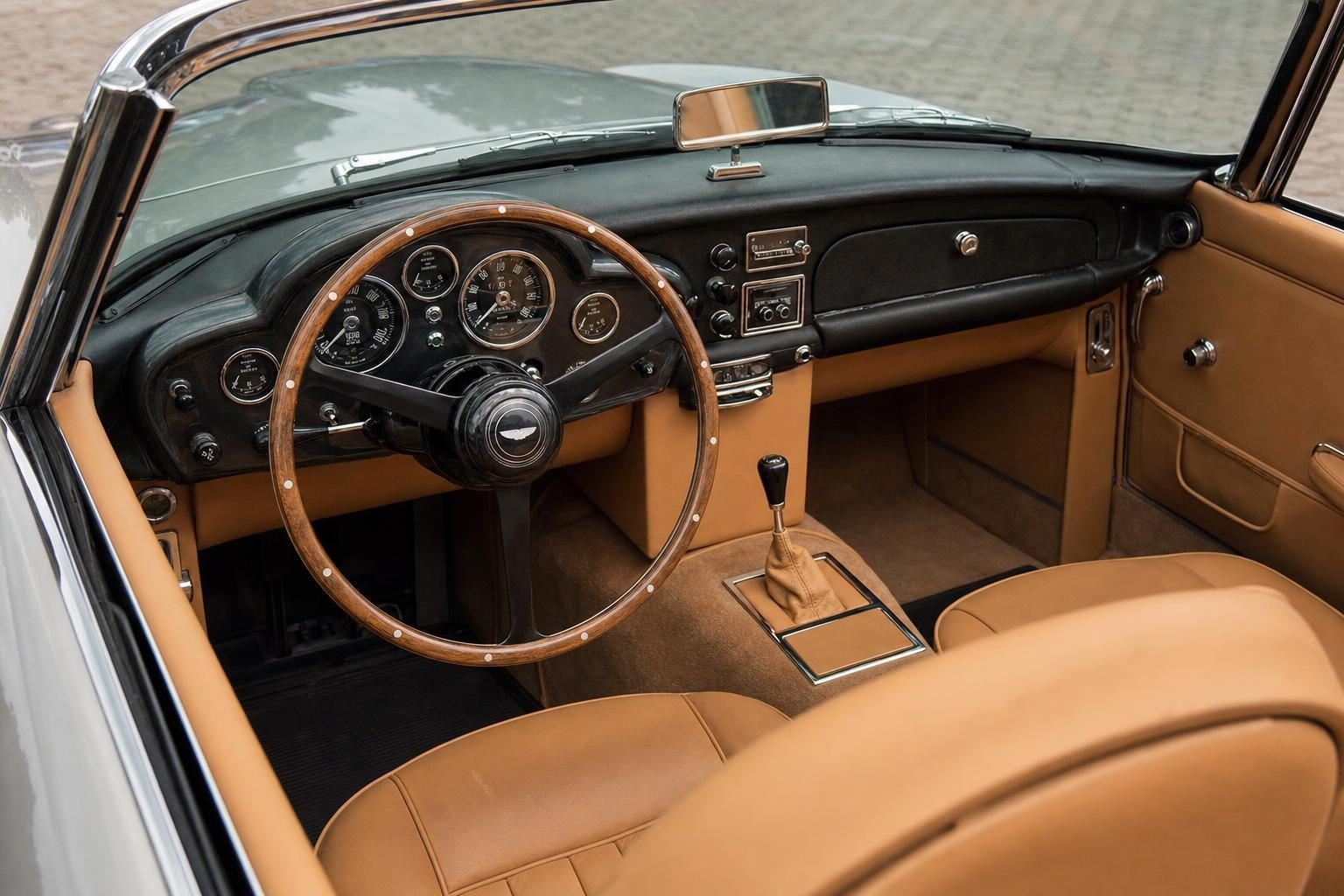
The 12 Vantage examples: a powertrain that official documentation understates
The spread of power outputs is the principal technical marker of the DB5 Convertible that we can document here. According to Nicholas Mee, the standard DB5 receives the 4.0-litre with triple SU carburettors for 282 bhp, while the Vantage rises to 314 bhp thanks to triple Webers. Wikipedia specifies that there are only 12 original DB5 Convertible Vantages — the exception within the exception.
This two-tier power level illuminates values. The majority of the 123 cabriolets retain the 282 bhp specification, already strong. But the Vantage subset, limited to 12 units, sits mechanically right at the top of the scale. Again, the numbers speak for themselves: the “cabriolet + Vantage” combination distils pleasure and rarity, two powerful levers in the market for period Astons.
Add a detail that matters to collectors: originally, 19 DB5 Convertibles out of 123 were left-hand drive, again according to Wikipedia. In a world dominated by export demand to LHD markets, this granularity also influences the desirability of each example, particularly when it intersects with the Vantage powertrain.
The Touring Superleggera body: what the word ‘Convertible’ concealed at the time
The DB5 belongs to a lineage whose styling and body execution have largely shaped the brand’s aura. The documents listed in our sources do not detail, for the cabriolet, a specific mention of Touring Superleggera. Consequently, we advance no unsourced element here regarding the DB5 Convertible’s body structure.
What the word “Convertible” certainly covers is a body variation on a DB5 basis, officialised by Aston Martin, produced between 1963 and 1965, and distinct in volume from the coupé. As the “Volante” nomenclature appears only in 1965, it is accurate to say that this 1963–1965 cabriolet first imposed itself through facts — small-series manufacture — more than through a carefully crafted commercial appellation.
This nominal sobriety has an unexpected effect today: for purists, the simple label “DB5 Convertible” suffices to evoke a Newport Pagnell period when each industrial decision weighed on the model’s posterity. That is precisely what fuels the narrative of this variant.
Values and today’s market: what 123 cars do to price in 2025
The market is not mistaken. Nicholas Mee places the value of a standard DB5 Convertible north of one million pounds sterling, and up to £1.5 million for a Vantage example. These orders of magnitude reflect the rarity–provenance–specification combination: 123 units in total, 12 Vantages, and a fraction in left-hand drive (19 originally).
The divergence on coupé volumes (887 according to Aston Martin, 899 according to the Aston Martin Heritage Trust) has little effect on cabriolet price dynamics, as the gap lies chiefly between “saloons” and “convertibles”. Aston Martin’s official communications moreover remind us of the restricted nature of the initial series — “a mere 887 DB5 saloons, 123 convertibles and 12 bespoke coach-built shooting brakes” — clearly framing the cabriolet’s positioning in the model’s history.
To place this cabriolet in the lineage, our dossier on the DB5 and its detailed specifications and our focus on the history of the DB5 and its evolutions offer useful reference points. And if the question of succession interests you, the next chapter will naturally lead you to the DB6 and its Volante derivative, born when the appellation entered the brand’s vocabulary.
Conclusion — DB5 Convertible, rarity forged by measured choices
The DB5 Convertible draws its rarity premium from a sequence of simple, verifiable decisions: a launch staged after the coupé (without a detailed official timetable), production limited to 123 examples between 1963 and 1965, only 12 units in Vantage tune at 314 bhp according to Nicholas Mee, and 19 cars originally in left-hand drive per Wikipedia. The market values precisely these parameters, beyond the name — the Volante designation appearing only in 1965.
When assessing or buying, the enthusiast therefore retains the essentials: tight volumes, clearly identified mechanical variants and a straightforward chronology. That is enough to explain why a standard DB5 Convertible exceeds one million pounds according to Nicholas Mee, and why a Vantage approaches £1.5 million. In short, more than a “decapitated coupé”, a piece shaped by Newport Pagnell to be rare — and which, six decades later, remains so.
Useful sources — Read at Aston Martin: the DB5 at 60 feature and the summary release. See also the Wikipedia page dedicated to the Aston Martin DB5 for Vantage figures and naming chronology.