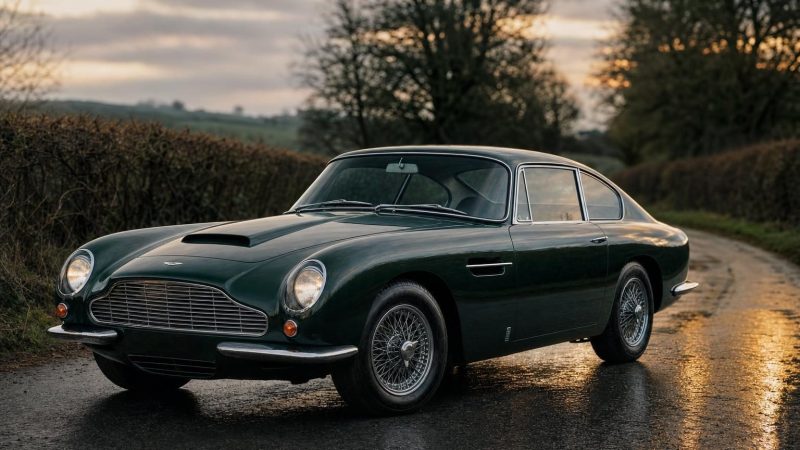
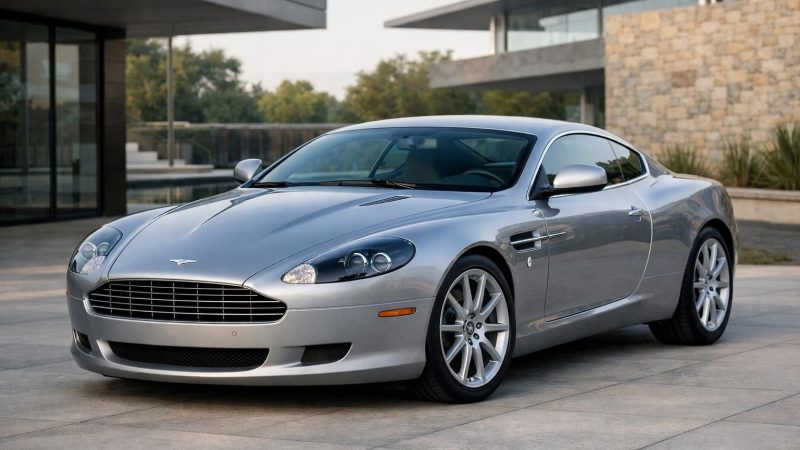
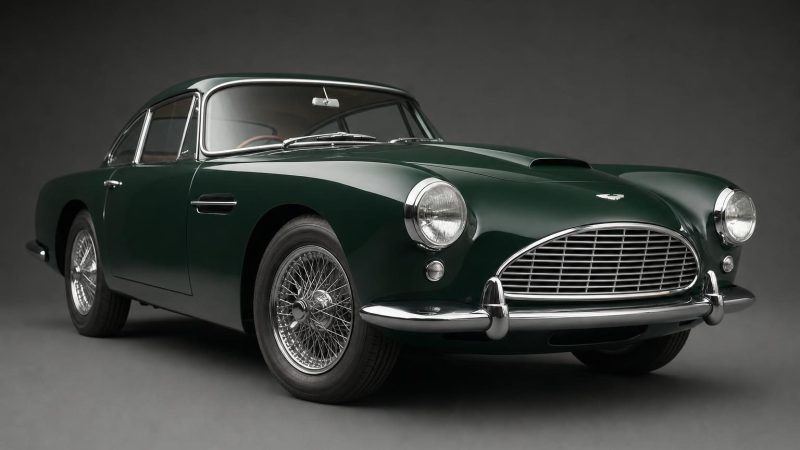
DBS 1967, quatre choix de design signés William Towns — fastback, grille carrée, habitacle 4 places, châssis élargi — qui ont redéfini la GT Aston.
DBS 1967: it is too often dismissed as merely a replaced DB6. In fact, William Towns set out four clear priorities — taut fastback, square grille, four true seats, widened chassis — that shifted Aston Martin’s cursor towards the 1970s GT. Here is how these decisions, taken in a tricky industrial context, paved the way for the DBS V8 and redrew the brand’s ambition.
Touring of Milan, then William Towns: why Aston Martin changed coachbuilder mid-course
At the outset, the DB6’s successor was entrusted to Touring of Milan. The brief was classic: extend DB elegance with a touch of modernity. But the Italian house went bankrupt before delivering a viable prototype, halting the project outright according to the page dedicated to the DBS on Wikipedia. Urgency forced Aston Martin to redirect its design strategy.
Management then handed the file to William Towns. The choice was no trivial matter: the aim was to break from a logic of discreet evolution and propose a silhouette capable of carrying the brand into the next decade. Towns did not inherit a usable canvas. He therefore signed off a car that was new in its visual architecture and proportions, while retaining the in-house technical genes.
This switch of coachbuilder changed the development tempo and, above all, the stylistic angle. Instead of Italianate “Superleggera” refinement, Aston Martin would assume a more geometric, broader presence, better suited to growing expectations of comfort and high-speed stability.
The fastback and the square grille: a stylistic break wanted by management
William Towns chose a fastback line and a square front grille. These two markers, attested by Wikipedia, sign a step away from the oval grille and more organic volumes of earlier DBs. The front end becomes a firm vertical plane, the tail extends in a gentle slope: two decisions that ran counter to the house’s habits.
The break was intentional. It placed the car in a new era where stability, visibility and a more imposing stance took precedence. The fastback increases cabin volume and roof continuity, while the square grille gives a more architectural formal language. To the eye, the DBS asserts itself more as a large-format GT than as a lightweight sports coupé.
This character also appealed to cinema: the DBS appears in 1969 in On Her Majesty’s Secret Service, driven by George Lazenby, without ostentatious gadgets apart from a sniper’s rifle mount in the glovebox, a detail noted by Wikipedia. An on-screen presence that consecrated its aesthetic shift towards a soberly powerful GT rather than a technological diva.
To place this inflection within Aston Martin’s genealogy, one can compare this stance with the GTs of the following years, from the AM V8 lineage to contemporary renewals. Our feature on the transition to the AM V8 illustrates this continuity of course.
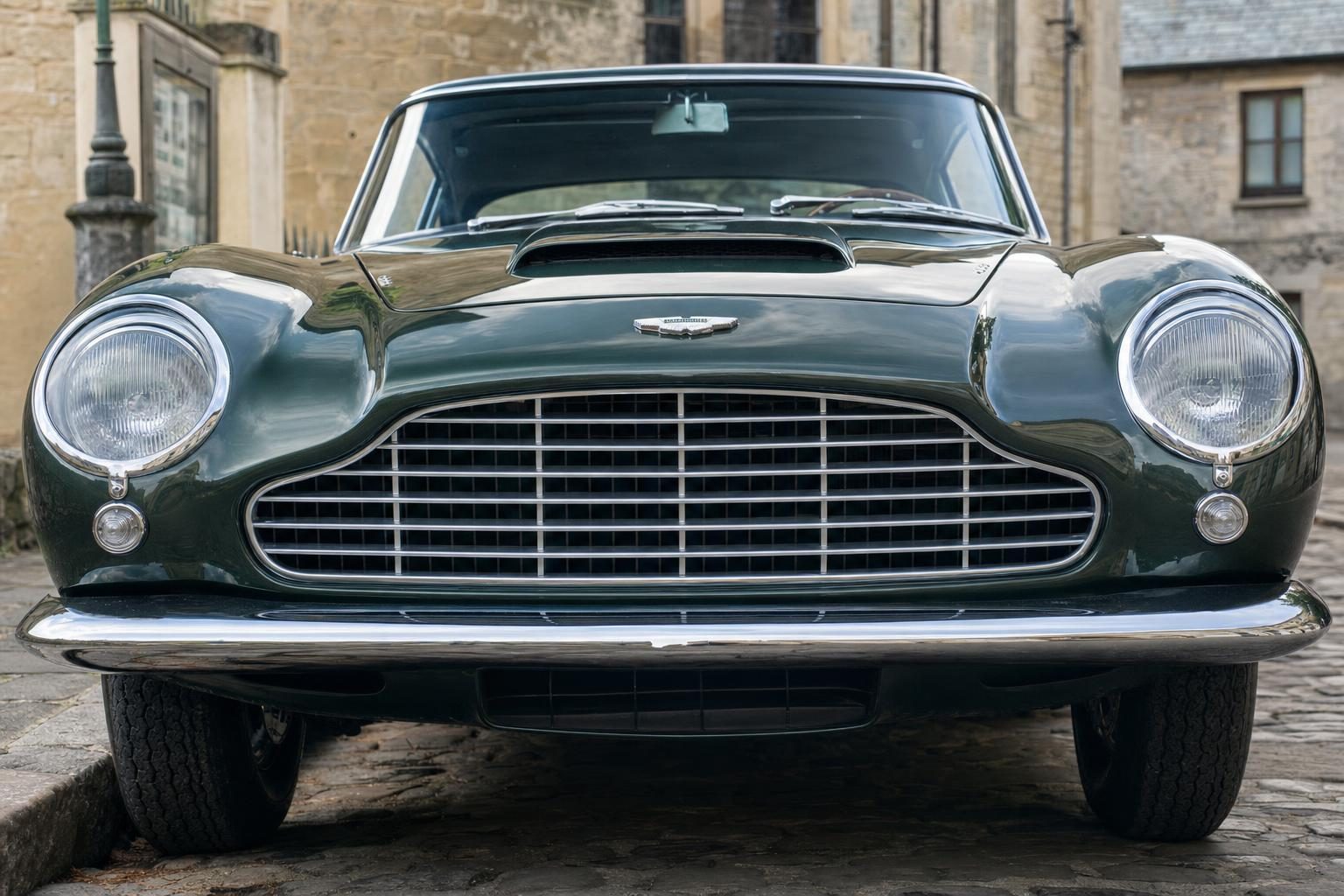
Four true seats: GT saloon ambition and coexistence with the DB6 until 1970
Beyond style, the promise lay in the cabin: four true seats. This point, rarely highlighted, anchors the DBS in a GT saloon logic. The wheelbase and width target long-distance comfort as much as performance. The fastback silhouette is not just a gesture; it frees up usable space and a practical boot, the sign of a GT made to cross Europe at a good pace.
This ambition did not erase the DB6 overnight. The DBS coexisted with it for three years, as recalled by a news item published on Aston Martin’s site. This overlapping period shows the brand’s commercial caution: testing a new design posture without jolting a clientele attached to DB codes.
In the landscape of British GTs, the DBS foreshadows the great touring cars of the 1970s, squarer and roomier. It heralds a lineage that would later lead to the great V8-engined Astons, explored in our guide dedicated to the AMV8.
- Intended use: four passengers at ease, grand touring.
- Design serving volume: taut fastback and widened tracks.
- Commercial strategy: overlap with the DB6 to secure the transition.
Tadek Marek’s inline-six: quoted at 280 PS and Vantage option at 325 PS
While the body breaks with the lineage, the heart remains faithful: the DBS received the inline six-cylinder designed by Tadek Marek. Output was quoted at 280 PS, with a Vantage option at 325 PS thanks to Weber carburettors, according to Wikipedia. On the road, one finds the supple surge and restrained timbre of this unit, a signature of the late DBs.
The decision to keep the straight-six reflected the desire to accompany customers through the transition. A widened chassis and roomier cabin, certainly; but a known, tunable and reliable powertrain, so the change was not brutal. The Vantage option confirms the fast GT vocation: more breath for high-speed cruising, without bluster.
This mechanical continuity clarifies the considered positioning of the DBS: a deliberate stylistic break, a mastered technical heritage. A balance that has often served Aston Martin well and would be seen in other periods of the marque, comparable to the approach described in our overview of the Virage, another bridge between eras.
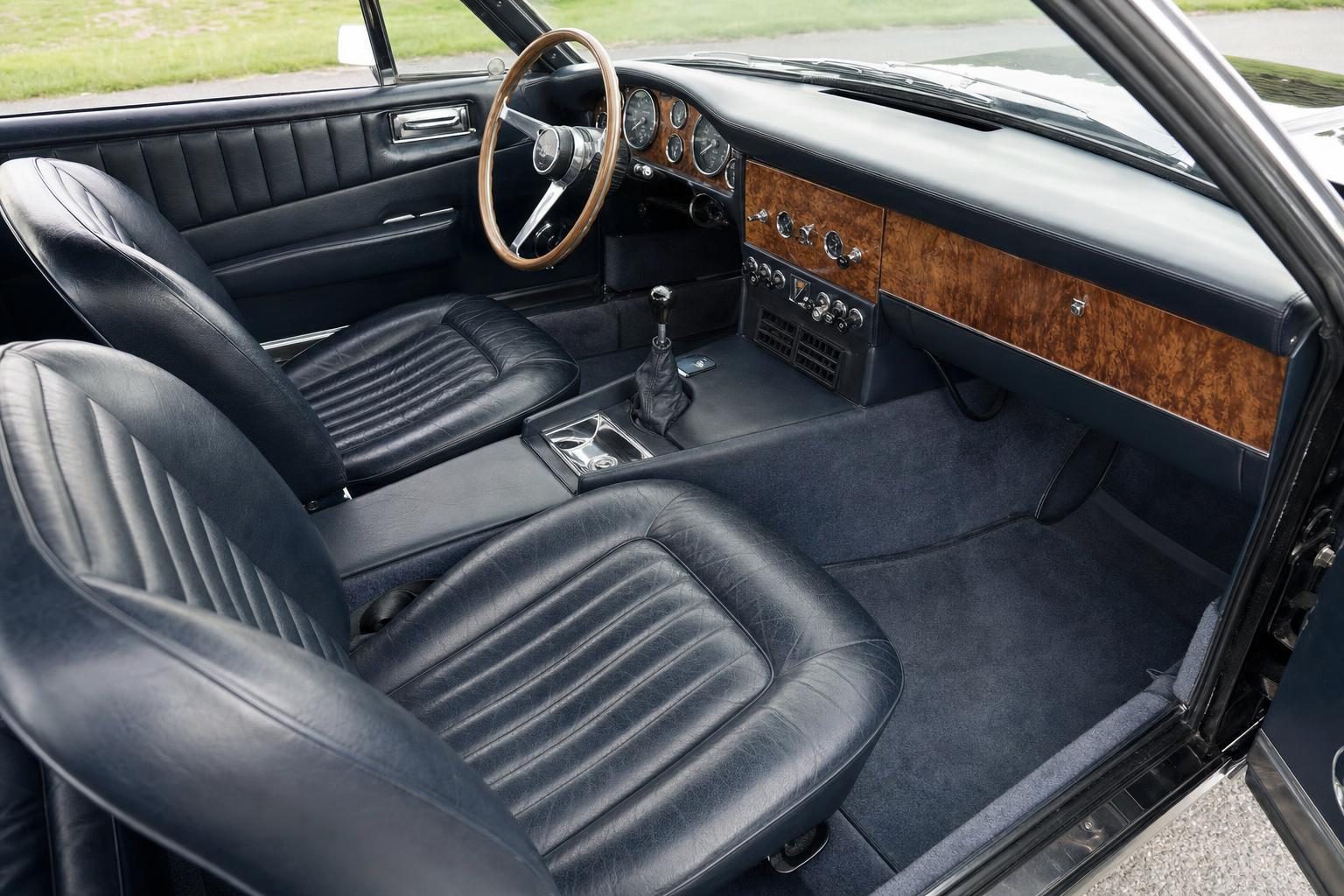
The 1969 DBS V8: how Towns’ widened chassis made the 5.3-litre V8 possible
From 1969, Aston Martin introduced a 5.3-litre V8 into the DBS chassis, giving birth to the DBS V8. Wikipedia notes that it was the widened architecture drawn by William Towns that made this transplant possible. The broader line was therefore not just an aesthetic stance: it prepared the mechanical future.
This shift to eight cylinders opened Aston Martin’s great V8 decade. The same basic design would support a leap in performance and a new, more muscular image. The DBS thus appears as a pivot platform, heralding the AM V8 lineage explored in our dedicated feature, and the matrix of an era that would leave a deep imprint on the brand’s DNA.
Commercially, the strategy reads clearly: gain acceptance for the new silhouette, then insert a powertrain commensurate with its ambitions. The Aston Martin retrospective on DBS naming also recalls the posterity of this badge, reactivated at regular intervals when the company wishes to signify a long-legged GT, fast and self-assured.
Conclusion — DBS 1967, a transitional GT that became a foundation
Ultimately, the 1967 DBS is far more than the DB6’s replacement. It embodies four decisive shifts — fastback, square grille, inhabited four seats, widened chassis — that enabled the 5.3-litre V8 and opened a new era. The break was measured on the mechanical side with Tadek Marek’s six-cylinder, but clear in formal language, sufficiently so to entice even James Bond.
In this sense, the 1967 DBS appears as a discreet foundation of Aston Martin modernity: a GT conceived for the next decade without denying its roots. To extend the comparison with its descendants, explore our features on the classic AM V8 and on the 1990s Virage, and revisit Aston’s cinematic itinerary in our James Bond and his Aston Martin guide.
For deeper history and specifications, consult the reference page on the DBS on the French side and the detailed English version. The official milestones on coexistence with the DB6 are recalled on the Aston Martin site. Here, the facts suffice: the 1967 DBS changed the trajectory, with quintessential British calm.