Ian Callum, from Project Vantage to Vanquish 2024: three milestones to read his formal grammar and the lasting influence on Aston Martin’s style.
At Aston Martin, Ian Callum forged a formal grammar expressed with muscular restraint: taut surfaces, a subtly truncated tail, aggression kept in check. Through three milestones — the Project Vantage concept (1998), the DB7 Vantage and the V12 Vanquish — we observe how this method infused twenty years of aesthetics before the handover to Marek Reichman. Here is an indirect portrait, traced by the lines rather than the words.
The 1998 Project Vantage: how a show concept directly spawned a production car
Unveiled at the North American International Auto Show in January 1998, the Project Vantage was the first design conceived entirely by Ian Callum for Aston Martin, according to the Vanquish page on Wikipedia. This prototype was not a mere styling exercise: it set proportions and volumes that would transfer almost unchanged to the future production GT.
The fundamentals of the Callum method are already there: a high beltline, flanks sculpted into crisp planes, and a compact rear that cuts short any unnecessary lyricism. These choices foreshadow the road‑going V12 that followed. For those who want to compare the concept with its offspring, the Wikipedia page dedicated to the Vanquish offers a useful thread.
The demonstration is simple: turn a show car into an operational draft. Project Vantage prepared both the public eye and the industrial tool, heralding a GT sharper, more compact, more technical than earlier Astons. A deliberate continuity, and already a signature.
The DB7 Vantage: why Callum made the V12 visible in the car’s proportions
Beyond the prototype, the method is also legible by contrast. In the DB7 Vantage, it is the proportions that seem to stage the mass and mechanical presence. Without piling on effects, the silhouette suggests the location and solemnity of the V12 with a assertive prow and a bonnet line that immediately places the car in the grand touring register.
This “visibility” of the engine through the drawing is anything but showy: it rests on very controlled volumes, taut surfaces and a shortened tail that avoids any heaviness. This is, implicitly, Ian Callum’s pedagogy: let the engineering speak, but articulate the narrative with clear axes. To continue exploring the model, our page dedicated to the DB7 offers a contextual overview.
From this perspective, the DB7 Vantage appears as the hinge: it conveys to the wider public the syntax set by Project Vantage and prepares what would become the centrepiece of the early 2000s.
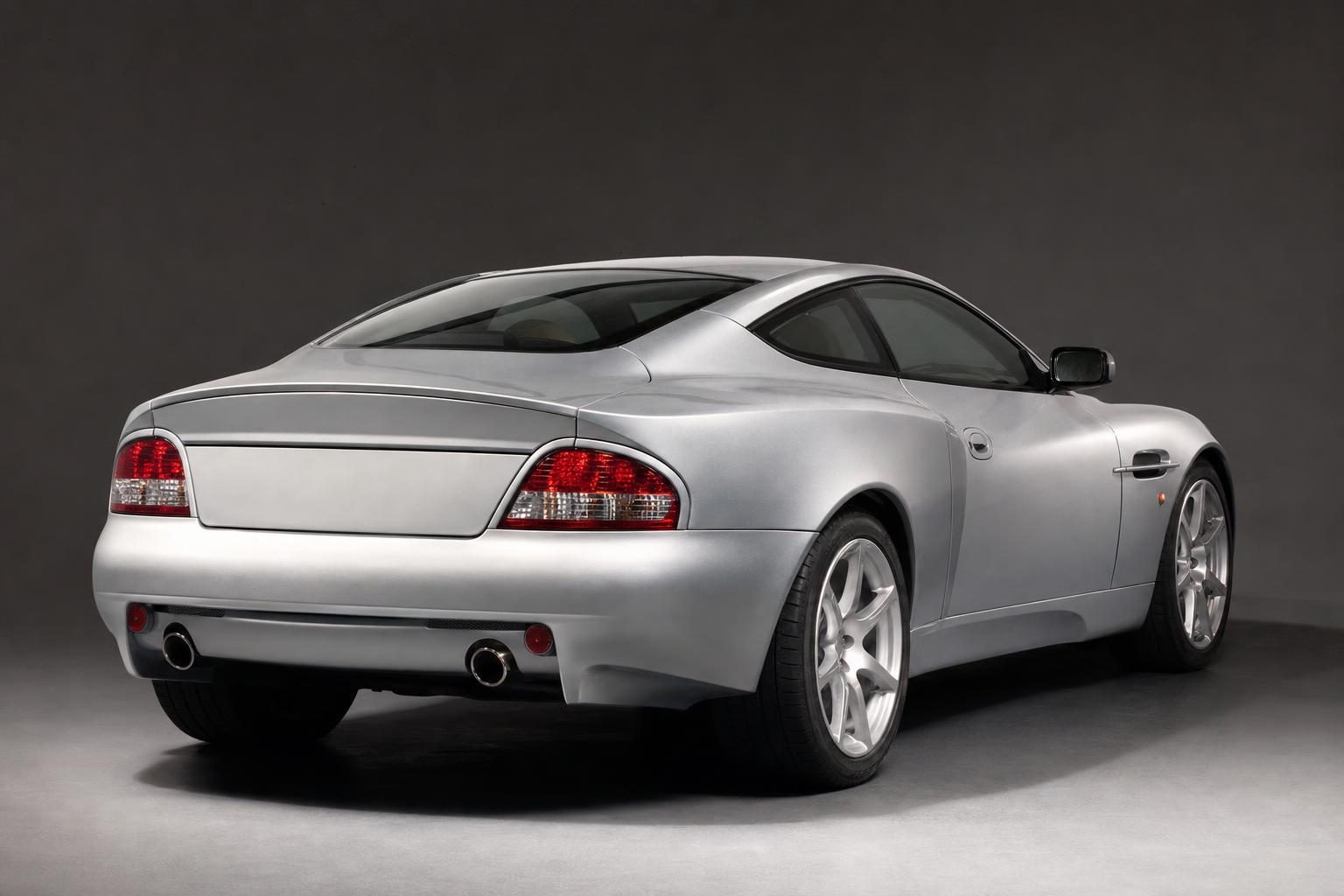
The V12 Vanquish: superformed surfaces and the DB4 GT Zagato’s influence in the car’s shoulders
Unveiled at the 2001 Geneva Motor Show, the V12 Vanquish bears Ian Callum’s signature. Wikipedia also recalls the inspiration claimed by the designer: the DB4 GT Zagato, for the “shoulders” and frontal presence. That’s where the impression of civilised muscle comes from: powerful curves over the wings, immediately counterbalanced by taut planes and crisp edges.
The bodywork delivers a lesson in economy of means: few lines, but the right ones; superformed surfaces that catch the light without ostentation; a shortened tail that sets the cadence. These choices establish a vocabulary that Aston Martin would carry forward widely. Our Vanquish Mk1 dossier links these commitments to the model’s career.
Twenty years on, the marque still celebrates this “modern classic”: Aston Martin’s media platform revisits the model’s imprint in an anniversary feature, to read here: 20 years of V12 Vanquish. It shows how the 2001 Geneva V12 consolidated the visual identity sketched as early as 1998.
The transition to Marek Reichman in 2005: what the DB9 owes to the foundations laid by Callum
Marek Reichman succeeded Ian Callum as Aston Martin’s head of design. According to Wikipedia, the second‑generation Vanquish (2012) was influenced by the lines of the One‑77, proof that the studio continued to articulate the house DNA with contemporary impulses. Continuity prevails over rupture: one recognises the volumetric skeleton and the restraint established earlier.
In this handover, the point is not the flourish of a signature but the solidity of the fundamentals. Simple volumes, controlled surfaces and an abbreviated tail form a framework that the following range — up to the GTs of the Reichman era — can vary without losing the thread. For a portrait of the successor, our Marek Reichman profile revisits his guiding principles and structuring role.
This ridge line — preserving surface tension, maintaining an expressive front without gratuitous aggression — allows new releases to rest on an immediately legible base. That is the most precious legacy of a successful in‑house design: a language that survives the passing of the baton.

The Ian Callum legacy today: recognising his hand in the lines of the 2024 Vanquish
The third‑generation V12 Vanquish, designed under Marek Reichman’s direction, claims 835 PS and 1,000 Nm, according to Aston Martin’s media platform. In the official images and materials provided by the brand, there is a clear lineage: controlled wing muscles, clean surfaces and a tightened rear. All constants readily associated with the Callum method.
With twenty‑five years between them, the kinship is no pastiche: it is a persistence of principles. The full shoulders, already nourished by the DB4 GT Zagato spirit according to Wikipedia, now converse with a more technological treatment of openings and aerodynamics. Coherence is the true luxury. To gauge this heritage against current events, the “Vanquish at 25” feature published by the marque is a useful reference: Vanquish at 25.
The trajectory, in short, highlights continuities more than ruptures. That is what emerges from a diachronic reading of the formal language inaugurated in 1998 and adjusted, without rigidity, under the next direction.
Conclusion — Ian Callum, a durable grammar for Aston Martin
From the 1998 Project Vantage to the Vanquish unveiled at Geneva in 2001, Ian Callum’s demonstration holds in three words: clarity, tension, measure. Marek Reichman, who succeeded him, continued this framework while opening it to other influences — the second‑generation Vanquish (2012) reminds us, according to Wikipedia. As for the 2024 iteration, its official figures and its lines attest to it: the legacy remains operative.
Recognising this “Callum grammar” in today’s recent output is not a matter of nostalgia but of reading the volumes. To extend the analysis, the biography of Ian Callum provides context, while our feature on the first opus, dedicated to the Vanquish Mk1, places the styling choices in their historical frame. An elegant way to verify that, at Aston Martin, sound ideas outlast fashions.