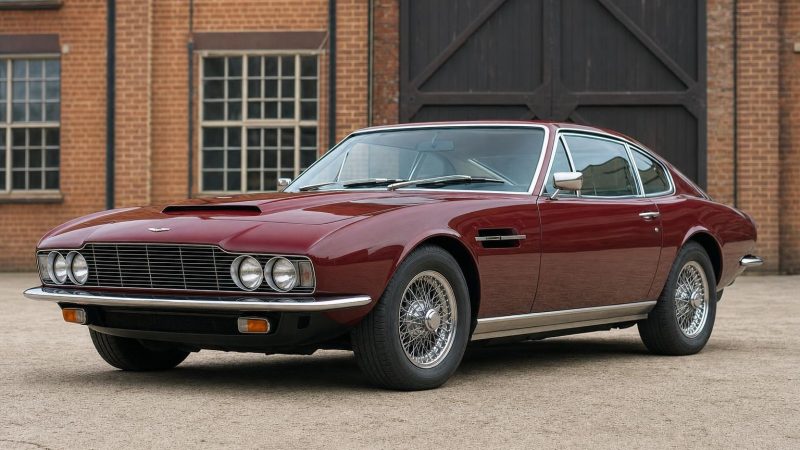
DBS V8, modèle charnière: moteur Tadek Marek, freins ventilés inédits, style William Towns, chiffres de production divergents et promesse tenue en 1969.
DBS V8 marks the anticipated yet delayed shift that opens the era of V8 engines at Aston Martin. This article sheds light, with supporting sources, on the gap between the expectation of a V8 promised as early as 1967 and its realisation in 1969, deciphers what the car changes technically and stylistically, and confronts the divergent production figures. A guide to understanding why this 2+2 coupe, presented at the time as the fastest four-seater in the world, is a true pivot in Aston’s history.
Why Aston Martin Replaced the DB6 with the DBS in 1967
The DBS was unveiled on 25 September 1967 at Blenheim Palace. According to Auto-Forever and Voiture-de-Film, it initially retains the 4.0-litre six-cylinder engine from the DB6 in its final years. This launch reflects the desire to modernise the image and offer a more spacious size, without immediately breaking away from the proven mechanics. Meanwhile, the brand is preparing a new V8 intended to support performance in line with the competition of the late sixties.
This two-step choice responds to a clear industrial constraint: the new all-aluminium engine designed by Tadek Marek is not yet ready in 1967. The grand touring coupe must therefore begin its career with the six-cylinder block from the DB6 to occupy the market. The strategy is evident in the total production of the lineage: around 787 DBS across all versions in five years, according to CarJager, compared to nearly 1,800 DB6 during the same period. The transition is gradual but crucial for the future of the range.
For the public, the gap between the completely renewed design and the familiar mechanics creates growing anticipation. This impatience is the backdrop to the birth of the DBS V8, destined to embody technological renewal and reposition the brand in the market for very fast four-seater GTs.
The Long-Awaited Tadek Marek V8 Engine Finally Installed in 1969
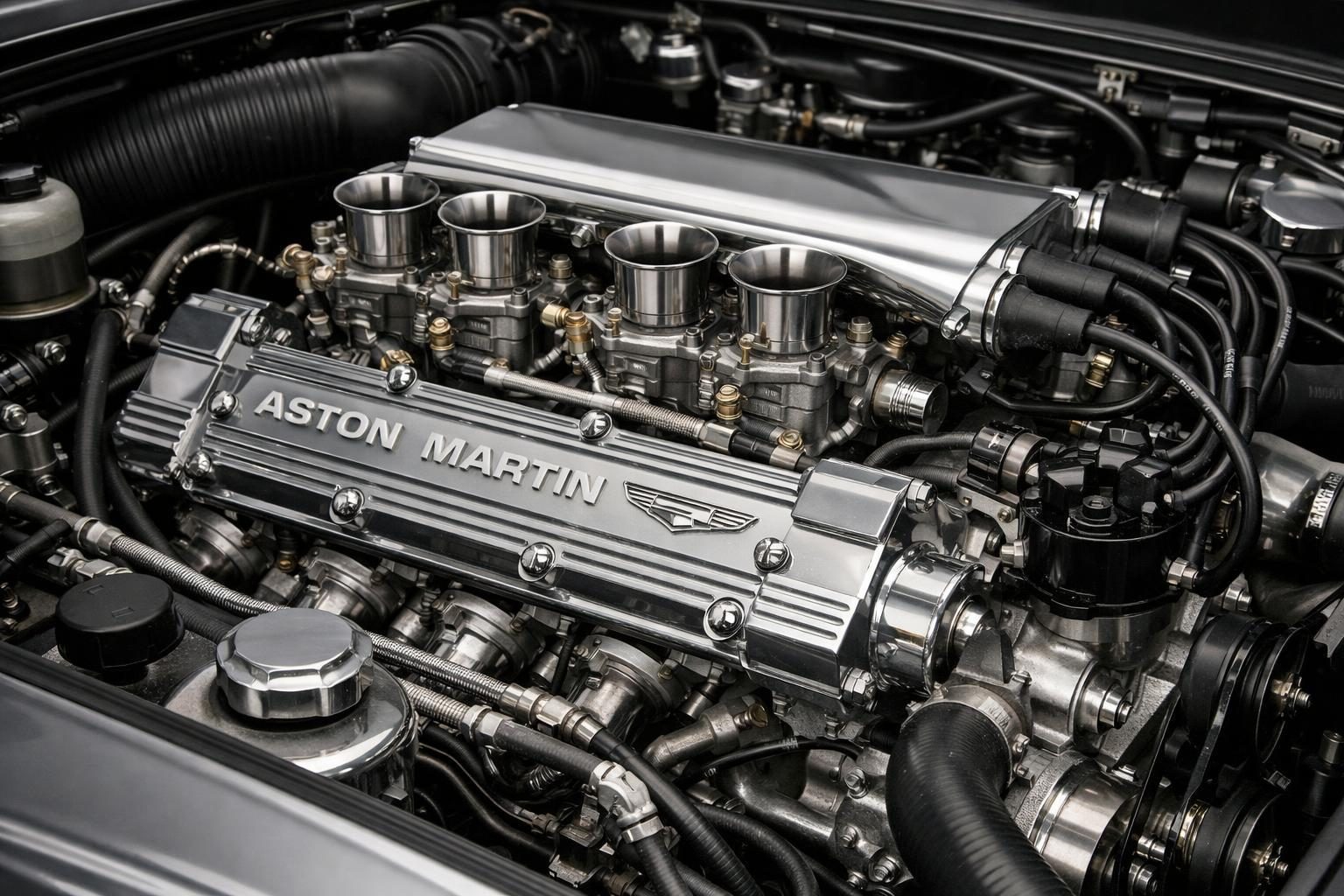
The V8 designed by Tadek Marek, all-aluminium and with double overhead camshafts, is only ready in September 1969. AutoEvolution, Voiture-de-Film, and Classic-Trader converge on this timeline. This is when the DBS V8 officially comes to life, transforming the promise into reality and giving the muscular silhouette the engine it demanded.
At its launch, this version is presented as the fastest four-seater car in the world, claim AutoEvolution and Classic-Trader. This positioning solidifies the contribution of the new V8 and legitimises Aston’s technical shift towards more modern and powerful mechanics. For immediate historical context, see the dedicated page on the DBS on Wikipedia (Aston Martin DBS) and the analysis of the V8 lineage published by AutoEvolution on the V8 era (1969–1990).
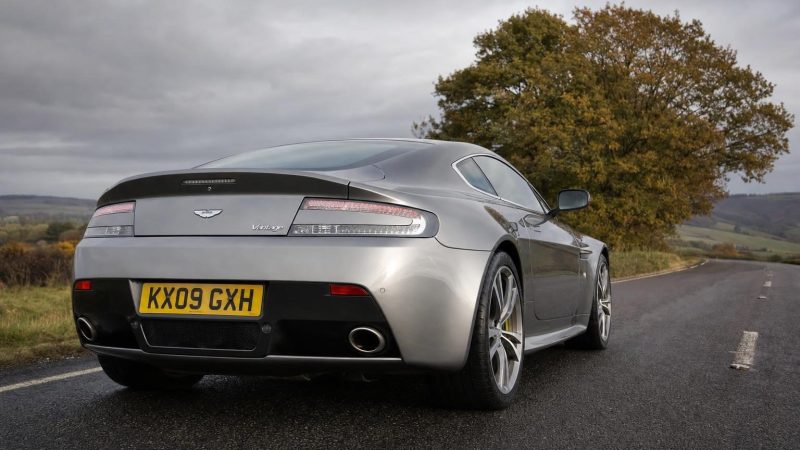
This late arrival of the eight-cylinder engine is not a detail: it reshuffles the cards of the range and foreshadows decades of V8 GTs. The DBS V8 thus serves as a template for the models that will follow, including well-known later evolutions like the V8-engined Virage, a distant heir to this architecture.
A William Towns Style Inspired by American Muscle Cars
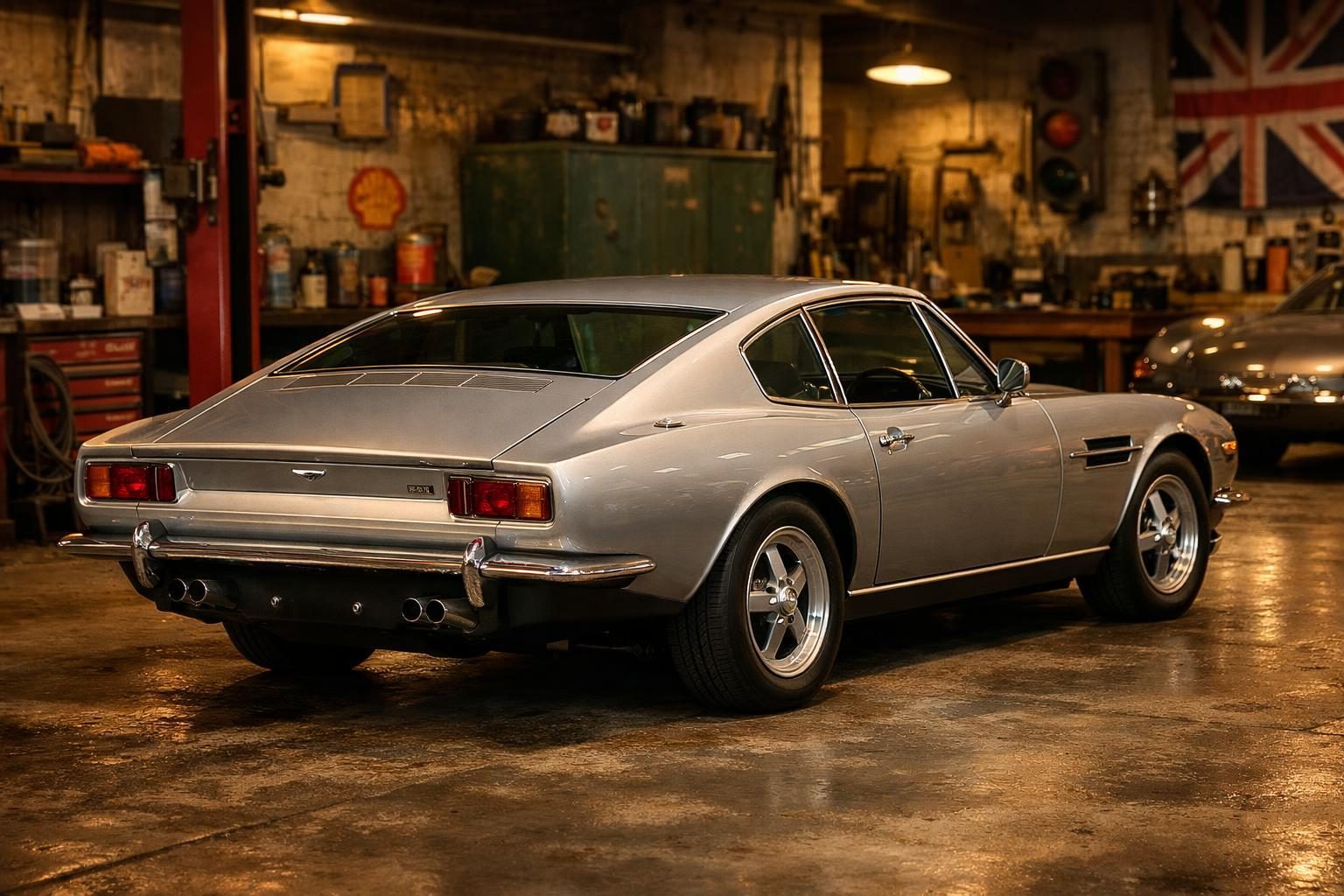
The design is by William Towns, after the abandonment of the project initially entrusted to Touring, according to Auto-Forever and Mécanicus. The design contrasts with previous DBs: long bonnet, taut surfaces, full volumes, and a widened grille. The result evokes, without copying, certain stances of American muscle cars, with a wide stance and a more assertive visual temperament.
This new visual identity is not arbitrary. It anticipates the power increase of the V8 and aims to give the GT a presence in line with its dynamic ambitions. The squared-off look, pronounced arches, and full rear end give the car an authority that complements the traditional sleekness of six-cylinder Astons. Once it arrives, the DBS V8 appears in perfect continuity with this formal language.
The message is clear: Aston Martin embraces a more contemporary and international aesthetic. In this respect, the bodywork designed by Towns serves as the setting for a major technical reorientation. One does not go without the other in the perception of customers and media at the end of the 1960s.
Ventilated Brakes and First Techniques: What Really Changes
Beyond the engine, the DBS introduces real engineering innovations. Auto-Forever highlights that it is the first Aston Martin equipped with four ventilated disc brakes. This technical advancement improves braking endurance, essential for a heavy and fast GT, and confirms the ambition for sustained performance over long distances.
These technical choices validate the expected increase in power with the switch to the V8. On the road, the better thermal dissipation of the ventilated discs contributes to the consistency of handling, a crucial point for a high-performance four-seater. On a brand scale, this is a further step towards a more methodical industrialisation of high-performance components.
The addition of these evolutions makes the DBS V8 not only a motorised iteration but a coherent whole. Assertive design, modern powertrain, and capable braking lay the foundations for future V8 Astons, which will remain in the catalogue and in the brand’s imagination for years to come.
How Many DBS V8s Were Produced: What the Sources Say
Production figures for the DBS V8 vary according to sources. AutoEvolution and Guide-Autosport suggest 402 units, while Classic-Trader and Voiture-de-Film mention 405 units. This slight discrepancy may be due to counting parameters (completed cars, chassis produced, prototypes included or not), but no absolute consensus emerges from the cited references.
What is established is the order of magnitude: a limited volume, reflective of a transitional period and artisanal production. Meanwhile, CarJager estimates the total production of the DBS, across all versions, at around 787 units over five years, compared to nearly 1,800 DB6 during the same period. The DBS V8 therefore represents a significant but minority fraction of the total, and its rarity today fuels its appeal to collectors.
This statistical debate does not diminish the model’s influence. Whether one counts 402 or 405, the contribution of the DBS V8 is qualitative: it places the V8 at the heart of the offering and paves the way for iconic V8 lineages, extending the legacy begun by the DB6 and deepened over the decades. To place this milestone in the overall trajectory, see our summary on the history of Aston Martin and its breakthroughs.
Conclusion — What the DBS V8 Changed
In summary, the DBS V8 is the moment when intention becomes reality. Unveiled in 1967 with a six-cylinder from the DB6 out of necessity, it receives the Tadek Marek V8 in 1969, fulfilling the promise and propelling the GT to the rank of the fastest four-seater of its time according to the cited sources. Its bodywork designed by William Towns, its ventilated brakes unprecedented at Aston, and its limited production — 402 or 405 according to references — make it a pivotal model both technically and symbolically.
This shift to the eight-cylinder shapes the brand durably, heralds the upcoming V8 lineages, and redefines the balance between style, performance, and endurance. In this sense, the DBS V8 is not just a transitional model: it is the starting point of an entire segment of Aston Martin’s modern DNA.