DB7 V8 1996: why Aston Martin introduced a 4.0-litre Ford V8 in the DB7, what it changed for the range, and the limits the platform imposed.
The DB7 V8 joined the range in 1996, three years after the launch of the coupé with the supercharged 3.2-litre inline-six developed by Cosworth. This article explores why this detour via a naturally aspirated Ford V8 made sense at the time, what it changed from behind the wheel, and how it prepared — without undermining — the arrival of the V12 in 1999.
DB7 1994: a Cosworth six that pleased everyone — except the sales figures
Launched in 1994, the DB7 relied on a supercharged 3.2-litre inline-six, developed by Cosworth from a Ford block, and assembled at Bloxham (source: Wikipedia). The package marked Aston Martin’s return to a more accessible niche without forsaking elegance. The choice of a blown straight-six gave it a highly distinctive personality, with a smoothness well suited to grand touring.
The platform, developed by Tom Walkinshaw Racing (TWR) from the Jaguar XJS chassis, nevertheless imposed dynamic limits acknowledged by the specialist press (Wikipedia). Nothing crippling, but a reminder that this was a composite base conceived as much for industrial efficiency as for sporting purity.
As for sales, the sources gathered here do not break down volumes by version. What is known, however, is that the DB7 would become, across all variants, the most-produced in Aston Martin’s history until the DB9 took over (Wikipedia). Overall success would therefore come over time, buoyed by a broadened line-up.
In this context, the addition of a DB7 V8 in 1996 fitted as a rational extension: widening the engine offer to cover different sensibilities without redrawing the model’s deep architecture.
The 4.0-litre Ford V8: origins, characteristics and what it brought in practice
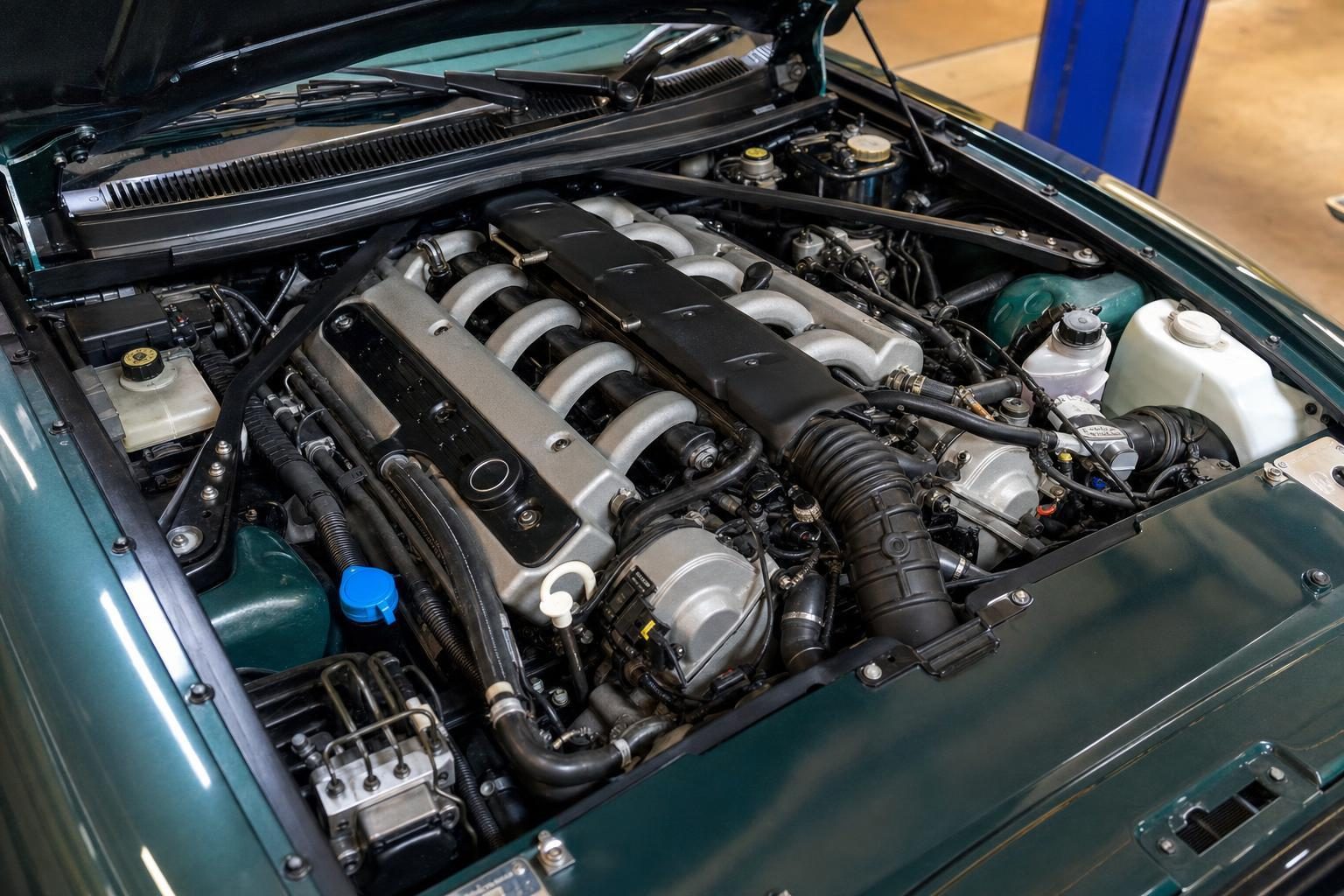
Introduced in 1996, the DB7 V8 received a naturally aspirated 4.0-litre Ford V8, referenced Ford Racing/Cosworth and rated at around 350 PS (Wikipedia). The technical positioning contrasted with the blown straight-six: here, no forced induction, but a crisper climb to the red line and a more full-bodied soundtrack.
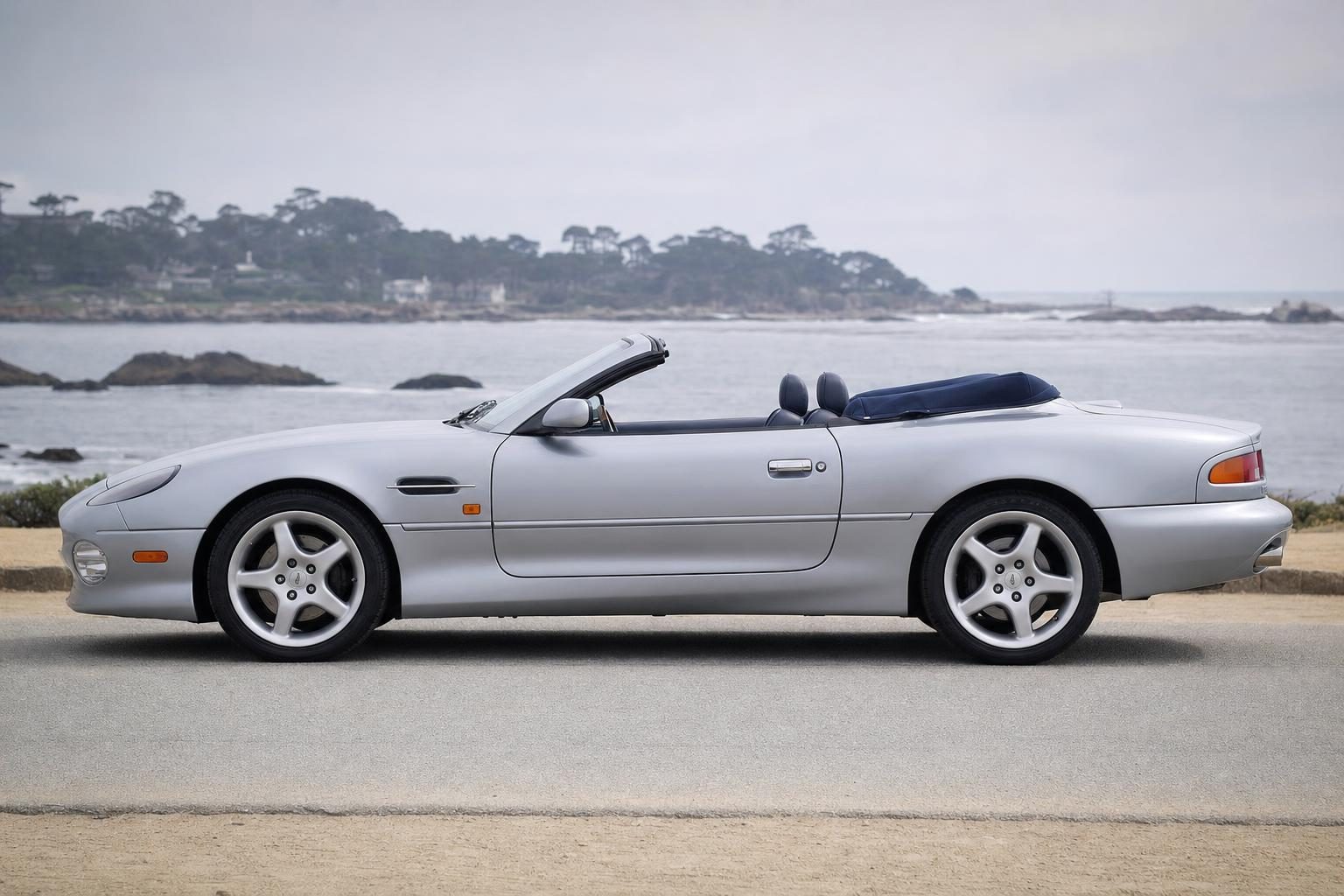
Available as a coupé and as a Volante, the DB7 V8 coexisted briefly with the six-cylinder (Wikipedia). In practice, it offered an alternative character: more immediate torque, mechanical simplicity (no supercharger) and potentially more straightforward maintenance for clients accustomed to tuned Ford V8s. Image-wise, the match between elegant bodywork and the hushed timbre of a naturally aspirated V8 could entice buyers coming from Anglo-Saxon GTs.
The DB7 V8 did not alter the fundamental structure of the DB7: the TWR base of Jaguar XJS origin remained (Wikipedia). The interest was therefore less to “reinvent” the sports car than to adjust its temperament. In that sense, this iteration reads as a judicious lateral step: broadening the usage spectrum without multiplying industrial costs.
At brand level, the move to a Ford Racing/Cosworth V8 also sat within the group’s technical ecosystem, already mobilised around Cologne for what would become, in 1999, the DB7 Vantage’s V12 (Wikipedia). The puzzle pieces were falling into place.
DB7 V8 vs DB7 six-cylinder: the measurable differences and the ones the brochures skipped
On paper, the DB7 V8 posted around 350 PS (Wikipedia). Opposite it, the supercharged 3.2-litre inline-six by Cosworth made its case with flexibility and the shove delivered by the blower. Two routes to the same GT objective: deliver character on the road and stamina on long journeys.
Beyond the numbers, two philosophies of pleasure quietly diverged. The supercharged straight-six seduced with its seamless stretch and almost “silken” mechanical refinement. The DB7 V8, for its part, played the rounded, breathing qualities of a well-honed naturally aspirated unit. In both cases, the TWR platform derived from the XJS (Wikipedia) reminded you the DB7 remained above all an elegant GT rather than a track weapon.
The brochures mostly talked power, trims and body choices (coupé and Volante for the DB7 V8, source: Wikipedia). What they said less was the strategic intention: to test the breadth of customer appetite without abandoning the core of the initial offer. In that respect, the DB7 V8 episode served as a marketing as much as a mechanical reveal.
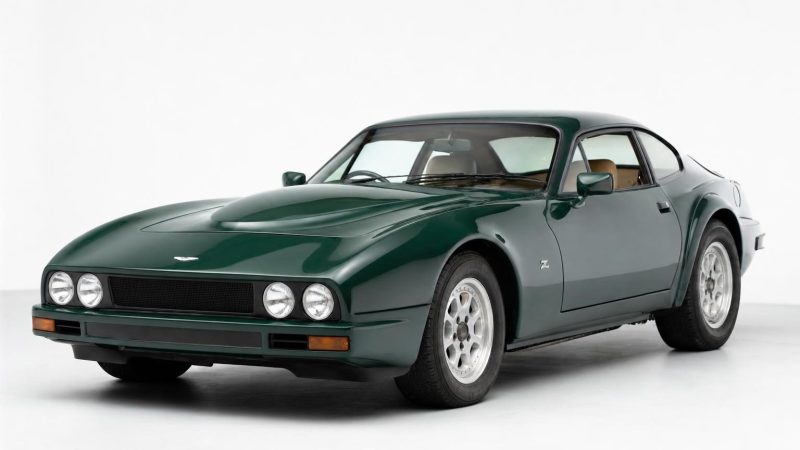
To put these variations in perspective, our synthesis dossier on the lineage is useful. See the guide dedicated to the model on the complete history of the DB7, as well as the singular offshoots on the DB7 Zagato and its end-of-line specifics.
Why the V8 did not survive the arrival of the V12 Vantage in 1999
In 1999, the DB7 Vantage arrived with a 6.0-litre V12 developed by Ford in Cologne (Wikipedia). In the hierarchy, the proposition was clear: a noble engine, a leap in image and a technological step that redefined the range. Coherent as it was, the DB7 V8 instantly became peripheral.
This repositioning did not doom the DB7 — quite the opposite. Total production across all versions would reach around 7,000 units (Wikipedia), and the model would hold the pillar role until the DB9 surpassed that marker (Wikipedia). Simply, the clarity of the line-up then required a clear staircase: V12 at the top, the supercharged six retaining its original place, and the DB7 V8 bowing out.
There is a strategic lesson here: when a major innovation enters stage, it clarifies the margins. The V12 Vantage reset the ambition and concentrated media attention, where the DB7 V8 had played an in-between score. For Aston Martin, the ridgeline between tradition and modernity was better traced.
For a detailed perspective on this shift, see our dedicated insight on the 1999 DB7 Vantage and its Cologne V12, a useful complement to understanding the rapid obsolescence of the DB7 V8.
What the DB7 V8 says today about the art of filling a range without blurring positioning
With hindsight, the DB7 V8 illustrates a pragmatic approach: offering a characterful alternative within the available industrial framework while the V12 reached maturity. According to Wikipedia, the arrival of the V12 in 1999 rendered the V8 obsolete within the range, confirming that the goal was not to reinvent the DB7 but to keep the conversation open with clients attuned to a naturally aspirated V8.
It also reminds us that a GT can embrace several temperaments without losing its thread. Between the supercharged straight-six and the DB7 V8, Aston Martin maintained the coherence of the TWR platform while modulating the experience. The marque then sealed the hierarchy with the V12, reinforcing its status without betraying the relative accessibility of the initial DB7.
Finally, the DB7’s afterlife — the most-produced until the advent of the DB9 (Wikipedia) — shows that a measured, well-timed stack of variants can build a solid customer base. The DB7 V8 was a transitional, useful and ultimately discreet step: exactly what you expect from a milestone before a great leap.
For further reading, Wikipedia dossiers provide a factual, concise framework: see the Aston Martin DB7 page in English and the DB7 entry in English. As a practical complement, Autocar’s DB7 buying guide contextualises ownership.
In sum, the DB7 V8 played its part with precision and proved that, between patience and timing, Aston Martin already knew how to orchestrate the V12’s arrival without losing its faithful.