Ultimate DBS, the swan song of the DBS V12 in 2012: a series mainly cosmetic, around 100 cars, not to be confused with the 770 Ultimate of 2023. Guide and valuation.
Ultimate DBS marks the precise farewell of the DBS V12 in 2012: a series that is mainly cosmetic and very limited, often confused with the recent 770 Ultimate. Here, in six key points, is what you need to differentiate the two “ultimates”, understand why the Aston faded away that year, what the edition truly offered, and to situate its rarity and valuation among collectors.
Ultimate DBS or DBS 770 Ultimate: two farewells not to confuse
First clarification: the Ultimate DBS of 2012 and the DBS 770 Ultimate of 2023 are not the same car. The former concludes the cycle of the naturally aspirated 5.9-litre DBS V12 launched in 2007; the latter marks the run-out of the modern DBS Superleggera, equipped with a 5.2-litre twin-turbo V12. According to astonmartins.com, the 2012 edition corresponds to the last 100 units produced in June-July 2012, while the 2023 770 Ultimate was manufactured in 300 coupes and 199 Volantes.
The confusion arises from the nickname “Ultimate” reused ten years apart, but the content differs profoundly. In 2012, the edition is essentially aesthetic on an unchanged mechanical basis. In 2023, the 770 Ultimate is a technical evolution of the end of the series, derived from the DBS Superleggera, not to be confused with the DBS from 2007-2012. To place the context of succession, the first generation DBS makes way for the second generation Vanquish in 2012, while the 770 Ultimate closes the Superleggera chapter.
Finally, the total production of the “first era” DBS is estimated at around 3,400 units (2,534 coupes and 845 Volantes) according to Nicholas Mee, distinctly separate from the volumes of the Superleggera lineage. This precision helps to correctly interpret advertisements and catalogues, where “Ultimate” can mask two very different realities.
Why the DBS V12 took its bow in 2012
The DBS V12 (2007-2012) is built on the VH modular platform, derived from the DB9 and inspired by the DBR9 race car. Lower by 25 mm and wider by 40 mm than the DB9 (sources: en.aston-martin-club.com; astonmartins.com), it imposes a more radical stance from its launch. After five years of production, the arrival of the second-generation Vanquish in 2012 reshuffles the stylistic and technical cards, justifying the model’s discontinuation.
Commercially, Aston’s product cycle was reaching maturity, and the brand was preparing for the next step. The DBS Ultimate edition then acts as a “last hurrah” very much controlled, focused on appearance and rarity, without mechanical evolution. This end-of-series strategy, classic at Aston Martin, enhances the last examples and marks the transition to the successor.
The Volante was introduced at the Geneva Motor Show in March 2009, with deliveries in the third quarter of 2009 and a kerb weight of around 1,810 kg (source: Wikipedia EN). In 2012, with the range being reshaped, the brand orchestrates the release of the coupe and convertible on a final batch with specific styling: the DBS Ultimate.
What the Ultimate trim really added (and what it did not change)
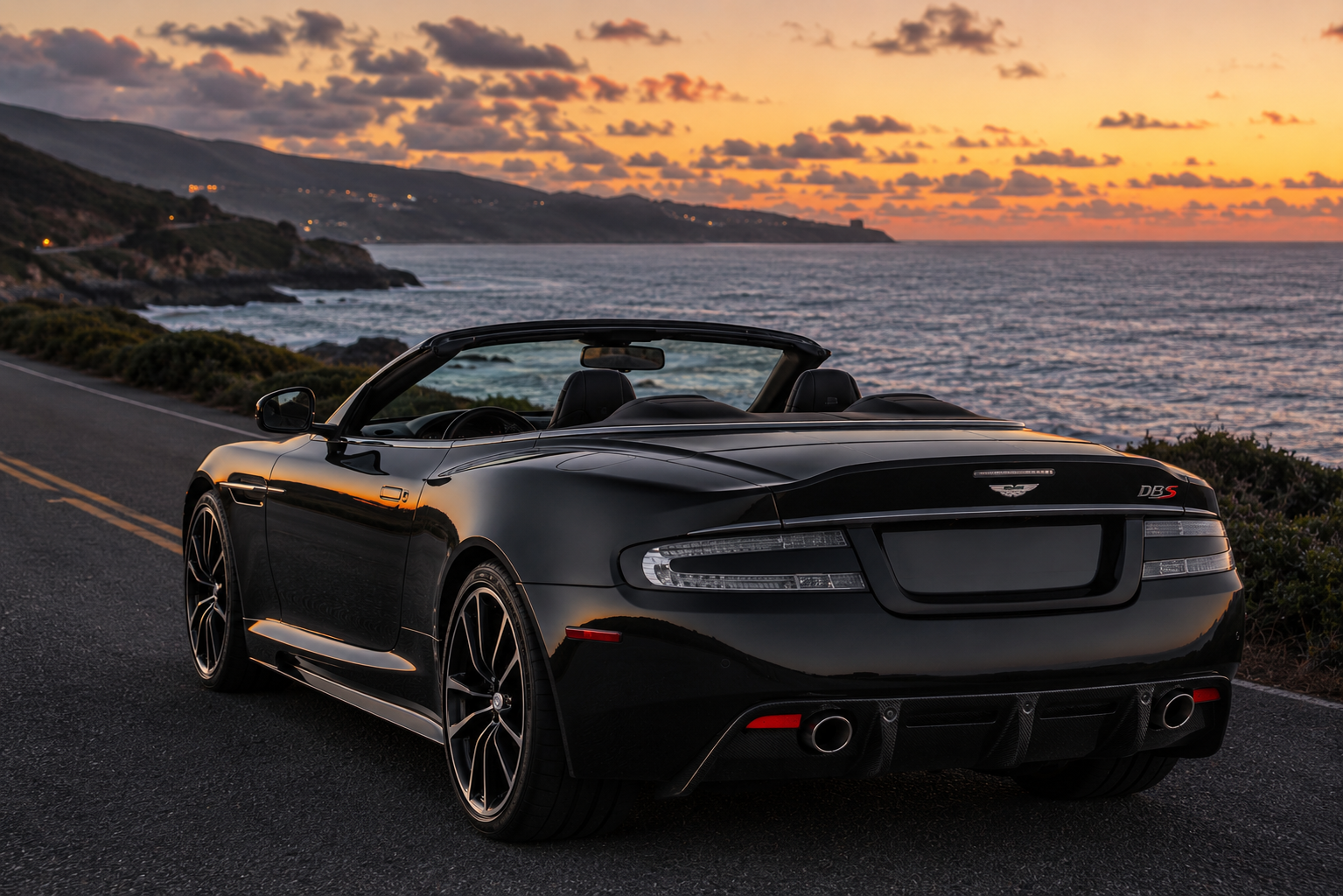
According to Supercars.net, Exotic Car Hacks, and Nicholas Mee, the DBS Ultimate is primarily a cosmetic trim. It is recognisable by a carbon element and dark accents pack: carbon fibre boot spoiler and diffuser, carbon mirror caps, blackened grille, smoked rear lights, Zircotec-treated exhaust outlets, and specific badges with a numbered plate. The calipers could be painted in yellow, black, or red.
The chosen colour palette tightens the visual identity: Carbon Black II, Quantum Silver, and Silver Fox. Inside, the ambience follows the same logic of sporty sobriety, with “DBS Ultimate” markings. The goal is clear: to sign the ultimate batch with an immediately identifiable aesthetic without touching the major components.
On the technical side, sources agree: the mechanics remain identical to that of the standard DBS at the end of production. No increase in power, no specific reworked chassis for the edition; the appeal lies in the combination of the final specification and rarity.
The 5.9-litre V12 and standard carbon-ceramic brakes
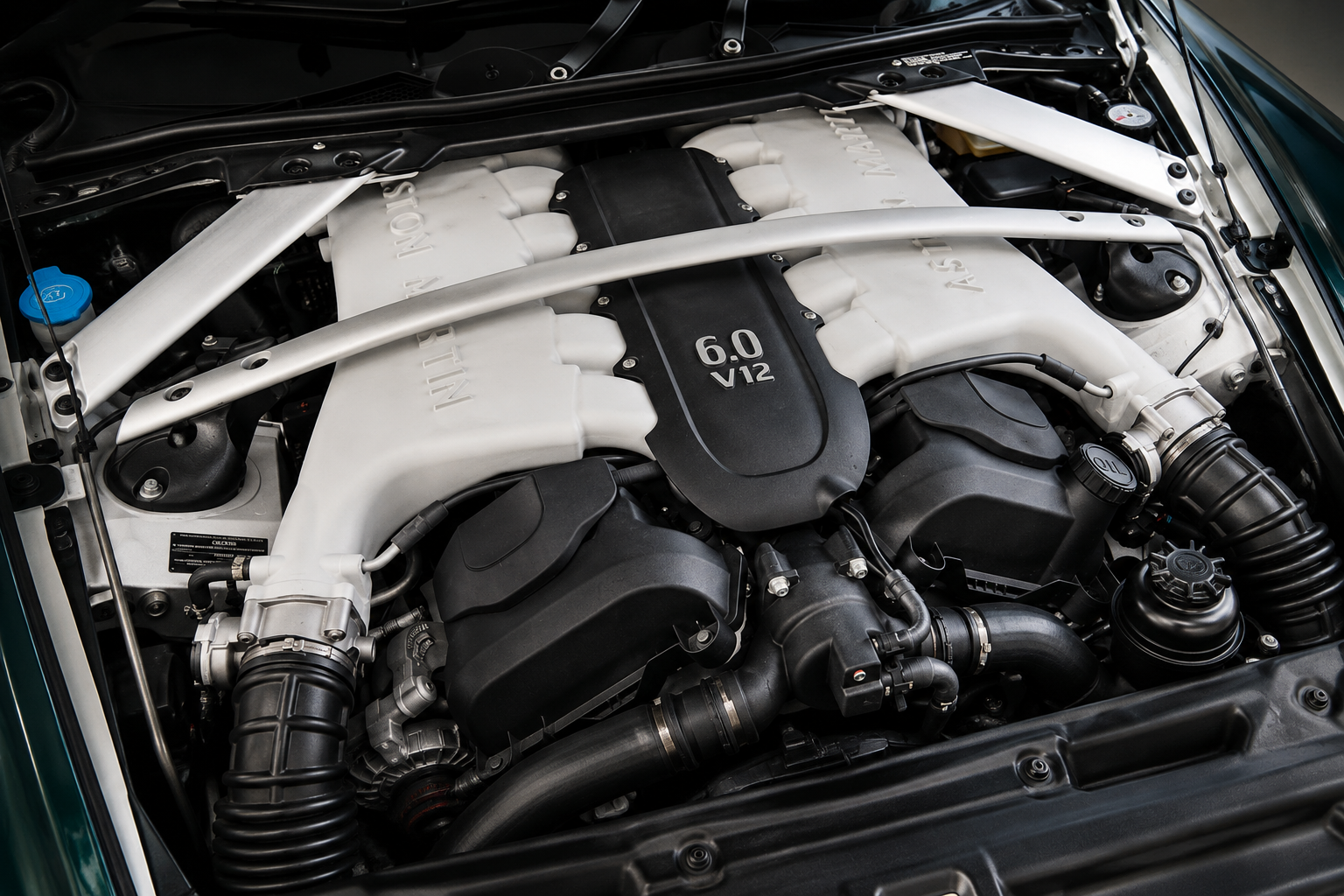
The heart of the model, common to the 2012 edition, is the naturally aspirated 5.9-litre V12 (marketed as 6.0 litres) hand-assembled in Cologne. According to Nicholas Mee, Exotic Car Hacks, and astonmartins.com, it develops 510 hp (517 PS) at 6,500 rpm and 569 Nm at 5,750 rpm. An isolated source (Supercars.net) mentions 572 hp from 2011, a figure not confirmed by specialist guides, which only mention a single mechanical specification.
The advertised performance hovers around 4.2 to 4.3 s on the 0-60 mph and a top speed of 191 mph (307 km/h) (Nicholas Mee; Exotic Car Hacks; auto-data.net). This places the car among the fastest GTs of its time, with a naturally aspirated character and a very distinctive tone.
The coupe introduces two firsts for a road Aston: standard carbon-ceramic brakes (398 mm six-piston at the front, 360 mm four-piston at the rear) and 20-inch wheels (sources: astonmartins.com; Nicholas Mee). These components, already present on the standard DBS, are carried over unchanged on the DBS Ultimate, the keystone of its driving pleasure and braking endurance.
How many examples, at what price, and what is the current valuation
On the volume, sources vary slightly. Astonmartins.com states that there are 100 last DBS produced (June-July 2012). Exotic Car Hacks speaks of a limited edition of 100 units worldwide, available in coupe and Volante, with manual or Touchtronic 2 gearbox. The consensus: the order of magnitude is around 100 units, placing the series among the rarest of road DBS.
For the new price, Exotic Car Hacks cites a price around $280,576 US for the 2012 coupe, to be taken with caution and not presented as certain. The market reality varied according to specifications (gearbox, body) and geographical areas. However, this figure provides a benchmark for the high-end positioning of the farewell edition.
Regarding current valuation, rarity, condition, history, and configuration (colour, type of gearbox, coupe or Volante) weigh heavily. Specialist dealers like Nicholas Mee remind us of the low overall volume of the model (around 3,400 units) and the desirability of late specifications. The numbered edition adds a collector’s premium compared to a standard DBS, especially if the configuration matches the triptych of official shades and the original details preserved.
To read an advertisement correctly, check the correspondence of specific elements (badges, plates, carbon finishes, exhaust treatments, and colours) with the period documentation, and clearly distinguish a DBS Ultimate 2012 from a DBS Superleggera 2019-2023, including its 770 Ultimate. This vigilance avoids costly confusions and protects the heritage value of the model.
Conclusion — DBS Ultimate, the swan song that deserves to be identified
The DBS Ultimate of 2012 condenses the essence of the DBS V12: a GT based on the VH platform, lower and wider than the DB9, powered by a 5.9-litre naturally aspirated engine with 510 hp and standard carbon-ceramic brakes. The farewell edition stands out with specific styling and a production limited to around 100 units, without mechanical evolution.
In an era of confusion with the 770 Ultimate of 2023, retaining these key points allows for informed purchasing, collecting, or simply admiring. To delve deeper into the historical and technical context, consult the Aston Martin DBS 2007 page and the specialist guide from Nicholas Mee, not forgetting the dedicated summary of the edition on astonmartins.com. Finally, follow the lineage by discovering the direct successor, the Vanquish Mk2, and related models like the DB9 and the DBS Superleggera to precisely situate this final series within the Aston Martin legacy.