Tadek Marek shaped the DB4, DB5, DB6 and the 1969 V8. Portrait of a key Aston Martin engineer, from the Newport Pagnell era to today’s legacy.
Tadek Marek is the engineer whose name does not always appear on the bonnet, yet whose engines defined Aston Martin’s voice for three decades. From his move from Austin in 1953 to Newport Pagnell to the development of an all‑aluminium dual overhead cam straight‑six, then a 5,340 cm³ twin‑cam V8 launched in 1969, his mechanical imprint is considerable. This profile retraces his career, his major powerplants and what the brand still owes him today.
Beyond the silhouettes signed by stylists, it is the dialogue between the design office and the workshops that wrote Aston Martin’s dynamic and aural reputation. Here we revisit established technical facts in context, drawing notably on Engines of Change from the brand’s official magazine, the media dossier dedicated to the DB5 and Wikipedia’s reference pages.
Austin, 1953: how a Polish engineer landed in Newport Pagnell and what he found there
In 1953, according to Engines of Change published by Aston Martin’s official magazine, Tadek Marek left Austin to join a small operation in full restart mode: Aston Martin at Newport Pagnell. He arrived in a still artisanal yet ambitious house, where engineering and motorsport conversed daily. This tight context, far from large R&D departments, favoured quick decisions and technical iterations.
On arrival, the challenge was clear: give Aston Martin modern, light and durable powertrains capable of sustaining racing efforts while powering refined road‑going GTs. Marek found workshops close to the track and teams ready to integrate competition solutions into customer‑bound engines.
This environment partly explains the path chosen: all‑aluminium, dual overhead cam engines with a clear, evolvable design. The goal was not spec‑sheet one‑upmanship, but a solid, adaptable base that could endure over time.
The all‑aluminium DOHC straight‑six: the genesis of a unit that powered DB4, DB5, DB6 and DBS
By the late 1950s, the engineer developed an all‑aluminium, dual overhead cam inline‑six. According to the official magazine, this unit powered the DB4, then the Lagonda Rapide, before driving the DB5, the DB6 and the early DBS. Its purpose was twofold: deliver power high up the rev range and keep weight down at the front to preserve GT balance.
The engine began at 3.7 litres in the DB4. For the DB5, the official spec sheets indicate a rebore taking bore to 96 mm and capacity to 4.0 litres, an evolution recorded in Aston Martin’s documentation and its DB5 media centre. This progression illustrates Marek’s philosophy: a sound architecture, able to grow in displacement without sacrificing reliability.
The longevity of this lineage strikes historians. According to Engines of Change, this straight‑six counts among “the longest engine lineages in the history of sports cars”, an assessment mirrored by encyclopaedic references on the DB5. The point is not merely temporal: it is a technical continuum that shapes sound character and reach, from DB4 to the first DBS.
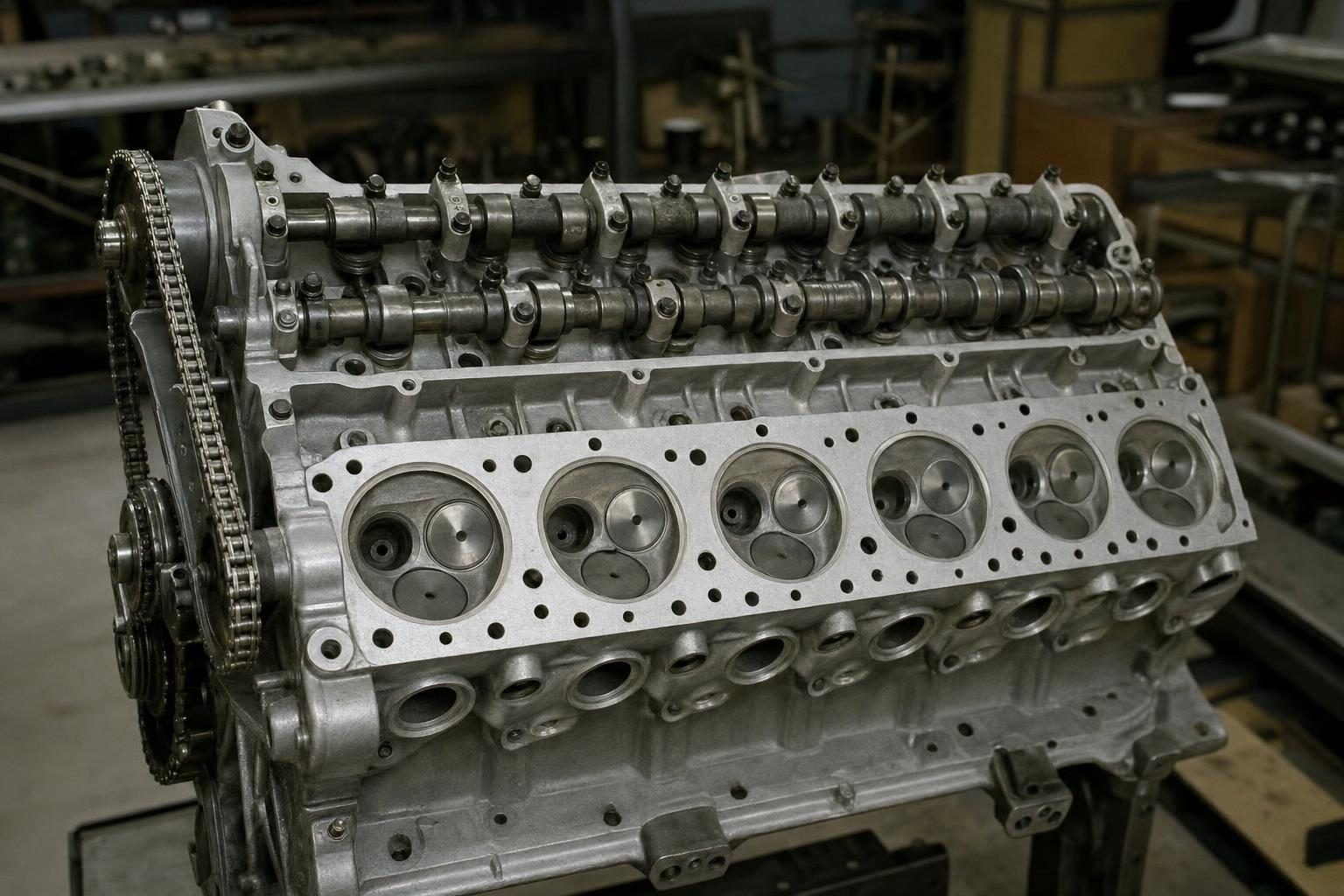
The 5,340 cc V8 of 1969: 20 years of development, 4 iterations, a longevity unrivalled for a niche constructor
In 1969, enter the second pillar by Tadek Marek: a 5,340 cm³ twin‑cam V8. Presented by the official magazine as a base designed to last, this engine propelled the AM V8 and its derivatives into the 1990s. Its period in service — around two decades — remains remarkable for a niche constructor.
Variants followed, with calibrations reflecting the priorities of the moment: grand touring tractability, peaks of performance, then a technical apogee late in life. In the United States, specialists Callaway supercharged this Marek V8 to create the V8 Vantage Le Mans V600 (1998) rated at 600 PS, a final flourish cited by Engines of Change that underlines the headroom in the original architecture.
The commercial and technical continuity of the Marek V8 is evident on the AMV8, and through historical studies devoted to the AM V8 line. The reference pages dedicated to the AMV8 family on Wikipedia confirm the scale and duration of this programme initiated in 1969, which underpinned Aston Martin’s GT offering for nearly a quarter of a century.
To delve deeper into this industrial and technical turning point of 1969, read our detailed analysis of the context and variants in our dossier on the first 1969 V8 and its production history.
Ted Cutting and Tadek Marek, the Newport Pagnell tandem: the porous border between road and race car
At the heart of Newport Pagnell, Ted Cutting, chief designer of racing cars, and Tadek Marek, engine architect, worked on the same floor, literally and figuratively. Engines of Change describes how knowledge gained in competition fed the development of road engines. This back‑and‑forth explains the coherence between GT suppleness and mechanical endurance on circuit.
The porosity between track and road is visible in technical choices: widespread aluminium, dual overhead cams, scope for evolution via bore and settings. It is also measured in a culture of continuous testing, with short improvement loops between the pits and the engine shop.
Beyond the numbers, this pairing says something about Aston Martin’s method at the time: few screens between an idea, the test bench and the customer’s car. Marek’s engines were not showpieces; they were organs designed to take punishment, breathe and progress season after season.
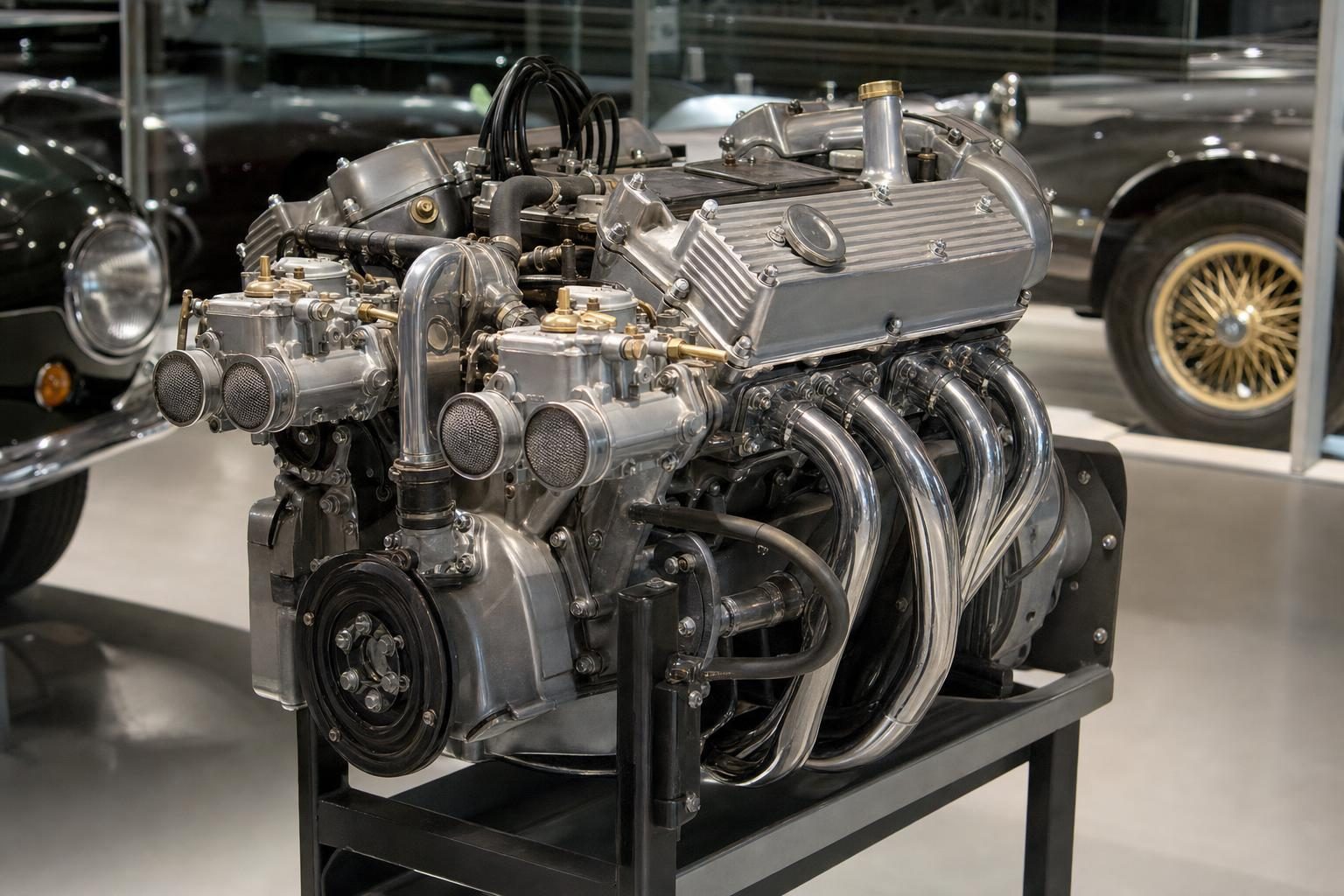
The Marek legacy in today’s range: what the Gaydon V12 does — and does not — owe to the work of the 1950s–1960s
The direct link between historical powerplants and the present is less linear than one might imagine. According to Engines of Change, Aston Martin’s modern V12 does not descend from Tadek Marek’s units: it was developed by Ford from the Duratec V6 for the Indigo (1996) concept. The lineage is therefore cultural rather than genetic.
What today’s range owes the engineer is a kind of technical orthodoxy: noble architectures, light components, and headroom for development built in from the drawing board. The way a powerplant is orchestrated — breathing, efficiency, character — still echoes Marek’s method, even if engines and industrial processes have changed.
We also find the idea of a foundation capable of evolving over a long cycle. The career of the 1969 V8, dotted with versions and tuners’ preparations, foreshadows this modular approach. As for the original straight‑six, its shift from 3.7 to 4.0 litres illustrates the same line: conceive a mechanical heart that accepts growth without denying its virtues.
To place these heritages in time, the archives of the DB5 on Aston Martin’s media site and the encyclopaedic entry dedicated to the DB5 recall the foundational role of the straight‑six, while historical pages on the AM V8 complete the perspective on the longevity of the 1969 V8.
Conclusion — Tadek Marek, the engineer who gave Newport Pagnell its voice
As we close this dossier, Tadek Marek appears as the indispensable counterpoint to the silhouettes that have made generations dream. Two engine families — the all‑alloy DOHC straight‑six and the 5,340 cm³ V8 —, decades of service and a diffuse influence even into the Gaydon era: the balance sheet is written in continuity rather than fireworks.
Even if the modern V12 is not his biological heir, it is the engineer’s methodical rigour that endures: engines designed to last, evolve and say something of Aston Martin with every start. A sober, precise mechanical grammar — in the image of Tadek Marek — that continues to guide the marque.
For further reading, Engines of Change revisits these architectures and their context at Aston Martin, while the official media page and encyclopaedic references set out the technical milestones. Worth exploring, with the modesty befitting those who know how to listen to an engine speak.