Cygnet V8 2018: 5 Ultimate stats on the most absurd city car in history
The Cygnet V8 encapsulates a very British contradiction: turning a micro city car into a road‑legal projectile, while recalling the raison d’être – and the failure – of the production Cygnet. Here, in five figures and some context, is how a one‑off order at Q by Aston Martin flipped from regulatory compliance to a bespoke engineering showcase.
The production Cygnet: a city car born of an EU emissions obligation
At the outset, the Cygnet wasn’t a whim, but a calculation. Its primary aim: to help the marque meet the European Union’s average emissions standards from 2012. According to Wikipedia, this city car was designed to lower the range’s average CO₂ without touching the DNA of the front‑engined GTs.
Built at Gaydon from 2011 to 2013, the production Cygnet is based on a Toyota iQ, deftly reinterpreted: bespoke grille, LED headlights and a cabin to the brand’s standards. Aston Martin presents it as a micro city car with meticulous bespoke finish on its “Past Models” page (astonmartin.com), in the spirit of an urban “accessory” for DBS or Vantage owners.
Production stopped in September 2013, after barely two years. Again, it’s Wikipedia that marks the point: the regulatory experiment was brief, but memorable enough to enter the marque’s folklore.
600 units sold for 4,000 expected: why the outcome disappointed
Ulrich Bez, then CEO, targeted 4,000 units per year. Reality was far more modest: fewer than 600 units in Europe, of which only 150 in the UK, according to the Toyota iQ page on Wikipedia (Toyota iQ). A striking gulf between aim and market that raises questions about positioning.
Why such a gap? The proposition was rational on emissions, less so on desirability. An iQ base, however richly trimmed, remained a pragmatic city car in a universe of sensory GTs. The post‑crisis context and short life didn’t help, nor did the struggle to create a dreamscape around an urban object, however useful, at Aston Martin.
The result reads between the lines: the Cygnet fulfilled its role as a regulatory corrective, without ever becoming a volume seller. The sequel, unexpected, would come from a single client set on flipping the script.
2018: a client commissions the Cygnet V8 via Q by Aston Martin Commission
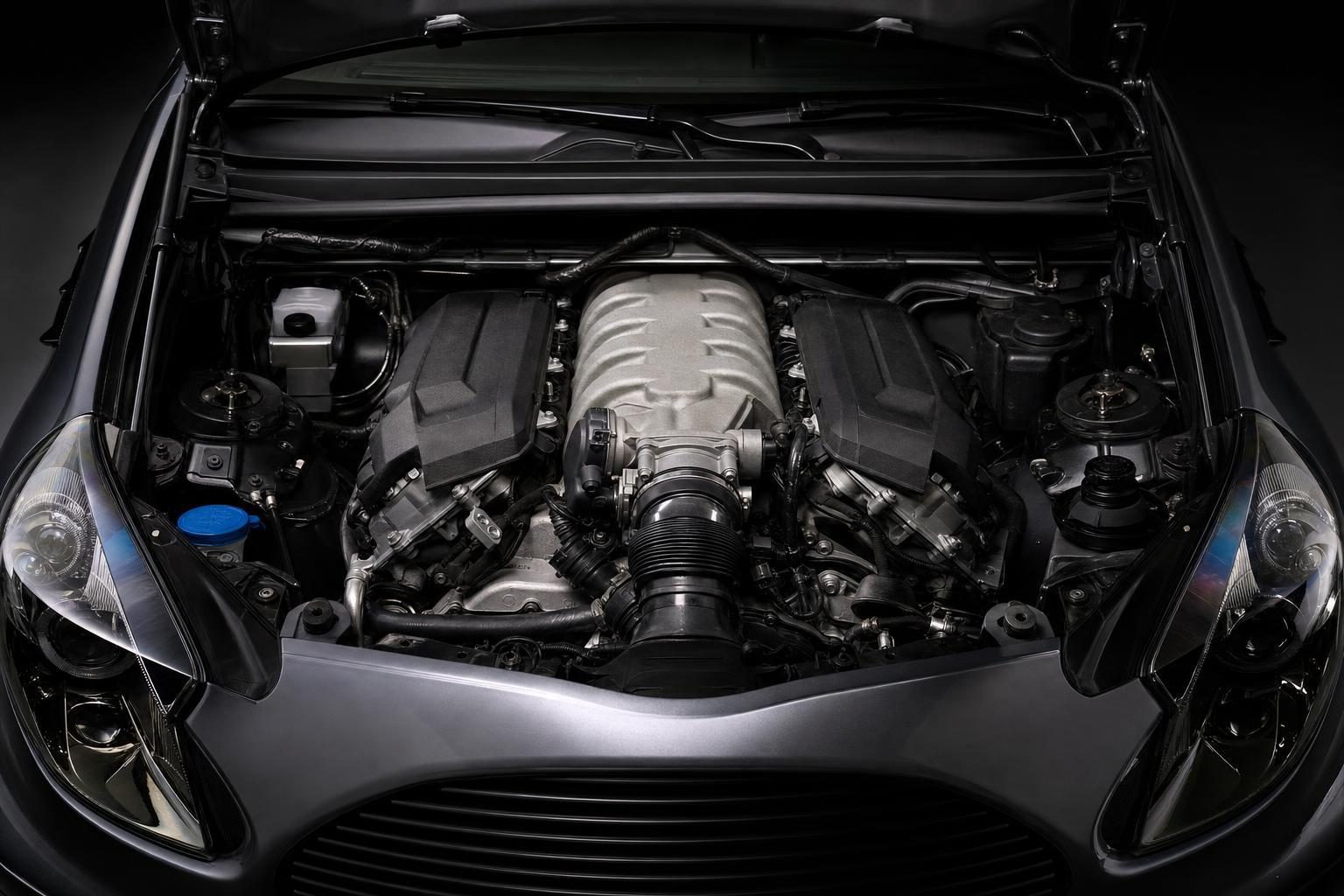
In 2018, a Q by Aston Martin – Commission order changed everything. Revealed at the 2018 Goodwood Festival of Speed, the Cygnet V8 is a one‑off. Aston Martin’s official release details the spec: the Vantage S’s 4.7‑litre V8, 430 PS, 0–60 mph in 4.2 s and 170 mph flat out.
The most astonishing part is the size and weight: roughly 3 metres of bodywork and 1,375 kg on the scales. Power‑to‑weight hits 313 PS/tonne, as confirmed by the same source. The micro city car turned grand‑touring battering ram, almost, but with a wink.
The transformation wasn’t limited to the engine. According to Aston Martin, the production Cygnet chassis was retained, paired with a new integrated safety cage and a widened carbon body. UK dealer Nicholas Mee also revisits these key technical points in its retrospective (nicholasmee.co.uk), echoing the press kit.
4.7 litres and 430 PS in 3 metres of bodywork: what the engineering demanded
Squeezing a 4.7‑litre V8 and its 430 horses into such a tiny volume required a thorough rework. Without listing every part, the elements published by Aston Martin convey the scale of the challenge: integrated safety cage, widened carbon shell and adaptation of the original chassis to handle the extra power and torque. It’s the grammar of “bespoke” pushed to the absurd, yet carried through.
The outcome, quoted at 4.2 seconds for 0–60 mph and 170 mph top speed, puts this minute coupé on par with far larger sports cars. At 1,375 kg and 313 PS/tonne, the Cygnet V8 becomes a spec sheet on wheels, demonstrating the plasticity of engineering know‑how normally reserved for GTs and special programmes.
Beyond the numbers, the point lies elsewhere: this one‑off proves the marque’s ability to answer a singular brief with industrial execution, not a mere show stand special. Hence the interest in reading the V8 in light of the original Cygnet: one born of constraint, the other of whim. Both tell of the same robustness of tooling and method.
Production Cygnet today: prices rising and future classic status
What remains today of the production Cygnet? First, rarity: fewer than 600 units in Europe, built between 2011 and September 2013. Then, a charming paradox: an urban Aston Martin, from a Toyota iQ base, but finished in earnest, as the official Aston Martin pages remind us.
Rarity and a short career are enough to stoke enthusiasts’ curiosity. The Cygnet has found its place in the brand’s “oddities” album, alongside other uncommon projects. For a concise view of the production model, our dedicated file gathers the key markers: history, production and specifics of the Cygnet.
In this mirror, the Cygnet V8 remains an absolute exception: a singular, Q‑signed commission, unveiled at Goodwood in 2018 and built on a reinforced original chassis. It isn’t meant to set market values; it rather reminds us that an inspired client and a well‑equipped house can move mountains… or a V8, in a space this small.
Conclusion: what the Cygnet V8 says about Aston Martin’s bespoke engineering
It starts with a city car born of a European obligation and a goal of 4,000/year that would never be met. It ends with the Cygnet V8, a one‑off with 430 PS and 4.2 s 0–60 mph, revealed at Goodwood 2018, a discreet symbol of Q by Aston Martin’s potential. Two sides of the same story: constraint and freedom.
To put these figures in perspective, revisit the V8 Vantage that donated the engine via our reference profile: the V8 Vantage (2005), genesis of a modern V8. And to extend the curiosities chapter, our in‑house selection: five unusual Aston Martin anecdotes. In short, the Cygnet V8 is more than a wink: it’s a demonstration, at micro city car scale, of what “bespoke” engineering can do when a client asks.
AMR1 Group C 1989: 4 Ultimate truths Aston Martin prefers to hide
The AMR1 Group C is not a tale of failure, but of a serious technical gamble, abruptly halted by a regulatory change of course. Here, without embellishment, is what you need to know about the 1989 programme: its engineering structure, its kevlar-carbon and V8 architecture, its Le Mans weekend, the unfinished AMR2 and the fate of the chassis. The aim: to put facts at the centre, based on what Aston Martin’s archives and the dedicated Wikipedia page establish.
Protech: the secret structure created to design the programme
To rejoin the World Sports Prototype Championship scene in 1989, Aston Martin relied on an ad hoc entity: Protech, for Proteus Technology Ltd. According to the page devoted to the AMR1, this structure brought together Peter Livanos, Victor Gauntlett, Richard Williams and Ray Mallock, via Ecurie Ecosse. Conceived as an engineering accelerator, the set-up avoided overloading the factory and concentrated talent around the Group C project.
Protech acted as an agile laboratory. The era demanded clear-cut technical choices and rapid development. By creating a British-style “skunkworks”, Aston Martin gave itself a rare degree of leeway in an environment still dominated by heavyweights such as Sauber-Mercedes, Jaguar and Porsche. The programme’s foundations were solid, the ambition measured, the method pragmatic.
People sometimes remember the brevity of the programme and forget its rigour. The formation of Protech, described by Wikipedia as a harness uniting industrialists, executives and tuners, explains the technical coherence that followed. It is also what enabled rapid iteration between AMR1 and the future AMR2, alas caught out by regulation.
Kevlar-carbon monocoque and a developed road-car V8: the project’s architecture
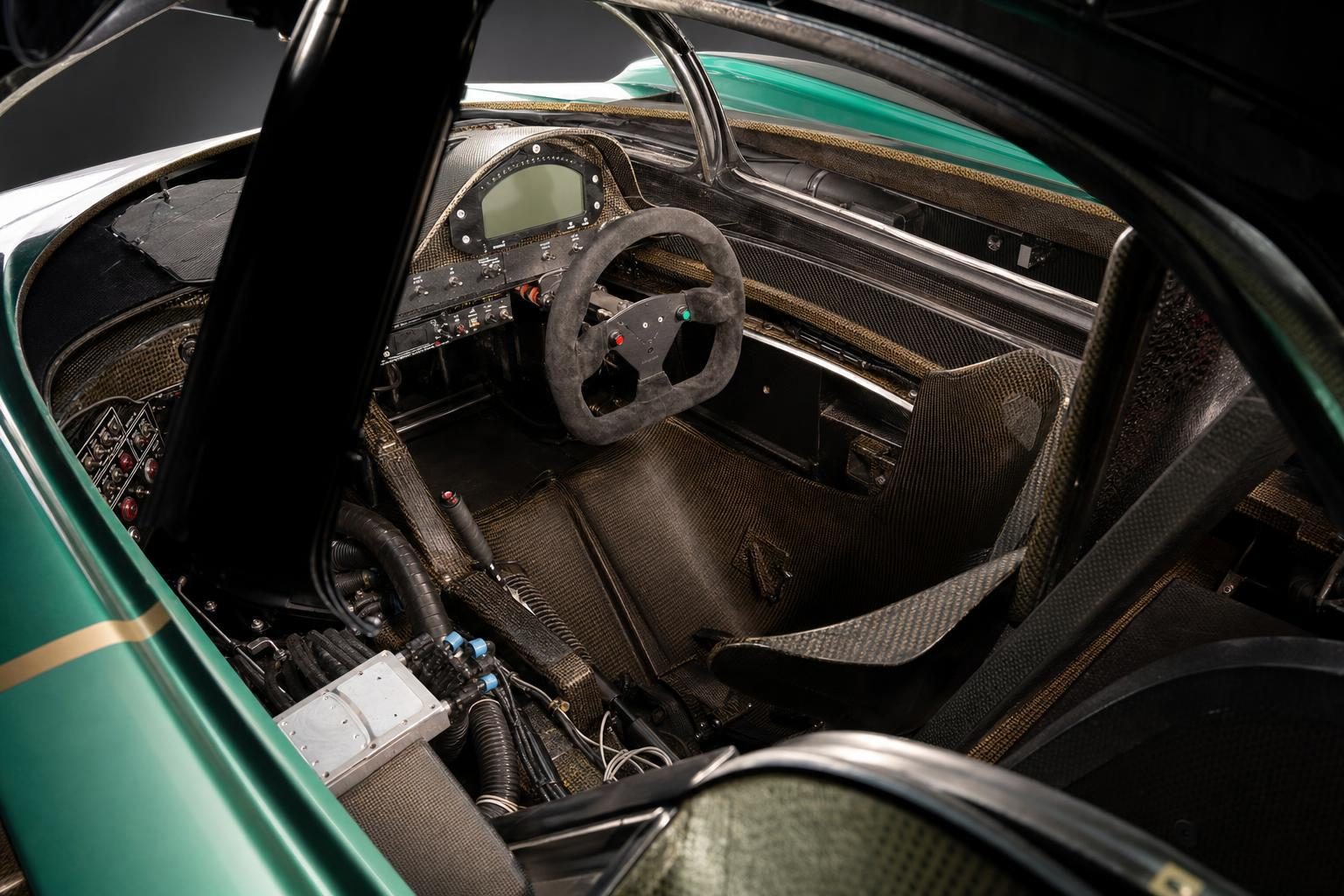
The AMR1’s technical basis centred on a kevlar/carbon monocoque, highlighted by Aston Martin as a radical technology in 1989. The goal was clear: rigidity, safety and weight control, in the service of efficient long-duration aerodynamics. For a tradition-steeped constructor, this choice signalled an assumed generational leap.
On the powertrain side, the programme relied on a large-displacement V8. Publicly available elements focus chiefly on chassis structure and materials, but the 1989 context logically places this V8 at the heart of a performance/endurance balance. This composite monocoque and V8 duo reflects the spirit of Group C: aerodynamic efficiency, mechanical robustness and fine management of endurance constraints.
The technical stance was no mere affectation. It aimed to bridge the gap to the benchmark teams on the grid, while preserving what the marque does best: an expressive, long-legged engine encased in a modern shell. In Aston Martin’s documents, the kevlar-carbon monocoque is indeed presented as the most disruptive element of the package.
Le Mans 1989: 32nd and 40th on the grid, then an early retirement for one of the two chassis
At the 1989 24 Hours of Le Mans, the competitive snapshot is precise. According to Wikipedia, the two AMR1 chassis qualified 32nd and 40th out of 56 cars. A modest grid position, but logical against top-tier opposition. More than anywhere else, Le Mans remains a technical and methodological filter: the slightest approximation is punished on the spot.
The race was cut short for chassis #03, forced to retire in the first half of the event due to electrical problems. The other car continued, though little more can be inferred than this lesson: sorting an endurance prototype requires mileage, and 1989 did not really offer a second chance.
It helps to place that Le Mans in the brand’s perspective. Between the foundational DBR1 victory in 1959 and more recent GT campaigns, the AMR1 embodied a return via the toughest route, the top tier of sports-prototypes. The learning curve there is implacable, yet it structures what follows.
The unfinished AMR2: how an FIA regulation killed the programme in six weeks
At the end of 1989, the FIA announced the switch to naturally aspirated 3.5-litre engines for 1991. According to Wikipedia, this decision sealed the programme’s fate: Protech closed in February 1990, even before the AMR2/06 chassis was completed. Six weeks between decision and execution, and a project stopped dead.
The irony is brutal. The Version III 6.3-litre V8 planned for AMR2 is indicated as more powerful, with a promised top speed of over 230 mph on the straight, where the AMR1 had been limited. The technical iteration was under way, and the answers to identified weaknesses were ready to test. The regulatory framework shut the door just as maturation began.
This regulatory shift, a major one, is no mere footnote. It redrew the entire endurance ecosystem and pushed players to rethink their approach. At Aston Martin, it left an interrupted project, immobilised investment and an incomplete learning curve. It reads less as a defeat than as an exogenously induced “missed opportunity”.
Where the AMR1 chassis are today: collections, auctions and historic circuits
The fate of the chassis sheds light on the programme’s heritage value. According to Wikipedia, AMR1/01 belongs to the Aston Martin Heritage Trust. AMR1/03 went under the hammer in 2004 for 294,250 euros. And AMR1/04 was the first to be sold at auction in 2000 for 133,500 pounds sterling. These markers state something simple: history attracts interest, especially when it is rare.
These prototypes appear periodically at historic events, witnesses to a period of technical transition. To grasp the wider arc of competition at Aston Martin, this chapter can be set alongside the marque’s subsequent GT successes, embodied by the DBR9 entered in GT1, and a Sarthe centenary full of twists, summarised in our Le Mans and World Championship dossier.
Beyond the sums, it is the AMR1’s place in the collection that intrigues. It illustrates a “composite + big V8” path that the AMR2 was meant to elevate. In a marque where racing feeds identity, these chassis are technical milestones more than trophies. They are judged by the lessons they left behind.
Conclusion – AMR1 Group C, a technical venture halted yet coherent
The AMR1 Group C did not deliver its full potential, not through any lack of ambition, but because of a sudden regulatory scissor effect. Protech enabled a swift, well-executed assembly of a solid base, the kevlar-carbon monocoque returned Aston Martin to the material standard expected in 1989, and the AMR2 promised to address top-speed limitations. The Le Mans results remain modest, the facts are stubborn; but the trajectory itself was coherent.
To extend your reading on the manufacturer and historical context, see the official Aston Martin site and the reference page on Wikipedia about Aston Martin. The AMR1 Group C deserves neither oblivion nor flagellation: it simply deserves to be put in its place, that of a serious attempt cut down by regulation.
DB7 Zagato 2002: 5 Ultimate Facts on an Anglo-Italian Revival
DB7 Zagato, or how an idea born around a dinner table reshaped the DB7’s twilight years with Milanese precision. This article revisits, in five points and without folklore, what this short, feisty coupé truly brings over the ordinary DB7 GT: anecdotal genesis, measured weight saving, retuned power, tightly defined sales geography and its American alter ego, the DB AR1. Enough to guide collectors on the technical and cultural originality of this short series, and to place the DB7 Zagato among the Astons that matter.
The Pebble Beach accord: a dinner as the act of birth
At Pebble Beach in 2001, a dinner seals the idea: Ulrich Bez, then CEO, and Andrea Zagato agree to revive an Anglo-Italian lineage thought consigned to the archives. According to media.astonmartin.com (confirmed by Aston Martin news published in 2018), the conversation moves quickly from intent to project. The alliance is no whim: it reactivates a shared post-war design language, transposed onto the DB7’s V12 platform.
The official reveal comes at the 2002 Geneva Motor Show, where the project is announced. The preliminary drawings are by Nori Harada (Zagato), then revised by Henrik Fisker on the Aston side, again per media.astonmartin.com. The brief: condense the essence of the DB7 into a short coupé, instantly legible, with that signature double roof blister and a shortened tail, to create a clear visual break from the DB7 GT.
For the collector, context matters. The DB7 Zagato beautifully closes the DB7 decade, synthesising Aston Martin’s renewed ambition in the early 2000s and Zagato’s sculptural eye. The result goes beyond a mere special series: it is a variation in character, designed to be felt as much as seen.
Hand-formed steel bodywork: 60 kg less than the GT
Despite the headline evoking steel, the bodywork of this coupé was crafted mainly in aluminium at Carrozzeria Zagato in Milan. According to specialist Nicholas Mee, this specific skin lightens the car by around 60 kg compared with the DB7 GT, a key figure that changes how this Aston turns in, brakes and picks up. The Milanese intervention goes beyond style: it is a tactile rethink of the shell, tighter and shorter, in the service of dynamics.
This weight saving is not a throwaway number. It results from more artisanal construction and simplified volumes, with aluminium panels shaped by hand. In a world then dominated by excess weight, this Aston embraces a discreet yet effective “diet” approach. Again, far from a mere badge: the DB7 Zagato is lighter, shorter and, on the road, it shows.
Practical upshot: front-end response feels keener, and the more compact rear calls for a flowing yet engaged driving style. In collecting terms, these tangible differences — more than the badge on the wing — justify the DB7 Zagato’s distinct standing versus a well-kept GT.
440 PS and 6-speed manual: the most concentrated DB7
The DB7 Zagato’s 6.0-litre V12 is quoted at 440 PS by astonmartin.com, while other sources cite 435 ch (Nicholas Mee) or 441 PS (Wikipedia). The discrepancy comes down to units (French ch, metric PS) and rounding, but the intent is clear: the DB7 GT’s powertrain is sharpened here to deliver a crisper response, matching the shortened footprint.
The transmission sets the tone: 6-speed manual only for the coupé, a choice that roots this version in old-school purity. This stance, confirmed by astonmartin.com, contrasts with the DB7 GT’s versatility, often delivered as an automatic. On the road, the blend of contained weight and manual gearing heightens the “concentrated coupé” feel: less fat, more intent.
In use, the DB7 Zagato does not chase lap times; it seeks harmony between hands and machine. The engine suits a measured, rhythmic drive, and the 6-speed lever becomes the punctuation. That is where the DB7 Zagato truly diverges from the GT: same base mechanicals, but a purer, more involving interpretation.
99 examples in Europe, 99 DB AR1 in the United States: two separate markets
Rarity here is perfectly orchestrated. According to Wikipedia, 99 DB7 Zagato customer cars were built, with a 100th kept by Aston Martin for its museum. Availability was limited to the UK, Europe and South-East Asia, as also confirmed by official documentation.
Across the Atlantic, the American Roadster 1 — DB AR1 — takes up the theme but offers a radically different reading: a roofless roadster with no weather protection, limited to 99 examples for the US market, as noted by astonmartin.com. Where the coupé is a short, dense blade, the AR1 is lived as a sun-soaked happening, unapologetic right down to the absence of a hood.
A final notable difference: the DB7 Zagato is manual; the AR1 prefers the Touchtronic automatic. Two temperaments, two continents, two experiences — and, for the collector, two distinct frameworks. This strict market separation still sustains each model’s identity today.
Values and today’s market: what DB7 Zagatos are worth now
The DB7 Zagato market remains narrow by design: 99 cars delivered, a network of informed buyers, and few public appearances. Values rest as much on the spec sheet as on the story: founding dinner at Pebble Beach, body shaped in Milan, exclusive manual gearbox and a deliberate contrast with the GT. These are the arguments that put the DB7 Zagato on a collector trajectory, beyond cyclical fluctuations.
To judge an example, look at body fit quality, the correctness of model-specific parts and the V12’s service history. A test drive beats a thousand words: the circa 60 kg saving, as reported by Nicholas Mee, should be felt in placement and pick-up. Original Zagato details and a complete photo file bolster desirability.
Lastly, the transatlantic DNA enriches the big picture. The 99 US-only DB AR1s, with Touchtronic gearbox and “open only” philosophy, do not compete head-on with the DB7 Zagato: they complement it. Together they define the 2002–2003 bracket, when Aston and Zagato signed a rare diptych, each carefully assigned to its audience.
Conclusion: why the DB7 Zagato remains an essential parenthesis
The DB7 Zagato is not a cosmetic tweak: it is a complete proposition, born at Pebble Beach, announced in Geneva in 2002, lightened in Milan and delivered in 99 coupés — while 99 AR1s basked in the American sun. Between 435 and 440 PS depending on sources, a 6-speed manual and a body shaped largely in aluminium make for a sharper portrait than the DB7 GT. For anyone seeking an Aston with character, the DB7 Zagato concentrates the essentials, with that blend of British understatement and Milanese line that ages well.
Virage 1988: 4 Ultimate Decisions That Shaped a Newport Pagnell Decade
Virage 1988: here is the discreet milestone that redefined Aston Martin’s decade at Newport Pagnell. Often masked by the aura of its successors, this model nevertheless concentrated four foundational decisions — design, engine, derivatives and volumes — that set a new grammar for the brand. Drawing on official sources, we revisit a turning point where artisanal elegance met an engineering rigour inherited from racing.
A design contest won in three months by two unknowns
Unveiled at the British International Motor Show in Birmingham on 18 October 1988, the project took everyone by surprise. According to media.astonmartin.com, Aston Martin launched a fast-track design competition, wrapped up in three months, won by John Heffernan and Ken Greenley. Two names then almost unknown to the general public delivered a low, taut silhouette with a square tail and clean volumes — a very late-80s language that broke with earlier V8s without disowning them.
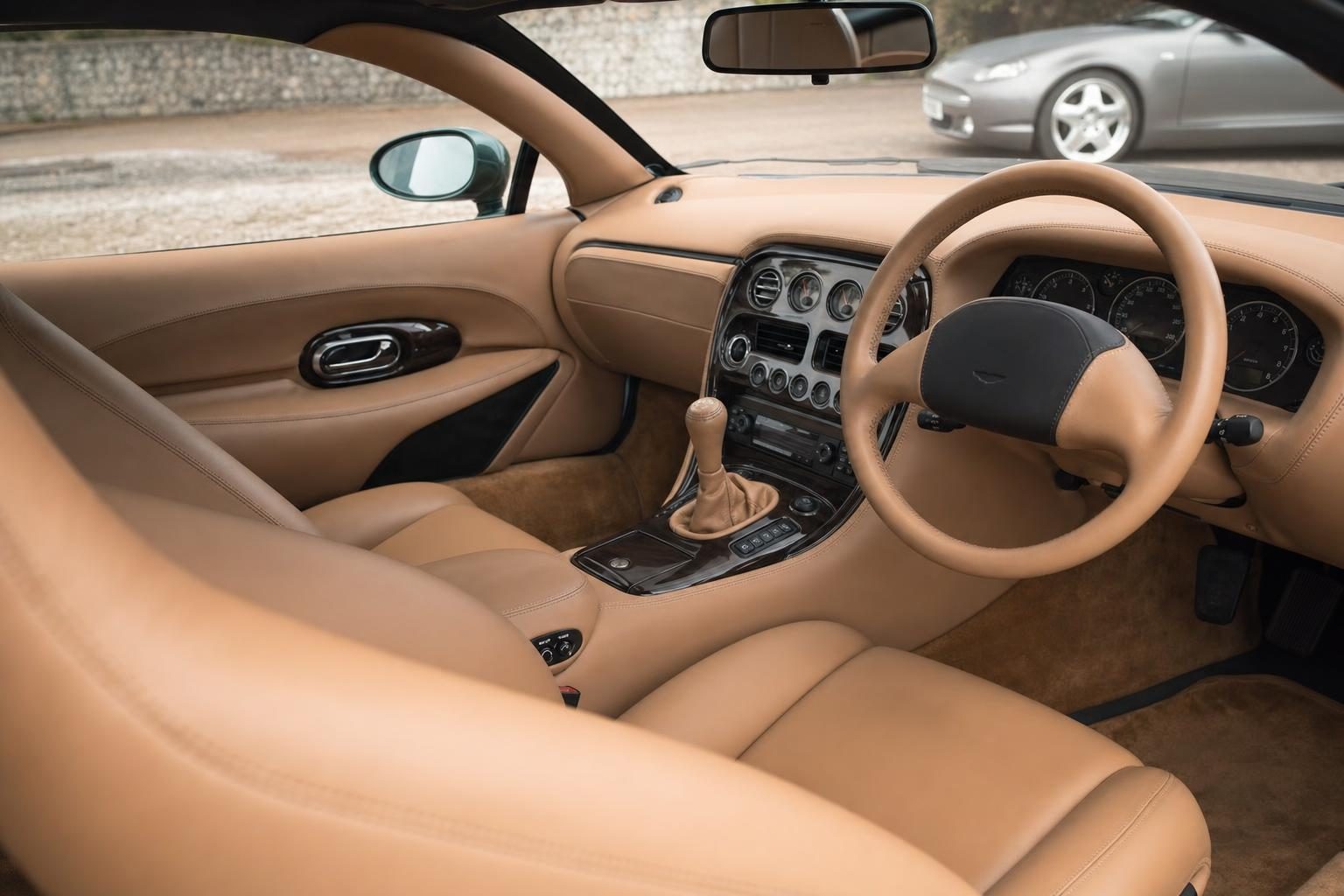
This contest-led choice is no anecdote. It established a method rather than a mere style: a clear brief, rapid decisions, production without dilution. The car revealed in 1988 looks restrained, almost understated, but it heralds the next decade: muscular proportions, reduced glazing, strong road presence. The historic Virage model also reinstates the grille as a structuring graphic signature, without retro pastiche.
As for the name, it came from within. Again per the official press room, Victor Gauntlett and his directors chose it from ideas proposed by employees and AMOC members. A “Virage” for a brand at a turning point: a French wink, just enough panache for an English coupé. For more, see our complete Virage file and its variants.
The four-valve V8: the discreet legacy of AMR1 competition
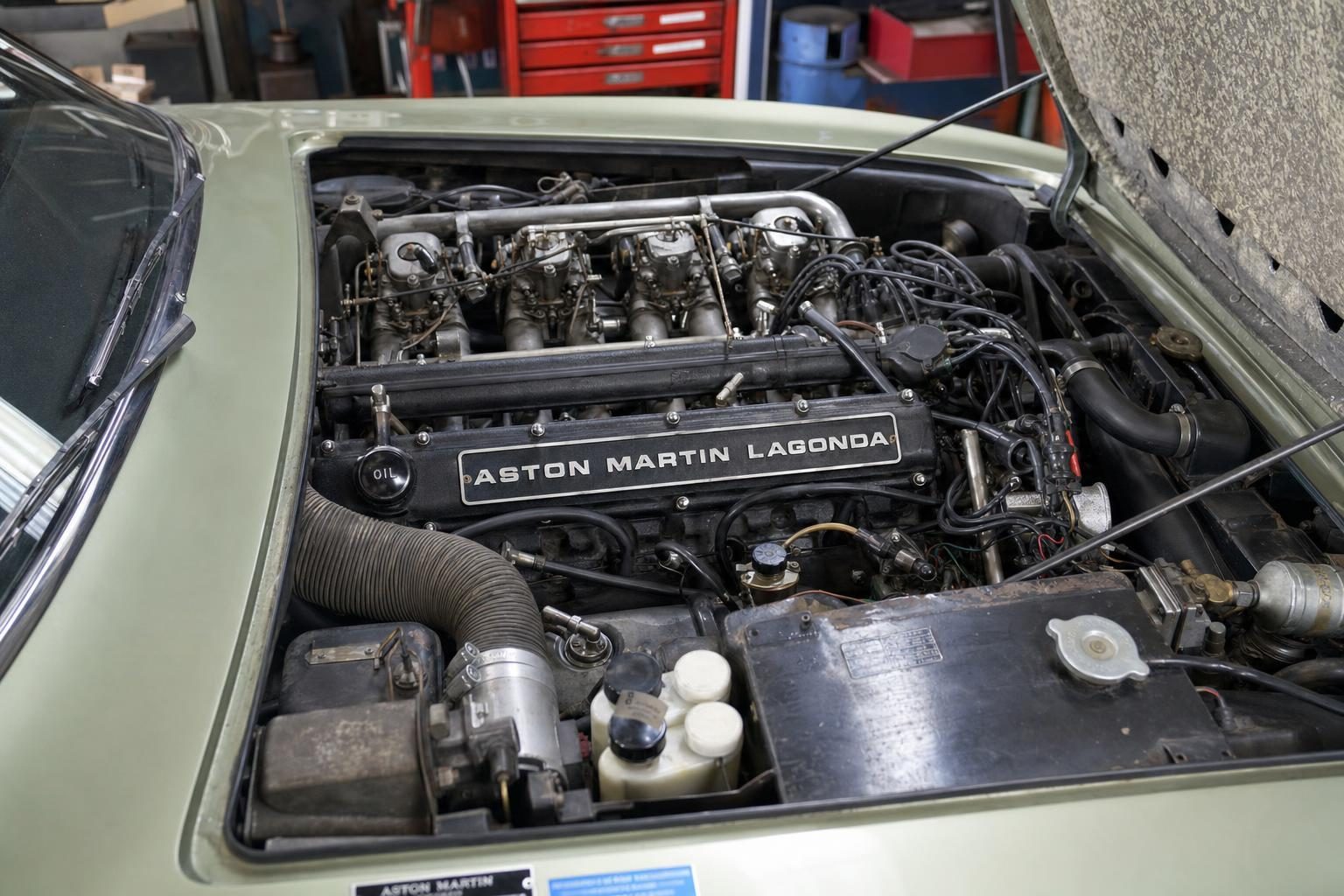
At launch, the 5.3-litre V8 received four-valve-per-cylinder heads, an advance documented by Aston Martin. The message is clear: refreshed aesthetics backed by modernised engineering. The architecture remained familiar to clients, but top-end breathing and cruising ease gained in clarity. The powertrain assumed its role as the decade’s backbone.
The most telling lineage would arrive in January 1992 with the 6.3-litre conversion. According to Wikipedia, this bored-and-stroked 6.3 traces its roots to the AMR1 racing car, an endurance runner. The quoted output varies by source compiled by the encyclopaedia, between 456 and 500 PS: a credible range reflecting evolutions and configurations. The essence lies elsewhere: a deliberate transfer of track-to-road know-how, serving a more authoritative grand tourer.
This technical link with the AMR1 makes the 1988 Virage a bridge. Without fanfare, it installed in series production the idea of a sharpened, exploitable V8, ready for more radical derivatives. To place this strategy in the long view, our history of the brand and its legend provides useful context.
Volante, 6.3 and 550 PS Vantage: three cars within one family
The programme’s strength is its plasticity. The initial coupé set the base, the Virage Volante distilled the open-air version, and mechanical evolutions redefined the hierarchy. In 1992, the 6.3 conversion amped up the DNA: more visual wheelbase, wider tracks, greater presence. According to Wikipedia, quoted outputs for these 6.3s vary, from 456 to 500 PS, a reminder that Aston Martin worked to order, in the Newport Pagnell spirit.
Then came the Vantage in 1993, again per Wikipedia, with a twin-supercharged 5.3-litre V8 peaking at 550 PS. It’s a different animal, more brutal, yet of the same lineage. The architecture, the principles, the chassis genes: the kinship is clear. The 1988 Virage is thus a family more than a single model, spanning a spectrum from hushed grand tourer to showpiece muscle car.
Rarity also works as a magnet. There are only 19 Virage Volante 6.3 “wide-body” according to specialist Nicholas Mee. A statistic that partly explains today’s appetite for unusual configurations and the diversity of values across body styles and specifications. For the parallel genealogy of road V8s, our overview of the AMV8 and its evolutions is a useful guide.
1,050 units in twelve years: deliberately contained production
Total volume remained measured: 1,050 units across all variants by end-2000, according to Wikipedia. At the scale of artisanal production, this figure is no accident. It reflects a deliberate scarcity strategy, aligned with the pace and capacities of Newport Pagnell. Build quality, meticulous assembly and personalisation explain the cadence.
Twelve years is long for a technical base, but coherent with house tradition. Mechanical evolutions (four-valve heads, 6.3, then 550 PS Vantage) punctuated the life cycle without a brutal break. Again, the 1988 Virage is less spectacular than influential: it carried a complete cycle, adapted, and eventually yielded to newer architectures, without ever straying from its backbone role.
This numerical frugality has two consequences. For collectors, each example becomes a piece with clear, traceable pedigree. In the market, the spread of configurations and power outputs creates very distinct sub-segments. The “Virage” label covers different realities, from the original coupé to the supercharged Vantage, which means assessing cars case by case.
Why the Virage remains the blind spot of the Aston classics market
In collecting, reputations can hinge on caricature. The 1988 Virage long paid for its “fin de siècle” style, less baroque than its elders and less techno than its juniors. Yet its strengths are tangible: restrained yet clean design, modernised engine, an explicit link to the AMR1, and a family of variants to suit all appetites. The official 1988 announcement indeed places this model as a pivot, not a parenthesis.
The market loves neat narratives. Here, everything is nuance. The four-valve 5.3 embodies classic grand touring; the 6.3 channels the racing legacy; the 550 PS Vantage speaks to thrill seekers. This plurality is the 1988 Virage’s richness, but it muddies the soundbites. Result: an image “blind spot” rather than a weakness of substance.
Finally, time-calibrated rarity (1,050 cars) sustains micro-markets. A Volante 6.3 wide-body — 19 units, per Nicholas Mee — is not comparable to an original 5.3 coupé. Usual metrics (production, power, silverware) are not enough; you must consider internal genealogy, condition and factory correctness. That is where the 1988 Virage reveals its virtues: a precisely storied piece, made to be understood as much as desired.
Conclusion — why the 1988 Virage truly changed the game
Placing the 1988 Virage back in its era clears up many misunderstandings. Selected by competition, named by the company itself, powered by a modernised four-valve V8 that would yield an AMR1-inspired 6.3, it then unfolded a coherent lineage through to the 550 PS Vantage. In twelve years and 1,050 cars, it imposed a method — and it is often method that shapes decades.
For the informed enthusiast, the lesser affection for the 1988 Virage is an invitation rather than a verdict. It opens doors to well-born examples, rare variants, and a compelling technical reading of the 1990s transition. All told, a “virage” that lives up to its name.
Road to Race WEC 2026: 5 Ultimate Behind-the-Scenes from THOR at Imola and Spa
Road to Race WEC 2026, the documentary series following Aston Martin THOR at the heart of the paddock, opens its Season 2 with two contrasting acts: Imola, first promoted to opening round by a shaken-up calendar, then Spa, the stage for a clear step forward. On the menu: sporting context, technical choices and team dynamics, to understand what these six weeks really changed in the build-up to Le Mans.
We decode what Road to Race WEC 2026 shows — and what it doesn’t — linking the footage to established facts: a season opener switched to Europe, a Valkyrie stringing together points finishes before sealing its best WEC result at Spa, and a doubled LMGT3 entry on THOR’s side. All with the subtext of a unique road-derived hypercar racing on two continents.
A reshuffled calendar: why WEC 2026 started at Imola
Season 2 of Road to Race WEC 2026 opens at Imola for a simple reason: the initially scheduled Qatar opener (1812 km) was postponed to October 2026 due to the war in Iran, making Imola the first round of the year. According to the Wikipedia page dedicated to WEC 2026, this rearrangement reshuffled the deck from the outset, forcing teams to adjust their logistical and technical plans.
This shift weighed on preparation: Europe replacing the Middle East at short notice meant teams had to reconfigure test windows and freight flows. In this fluid context THOR launches its campaign, the cameras of Road to Race WEC 2026 trained on the workshops and the pit wall, between caution and the opportunities offered by a demanding circuit.
Imola, with its succession of chicanes and loaded braking zones, is hardly a “warm-up lap”. The documentary shows the team settling into this new tempo, while the WEC formalises its results and sporting narrative. For an overview of the Imola round, it’s worth consulting the series’ report via the FIA WEC news page dedicated to the race.
The Valkyrie at Imola: ninth place and a third consecutive points finish
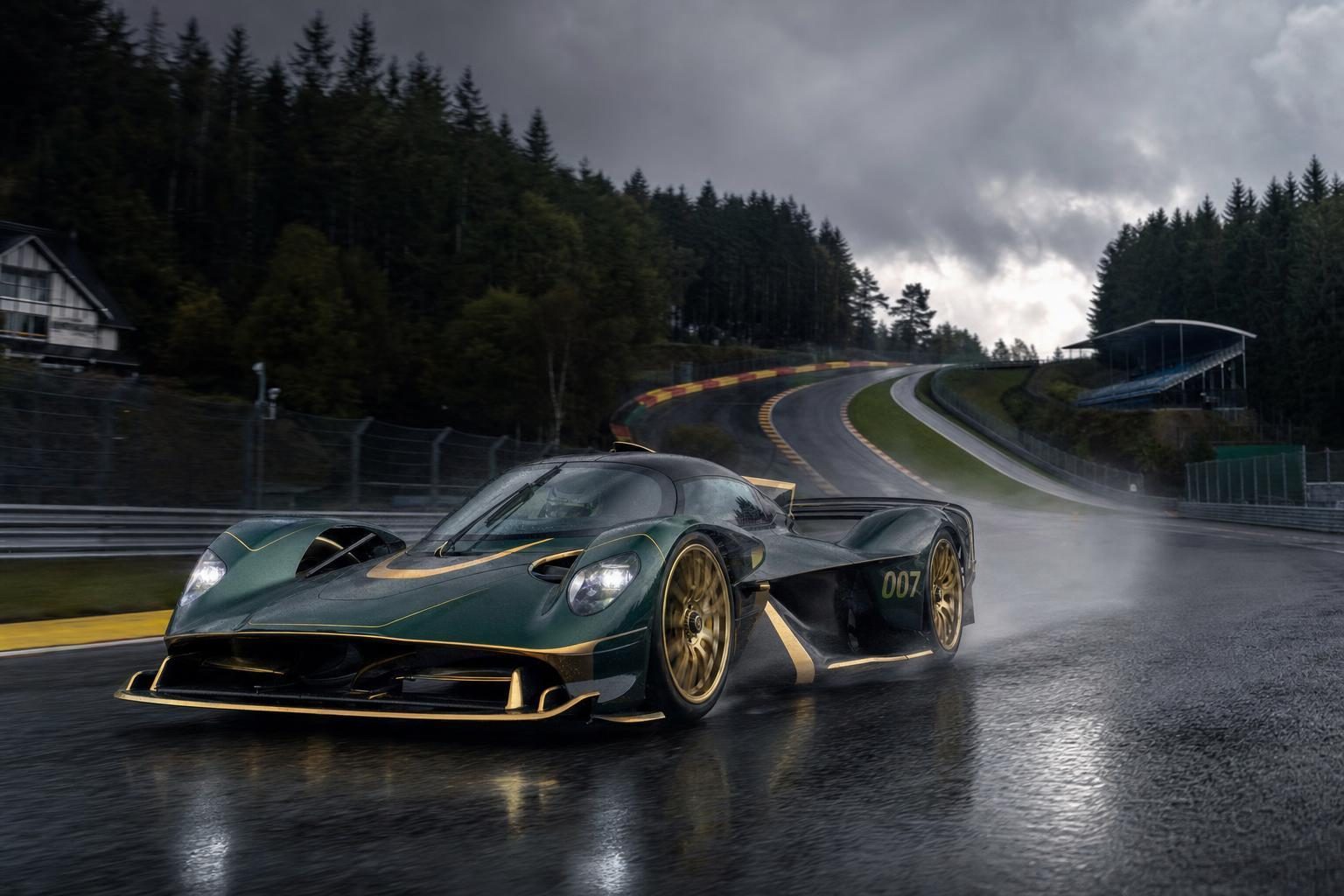
At Imola, Road to Race WEC 2026 captures the essentials: THOR’s #007 Valkyrie, entrusted to Harry Tincknell and Tom Gamble, finishes the race in ninth position. According to astonmartin.com (5 May 2026), this marked the third consecutive points finish for the Valkyrie in the WEC, after two top 10s recorded in Japan and Bahrain at the end of 2025.
This ninth place is worth more than a simple statistic. On the one hand, it extends a run of consistency that underpins the programme’s progression. On the other, it comes in the context of a reconfigured calendar, with no margin for error on a circuit that punishes imprecision. The documentary, for its part, stages set-up work under pressure and traffic management — the lifeblood of a hypercar in accelerated learning.
Another salient point recalled by astonmartin.com: the Valkyrie entered by THOR is the only hypercar derived from a road-homologated car to race simultaneously in the WEC and the IMSA WeatherTech SportsCar Championship. This double life imposes technical and operational choices that are hinted at throughout Road to Race WEC 2026 — and which would help explain, in part, the ramp-up seen at Spa.
Spa-Francorchamps: the Valkyrie’s best WEC result before Le Mans
At Spa, Road to Race WEC 2026 documents a genuine step: the #007 Valkyrie completed the 6 Hours in fourth place, the programme’s best WEC result to date, before an eighth place at Le Mans. The progression is clear and, according to astonmartin.com (14 June 2026), it crowned a run of points finishes with an overall performance finally reflected on the results sheet.
The interest of Spa, in this story, also lies in Aston Martin’s history with the Ardennes: the brand took the first GTE win of the WEC era there in 2012, and the Vantage had, before 2026, six class victories and fourteen further podiums. The documentary doesn’t dwell on it, but the backdrop matters: it illuminates internal expectations at a circuit that has often smiled on Gaydon’s cars.
To place these images and results in their official context, the documentary can be cross-checked with the factory communication by consulting Aston Martin’s Spa recap — useful for gauging what Road to Race WEC 2026 shows… and what it merely hints at.
THOR expands to two Vantage GT3s: the stakes of doubling the LMGT3 effort
In 2026, THOR expands its LMGT3 footprint to two Vantage GT3s, absorbing the entry previously run by Racing Spirit of Léman. The FIA WEC specifies that Ian James combines the roles of Team Principal and driver of the #27. This structural step up, perceptible in the background of Road to Race WEC 2026, changes the weekend economy: more data, more operational obligations, and a beneficial scale effect if coordination follows.
The Vantage GT3 is built around an in-house bonded aluminium chassis and a 4.0-litre twin-turbo V8, carrying over the mechanical architecture of the road-going Vantage. These technical fundamentals — recalled by astonmartin.com — help explain the coherence of Aston Martin’s LMGT3 roster: a solid industrial base, built around a modern road platform refined for endurance.
At Imola, the #23 Vantage GT3 brought in Kobe Pauwels, a graduate of the Aston Martin Academy, replacing Eduardo Barrichello who was unavailable due to an IMSA scheduling clash (source: Wikipedia for the 6 Hours of Imola 2026). A timely adjustment, and an example of the flexibility required in a season defined by adaptation. For readers wanting to locate the product base, find the road lineage via our page dedicated to the production Vantage (MKII) and its evolution, as well as the spec sheet for the Valkyrie, road side and competition DNA.
What Road to Race doesn’t show: headroom for progress up to Le Mans
Road to Race WEC 2026 suggests the trend without opening every folder. First, the Valkyrie’s regulatory and technical uniqueness — a road-derived hypercar, racing in both the WEC and IMSA — demands careful management of operational correspondences. The documentary shows logistics and pit stop rhythm, but the crux lies in invisible engineering: track-to-simulator correlation, refreshing damper sets, aerodynamic operating windows.
Next, the impact of the modified calendar doesn’t end at Imola. Bringing Spa forward before Le Mans, for THOR, means validating set-up choices on a high-speed, high-elevation track, then extrapolating to a 24-hour circuit where efficiency and stability are paramount. The documentary captures the momentum, but leaves off-camera the granularity of technical decisions that Aston Martin’s official releases confirm.
On the LMGT3 side, moving to two cars creates its own challenge: turning the volume of data into a sporting advantage without diluting human resources. Road to Race WEC 2026 shows the beginnings — synchronising briefings, sharing tyre trends — while the results will reveal whether the scale effect pays dividends at Le Mans.
Conclusion — Road to Race WEC 2026, a clear foundation before La Sarthe
Between Imola and Spa, Road to Race WEC 2026 tells a measured progression: consistency in the points, then the best WEC finish to date, while the THOR structure broadens its LMGT3 footprint. Nothing overblown, but concrete milestones before Le Mans.
What next? Capitalise on what Road to Race WEC 2026 hints at: a hypercar unique for its road DNA and dual-championship campaign, a more capable Vantage GT3 duo, and a team learning fast in a disrupted calendar. The facts are there; the season is still being written, and that’s precisely what makes it compelling.
Q by Aston Martin: 5 Ultimate orders that show how far customisation goes
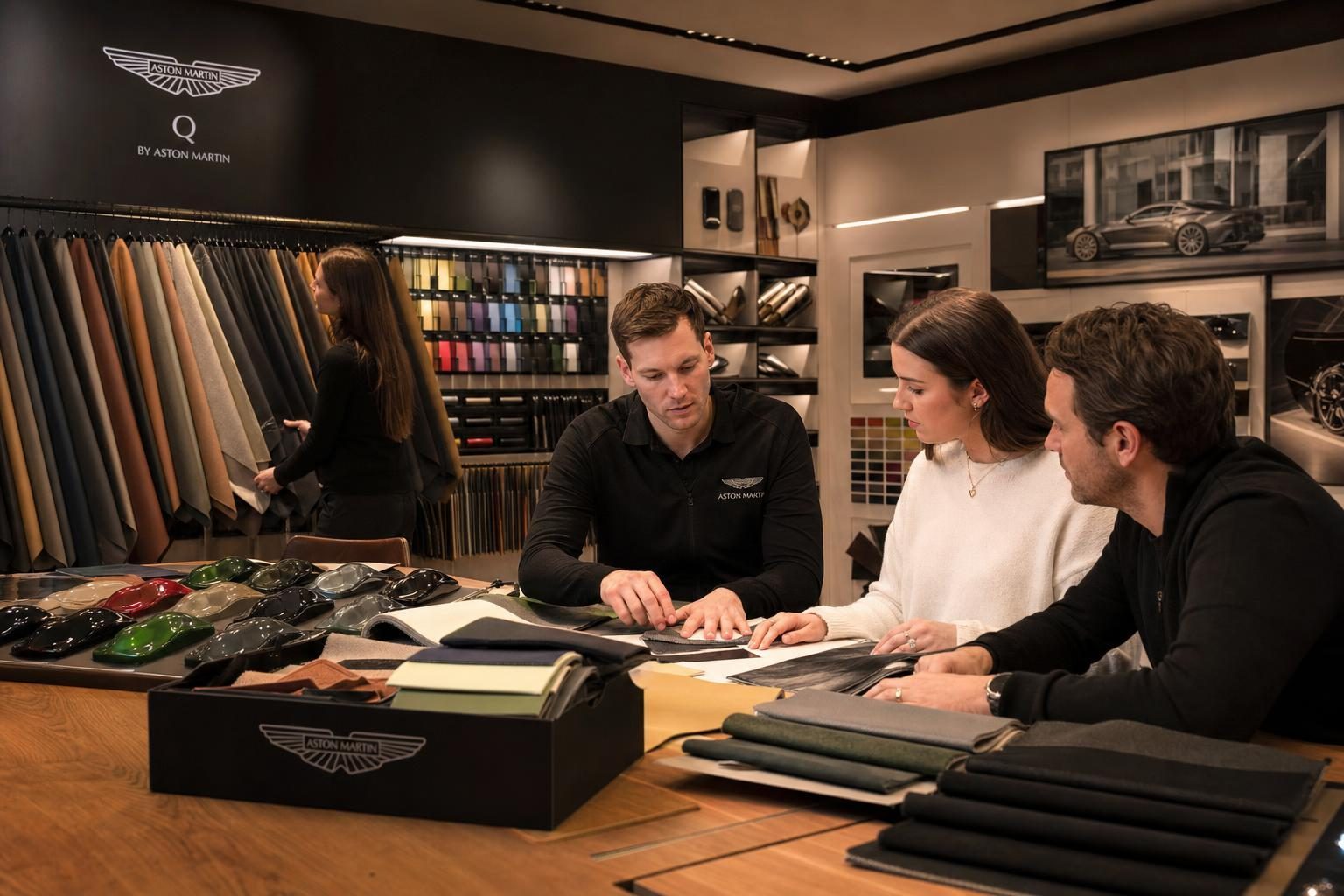
Q by Aston Martin is not just a discreet label on a sill plate: it is a method for turning a clear idea – or a vague desire – into a singular motor car. Through five concrete angles, we move from the Vanquish Volante Wave Edition 2026 commissioned for a charity sale to experience programmes, to shed light on what this bespoke offering covers today and what owners or collectors can reasonably expect from it.
The Vanquish Volante Wave Edition 2026: a one-off car commissioned for a charity auction
Created as a one-off by Q by Aston Martin, the Vanquish Volante Wave Edition was unveiled for the Naples Winter Wine Festival Auction on 31 January 2026. Announced by Aston Martin on 29 January 2026, it embodies a brief with crystalline clarity: a high-performance convertible celebrating the Collier County coastline in Florida, sold in aid of a local cause.
Under the bonnet, we remain in the realm of the tangible rather than wishful thinking: 5.2-litre twin-turbo V12, 835 PS (824 hp) and 1,000 Nm, for 0–62 mph in 3.4 s and a top speed of 214 mph. Official figures that place the unique piece in the category of very serious GTs, even when they wear embroidery.
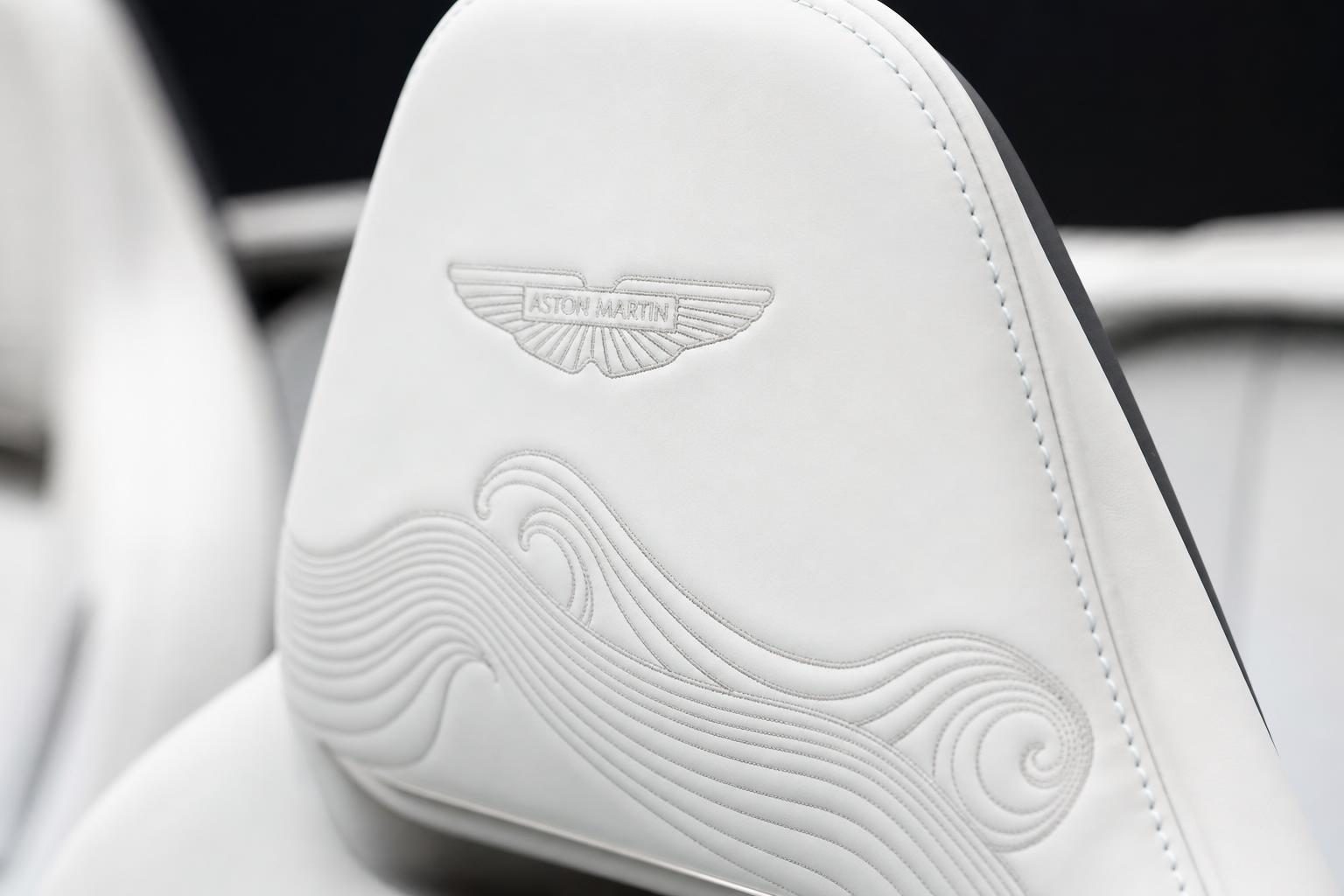
The marine theme runs through the exterior, explicitly “inspired by the coastline of Collier County”. Inside, the stance is reversed: the interior palette flips the visual tempo, with Glacier White as the principal fabric echoing, in negative, the exterior treatment. The wave motif, the signature of this commission, is found embroidered in the headrests and etched on the sill plates – precise gestures that summarise the department’s contribution.
Finally, the charitable context is no footnote: since 2001, the Naples Festival has raised over 336 million dollars for underprivileged children. This Wave Edition follows in that tradition, a reminder that exception can also serve purposes beyond a collector’s ego.
The Q process: from the first conversation with designers to delivery
What the Wave Edition reveals first is a close relationship between the intention and the finished object. Without disclosing further behind-the-scenes detail, the public elements show a coherent execution of a thematic brief – colour, materials, visual signatures – down to tactile details such as embroidery and engraving. In other words, Q by Aston Martin operates where standard finishes stop, with continuity of aesthetic language.
The rhythm set by the “coastal” exterior and the Glacier White interior illustrates a logic of composition, not a simple juxtaposition of options. For an owner, this is a concrete clue: the value of the programme lies in its ability to orchestrate a theme, from bodywork to cabin, rather than stack choices.
As for the stages – exchanges, validations, manufacture – they are not detailed in the official information associated with this specific case. So we’ll retain the essential: the existence of a framework in which a well-crafted brief becomes a singular object, with clear traceability (plaques, signatures) and faithful execution.
To better understand the grammar of Aston Martin style, the profile of Marek Reichman and his vision of design offers useful context, distinct from Q commissions but enlightening on the marque’s culture.
Unique paints, rare materials and bespoke embroidery: what recent examples reveal
The known facts around the Wave Edition allow us to document three concrete levers. First, the exterior colour can translate a landscape – here the Collier County coastline – into a palette and effects that go beyond the standard colour chart. It’s a narrative approach, where the body carries the story as much as the sheen.
Next, the cabin becomes a counterpoint, sometimes against the grain of the first glance. The Glacier White principal fabric and the “inversion of the visual tempo” show that bespoke can spring a surprise without losing overall coherence. The use of materials and textures contributes to this dialogue, with measured touches.
Finally, the discreet signatures – headrest embroidery, sill engraving – anchor uniqueness. These are surfaces small in size but crucial for recognising a Q by Aston Martin commission day to day: each time you get in, eye and hand rediscover the original intention.
These gestures say nothing about one-upmanship; they speak of precision. And that may be the true luxury at Aston Martin: show less, suggest more.
Q in competition: special liveries and finishes for the THOR and UNLEASHED programmes
On this ground, let’s stick to facts. Official information published in January 2026 mentions the UNLEASHED programme within Aston Martin Experiences, reserved exclusively for owners of limited-edition track models. It does not detail specific liveries tied to this programme, nor a programme named “THOR” in those same publications.
What can reasonably be retained, in light of the Wave Edition, is Q by Aston Martin’s ability to materialise a precise brief through colours, materials and graphic signatures. Applied to track-oriented experiences, this know-how could serve dedicated finishes when the framework demands – without any additional specification being set out in the sources available.
For the rest, prudence and method: distinguish aesthetic accessorising from technical preparation, and don’t confuse a successful graphic theme with an advantage against the clock.
Resale value of a Q commission: advantage or constraint on the secondary market
The temptation to take sides is strong. The public data associated with the cases cited here, however, deliver neither percentages nor value curves. It would therefore be rash to assert a market “bonus” or “malus” attributable, in itself, to Q by Aston Martin personalisation.
Two markers nevertheless emerge from the reported facts. On the one hand, documented uniqueness – like the Wave Edition, created as a single example and associated with a leading charity sale – confers traceability that collectors appreciate. On the other hand, the coherence of the theme and the quality of execution (colours, materials, signatures) weigh more than a simple accumulation of options with no through-line.
Put another way, what resells best is not necessarily the showiest, but what clearly tells why the car is as it is. A line that Q by Aston Martin enables you to hold, provided you frame, from the outset, a clear and measured brief.
To broaden the perspective on brand culture, our selection of five unusual Aston Martin anecdotes recalls that Gaydon’s history values singularity… when it makes sense.
Conclusion: Q by Aston Martin, the art of refining desire
Taken together, these elements sketch a nuanced reality. Q by Aston Martin can produce a one-off that is technically impeccable and aesthetically grounded – the Vanquish Volante Wave Edition provides the public demonstration – and fit within exclusive frameworks like UNLEASHED, without blurring the lines. For an owner, the challenge is to turn an idea into a coherent theme; for a collector, to identify commissions where intention and execution answer each other. The rest, as so often at Aston Martin, comes down to rightness rather than volume.
Official sources consulted: Wave Edition announcement (29 January 2026) and January 2026 Experiences information, published by Aston Martin.
AMR26 Honda 2026: 5 Ultimate Tech Shifts Redefining F1 Integration
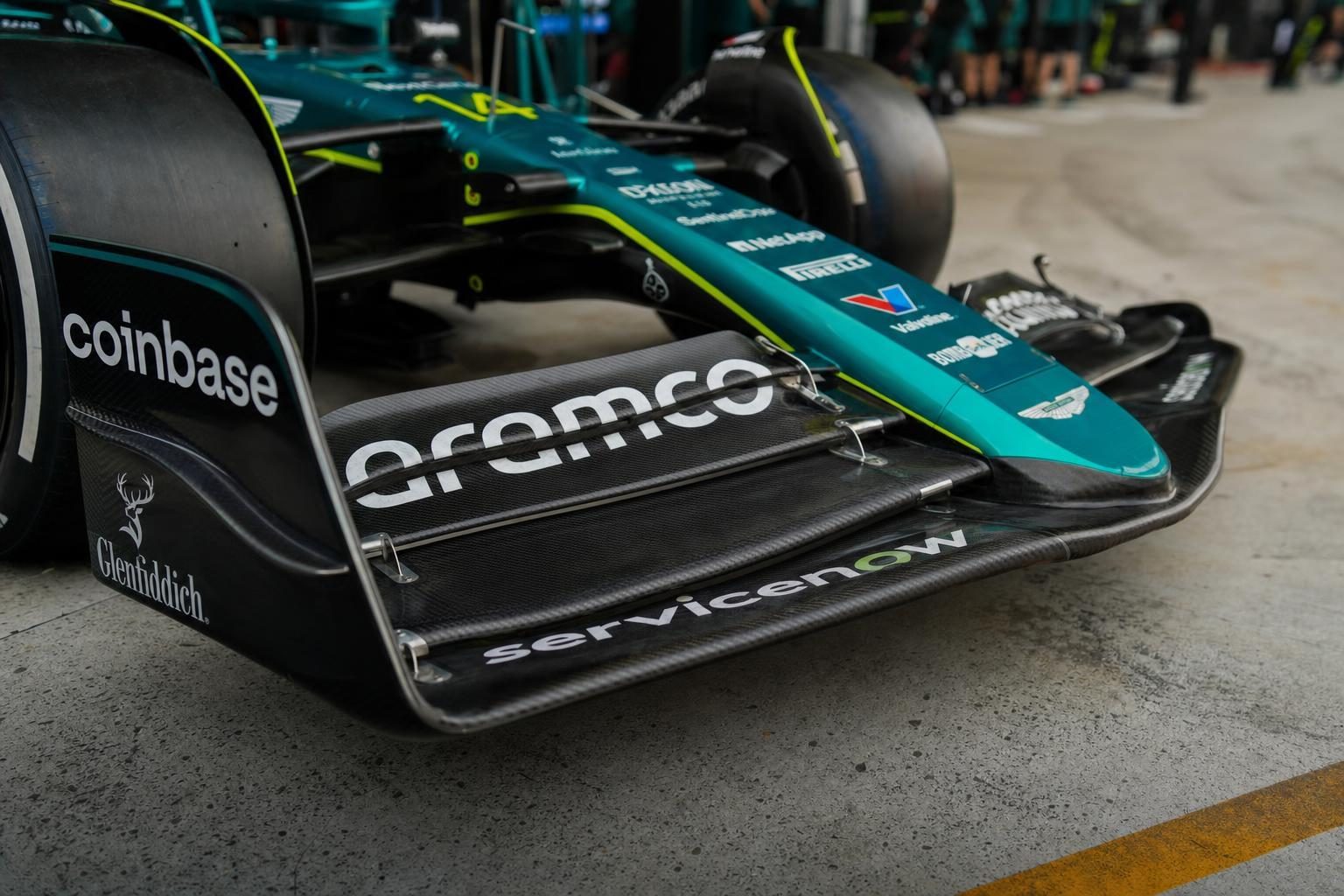
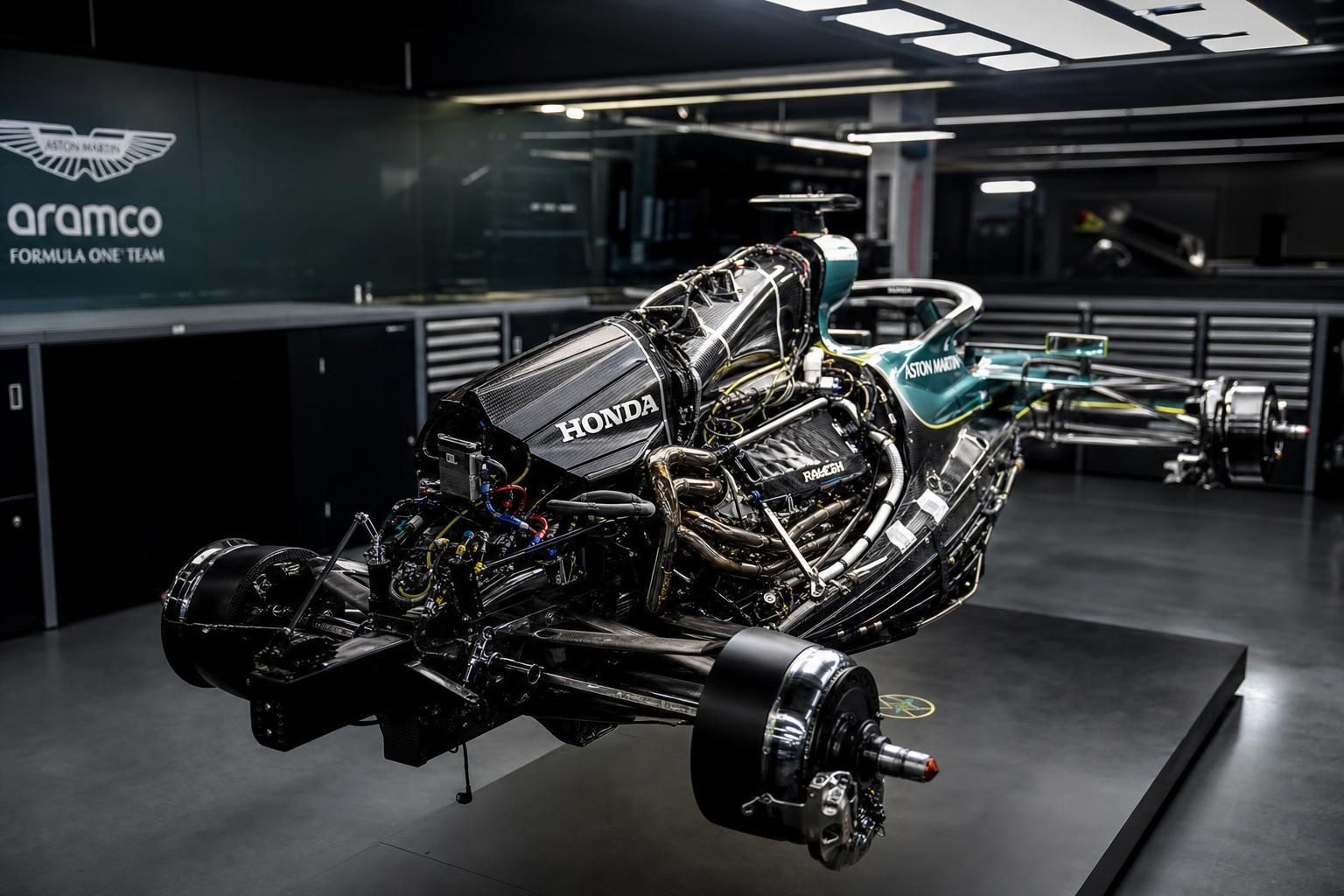
The AMR26 Honda is Aston Martin’s first car of the 2026 era conceived around the new rules, with five ruptures that redefine both design and on-track operation. We review these technical pivots — in-house gearbox, active aerodynamics, reinforced MGU-K, 100% sustainable fuel and Honda power unit — through the very concrete lens of what the Silverstone team is changing, learning and risking.
The first gearbox developed in-house since 2004: why it matters
According to Aston Martin, the AMR26 debuts an eight-speed semi-automatic gearbox designed in-house, a first at Silverstone since 2004. This choice breaks with the era of purchased, locked components and restores control over a unit that dictates chassis–engine integration and energy management. The aim is clear: optimise mass, packaging and rigidity for a more compact, more electric 2026 architecture.
The impact goes beyond packaging. By taking responsibility for kinematics and materials, the team can synchronise shift maps, torque dampers and electric torque strategies with the needs of the Honda RA626H. System coherence comes first: aligning mechanics, calibration and software creates performance margins that an external component often limits.
Finally, mastering the gearbox reshapes maintenance and upgradability. Iteration cycles, from track to dyno, shorten. In a regulatory framework where active aero and hybridisation stress the transmission differently, this internal control is as much a defensive as an offensive advantage, as the AMR26 spec sheet published by Aston Martin reminds us.
Active aerodynamics in 2026: Corner Mode, Straight Mode and what it changes on track
The 2026 regulations mandate fully active front and rear wings operating in two states: Corner Mode (maximum angle of attack) and Straight Mode (drag reduction), not relying solely on DRS, according to the official AMR26 presentation. The objective is twofold: restore downforce in corners and unlock top speed on the straights, via real-time orchestration of incidences.
For a team, this transforms both the driver’s tool and the engineer’s tool. The interaction between aero modes, rake and brake balance becomes a living triptych. Braking grip, mid-corner stability and re-acceleration are tuned as much by the actuation logic of the flaps as by springs and bars. In practice, mode mapping must anticipate wind, traffic and tyre state.
The flip side is software. Ensuring watertight Corner/Straight transitions, preventing oscillations and anticipating destabilisation in gusts require predictive control. It is a new craft that brings aerodynamics closer to energy strategy and the transmission, a topic we detail below. The foundations are set out in Aston Martin Racing’s technical content.
The next-generation MGU-K and bidirectional torques in the transmission
Per Aston Martin, the 2026 MGU-K delivers and harvests significantly more energy than before. For the transmission, that means handling high torques in both directions: propulsion when deploying, resistance when regenerating. Gears, shafts, bearings and torsional damping are sized to withstand more frequent, more intense shocks.
The novelty is as much mechanical as software-based. Clutch and engine torque maps must smooth the switch between traction and regeneration without unsettling the chassis at the apex. The longitudinal balance perceived by the driver depends on this smoothing, synchronised with active aero transitions. Here, the in-house gearbox becomes an asset: the alignment of torque ramps, phasing and synchronisations is managed to a tenth of a second.
On track, expect crisper low-end launches and more aggressive regeneration strategies approaching braking zones. At Silverstone and elsewhere, this forces a rewrite of differential and traction-control maps, for a homogeneous chassis–propulsion package, as described in the AMR26 documentation.
Aramco ProForce+: 100% sustainable fuel as constraint and technical opportunity
Aston Martin specifies that Aramco exclusively supplies ProForce+, a 100% sustainable FIA-compliant fuel derived from non-food biomass or municipal waste. This chemistry changes calibration fundamentals: volatility, flame speed, latent heat and lubricity dictate ignition timing, injection pressure and thermal strategy.
The constraint can become an opportunity if the engine and intake are designed around this profile. Tumble and swirl targeting in the chamber, injector geometry and intake air temperature management are tailored to the ProForce+ window. On track, performance repeatability between batches is essential; direct engine–fuel collaboration reduces variables.
For the team, integration extends to electrical recovery. Higher-efficiency combustion improves the thermal/electric energy balance, hence the MGU-K deployment strategy. The AMR26 page at Aston Martin makes it a pillar of the 2026 package.
Honda RA626H: what the return of a Japanese power unit supplier brings to Silverstone
According to Wikipedia, the AMR26 is powered by the Honda RA626H, the first Honda engine to power an Aston Martin in F1, and the first non-Mercedes engine on a Silverstone-based single-seater since Force India’s Ferrari in 2008. This change goes beyond the badge: architecture, hybridisation philosophy and integration tools differ.
The collaboration imposes a new technical interface: electrical systems, cooling, mounting and accessory inertias are aligned to Honda specifications. For aerodynamics, the packaging of the power unit and heat exchangers redefines the side volumes and rear profiling. The freedom gained with the in-house gearbox eases this junction.
Operationally, Honda brings testing methods and dyno/track correlation. The iteration loop between the RA626H, the reinforced MGU-K and active aero runs through coordinated map sets. It is a measured yet profound cultural shift: the team adjusts its procedures, and the drivers tune their style to the torque delivery and regenerative braking associated with the Honda package.
Conclusion — AMR26 Honda, five ruptures that rewrite integration
With AMR26 Honda, the 2026 edition is no mere facelift. An in-house gearbox, two-faced aerodynamics, a more powerful, reversible MGU-K, 100% sustainable fuel and an all-new RA626H engine form a coherent whole. Performance will hinge on the fine integration of these building blocks, as much as on trackside execution.
AMV8 Aston Martin: 6 Ultimate Facts from 1972 on a Survivor
AMV8 Aston Martin, or the art of enduring when everything around it changes: this piece gathers six sourced anecdotes on the coupé born in 1972, its standout variants — the 1977 Vantage and the Volante — and the markets that kept it afloat until 1989. On the menu: atypical industrial longevity, disputed top-speed figures, the crucial role of the United States and the Middle East, sometimes forgotten projects, and a useful read on the traceability of a model shaped over four successive managements.
17 years and 4 owners: the production longevity that defies industrial standards
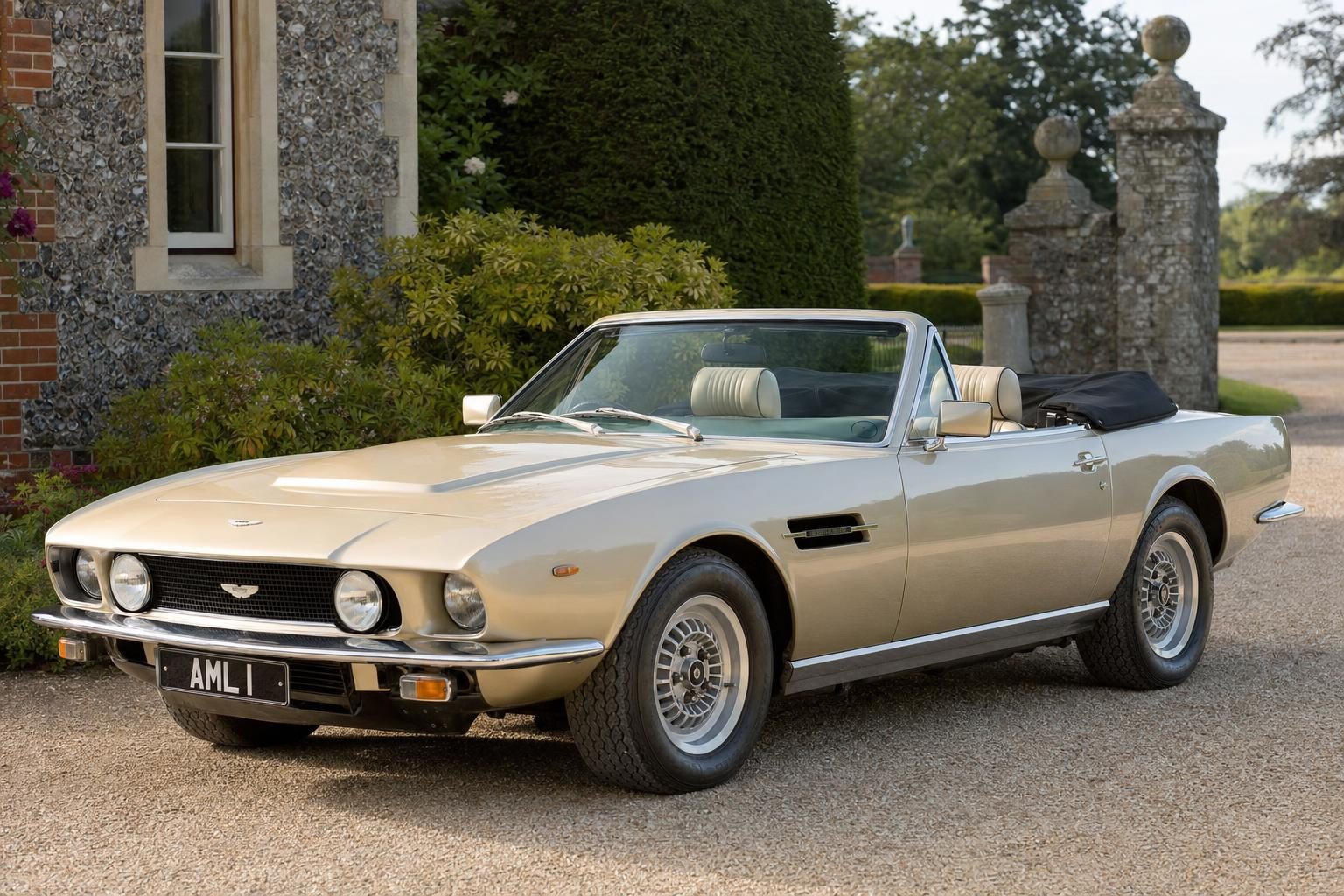
From May 1972, the designation “Aston Martin V8” replaced the DBS V8 when the car adopted a single-headlamp front end, according to reference data on Wikipedia. This name change marked the start of an unusually long cycle for a V8 grand tourer: production stretched to 1989 — seventeen years of continuous evolution on the same base, a singular case in the industry.
Over this period, the company passed through the hands of at least four owners, among them the Gauntlett family and Ford, which took control in 1987 according to the marque’s history. And yet, despite these major transitions, the coupé remained in the catalogue, reconfigured to suit the priorities of the moment. The most notable fact is not so much the raw longevity as its ability to stay relevant amid shifting industrial and financial contexts.
Introducing strategic variants proved decisive. According to official and encyclopaedic histories, the new owners launched the V8 Vantage in 1977, then the Volante in 1978, before the Bulldog concept in 1980. In other words, longevity was not simple conservatism: it was a methodical adaptation, with the Aston evolving just enough to remain coveted without betraying its character.
The 1977 Vantage: the era’s most powerful version and its disputed figures
The V8 Vantage announced in 1977 stands out as the sharpest iteration of the programme. In the specialist press of the time, there is a documented divergence on its top speed: some sources claim an official figure beyond 170 mph, or 273 km/h, while others place the maximum at 168 mph. This ambiguity — rare today — recalls a time when test protocols, conditions and exact configurations could move the needle.
Beyond the number, the essence lies elsewhere: the Vantage repositioned the GT as a credible British alternative to top-tier sports cars. This role, attributed by the marque’s histories, helped maintain the programme’s appeal and gave a technical backbone to the entire V8 range in the late 1970s.
This debate over v-max still fuels insider conversations. Above all, it illustrates a reality: the 1977 Vantage’s performance, in a demanding across-the-Channel context, contributed to the endurance reputation of the whole lineage, including the more civilised versions.
The Volante and the markets that saved the marque: United States and Middle East
Launched in 1978, the Volante proved a sound bet. According to general histories, the convertible became an essential commercial tool in the 1980s, particularly in the United States and the Middle East. These markets, receptive to characterful GTs and open body styles, provided the volume and margin vital to the financial survival of a still-fragile company.
The Volante’s merit was not merely aesthetic. In these strategic destinations, the open silhouette reinforced the marque’s identity and established the idea of a long-distance grand tourer, elegant yet capable. In return, international demand consolidated the industrial viability of a car built at a measured pace.
To explore the broader context, our dossier on the marque’s DNA offers a useful framing of cycles of crisis and rebound. Read here: histoire de la marque et culture de légende.
Forgotten variants: Nimrod, Bulldog and the abandoned projects of the 1980s
The 1980s saw some bold avenues take shape. In 1980, the Bulldog concept — mentioned in encyclopaedic sources — embodied an experimental, near-manifesto vision that spoke to a desire for stylistic and technical rupture. It never made production, but its existence says much about the ambition of the moment.
In a more sporting register, the Nimrod C2 programme, derived from the V8 engine, entered Group C. According to Wikipedia, the car placed 7th at the 1982 24 Hours of Le Mans. Modest in absolute terms but significant given the resources, this result fed the V8’s aura in endurance racing.
These parallel paths — spectacular concept on one side, endurance on the other — enriched the V8’s technical genealogy. They help explain why, beyond the road coupé alone, the engine and architecture retained a firm place in enthusiasts’ imaginations.
Chassis numbers and traceability: why every AM V8 differs from its neighbour on the line
For a model produced from 1972 to 1989, under several managements and with successive evolutions, traceability takes on particular importance. Without entering into an inventory, keeping track of the succession of model years and variants (1977 Vantage, 1978 Volante, 1980 Bulldog concept) already helps explain why two examples close in appearance may reflect different technical priorities.
This diversity, the consequence of a history of relaunches and adjustments, strengthens the case for precisely documenting a given car: its milestones, its original market (notably when it comes to the United States or the Middle East, pivotal in the 1980s), and any updates. For an enthusiast, it is the best way to read the car through the marque’s chronology as attested by official and encyclopaedic histories.
To delve deeper into the thread between the DBS V8 and the Aston Martin V8, our dossier dedicated to the first road-going V8 offers useful context: histoire et genèse de la DBS V8. As for the model studied here, its overview page appears in our models section: Aston Martin V8 (1972-1989).
AM V8 in 2026: current values, clubs and restoration specifics
In 2026, interest in the line remains driven by what recent history has validated: rare longevity, a 1977 Vantage with performance striking enough to keep debates alive, and a Volante that mattered to the financial balance of the 1980s. All points to bear in mind when assessing an example or considering a period-correct restoration.
The official and encyclopaedic reference sources — starting with the manufacturer’s heritage page and the model summaries — offer a solid factual basis for situating a chassis in the chronology and appreciating the importance of export markets. Two useful entry points:
The rest is a matter of method: cross-checking the available information, placing the example within the sequence marked by 1972, 1977, 1978 and 1980, and drawing on known archives. For an overall panorama of the marque and its cycles, see also the page dedicated to the model in English, a useful complement to the marque’s histories.
Conclusion — AMV8 Aston Martin, six milestones to understand a survivor
From 1972 to 1989, the AMV8 Aston Martin spanned seventeen years, at least four managements and several repositionings without leaving the stage. The 1977 Vantage — with a top speed still in dispute — and the 1978 Volante structured this resilience, while Bulldog and Nimrod added contour to the 1980s. When evaluating an example, remembering these milestones and the markets that mattered is already to restore the essentials: the context that gives an Aston V8 its value.
V12 Vantage 2009: 5 Ultimate Reasons this Model Redefined the Sports Car at Aston Martin
The V12 Vantage was born from a simple, stubborn idea: squeeze a 6.0-litre V12 into Aston Martin’s most compact chassis. This contrarian choice forged a car with a singular personality, praised by the contemporary press for its mechanical purity and unfiltered character. Here, in five points, is why this short coupé and its big naturally aspirated engine became a reference among modern Astons, balancing accepted technical constraints with preserved sensations.
A V12 in Aston Martin’s smallest chassis: the technical decision and its constraints
Planting the 48-valve V12 from the DB9/DBS family into the Vantage shell was British orthodoxy at its most daring. According to Aston Martin’s dedicated page, the V12 Vantage indeed belongs to the line of past models powered by this 6.0-litre, here adapted to the Vantage’s short format. The intention was clear: blend the GT DNA of the twelve-cylinder with a more compact footprint for a direct mechanical response and a denser road feel.
This decision immediately raised challenges of packaging, cooling and balance. The 2009 press, notably Autocar, documented the adaptations required to make the mass and volume of the block coexist with a front end originally designed for a V8. The result is as much surgical assembly as it is character tuning: more engine, less superfluous inertia, and a car that speaks plainly.
This intentional contrast — a large engine in a compact shell — explains the model’s special aura. This is not about absolute versatility, but a concentrated, “analogue” experience ahead of its time, whose singularity won over testers at evo and Autocar: the V12 Vantage puts the driver at the centre and lets the engine set the tempo.
510 PS, 6.0-litre naturally aspirated and manual gearbox: the figures that define the character
According to the Wikipedia page devoted to the model and echoed by the British reference press, the V12 Vantage produces 510 PS in its launch configuration. Several sources, however, mention a power divergence (510 PS vs 517 PS) depending on markets and measurement standards (DIN versus SAE): a minimal gap, yet significant for purists. The essence lies in the temperament of a 6.0-litre naturally aspirated V12 that breathes unfiltered and delivers progressive, readable, sonorous thrust.
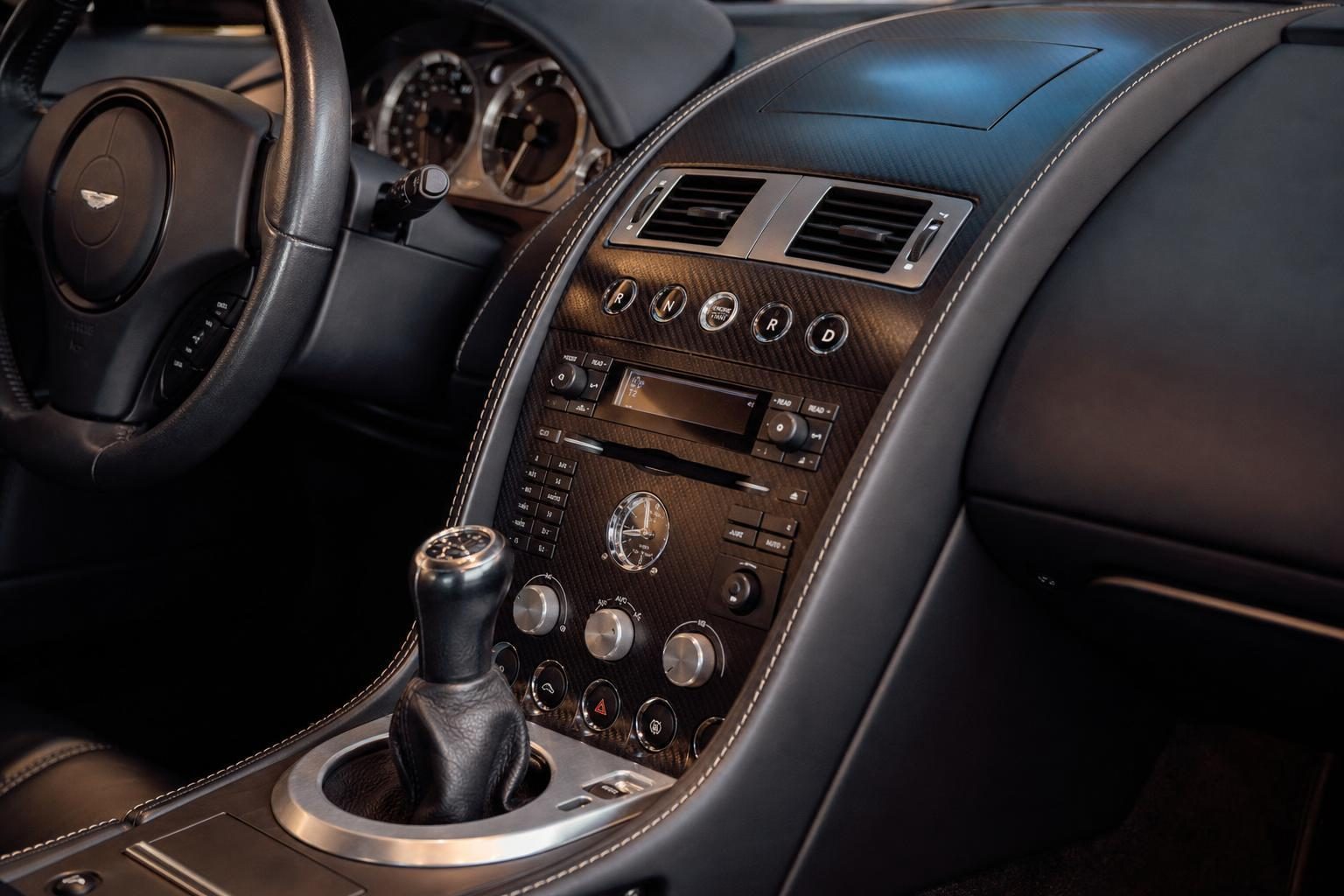
Another pillar of its identity: the 6-speed manual gearbox, offered from the outset. At the time, it was a rarity in the segment, noted by evo magazine, and a key component of the man–machine relationship. The choice of lever and clutch contributes to that analogue precision so sought after in an era already tipping towards automated transmissions.
Beyond the power figure, the “big engine/short format” mechanical pairing shapes a crisp throttle response and traction to be mastered. The V12 Vantage demands finesse, but rewards with a mechanical connection not yet smoothed by digital intermediaries.
The structural and aerodynamic changes imposed by the engine
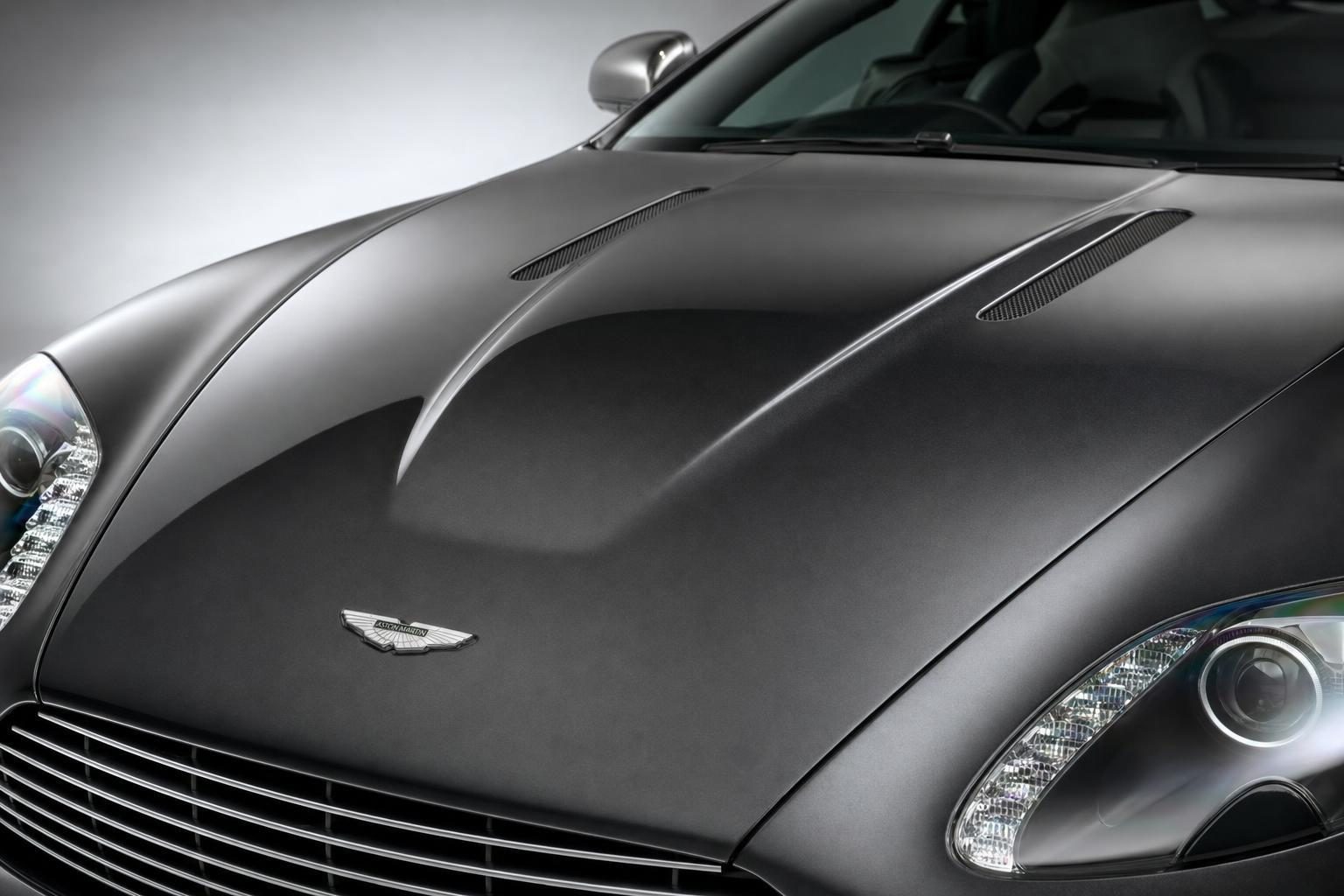
To house the 6.0-litre, Aston Martin revised structural and body elements. The 2009 press (Autocar) mentions a noticeably domed bonnet to accommodate the V12’s height and ancillaries, as well as a specific rear diffuser to stabilise the stance and manage airflow beneath the car. This two-pronged approach — volume up front, extraction at the rear — is not decorative: it answers packaging needs and high-speed stability.
The chassis was also adjusted to cope with the extra mass over the front axle. Without chasing the theoretical balance of a prototype, engineers worked on local distribution and rigidity to preserve the Vantage’s agility while channelling the V12’s potential. This compromise explains the sensation of a sports car more compact than long-wheelbase GTs, yet denser to handle than a standard V8 Vantage.
Finally, the addition of these aero and structural items defines the V12 Vantage’s highly functional aesthetic. The bonnet’s curves, the vents and that dedicated diffuser tell a technical constraint before they tell a style. It is precisely this engineering candour that fed its reputation.
Limited production and S versions: how many and what differences
The V12 Vantage remained a naturally limited proposition by its technical positioning and build cost, without the brand detailing, in accessible indexed releases, an exact production by model year. This vagueness fuels its perception as a rare object, more confidential than long-wheelbase V12 GTs.
In 2012, the V12 Vantage S broadened the brief. The specialist press indicates power raised to 565 PS and the introduction of the optional 7-speed Sportshift III gearbox, an evolution designed for quicker shifts and more versatile use. The S thus stands out with a sharper powertrain and a choice of transmission, while retaining the philosophy of a Vantage with a V12 heart.
Whether you favour the initial version with its manual gearbox or the more powerful S, the spirit remains the same: a compact Aston Martin driven by the naturally aspirated 6.0-litre from the DB9/DBS family, as recalled by official sheets and archives and evo’s analyses. The key differences lie in the extra power, the transmission and the refinement of the setup.
V12 Vantage in 2026: values, maintenance and standing in the recent-classics market
In 2026, the V12 Vantage stands as a recent classic with a clear pedigree: big naturally aspirated engine, compact format, manual gearbox available and an image of engineering worn on its sleeve. Its values reflect this singular equation and the model’s relative rarity, even if exact volumes by year are not published in accessible releases. The nominal power differences (510 versus 517 PS depending on standards and markets) interest specialists without altering the broader appeal.
From both usage and collecting perspectives, the core remains mechanical authenticity. The 6-speed manual gearbox of the initial V12 Vantage is a major asset for a discerning audience, while the V12 Vantage S attracts with its extra power and Sportshift III option. In both cases, buyers seek a car with proper history and servicing to factory prescriptions, with Aston Martin’s reputation for excellence a useful benchmark for the savvy purchaser.
On the youngtimer and “modern classic” market, the V12 Vantage occupies the niche of analogue, naturally aspirated sports cars — a species growing rarer amid paddle-shift transmissions and ubiquitous aids. It is precisely this tension — a big V12 in a small chassis — that gives it a singular place in 2026, between driving pleasure and heritage value.
Conclusion – what the V12 Vantage really changed
The V12 Vantage redefined, within Aston Martin, how to approach the modern sports car: a DB9/DBS V12 in the short Vantage, 510 PS quoted (with a reported gap up to 517 PS depending on standards), a 6-speed manual gearbox standard at launch, and visible structural and aerodynamic adjustments because they were necessary. Neither showy nor smoothed over, it cemented the idea that an Aston could remain mechanically forthright in the age of automation. In that sense, the V12 Vantage remains a beacon: a car of convictions, whose character is born of a mastered antagonism — and whose appeal, in 2026, shows no sign of fading.
Valkyrie LM 2026: 10 Units, 697 PS Secrets and the Ultimate Track Club
The Valkyrie LM is the most direct bridge between the road-going hypercar and international competition, and the aim here is simple: to understand what this customer programme offers compared with the road-legal Valkyrie and the car entered in WEC/IMSA. In short, which technical choices, what on-track support, what timetable — and at what price — for an owner who wants to drive hard without lining up on a starting grid.
Valkyrie LM: what technically sets it apart from the road Valkyrie and the race car
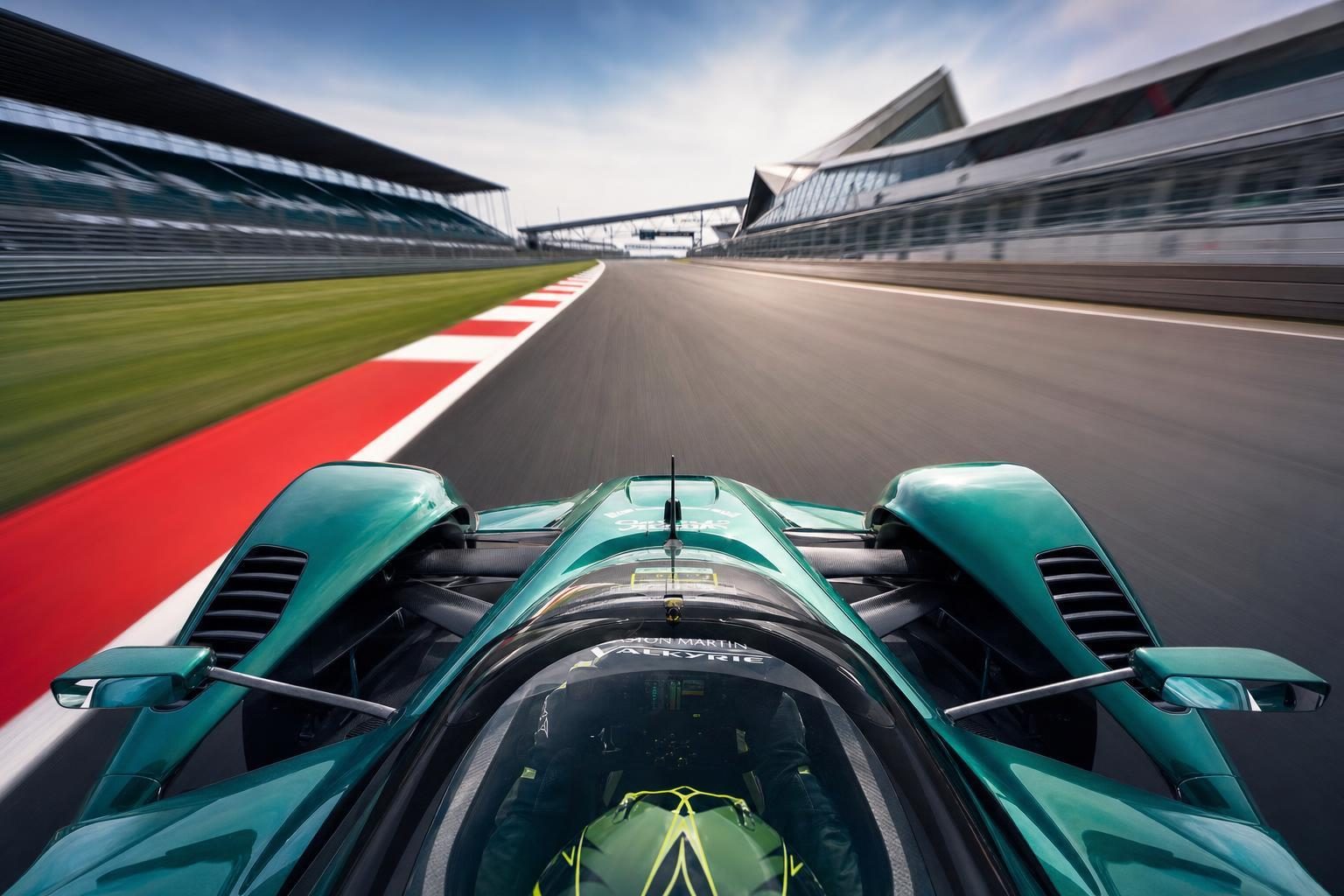
Technically, the Valkyrie LM sits between the road Valkyrie and the endurance variant. It carries over the fundamentals of the concept designed for competition — chassis and aerodynamics prioritising downforce and durability — while sidestepping the regulatory constraints of a WEC/IMSA entry. This middle ground lets it deliver very high performance with an operating window tailored to customer use.
Compared with the road car, the focus shifts towards track efficiency: dedicated set-up, aero package and components sized for sustained loads. Unlike the race car subject to equivalence and BoP, the Valkyrie LM can free itself from certain regulatory caps while retaining reasonable operating margins for private track days. The spirit is close to the race car, the user manual more accommodating.
Against the machine entered in WEC/IMSA, the Valkyrie LM saves the operational complexity of a factory programme. It does not have to comply with power windows, weight or post-race scrutineering. The goal is not to optimise a qualifying lap under the marshals’ control, but to deliver quick, repeatable sessions with a technical team dedicated to the owner-driver.
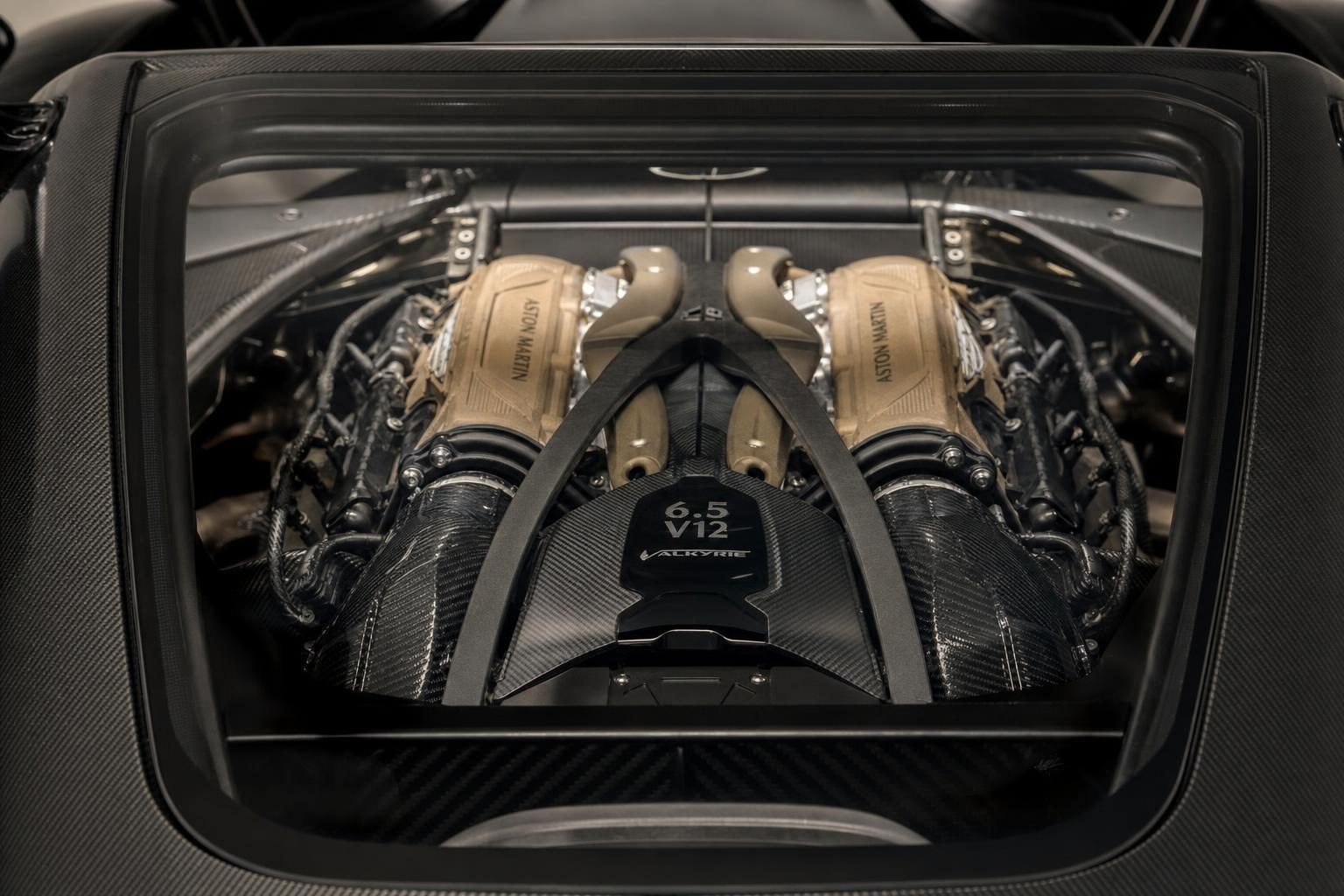
The naturally aspirated 6.5-litre V12 at 11,000 rpm: the same hardware as the IMSA and WEC cars
The heart of the project is the naturally aspirated 6.5-litre V12 capable of revving to 11,000 rpm, the same mechanical architecture used by the Valkyries competing in IMSA GTP and WEC. According to Aston Martin’s release published at Laguna Seca in April 2026, this engine exceeds 1,000 PS in unrestricted form, then is capped at 680 PS (500 kW) in IMSA to comply with the regulations.
For the Valkyrie LM, HiConsumption (June 2025) reports an output of 697 PS, a figure consistent with the “customer track” approach but not officially confirmed by Aston Martin in its releases. That is a key point to keep in mind: the brand confirms the shared racing DNA, but does not validate, at this stage, the exact power value quoted by industry sources.
This technical kinship has an interesting strategic corollary: Aston Martin notes that its GTP car is the only one on the IMSA grid directly derived from a road-homologated hypercar, a singularity reaffirmed in the same Laguna Seca communication. For those tracking the evolution of regulations and grids, this continuity strengthens the platform’s legitimacy and the road/track transfer value.
To dig deeper into the factory sporting and technical context, you can consult the page dedicated to the racing programmes on Aston Martin’s media site, as well as the IMSA news round-up, useful to place this V12 within its regulated environment.
10 units and the Valkyrie Performance Club: logistics, engineers, simulator
The Valkyrie LM is announced at 10 units, a volume confirmed by the communications around the Valkyrie Performance Club and echoed by HiConsumption (June 2025). For owners, the appeal goes beyond the object alone: the programme pairs the car with a track operations package designed to remove logistical friction and maximise useful time on circuit.
According to HiConsumption, the Valkyrie Performance Club includes vehicle storage and transport, engineers on hand, driver coaching and full safety equipment. These elements outline a very polished “arrive and drive” support. As Aston Martin has not officially detailed the entirety of these services in its releases, some of them should be treated with caution until confirmed by the brand.
The detail that matters to an owner is not incidental: access to preparation tools such as the simulator and structured briefings can make the difference between a beautiful garage hypercar and a machine exploited at 90% of its potential on circuits where you rarely run alone. The ambition is clear: to turn a track day into a coherent technical experience, where you progress and where the car fully expresses itself.
To place this customer programme in the lineage of the brand’s extreme models, our dossier on the spiritual forebear One-77 recalls how Aston Martin has already orchestrated ultra-exclusive experiences around limited series, with an emphasis on support and technical mastery.
Pricing and first deliveries in 2026: what sources say and what Aston Martin does not confirm
On timing, HiConsumption mentions first deliveries in the second quarter of 2026, together with two track experiences held on Formula 1 circuits. Again, these are elements reported by the specialist press and not confirmed point by point by Aston Martin, even if the 2026 window logically aligns with the endurance programme’s maturity and associated industrialisation.
As for pricing, the same industry source cites an order of magnitude around 7 million dollars. The brand, for its part, has communicated no official price. We are therefore faced with a classic of the ultra-exclusive: a credible market-side figure, and a sparing official communication, in keeping with the confidentiality of a run of 10 cars and the expected tailoring of customer support.
This divergence does not prevent us reading the outlines: with 10 units, a racing-DNA V12 revving to 11,000 rpm and a turnkey operations programme, the Valkyrie LM naturally positions itself at the top of today’s “track only” offering. Comparisons should, however, be made case by case, as the proposition blends technical substance and associated services, making any purely technical price grid incomplete.
For a nuanced panorama of the family, our guide dedicated to the road model traces the origins of the Valkyrie concept and helps gauge the gap between road homologation and private track use, a decisive step for anyone considering such a personal and financial commitment.
Owning a Le Mans Hypercar category machine without racing it: a precedent in the brand’s history
Owning a machine from the Le Mans Hypercar category without chasing the chequered flag may seem new, but its logic echoes long-established Aston Martin traditions: proximity between road and race, and the ability to offer well-honed customer programmes. The Valkyrie LM fits precisely into this vein, converting endurance DNA into a driving tool for informed private owners.
This precedent is explained by the V12’s shared architecture and by the declared intent of continuity between the road car and the IMSA/WEC entry. Aston Martin highlights the unique nature of this lineage in its Laguna Seca release, a narrative also found in historical summaries devoted to the Valkyrie and its development.
To set this trajectory within the brand’s culture, you can revisit our analysis of the Aston Martin One-77 and its technical and symbolic significance. While the Valkyrie LM pushes the slider further towards the track, the idea of an ultra-limited series backed by expert support is nothing new in Gaydon.
From a collector’s perspective, the appeal is twofold: a driving experience that brushes up against racing without the pitfalls of an official weekend, and a piece of history whose value is rooted in a live endurance programme. A rare balance, hence a coveted one — and, logically, reserved.
Conclusion: the Valkyrie LM, a deliberate bridge between road and endurance
At the end of this overview, the Valkyrie LM appears for what it is: a deliberate bridge between the road Valkyrie and the car entered in WEC/IMSA, with a common naturally aspirated V12 revving to 11,000 rpm, a production run of 10 and track support that turns the object into an experience. The power (697 PS) and price (~$7m) figures reported by HiConsumption shape expectations, but are not confirmed by Aston Martin at this stage. For anyone wishing to gauge the gap between road, customer track and competition, this Valkyrie LM condenses the essentials: the hardware, the operating framework and the racing culture, without the starting line.