The AM V8 is Aston Martin’s great survivor: launched in 1969 and produced until 1989, it weathered crises, ownership changes and two liquidations while serving as the pillar model. Here’s how this coupé, then convertible and even Zagato, carried the marque for twenty-four years, spanning DBS heritage, officially muted power and emblematic versions.
1969-1972: the DBS V8/AM V8 transition, why the name changed
In 1969, Aston Martin unveiled the DBS V8, a grand coupé designed to house the new eight-cylinder. Three years later, in 1972, the model changed its name to AM V8 after the six-cylinder was dropped from the range. According to Wikipedia (Aston Martin V8), this renaming marked the end of the DBS era and clarified the line-up around the V8, now the sole mechanical heart of the company.
This change was not a matter of simple badging. It accompanied an industrial and commercial reorganisation as the marque sought its path between GT tradition and the imperatives of financial reliability. The silhouette remained similar, but the emphasis shifted from the DBS name, inherited from the six-cylinder, to a simple acronym that said the essentials: AM V8.
This repositioning also corresponded to a pivotal time for the manufacturer, when every range decision had to serve long-term viability. By making the V8 the reference point, Aston Martin prepared for the following decade, when the car would, by force of circumstance, become the main — and sometimes only — offering.
The 5.3-litre V8: intentionally vague power figures
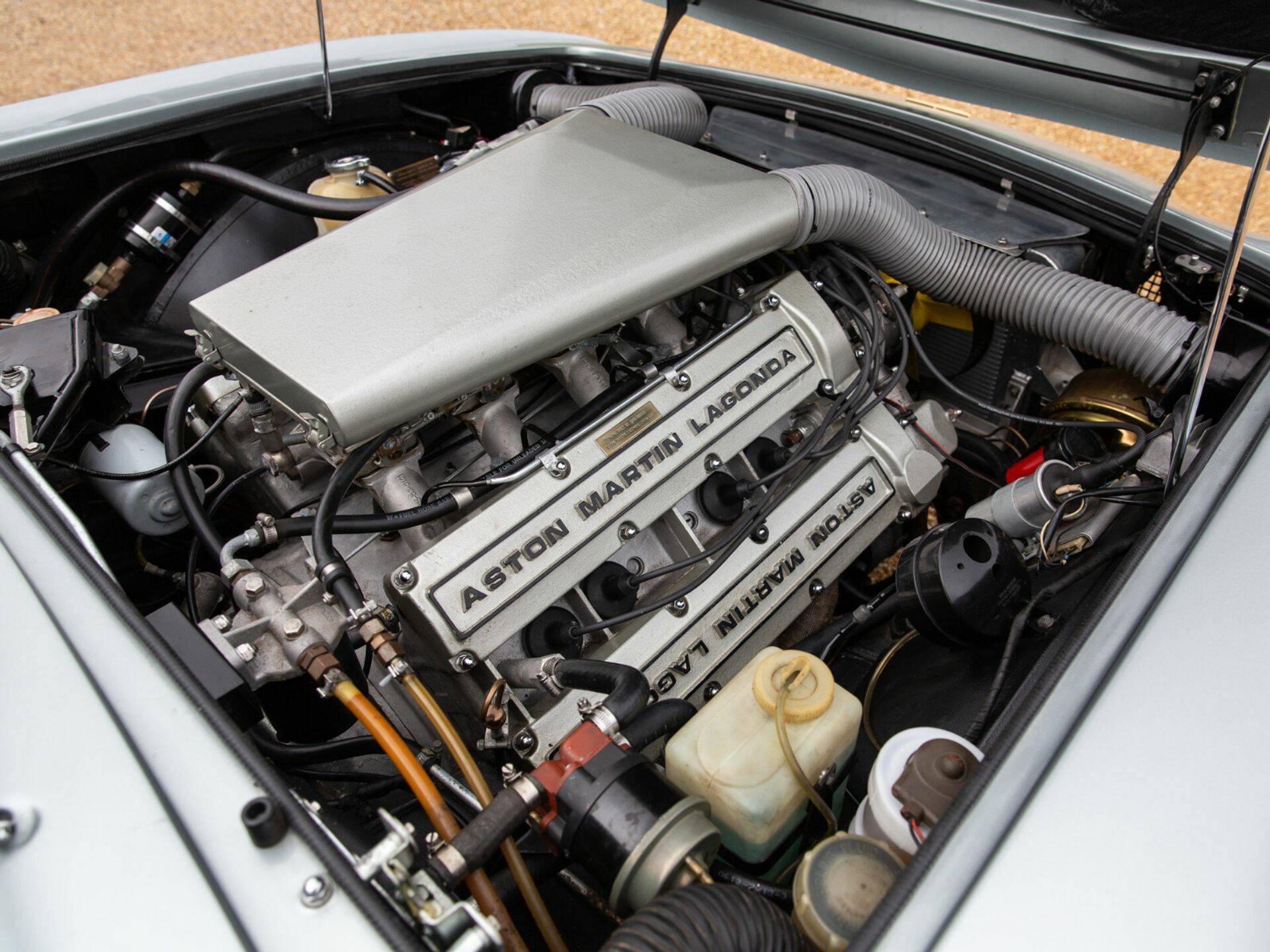
At the heart of the car, the 5.3-litre (5,340 cm³) twin-cam V8 gave the series its personality and its name. According to Wikipedia (Aston Martin V8), Aston Martin chose not to officially communicate the exact power output, a rarity at the time. Estimates range from 280 to 340 PS depending on intake and emissions configurations.
Car and Driver archives mention the same caution and confirm varying performance depending on markets and model years. This ambiguity was not just a marketing ploy: it reflected successive changes to carburation, injection and settings required by regulations, with noticeably different results from one series to the next.
This choice maintained a degree of mystery and avoided a numbers race against chattier rivals. Above all, it let the car speak through its torque, soundtrack and the finesse of a GT chassis. In use, the AM V8 favours surge and flexibility rather than raw data tallied to the last horse.
The major variants: 1977 Vantage, Volante and 1986 Zagato
The lineage first expanded in 1977 with the V8 Vantage, a high-output version that became the series icon. Wikipedia (Aston Martin V8 Vantage 1977) reports power estimates at around 380 PS according to some sources, and 432 PS according to others. Again, the marque did not endorse a single figure, and configurations varied. The result was clear: the Vantage asserted the platform’s sporting potential.
The Volante, the convertible interpretation, broadened the range’s appeal without denying its temperament. It added a more hedonistic grand touring dimension, much sought-after in the late 1970s and mid-1980s. The mechanical base remained the 5.3-litre, with settings aligned with the series’ evolutions.
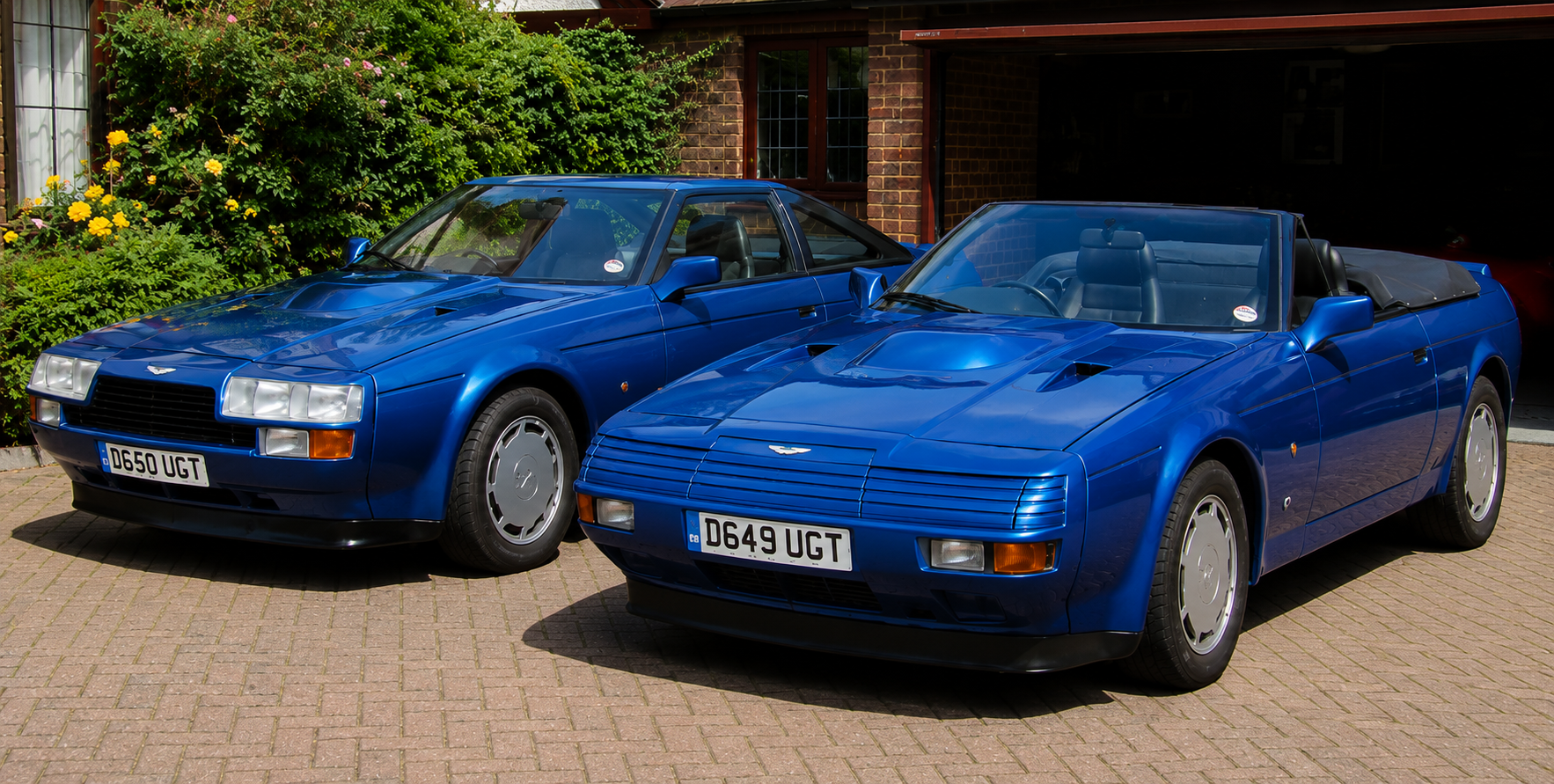
Finally, the AM V8 Zagato (1986-1989) offered a more radical and limited take on the GT, with coachwork by the Milanese carrozzeria. According to Wikipedia (Aston Martin V8 Zagato), around 52 examples were built. This separate series, crafted in small numbers, crystallised the 1980s aesthetic and testified to a historic collaboration with Zagato rekindled.
24 years, multiple owners, two liquidations: the V8 as a lifeline
The car’s career mirrored Aston Martin’s turbulence. According to Wikipedia (Aston Martin), the marque went through two liquidations in 1974 and then 1975, while the V8 series remained its sole product. In that period, the model was not just a shop window: it was the revenue, the workshop and the reason to open on Monday.
1974: first liquidation, activity contracted.
1975: second liquidation, production reorganised on a small scale.
These episodes came with frequent ownership changes. Despite this, the car continued to evolve in measured steps. This continuity, sometimes artisanal, partly explains the model’s exceptional longevity, with production spanning 1969 to 1989.
The platform’s versatility — coupé, convertible, high-performance version and coachbuilt special — sustained commercial appeal over the years. Around 1,675 examples across all variants are mentioned by Wikipedia, with the exact figure debated. In the Aston world, where volumes remain confidential, this constancy translated into symbolic capital and minimal cash flow.
Current values: AM V8, Vantage and Zagato on the classic market
On the classic market, the AM V8 attracts with its timeless style and historic role. Standard versions offer a more accessible entry into Aston Martin’s V8 universe, with values influenced by condition, original specification and provenance. Successive evolutions and tuning differences weigh on appraisal, as does restoration quality.
The 1977 V8 Vantage and its derivatives sit at the top of the family in terms of aura and demand. Power estimates from 380 to 432 PS depending on sources contribute to its image, but it is the overall mechanical package and dynamic poise that set the price. Original, well-documented examples trade at a marked premium over milder versions.
The AM V8 Zagato (1986-1989), limited to around 52 units, occupies a connoisseur’s niche. Its very limited production, strongly 1980s styling and distinct place in the lineage justify high price levels. To gauge the market, auction catalogues and specialist platforms such as Aston Martin V8 listings on Classic Driver offer a useful snapshot of recent transactions and value spread.
Beyond the — sometimes blurry — figures, the AM V8 embodies rare resilience. Born a DBS, renamed AM V8 in 1972, it carried a turbulent marque on its back, served as a laboratory for the Vantage, offered an open-air interlude with the Volante and rekindled the taste for bespoke with the Zagato. Its twenty-four-year longevity was no accident: it proves that a well-born grand coupé can, in its own way, save a company.
To explore the details of this lineage and its offshoots, see our dedicated model file on the AM V8 and its evolutions, the genesis of the V8 at Aston via the story of the 1969 DBS V8, and put the epic in perspective with our history of the Aston Martin marque. For many enthusiasts, the AM V8 thus remains more than a model: a discreet and essential milestone in Aston Martin’s survival.
Valkyrie LM: here is the Aston for the collector who wants everything but the easy route. Neither a racing LMH nor a road-going Valkyrie, this third way brings together a 697 PS Cosworth V12, a chassis derived from the Hypercar and a proprietary programme designed to run often, well, and somewhere other than parc fermé. We decode what you are buying, what you will not be able to do, and why 10 examples are enough for Aston Martin.
LMH, Valkyrie LM, road: the Valkyrie family in three branches
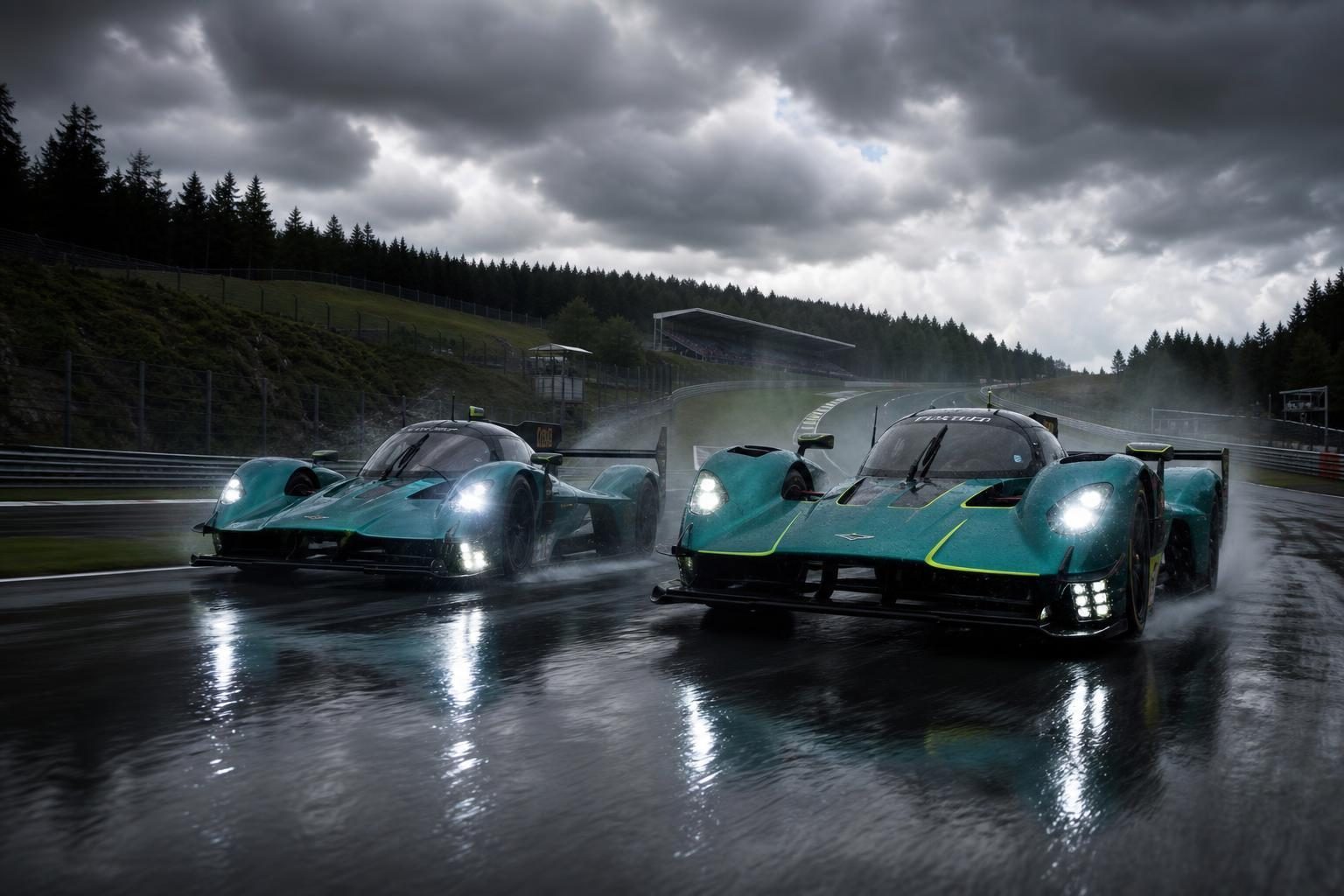
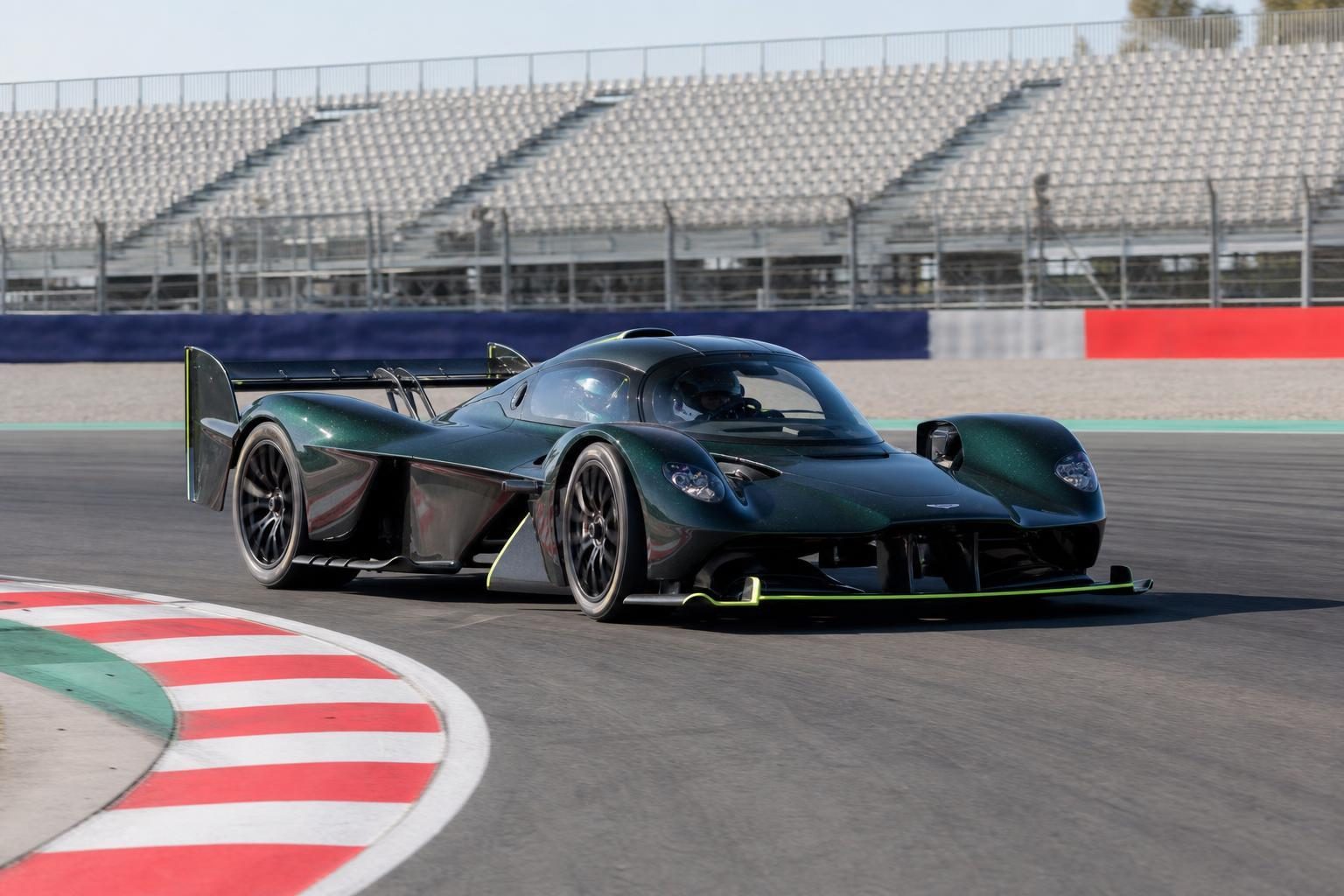
The Valkyrie lineage now splits into three clear strands. First the race car, the Valkyrie Hypercar, entered under LMH regulations. Then the Valkyrie LM, derived from this competition base but explicitly not homologated to race. Finally, the road-going versions, including the Valkyrie Spider and the extreme Valkyrie AMR Pro reserved for private tracks.
According to astonmartin.com (9 June 2025), the Valkyrie LM is engineered from the Valkyrie Hypercar, the brand’s first LMH. It carries over the aerodynamic ethos and mechanical heart, without the constraints of a rulebook. This latitude allows a hand-picked group of owners to enjoy a driving experience close to racing, but freed from calendars and BOP.
To place the family tree, recall that the Valkyrie concept was unveiled in 2016. Since then, the family has branched into road and track programmes. The LM occupies the most singular niche: an engineering object extrapolated from the endurance car, conceived for intensive private circuit use.
The naturally aspirated 6.5‑litre Cosworth V12: same tune as the race car
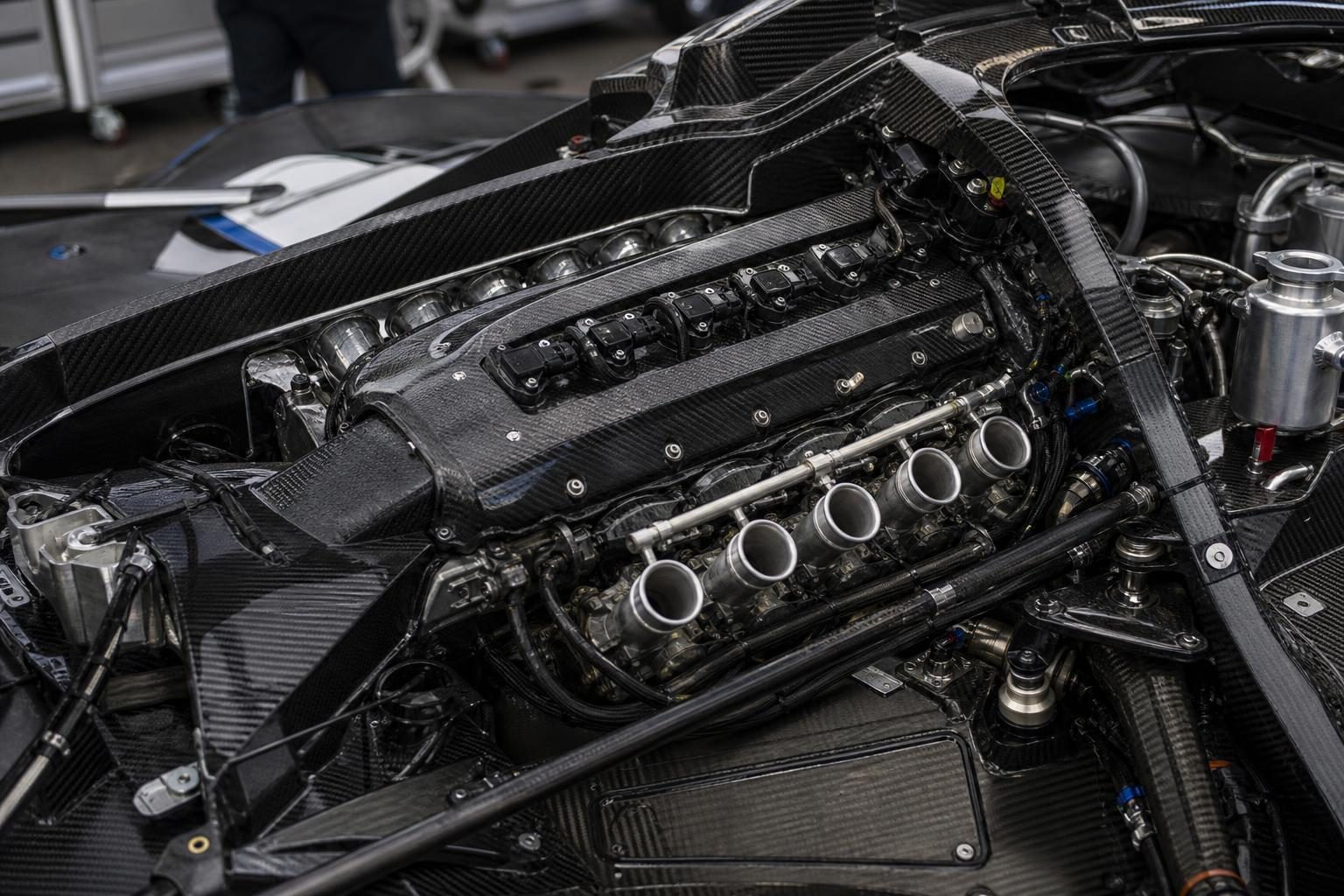
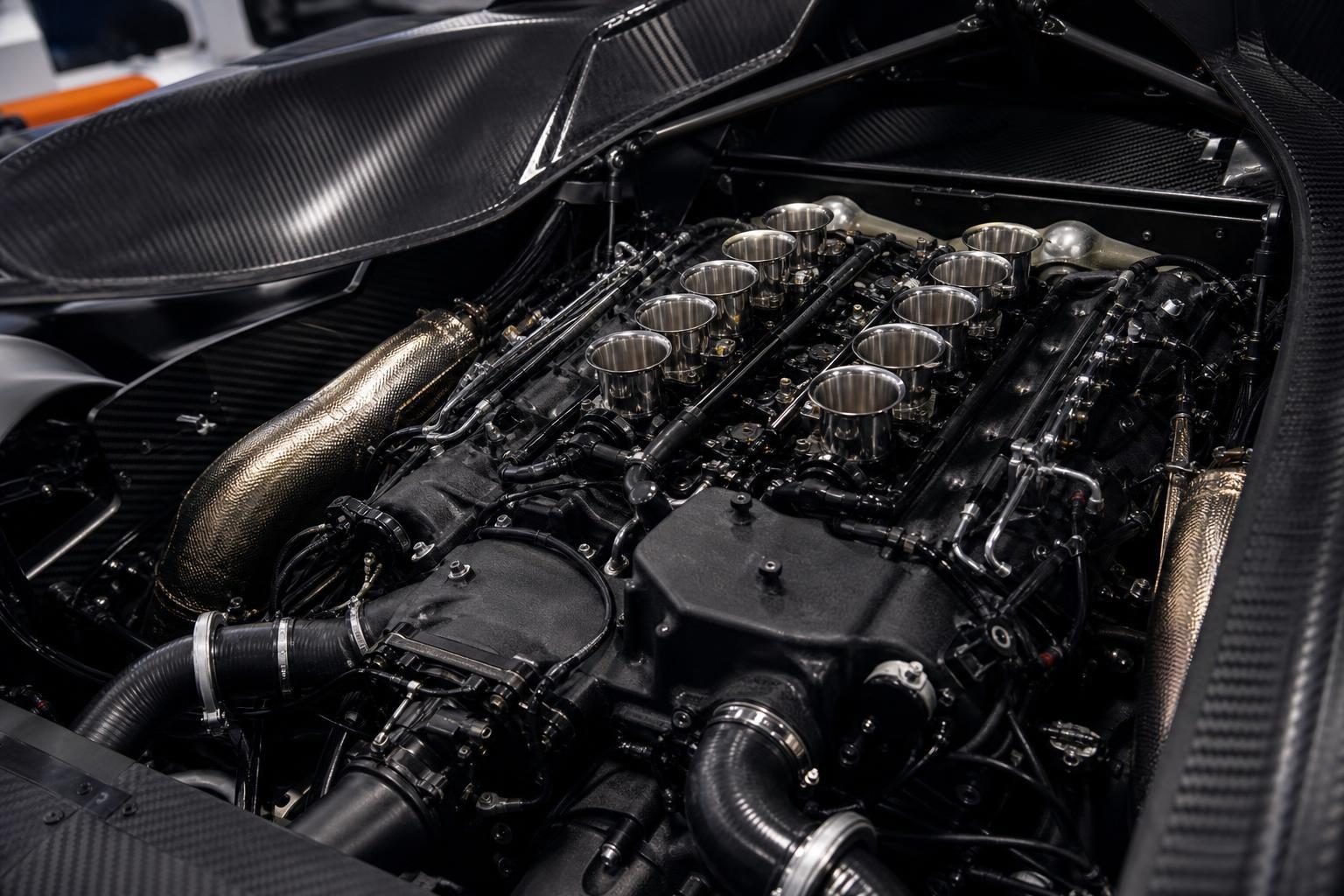
The core of the package is a naturally aspirated 6.5‑litre Cosworth V12, lean-burn, quoted at 520 kW, or 697 PS. The key point: its tune is identical to that of the WEC car, again according to astonmartin.com (9 June 2025). In other words, the Valkyrie LM does not settle for sound and style: it adopts the Hypercar’s mapping and thermal philosophy.
This technical choice is a promise of authenticity at the wheel. With no hybrid system, the V12 breathes freely and delivers crisp response, with the progressive build of a great naturally aspirated engine made to sustain effort. In practice, this means temperatures to watch, warm-up times to respect and maintenance that belongs more to a race outfit than a home garage.
The mechanical coherence also shows in its vocation: to string together long, repeatable, instructive track sessions. The Valkyrie LM is not playing at one-lap qualifying sprints. It is built for the long run, exactly like the platform it descends from.
10 units and a three-stage track programme in 2026
The series is strictly limited to 10 units. The owner calendar is mapped out: handover in the second quarter of 2026, then two UNLEASHED track days in the third and fourth quarters of 2026, on Formula 1 circuits. Finally, an owners’ dinner is scheduled at the Gaydon headquarters in December 2026.
The interest of this protocol is twofold. First, to support learning the model in suitable environments, with factory backing and top-level infrastructure. Second, to create a technical as well as social community around the Valkyrie LM, where data, set-ups and feedback are shared over the sessions.
This format is no marketing bundle: it structures a year of progressive familiarisation in three stages, paced like an endurance season. To prepare for these steps, our feature on the UNLEASHED day at Paul Ricard with the AMR Pro gives a good foretaste of the methods and atmosphere: feedback from an UNLEASHED day at Paul Ricard.
What ‘non-homologated’ means in practice for the owner
The note “not homologated for competition” is central. It means the Valkyrie LM cannot be entered in an official series, and it is not intended for road use. It lives on private tracks, owners’ days, tests and dedicated events. It is both a freedom and a constraint: freedom of set-up and use outside a calendar, constraint of a more demanding logistical framework.
Practically, expect to operate in “mobile workshop” mode: tyres, fluids, sets of parts, and a technical crew that knows the model. The UNLEASHED days are a foundation, but you will be able to drive beyond them, subject to track slots and transport logistics. The Valkyrie LM is an investment in time, not just in capital.
Valkyrie LM versus client hypercar rivals: positioning and price
The question of positioning calls for clarity and caution. The Valkyrie LM is an extrapolation of the racing Hypercar, delivered with a running programme and factory supervision. It does not slot into a standard spec sheet, nor a public price list. The price is not disclosed on available official channels; the goal is not to beat a number, but to guarantee mechanical proximity and operational closeness to the WEC car.
In the “client hypercar” market, rarity (10 cars), engine identity (Cosworth V12 in Hypercar tune) and the 2026 owner calendar form a triptych rarely seen. Where other approaches emphasise racing entries or road registration, this Aston embraces the in-between: a private endurance machine, intended to run full days, as close as possible to the factory way.
For context, the releases and official pages detail the intent and contours of the programme. The dedicated presentation and Aston Martin’s racing section are useful reads to position the Valkyrie LM alongside the endurance Hypercar project: official presentation of the Valkyrie LM and overview of Aston Martin racing activities. For a complementary, usage-and-feel oriented read, EVO’s analysis of the Valkyrie family places this model within the ecosystem of contemporary hypercars.
Conclusion – why the Valkyrie LM is the right “third object”
For the collector who wants the experience closest to endurance without committing to a championship or giving up the V12, the Valkyrie LM ticks the right boxes. It combines a Cosworth engine in Hypercar tune, a precise support programme in 2026 and a 10‑unit production that guarantees factory attention as much as the durability of its use value.
It is not a weapon for an official podium, nor a road-registered diva. It is that rare “third object”, designed to run often and progress long, in a chosen setting. For these reasons, the Valkyrie LM naturally finds its place in a demanding garage: at once instrument, school, and a signature of engineering.
Nürburgring Aston Martin Triumph: 6 Ultimate Facts on the 2026 24H Podium
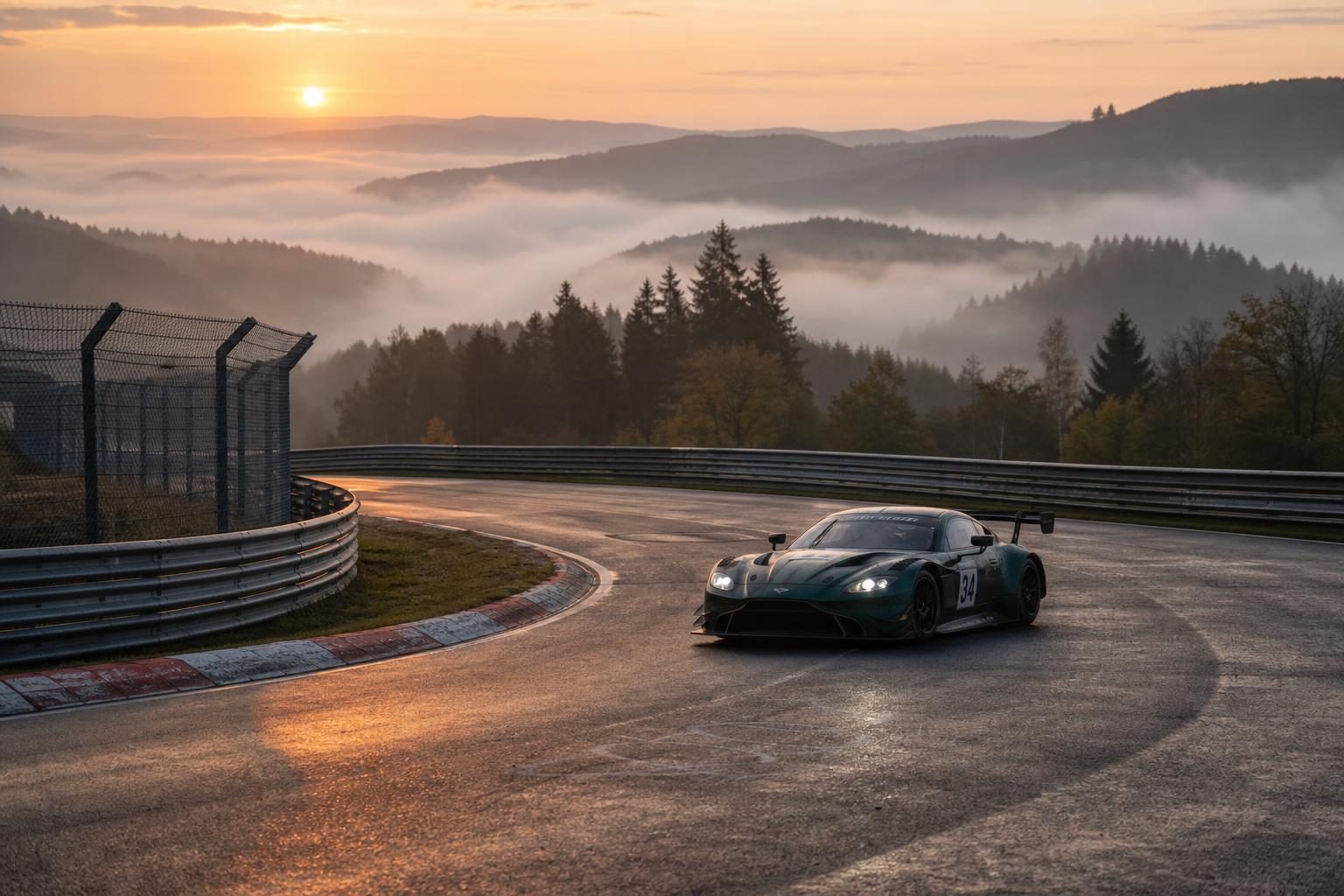
Nürburgring Aston Martin enters a new era with a first-ever overall podium secured at the 2026 24 Hours, a performance delivered by the Walkenhorst-run Vantage GT3 #34. Here, in six points, is why this result matters, how it was achieved and what it means for this year’s endurance campaign.
The ‘Green Hell’ by the numbers: why this race stands apart
The Nürburgring in the Eifel remains a world of its own: a 15.8-mile circuit, around 25.4 km, blending the Grand Prix layout with the Nordschleife. Its length, the variety of sequences and the altitude changes create a battleground where endurance is won as much through anticipation as through attack. Over 24 hours, the smallest mistake is costly and any lull in the weather is never guaranteed.
In 2026, the SP9 class gathered more than 40 GT3s, immediately setting an unusually dense level of competition. In this constant traffic, keeping a qualifying rhythm while respecting the car and tyres is a tightrope act. The event demands a cool reading of risk, especially at night, when temperatures drop and grip slips away.
This 2026 running was the 54th edition of the classic, a milestone reminding us that the honours list is built over time. An overall podium here is never accidental: it requires a rare alignment of preparation, execution and strategy. According to the release of 17 May 2026 published by Aston Martin, that is precisely what Walkenhorst’s #34 managed to bring together.
Drudi, Krognes, Thiim and Walkenhorst: the strategy that worked
The trio Mattia Drudi (ITA), Christian Krognes (NOR) and Nicki Thiim (DEN) built their race on a strong grid position and meticulously managed stints. The foundations were laid as early as Top Qualifying, with Drudi and Krognes classified 1st and 2nd in their respective sessions. Starting up front at the ’Ring means seeing the traps coming, choosing your lines in traffic and imposing your tempo without over-defending.
The Vantage GT3 #34 then pursued a measured approach: clean stops, calibrated stints, and a safety margin preserved in the trickiest zones. The Walkenhorst team clearly prioritised consistency over sprinting, banking on a sustainable tempo. In the critical phases, the trio exploited the tyre performance window while preserving the machinery.
The result—third overall—rewards execution without obvious missteps. Coordination between the pit wall, tyre strategy and on-track pace made the difference in a crowded SP9 field. This overall podium validates the potential of the new-generation Vantage GT3 on one of the most selective stages there is.
Twenty years after its Ring debut: Aston Martin’s evolving record
This overall podium arrives in the year marking the 20th anniversary of Aston Martin’s debut at the Nürburgring 24 Hours. Two decades to tame the demands of the ‘Green Hell’ and set a tangible overall benchmark: the symbolism is clear. The brand’s story at this circuit does not begin in 2006, however. In the 1950s, Stirling Moss had already delivered a resounding hat-trick at the 1000 km of the Nürburgring, including the 1959 edition.
This continuity matters. It connects contemporary endurance racing to a heritage defined by strong-willed drivers and cool-headed cars. The Vantage GT3 #34 sits in that lineage, adding a line to a record that, until now, lacked an overall 24-hour reference at the Ring. For collectors as well as followers of the marque, the trajectory becomes clearer.
In Aston Martin’s endurance landscape, this Nürburgring result echoes the campaigns fought in GTE and at Le Mans. To extend that perspective, our feature on the history and victories of the Vantage in WEC and Le Mans usefully resets the markers of the past decade: the Vantage GTE odyssey in WEC and Le Mans.
Race conditions: 3–5°C and the Pirelli advantage
The weather played its part. Unusual for May, the 2026 edition ran in 3 to 5°C ambient temperatures. In this cold, managing warm-up and keeping tyres in the grip window is crucial. According to Aston Martin (media.astonmartin.com, 17 May 2026), these conditions favoured Pirelli tyres, a factor the #34 converted into a measured competitive edge.
Practically, this shows in the activation pace out of the pits and consistency over long stints. Gaps are made and unmade over a handful of corners when grip is slow to arrive. Exploiting this phase better sometimes counts more than a heroic flyer in the dead of night. Here, driver discipline took precedence over bravado.
The Pirelli window, favourable in the cold, does not explain everything. You still have to preserve the rubber over 25.4 km, with compressions, bumps and very high-speed sections. It is this sum of micro-gains—clean warm-up, protecting the carcasses, stretching a stint—that helped stabilise the Walkenhorst #34’s race at the sharp end.
What this podium changes in Aston Martin’s 2026 endurance campaign
An overall Nürburgring podium, at the 54th edition, shifts outside perception as much as it consolidates the inside. For the marque, it is a milestone that lends credibility to the Vantage GT3 against a sizeable SP9 opposition. For engineers, it is an ideal dataset: low temperatures, dense traffic, and real-world validation of tyre, brake and aerodynamic windows under extreme conditions.
Sportingly, this performance strengthens the momentum of a 2026 endurance campaign fought on several fronts. It neatly complements ambitions across factory and customer programmes. On that note, revisit our overview of the commitments at Le Mans and in the World Endurance Championship: Aston Martin at Le Mans and in WEC, programmes and markers.
On the product side, there is marketing resonance, even if discreet. The racing showcase supports the road, especially for those eyeing the latest evolution of the production coupé: the Vantage MkII, specs and first impressions. Without overreaching, a successful ’Ring speaks to customers who recognise the transfer of know-how, especially when the performance rests on facts rather than slogans.
Conclusion – Nürburgring Aston Martin, a milestone that matters
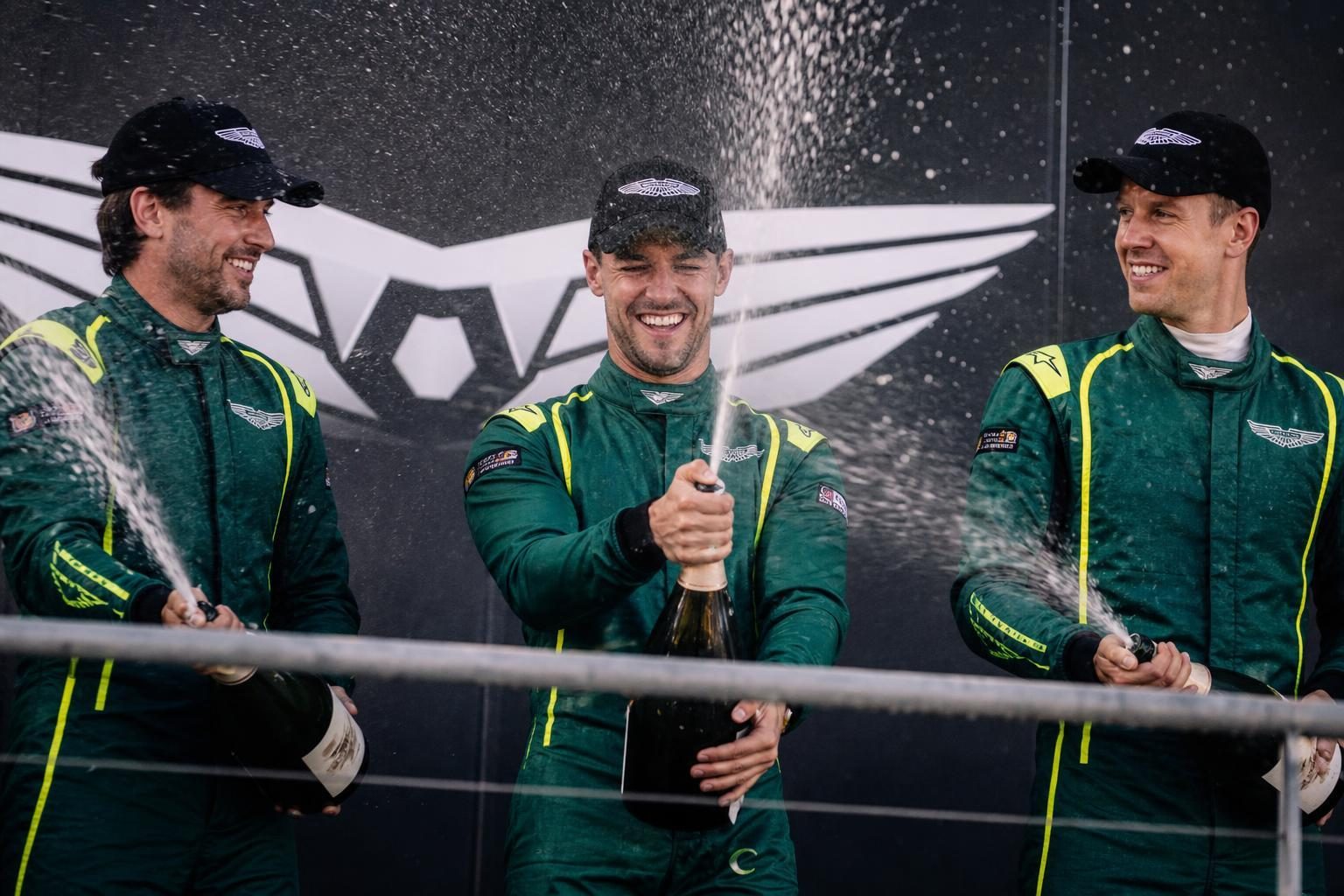
After 24 cold, intense hours, Nürburgring Aston Martin reaches its crescendo: the Walkenhorst Vantage GT3 #34, third overall, signs the marque’s first overall podium at this race. The key? A strong Top Qualifying, flawless stint strategy and intelligent exploitation of a tyre advantage in 3–5°C.
This result, twenty years after the marque’s debut at the Nürburgring 24 Hours, highlights a patient, coherent progression. It does not rewrite history; it clarifies an important line within it. To extend the analysis from the manufacturer and competition side, see the official resources: the detailed 17 May 2026 release and Aston Martin’s racing page; and, for context, the event encyclopedia. Here, the performance speaks for itself—quietly, durably.
Aston Martin DBS V12 Ultimate 2012: leaving without knocking over the silverware
Announced in May 2012, built over the final two months of production, in June and July 2012, the DBS Ultimate is the farewell edition of the 2007-2012 generation DBS. One hundred examples in total, coupés and Volantes combined. One hundred final cars to close a story that began with a grand GT derived from the DB9, spiritual heir to the Vanquish S, and replaced in 2012 by the new Vanquish. At Aston Martin, they call that the end of a career. In the real world, they call it a final glass of whisky in a leather-lined lounge.
The swan song — but with a V12
The DBS Ultimate is not a limited series designed to turn the car into a steroid-fed ballistic missile. No engineer was locked in a hangar with a 12 mm spanner and ordered to find twenty extra horsepower before tea. The Ultimate is a purely cosmetic edition. Mechanically, it remains a standard DBS. Which, let’s be honest, is exactly like saying Buckingham Palace is a decent house with a bit of potential.
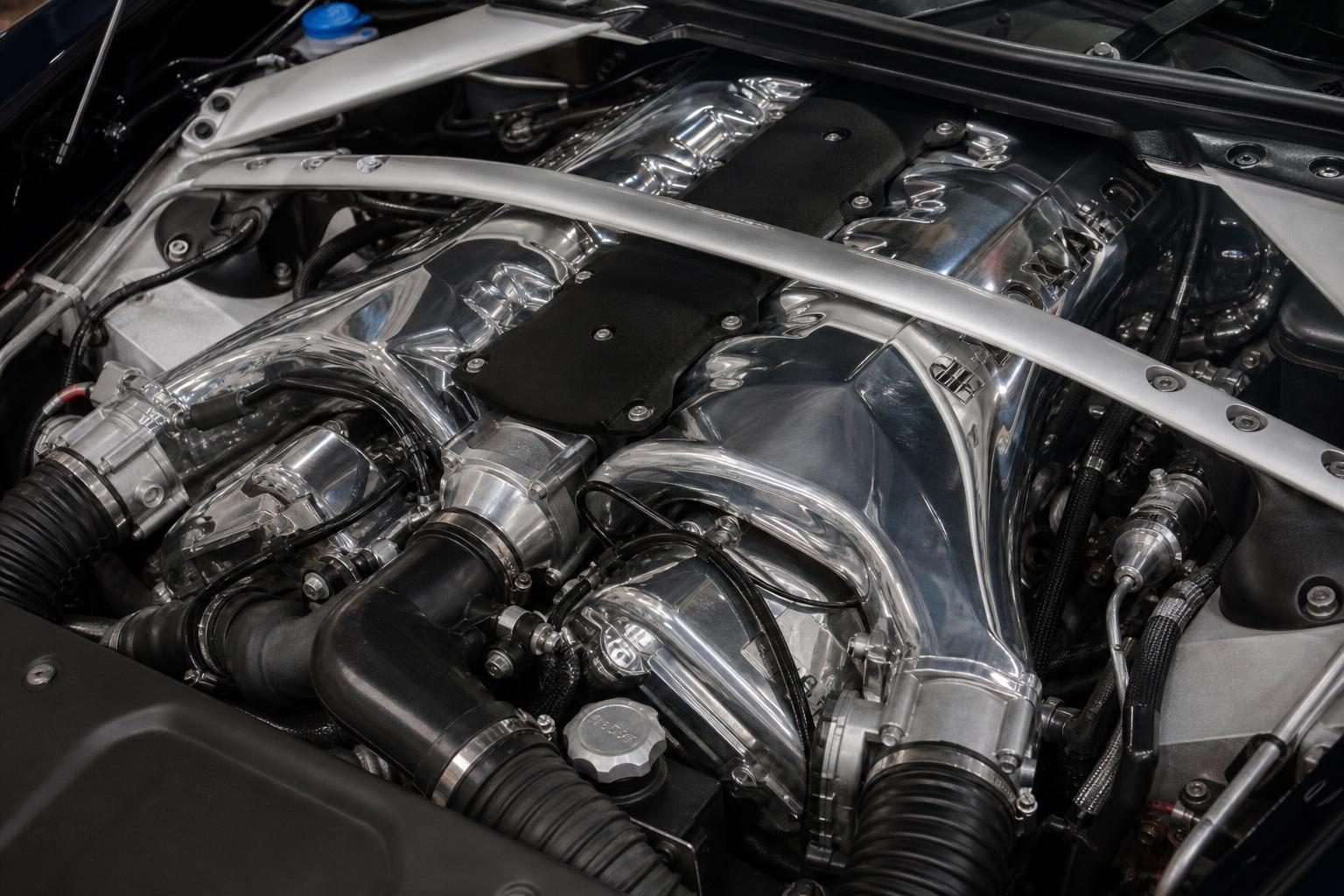
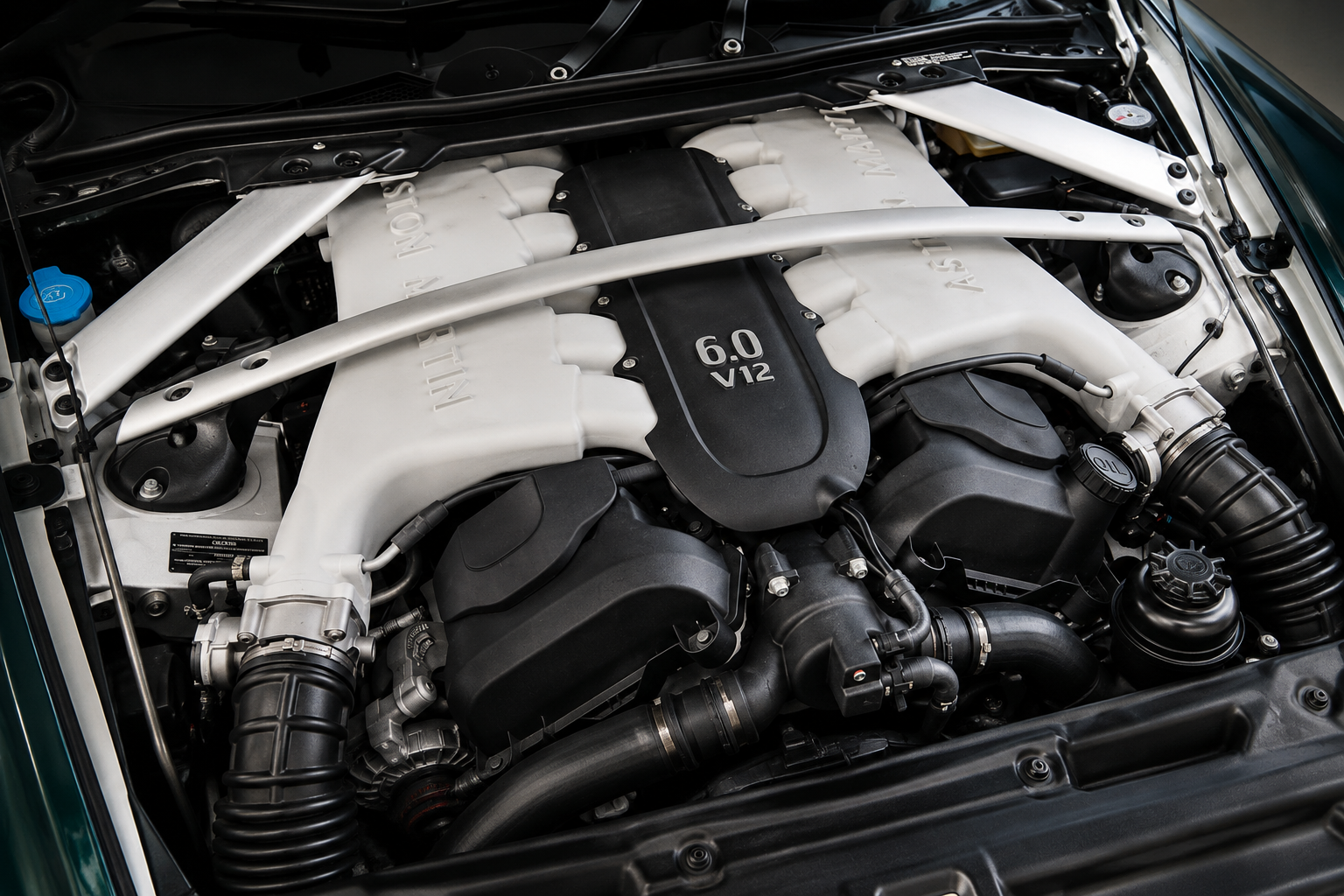
Under the long bonnet, then, sits the naturally aspirated 5.9-litre V12, 5,935 cm³ for people who organise their socks by cotton density, sometimes rounded up to 6.0 litres depending on the source. An AM08 engine with 48 valves, no turbo, no forced-induction trickery, none of that modern feeling that a computer is serving you power with pickle tongs. Here, air enters, fuel burns, the V12 sings, and the world immediately becomes more bearable.
Power is 517 PS, or 510 bhp, at 6,500 rpm. Torque reaches 570 Nm, or 420 lb-ft, at 5,750 rpm. The coupé runs from 0 to 100 km/h in around 4.3 seconds, and top speed is about 307 km/h, or 191 mph, with the manual gearbox. These are not numbers screamed by a marketing department on a caffeine drip; they are the figures of a great old-school Aston, from a time when British elegance could still do 307 km/h in a dinner jacket.
One of the last great naturally aspirated V12s
The emotion of the Ultimate lies mainly in this: it arrives at the twilight of the great naturally aspirated V12 at the top of the Aston Martin range. Careful, no panic, no proclamation carved in stone by an overexcited commentator: the Vanquish that succeeds it still keeps a naturally aspirated V12 for a while. But the DBS Ultimate clearly belongs to that end of an era, before the DB11 brought, in 2016, the 5.2-litre twin-turbo V12 into the Aston landscape.
So it is less “the very last” than one of the final great salutes. And perhaps it is more beautiful that way. Endings that are too neat smell of administration. This one carries the scent of an engine that revs freely, of a long bonnet under tension, of a quilted cabin and mechanical nobility that nobody needed to compress in order to make interesting.
Incidentally, do not confuse it with the DBS Carbon Edition, another end-of-career series. The Ultimate has its own role: to close the book, not by adding a technical chapter, but by underlining the final page in black ink.
The outward signs of a successful farewell
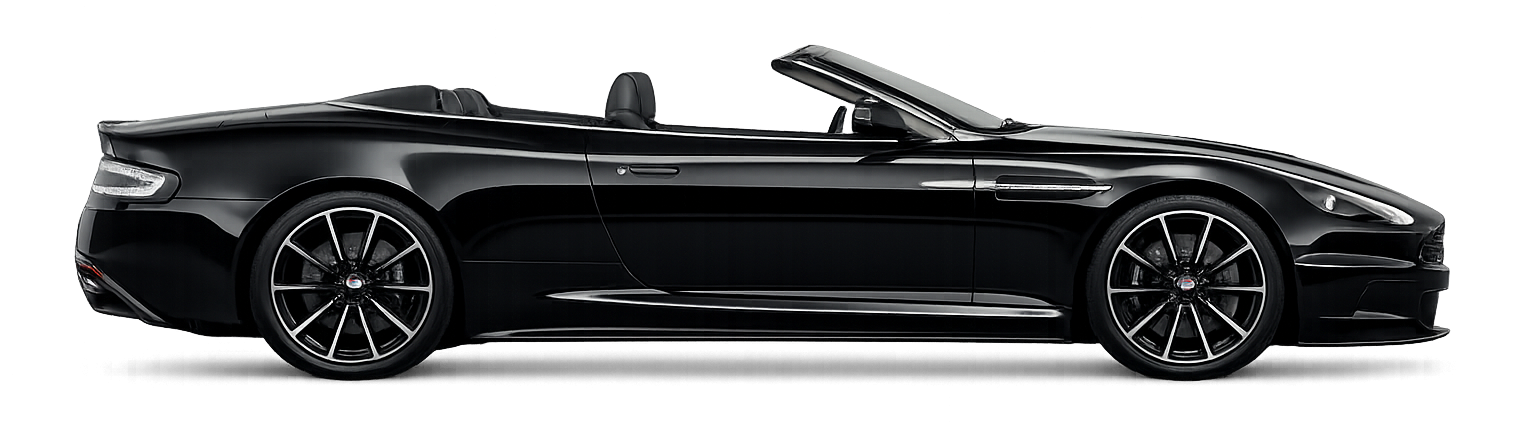
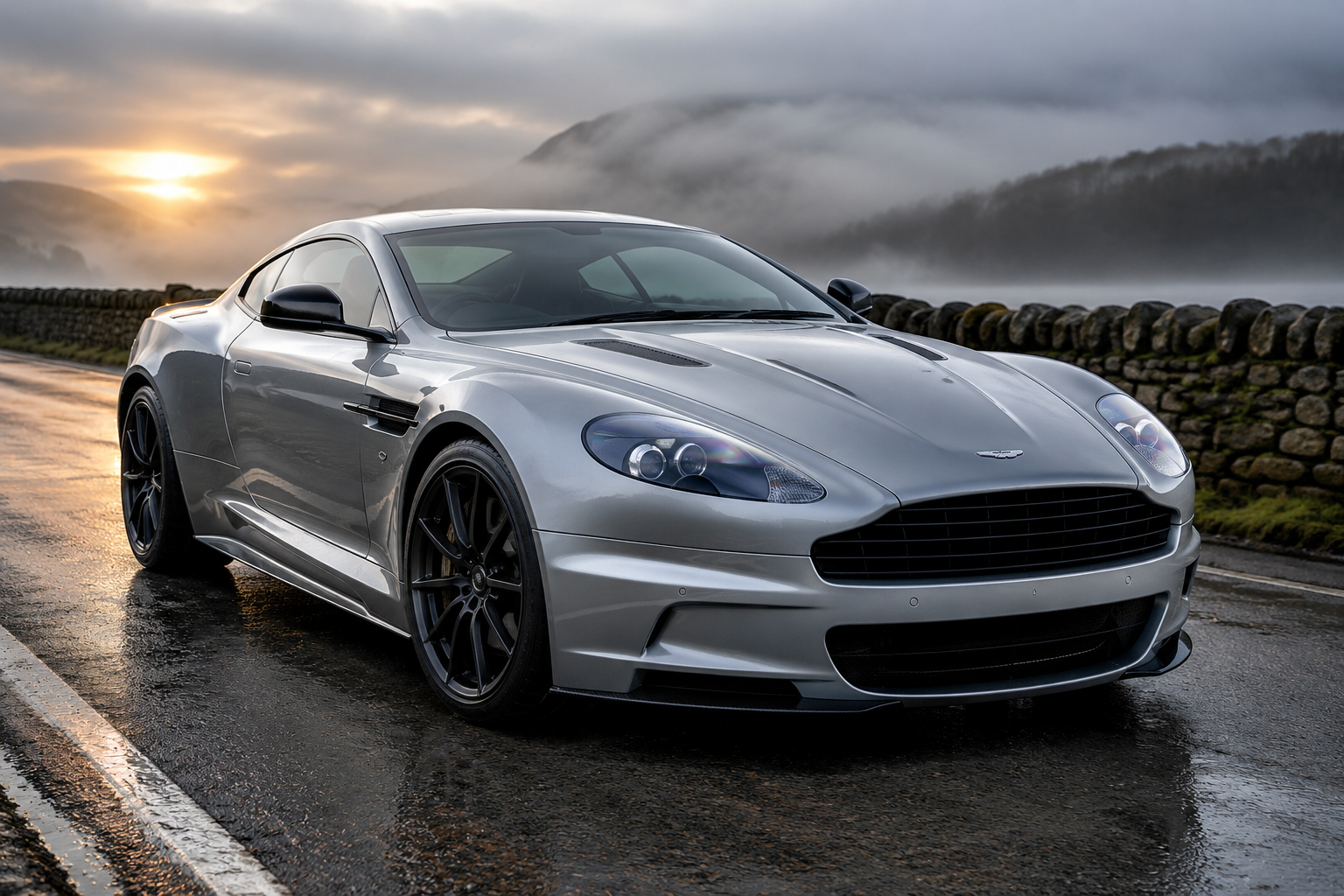
The Ultimate can be recognised by a series of details which, taken separately, might seem reasonable. Together, they turn the DBS into a statement of intent. Three colours were offered: Quantum Silver, Silver Fox and Carbon Black II. Three ways of saying “discretion” with the visual volume of a butler pushing open the door of a cathedral.
The grille is black. The rear diffuser is carbon fibre. The rear lights are smoked. The number plate surround is contrasting. The brake calipers could be chosen in three colours. This is exactly the kind of detail Aston Martin knows how to sell as if every option had been polished by a craftsman in a Warwickshire village while his dog was called Bentley. But on the DBS, it works. Everything works. The car does not look dressed up; it looks as though it chose its evening wear.
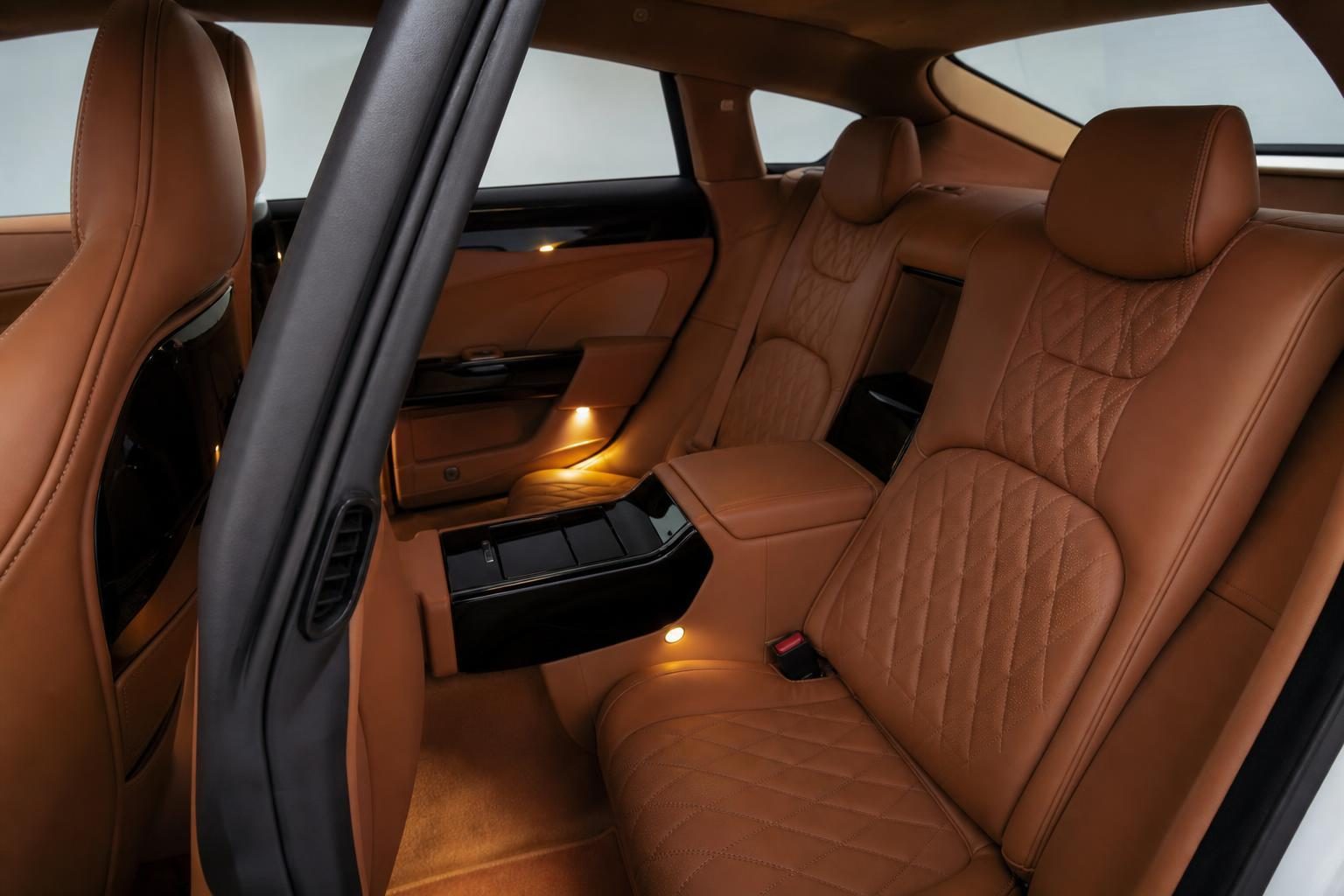
Inside, the treatment is just as theatrical, but with the restraint that prevents the whole thing from tipping into a Russian yacht lounge. There is diamond-quilted leather, an Alcantara headliner, a carbon-fibre fascia, “DBS Ultimate” badges and a numbered plaque. The kind of cabin that makes you want to speak more quietly, even alone, even at a standstill, even if you have merely dropped your glasses between the seat and the console.
One hundred examples, and a coughing calculator
The total is clear: 100 examples. The exact split, however, is less official. Enthusiast registers mention around 59 coupés and 41 Volantes. It should therefore be stated as such: an estimate, not a factory figure. Nobody at Aston seems to have engraved the coupé/Volante split on a silver plaque, which is a shame, but perfectly in keeping with the charm of the matter.
Almost all cars are believed to have received the Touchtronic 2 automatic gearbox. Manuals are extremely rare. Depending on the sources, there is said to be a single manual coupé, in the United States, presented as the last manual DBS ever built, and two American manual Volantes. In the collector world, this kind of detail has the same effect as throwing a rib of beef into a cage of greyhounds.
The coupé weighs around 1,695 kg, the Volante around 1,810 kg. Yes, it is not light. A DBS is not a track-day bathtub made of prayer fibre. It is a large V12-engined GT, built to cross countries while giving the impression that toll gates ought to open out of constitutional respect.
New price: the bill for the final bow
In the United Kingdom, the list price of the DBS Ultimate sat just below £187,000. The Ultimate pack added around £10,000 to the price of an ordinary DBS. Put another way, Aston was offering you the chance to pay the supplement of a nice small car to obtain the final ornaments of a great car. It is absurd, of course. But it is a wonderful absurdity, like buying cufflinks for a suit of armour.
No reliable American price specific to the Ultimate allows a clean figure to be stated. And since a beautiful story does not justify bad data, we shall stop there.
Current value: rarity, caution and a V12 in a dinner jacket
The current value must be approached with caution, because most of the available data concerns the DBS V12 in general, not the Ultimate specifically. In 2024, standard DBS examples sold at auction for around £60,200 for a right-hand-drive car with 23,000 miles in August, and around $95,000 for a left-hand-drive car in October.
Online valuation data dated 2026 indicates around £84,700 in average condition, with a public record stated at £241,250. For an Ultimate example, a Swiss coupé showing around 205 km, but requiring recommissioning, was sold for £97,750 by Bonhams. Once again, condition, specification, market, gearbox and history all carry considerable weight. A manual Ultimate, should one appear, clearly does not play in the same league as a more common Touchtronic DBS.
The trend in 2026 seems to be a slow rise, driven by several forces: the James Bond connection, its status as an Aston Martin flagship, the rarity of the Ultimate, and growing interest in large naturally aspirated V12s. Nothing hysterical, nothing that requires selling a Scottish county before Friday, but a gradual appreciation. The kind of climb that makes no noise, precisely because it has class.
Why it matters
The DBS V12 Ultimate is not important because it is more powerful, faster or more radical than the standard DBS. It is important because it understood its role. It does not try to correct the DBS. It celebrates it. It takes a grand GT that is already dramatic, already beautiful, already sonorous, and adds the final punctuation mark.
It is a farewell car. Not a fairground firework display, but a final note held by an orchestra that knows exactly when to stop. It marks the end of a generation, the last breath of a lineage before the new Vanquish, and one of the final moments when Aston Martin’s flagship still spoke through a naturally aspirated V12 without a turbo holding the microphone.
In that sense, the DBS Ultimate may be one of the easiest Astons to love. It does not need to be explained for three hours by a man in a quilted jacket. It simply says: this is what we knew how to do. A silhouette, an engine, a cabin, one hundred examples, and that very particular feeling that the car was not assembled to fill a box in a range, but to close an era with panache.
Rapide 2010: 4 Ultimate Reasons the Four-Door GT Didn’t Conquer the Market
Rapide, or the art of shaking up Aston Martin habits: this four-door, V12 saloon, launched in 2010, tried to open up a niche as logical on paper as it was delicate in practice. We revisit its atypical gestation, its technical choices, its internal duel with the DB9, then the 2013 Rapide S relaunch attempt, before assessing the value of the examples on the road today.
Genesis: from the 2006 Jet concept to production in Austria
In autumn 2006, the Jet 2 concept shown at the Frankfurt show gave a foretaste of a four-door Aston inspired by the marque’s GTs. The idea was clear: stretch the brand’s elegant DNA into a more habitable format without denying the look of a coupé. According to Wikipedia, this concept served as the clutch for a development that was longer than expected, a prelude to series production from 2010.
For industrialisation, the marque entrusted assembly to Magna Steyr in Graz. It was a first in the Gaydon era: while other Astons rolled out of England, the Rapide took the road to Austria. This choice, documented by Wikipedia, met capacity and flexibility constraints while embracing small-series manufacture.
The timetable took shape between 2010 and 2015, with a major update in 2013. Running through it all was a demanding equation: preserve a coupé silhouette, offer two genuine rear seats, and maintain that veneer of understatement so dear to the marque.
Four doors, 470 PS, 295 km/h: a spec sheet that made waves
Mechanically, the Rapide claimed a naturally aspirated 6.0-litre V12 with 470 PS at launch. The stated top speed brushed 295 km/h, while the length reached 5,019 mm, making it the longest series-production Aston of its time, according to Wikipedia. The message was crystal clear: it was indeed a GT, but with two extra doors and a bonnet worthy of the grand house traditions.
The architecture stayed true to British grand touring, with balanced weight distribution and an interior tailored for very high-speed travel. Two usable rear seats, graceful apertures and a profile that remained that of a coupé… On paper, the Rapide ticked the boxes to attract hurried, aesthetic-minded families.
In practice, the proposition addressed a narrow audience. The five-metre-plus footprint, modest rear headroom and resolutely GT approach placed it halfway between an executive saloon and a four-seat coupé. A grey area that customers sometimes struggled to decode.
Why buyers preferred the DB9: positioning compared
Against the DB9, Aston’s grand touring coupé benchmark, the Rapide had to justify its two extra doors without diluting the emotion. Yet the DB9 already concentrated the essence of the sought-after experience: a noble V12, a purist line, and an image crystallised by a decade of success. Most buyers judged that the occasional rear seats of a coupé sufficed, preferring the icon to the newcomer.
The difference in length and mass, as well as the more utilitarian message – however discreet – of the saloon may have weighed in the balance. In real-world use, the added versatility did not eclipse the emotional pull of the DB9. Implicitly, the Rapide highlighted a house bias: at Aston, the coupé’s irrational appeal often trumps the rationality of a four-door GT.
In the market of the time, the rival offering did not overlap perfectly, further complicating the reading of its positioning. The Rapide addressed exacting aesthetes, willing to accept habitability compromises in exchange for a preserved silhouette. Many preferred to stay on the DB9 side, as shown by the model’s enduring renown, detailed in our DB9 profile.
The 2013 Rapide S: a course correction that didn’t change sales verdicts
In 2013, the Rapide S brought a substantial power increase, quoted at 558 PS (source Wikipedia). The facelift aimed to assert character and flesh out the offer without denying elegance. The promise: more response and a more assured visual presence, while preserving the GT philosophy.
Even so, the essentials did not change: footprint, architecture and use case remained close. Customers already won over by the Rapide saw a welcome update. The fence-sitters stayed loyal to the house coupé. The repositioning, real on the technical front, did not materially alter the commercial trajectory.
In total, Wikipedia mentions around 1,500 examples produced between 2010 and 2015, a figure not officially confirmed by Aston Martin in the sources consulted. A low-key run, revealing a niche as singular as it was narrow for this model.
Values and today’s market: what the c.1,500 examples are worth
With production estimated at around 1,500 units over the full cycle, the Rapide now occupies a niche coveted by contrarian Aston enthusiasts. Its relative rarity and naturally aspirated V12 speak for it, while its lukewarm period positioning has become a discreet charm on the secondary market.
Well-maintained examples, with clear history and understated specification, draw the most interest. The more powerful Rapide S appeals to those seeking a firmer reading of the concept. In an era of standardised forced induction, the linear character of the atmo V12 adds both use-value and image.
Conclusion: what does the Rapide teach us about Aston Martin strategy?
The Rapide is a reminder that a GT crest does not mechanically transpose to a saloon, even an ultra-luxury one. Its genesis marked by the Jet 2 concept, its outsourced production in Graz at Magna Steyr, then the Rapide S evolution illustrate a coherent ambition but a market narrower than expected.
Technically accomplished, elegant and faithful to the house aesthetic, it nonetheless yielded to the emotional magnetism of the DB9. In this sense, the Rapide serves as a useful marker for understanding the limits of a four-door format within a marque whose soul remains that of the coupé.
Ultimately, the Rapide earned its place in the family album not through volumes, but through the strategic lesson it imparts.
Aston Martin Newport Pagnell: 5 Ultimate Secrets that Shaped a Legend
Aston Martin Newport Pagnell is not just a dot on the map: it is where the DB4 ushered in, from 1958, a new era for the marque, and where artisanal know-how continues to thrive. In this portrait of a place, we retrace the move to Buckinghamshire, the decisive role of Touring in Milan, the long production run through to the Vanquish Mk1, then the activity of Aston Martin Works between restoration and Continuation, before concluding with the handover to Gaydon. The idea is not to mythologise: simply to observe, chronologically, how Aston Martin Newport Pagnell shaped the identity of a very British sports car house.
1958: why Aston Martin left Feltham for Newport Pagnell
The established fact, first: the DB4 is the first Aston Martin assembled at Newport Pagnell, from 1958, in Buckinghamshire. This is the tipping point, documented by Wikipedia dedicated to the DB4. From then on, the village became synonymous with hand-shaped bodywork and chassis tuned for both road and track.
As for the precise reasons for leaving Feltham, the sources cited here do not detail them. What can be stated, according to the available information, is that Aston Martin Newport Pagnell established itself from the DB4 onwards as the industrial and artisanal heart of the marque. The site became the address where Astons were designed, assembled and serviced with a workshop mindset rather than a factory in the strict sense.
Implicitly, this geographical shift marked a rise in ambition. The DB4, first-born of the Newport Pagnell era, inaugurated a technical and stylistic language that would infuse the following ranges. Place and car reflect each other, as often at Aston Martin: the quality of the artisanal gesture here found a lasting home.
Hand-built bodywork: superleggera, beaten aluminium and the role of Touring Milan
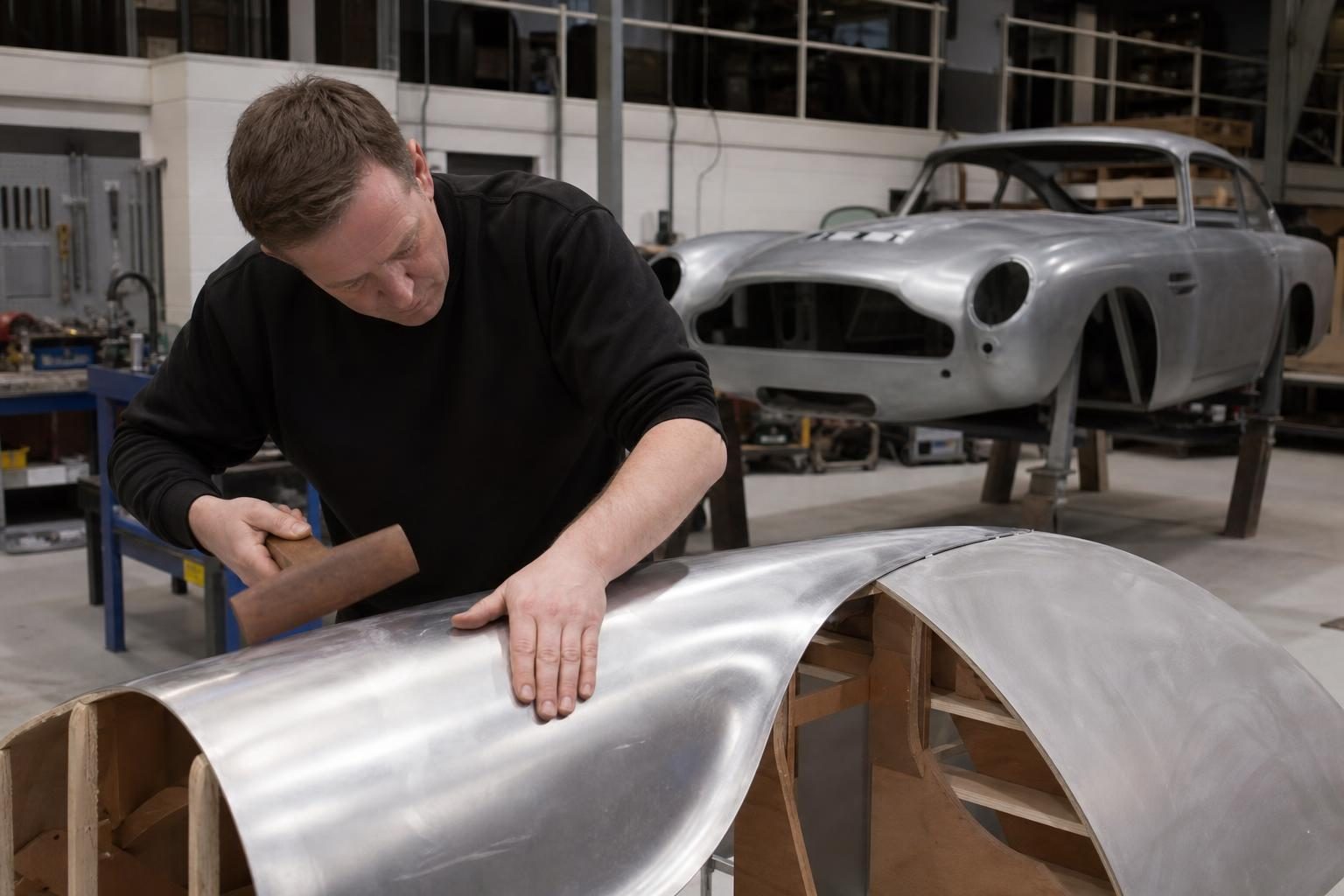
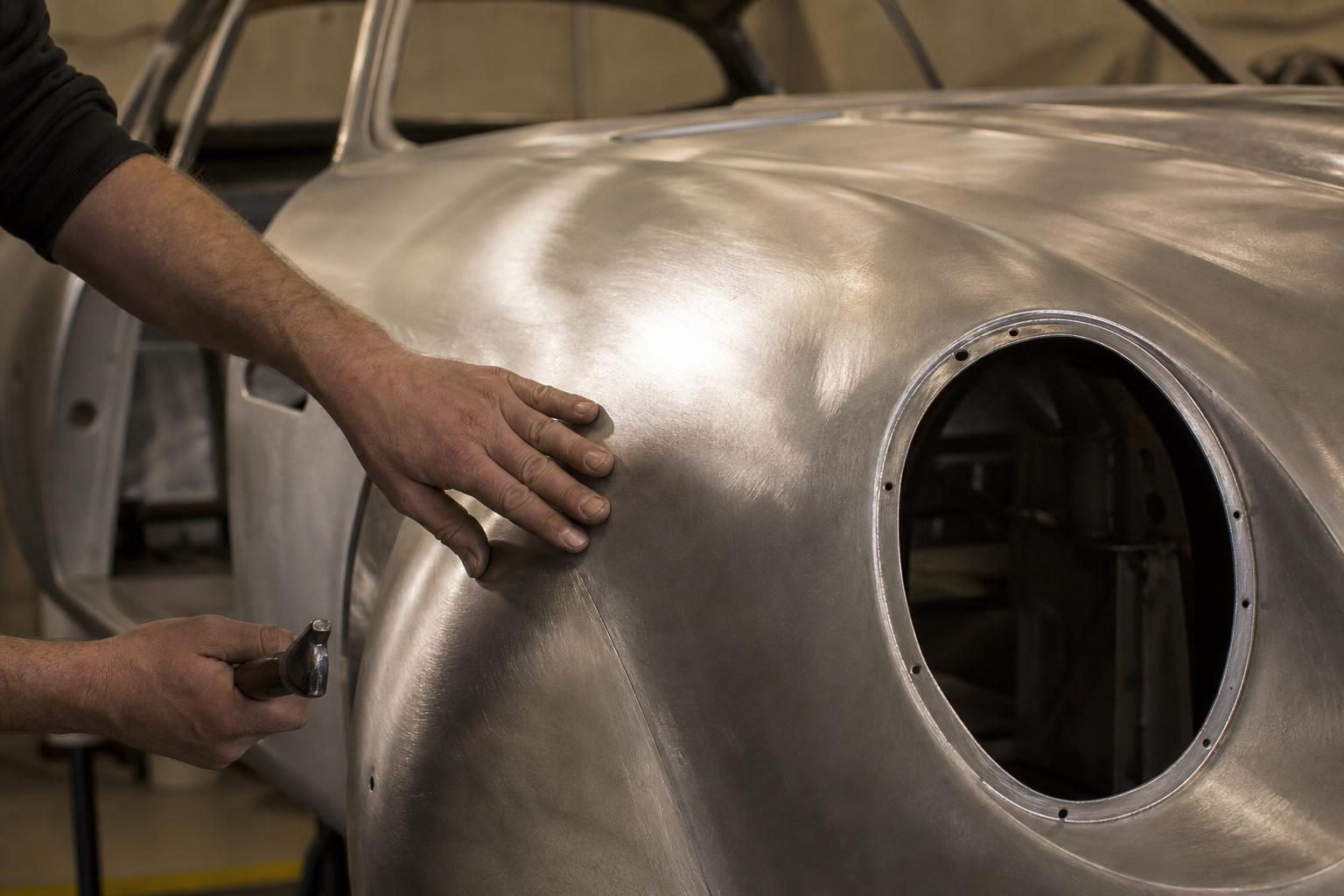
From the DB4 onwards, the superleggera technique signed by Carrozzeria Touring (Milan) set the tone. According to the DB4’s Wikipedia page, this architecture relies on a light tubular frame onto which manually crafted body panels are fixed. The approach targets rigidity and lightness, in the service of performance and steering precision.
This scheme, initiated with Touring, strongly contributed to the visual and technical DNA of the British coupé. In Newport Pagnell, people speak of gestures more than processes: shaping components, fitting to gauges, meticulous alignments. In other words, a car conceived as an assembly of parts adjusted to perfection, with patience and method.
This “superleggera” signature is not just a badge. It anchors Aston Martin Newport Pagnell in a European coachbuilding tradition, blending Italian exacting standards of line with British rigour in assembly. The result: proportioned, taut bodies that age well because they were born of a clear design and careful hand execution.
From DB4 to Vanquish Mk1: over forty years of production on the same site
The continuum between the DB4 and the Vanquish Mk1 tells the story of production rooted on the same site. The former inaugurated Newport Pagnell in 1958; the last examples of the Vanquish Mk1 would still leave these workshops, a chapter already covered in our feature on end-of-line anecdotes, to which we refer for model-specific details.
For those wishing to go back to the origins of the lineage, our page dedicated to the DB4 and its pivotal role offers useful perspective. It sheds light on the driving forces of the period: style, engineering and a controlled ramp-up within Aston Martin Newport Pagnell. In parallel, for the earlier historical bedrock, the article on the DB2, foundational on the technical front, completes the picture.
What stands out, beyond the model years, is the constancy of the craft. The same address, the same workshops, a gradual evolution of methods but an unchanged course: building Astons with an unabashed artisanal density. Here, place is not decorative: it is constitutive of the perceived quality and the reputation for longevity of the bodywork and fit.
Aston Martin Works: restoration, Continuation and today’s Zagato projects
Based in Newport Pagnell, Aston Martin Works is described by the marque as “the largest and best equipped Aston Martin restoration centre in the world”. This position, recalled in the context of the DBZ Centenary Collection (2018) on media.astonmartin.com, speaks to the breadth of expertise on site: evaluation, faithful reconstruction, and turnkey delivery of historic examples.
The site has also distinguished itself with its Continuation cars. In 2017, 25 examples of the DB4 GT Continuation were allocated to collectors, according to the official communication repeated by media.astonmartin.com. Then, in 2019, the DB4 GT Zagato Continuation required around 4,500 hours of work per car at Aston Martin Newport Pagnell, again per the same source.
This programme, led by Works, embraces a dual objective: preserving original correctness and ensuring roadgoing ability to current standards of reliability. For readers wishing to dive into the DB4 GT Zagato odyssey, our feature on the iconic collaboration is available here: history and examples of the DB4 GT Zagato.
To grasp the entity’s offer and philosophy, the official Aston Martin Works page provides a clear overview: restoration, service, parts, and limited production of Continuations. A seamless link between history and the present, materialised by the very address of Aston Martin Newport Pagnell.
The move to Gaydon and what Newport Pagnell still retains
The company’s centre of gravity shifted to Gaydon, opened as the new global headquarters after Newport Pagnell, according to Aston Martin’s corporate information. The Gaydon site today concentrates the executive management and main R&D, while Newport Pagnell remains the home of heritage and service activities.
What remains in Newport Pagnell is, first and foremost, Aston Martin Works and its mission: restore, maintain and, occasionally, recreate. In other words, extend the life of historic models and guarantee their correctness, with the incomparable advantage of factory expertise. A speciality that confirms the unique place of Aston Martin Newport Pagnell within the marque’s ecosystem.
This division of roles has a virtue: the historic address can focus on the cultural and technical value of the classics, while Gaydon steers contemporary projects. To grasp the overall architecture, the corporate Aston Martin site presents the company strategy and site organisation.
Result: heritage is not frozen in a museum; it lives in the workshops, in the measured body tolerances, in engines tuned methodically. And the name Aston Martin Newport Pagnell continues to be associated, in modern releases, with exceptional cars delivered to highly knowledgeable clients.
Conclusion — Aston Martin Newport Pagnell, an address that made history
At the scale of a marque, few places sign the identity as strongly as Aston Martin Newport Pagnell. The facts are stubborn: the DB4 was born there in 1958, under the technical aegis of Touring and its superleggera; the site supported decades of production before handing the industrial torch to Gaydon; today, via Aston Martin Works, it concentrates restoration, service and Continuations as rigorous as they are spectacular in execution.
Put another way, Aston Martin Newport Pagnell is less a factory than a living heritage. A place where one verifies that precision has lost nothing in being passed down from one generation to the next, and where one understands why a well-born British coupé remains desirable sixty years later. That’s the whole idea: let the place speak, and observe that, decidedly, it has a great deal to say.
DB4 GT Zagato: Ultimate 1960 Legend, 19 Built and a 23-Year-Old Designer
The DB4 GT Zagato is both an icon and a textbook case: 19 originals instead of the 25 planned, a young 23-year-old stylist refining its lines, then “sanctioned” series and a Continuation dated 2019. Here is the monograph that places this Anglo-Italian coupé in its true chronology, explaining where the three “sanctions” came from and how Ercole Spada shaped the car’s stance, without needless folklore.
1960: why 19 and not 25 – the order that didn’t fill
Originally, Aston Martin planned 25 examples of the DB4 GT Zagato. Industrial reality delivered 19. According to the official sheet published by media.astonmartin.com, the initial plan was not fully met, resulting in a curtailed production. The UK list price stood at £5,157 including taxes, placing the model at the top of Newport Pagnell’s range.
The process was clear: chassis left Newport Pagnell before being shipped to Zagato in Italy for body shaping and assembly. This round trip embodied the alliance of Aston Martin engineering and Milanese craftsmanship. The DB4 GT Zagato therefore emerged from an international supply chain, already demanding in 1960, where each batch added delays, costs and commercial uncertainties.
As the order was not completed, the series stopped at 19 units. This numerical shortfall contributed to the cars’ reputation and value, but above all reflects a period when the viability of such a collaboration was judged car by car. On the mechanical side, the 3.7-litre twin-spark straight-six claimed 314 bhp, according to media.astonmartin.com and astonmartin.com, giving this shortened coupé a decidedly sharpened foundation.
Ercole Spada, 23, apprentice at Zagato: how he redrew the GT
February 1960: Ercole Spada, 23, joins Zagato as an apprentice. A few months later, he leaves his mark on the DB4 GT, proposing a lighter, more fluid interpretation. According to media.astonmartin.com, it was this very young stylist who redrew the key volumes of the DB4 GT Zagato, in the spirit of the Milanese house: fewer embellishments, greater aerodynamic efficiency, taut surfaces and a roofline that looked visually lighter.
Spada didn’t reinvent; he pared back. The curves tightened, the overhangs were disciplined, and the silhouette gained tension. In this DB4 GT Zagato one sees the language of a racing workshop transposed to the road, born of a fresh eye yet firmly rooted in Zagato’s grammar. It is this almost intuitive coherence that gave the model its distinctive stance, both urgent and elegant.
Context matters: with chassis supplied by Aston Martin and a clear brief – lighten and refine – the young designer set out to make the car more alert and more effective. Spada signed off one of his first achievements here, a foundational work that, in retrospect, established his reputation. The DB4 GT Zagato is not just a pretty dress: its lines express a search for performance consistent with its 3.7-litre straight-six.
Sanction II (1991) and Sanction III (2000): the “new old” cars approved by Newport Pagnell
The rarity of the 19 originals paved the way for “official” re-runs. Sanction II appeared between 1987 and 1991: four cars in total, assembled with Aston Martin’s approval. According to Wikipedia, these DB4 GT Zagato Sanction II sold for over $1,000,000 each, an early signal of collectors’ appetite for reconstructions duly authenticated by the marque.
In 1992, Walter Hayes – then Aston Martin’s chairman – approved two additional units, known as Sanction III, using available Zagato bodies, according to Wikipedia. The common thread of Sanction II and III? Formal legitimacy conferred by Newport Pagnell, which recognised and supported these late resurrections, without confusing them with the 19 cars from 1960.
This “sanctions” regime set a precedent: the idea that a DB4 GT Zagato could be reborn to period standards, under the marque’s oversight and with original or Zagato-method bodies. For owners, the interest is twofold: to recapture the stylistic and mechanical experience, while clearly distinguishing the DNA of the 1960 cars from that of the later series.
The 2019 Continuation: 4,500 hours per car and the DBZ collection
A new step in 2019: Aston Martin launched the DB4 GT Zagato Continuation. According to media.astonmartin.com, 19 examples were built, each requiring around 4,500 hours of work. The programme formed part of the DBZ Centenary Collection, a pair comprising a DB4 GT Zagato Continuation and a contemporary DBS GT Zagato, announced at £6 million for the set.
The mechanical heart evolved: the DB4 GT Zagato Continuation received a straight-six enlarged to 4.7 litres for around 400 PS (source Wikipedia), preserving the spirit of the original unit but with extra breathing. The aim is not to rewrite history, but to offer a faithful, usable reading of it, under the direct eye of Aston Martin Works.
The stated level of craftsmanship – those 4,500 hours per car – reflects a near-archaeological approach: recover the touch, the bucks, the texture, and tune each element. This stance, publicly embraced by Aston Martin, places the Continuation not as a rival to the 19 from 1960 but as a meticulously replicated homage, within an official, well-documented framework.
Current values: what auctions say about originals and continuations
On the market, the categories are read distinctly. The 19 original DB4 GT Zagatos, with their joint Newport Pagnell–Zagato history and 3.7-litre twin-spark 314 bhp engine, occupy a rarefied summit. The Sanction II (four cars, 1987–1991) and Sanction III (two cars, 1992), all approved by Aston Martin, form a second sought-after tier, already beyond the million-dollar mark from launch, according to Wikipedia.
As for the 19 Continuations of 2019, they form a third way, signposted by the marque and endowed with known characteristics – around 400 PS from 4.7 litres – and a particular sales framework: the DBZ Centenary Collection at £6 million for the pair (source media.astonmartin.com). This specific positioning, devised by Aston Martin, tends to stabilise their status as recent heritage objects, without encroaching on the aura of the 1960 vintages.
For a collector, the equation comes down to intent: absolute historical purity and documentary rarity of the 19 originals; official legitimacy and scarcity of the Sanction II/III; or serene usability and exemplary traceability of the Continuations. In all cases, the DB4 GT Zagato remains a marker, as much for its production figures as for the clarity of its successive “chapters”.
Conclusion: one DB4 GT Zagato, three chapters and Spada’s signature style
The DB4 GT Zagato tells a simple, precise story: 19 originals instead of 25, a silhouette refined by a 23-year-old Ercole Spada, then three successive “sanctions” – Sanction II, Sanction III and the 2019 Continuation – all approved or led by Aston Martin. The marque’s official sources, relayed by media.astonmartin.com and complemented by Wikipedia, unambiguously frame the figures and chronology.
This sequence illuminates the model’s heritage value: the “1960” cars for absolute authenticity, the Sanction II/III for authorised rarity, the Continuations for contemporary executional excellence. If one thread is to be retained, it is that of a right, unfussy design, conceived at Zagato by a young man impatient to simplify. In this, the DB4 GT Zagato remains a lesson in swift sobriety, preserved by each chapter.
The technical context of the DB4 lineage on our DB4 dossier.
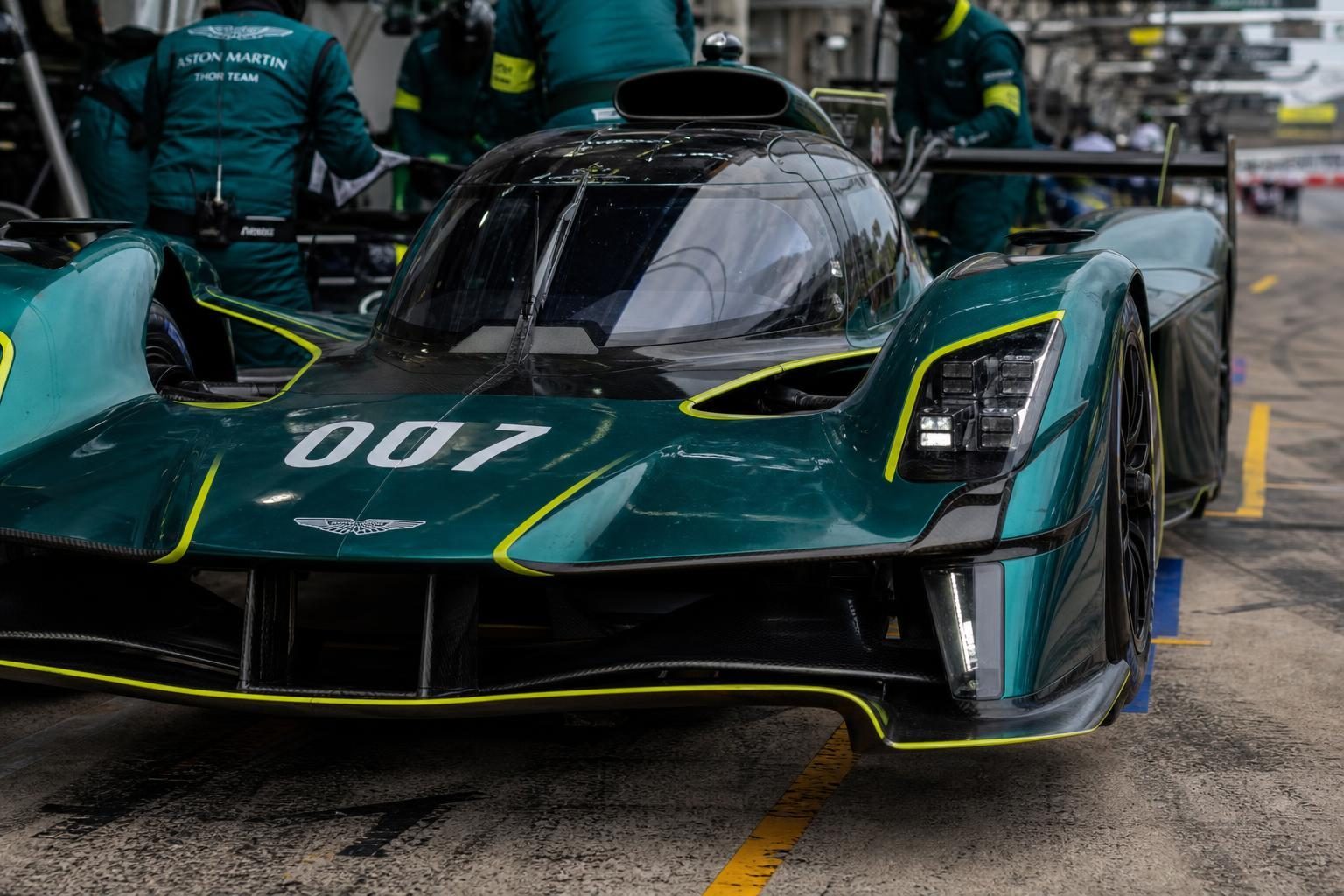
Valkyrie LMH: 3 Ultimate 2026 truths Le Mans 2025 won’t show
The Valkyrie LMH didn’t win Le Mans in 2025, but it opened a far more instructive chapter: a first double finish in the top 15, manufacturers’ points in the bag and, above all, a solid base for 2026 in both WEC and IMSA. Here are three facts the classification alone doesn’t tell you, which sketch the true trajectory of Aston Martin’s Hypercar programme.
Le Mans 2025: 12th and 14th, the bare numbers and their context
First, the numbers. According to astonmartin.com (December 2025), the Valkyries #007 and #009 finished 12th and 14th at the 93rd 24 Hours of Le Mans (14–15 June 2025). For a first Hypercar entry, it’s modest on paper, but enough to score the project’s first manufacturers’ points. In endurance racing, a classified double finish, straight out of the box, is anything but trivial.
The context casts these results differently. The 2025 Hypercar field is dense, reliability is unforgiving, and a new prototype must swallow a volume of development no simulator can replace. In that frame, the British coupé’s ability to hold pace, avoid incidents and see the flag with both cars validates fundamentals: a sound technical package, an operational team in place, disciplined drivers.
Another indicator of overall competitiveness at La Sarthe 2025: the #27 Vantage LMGT3 took LMGT3 pole (source: Wikipedia, 2025 24 Hours of Le Mans). Granted, not the same class, nor the same car, but it speaks to a technical and human environment capable of producing performance at Le Mans. At a manufacturer’s scale, cross-functionality matters.
Progress in the WEC: from Imola to Spa, three consecutive points finishes
The upward curve is better measured over time. After Le Mans, the season confirmed a ramp-up. Aston Martin reports that at Imola (19 April 2026), the #007 of Tincknell and Gamble finished 9th, marking its third consecutive result in the points (astonmartin.com, 5 May 2026). In other words, consistency is taking hold: the team isn’t snatching a one-off, it’s stacking paying finishes.
From “Imola to Spa” — to follow the calendar’s thread — the momentum announced by the marque reflects a step forward in operations and reliability. Without detailing every round, the fact the sequence reached three points finishes on the bounce means the car lives well over the distance, pitstops and tyre management are better timed, and setup choices offer a usable performance window.
This foundation is all the more notable as the Valkyrie LMH runs in both WEC and IMSA, a particularity highlighted by astonmartin.com (October 2025). Being the only road-homologated hypercar to race on both continents multiplies learning loops, data banks and use cases. Logistical complexity, yes, but an accelerator of maturity when feedback irrigates both programmes quickly.
Cosworth 6.5-litre naturally aspirated V12: why this technical choice
At the heart of the project, the engine. Aston Martin states the Valkyrie LMH is powered by a Cosworth 6.5-litre naturally aspirated V12, rated at 520 kW (697 PS) under the regulations (astonmartin.com, 9 June 2025). It’s not a nostalgic engineer’s whim: it’s a stance aligned with the road car’s DNA and the balances of the technical rulebook, which governs performance via the BoP.
A naturally aspirated V12 is a clear answer to the search for linearity and predictability over long stints. Torque delivery without forced induction simplifies simulator-to-track correlation and makes life easier for drivers in traffic. On reliability, a large, relatively unstressed engine can soak up 24 hours with a controlled thermal margin, provided it’s cooled and run in its optimal window.
This architecture also has a strategic virtue: alignment with the road-going Valkyrie, a cornerstone of Aston Martin’s product narrative. For readers wanting to place it within the range, our feature on the road-going Aston Martin Valkyrie sheds light on the technical and philosophical bridges between road and track. The Valkyrie LM derivative, a non-homologated customer version limited to 10 units (deliveries announced for Q2 2026, source: astonmartin.com, 9 June 2025), further extends this continuum.
Unchanged 2026 line-up: Tincknell, Gamble, Riberas, Sørensen, De Angelis
Stability, again. According to astonmartin.com (8 December 2025), the 2026 line-up remains unchanged from 2025, with the crews Gamble/Tincknell in the #007 and Riberas/Sørensen in the #009. In endurance racing, driver–engineer continuity is precious currency: it speeds up setup iteration, secures procedures, and reduces the “noise” in performance analysis from one race to the next.
The chapter title also cites De Angelis. As of the referenced release, only the above pairs are explicitly confirmed, however. Let’s retain the established core: two renewed duos, proven at Le Mans 2025 and drivers of the points-scoring run highlighted at Imola. It’s a reassuring snapshot of the programme’s sporting governance.
Realistic targets for the 94th Le Mans, 12–14 June 2026 (Valkyrie LMH)
What to aim for at Le Mans 2026 without drifting into hazy prophecy? First, capitalise on the demonstrated reliability and the run of points finishes. In practice, that means converting consistency into night-time pace, tightening pitstops and holding the tyre performance window for longer. The top 10 then becomes a credible goal, if the race runs without major incident.
Next, anchor gains in qualifying. The Vantage’s 2025 LMGT3 pole (Wikipedia) doesn’t foreshadow the Hypercar hierarchy, but it reminds us the Aston package can put heat into the tyres over a single lap. If that learning feeds the Hypercar, starting higher up means less traffic to manage, therefore lower wear and exposure to risk.
Finally, leverage the dual WEC/IMSA campaign. The Valkyrie LMH gathers more relevant laps than rivals confined to a single championship. The key isn’t the headline, but the feedback: refined endurance procedures, engine maps proven across varied circuit types, and a richer incidentology database. Come mid-June, that can be the difference between suffering the race and managing it.
To place 2026 within Aston Martin’s long Le Mans history, revisit our analysis of the keys to the DBR1’s 1959 victory. And to trace the Hypercar programme from its Sarthe debut, our round-up dedicated to the first Le Mans 2025 sets out the essentials.
Conclusion – what Le Mans 2025 signals (and what it doesn’t) about the Valkyrie LMH
Le Mans 2025 delivered modest finishing spots, but robust lessons: two cars at the flag, points, a validated technical base and tangible WEC progress through to Imola 2026. The choice of a naturally aspirated Cosworth V12 embraces a clear, exploitable identity over 24 hours, while stable crews consolidate iteration. In 2026, the Valkyrie LMH promises nothing it can’t keep: target further points, raise its pace benchmark and give itself, methodically, a chance to exist in the race’s final quarter. Sober, British, effective.
Vantage GT3 Ultimate 2026: 4 Podiums in 4 IMSA Races Lead the British Armada
Vantage GT3 in metronomic mode: four IMSA 2026 races, four podiums, and a swelling lead heading to Watkins Glen. We take stock, calendar in hand, of the results, the crews highlighted by the manufacturer and the coupé’s engineering, to understand why this GT is today the GTD field’s benchmark.
Four races, four podiums: the detailed calendar
The kick-off at Daytona set the tone. According to astonmartin.com (25 January 2026), THOR finished 3rd and Magnus Racing 2nd, delivering a double podium right from the Floridian 24 Hours. A solid base for a long championship, where consistency counts almost as much as the sparkle of a win.
The sequence continued at Sebring, Long Beach and Laguna Seca. As summarised by astonmartin.com (4 May 2026), the Vantage GT3 stacked a podium at each of these rounds, taking the run to four podiums from four IMSA starts in 2026. Statistical consistency rules here: four races mentioned (Daytona, Sebring, Long Beach, Laguna Seca) and as many parc fermé visits, hallmarks of a complete car and executions without major errors.
Beyond the final classifications, outright performance did not go missing. Per media.astonmartin.com (22 March 2026), the model claimed pole at Daytona 2026 and Sebring 2026, extending a dynamic already seen at Le Mans 2025. Enough to cement a position as “time-agitators”, useful for controlling traffic and managing tyre/fuel strategy.
A provisional but telling outcome: by the end of Laguna Seca, the British camp had turned repeated podiums into a true lever in the championship, laying the groundwork for a methodical, controlled title charge.
Barrichello, Gamble, Drudi: who drives what and why
The manufacturer’s releases highlight a trio of Barrichello, Gamble and Drudi for the American campaign. One of them, Barrichello, leads the GTD drivers’ standings with more than double the points in hand after Laguna Seca (astonmartin.com, 4 May 2026). It’s both a speed marker and, above all, a sign of consistent execution, week after week.
The precision of roles by crew and by round is not detailed in the available facts, but the essence lies elsewhere: these drivers are operating to maximise the car’s performance window. When the car is competitive over a single lap — as the poles at Daytona and Sebring 2026 attest — the next step is to convert track position into a result over the distance. The run of podiums shows the equation is correctly set.
In an IMSA season, individual talent must blend into collective discipline. The points amassed by the trio and Barrichello’s margin in the standings paint a simple picture: the reliability/pace slider sits in the right place, and strategic execution follows.
The current Vantage GT3 mechanics: twin-turbo V8 and aluminium chassis
At the heart of the package, the Vantage GT3 relies on a 4.0-litre twin-turbo V8 and a bonded aluminium chassis (Vantage GT3 spec sheet, astonmartin.com, December 2025). A technical choice echoing the marque’s tradition: structural rigidity, contained mass and generous engine response to tune balance across IMSA’s variety of circuits.
Raw performance indicators have punctuated the recent period. According to media.astonmartin.com (22 March 2026), the poles secured at Daytona 2026 and Sebring 2026, in the wake of that at the 2025 24 Hours of Le Mans, betray a car at ease over one lap, and capable of exploiting track evolution. Another yardstick lies in success on the highly selective Ardennes rollercoaster: the Vantage GT3 won the 2024 24 Hours of Spa (astonmartin.com, December 2025), an endurance race that forgives no overall weakness.
The pedigree doesn’t come from nowhere. The preceding Vantage GTE amassed 52 class wins and 11 world titles between 2012 and 2023 (media.astonmartin.com, 12 February 2024). That historical baggage informs current setup choices: pragmatic aerodynamic efficiency, traction out of slow corners and component endurance. For those wanting to dig into the family tree, our feature retraces the history and victories of the Vantage GTE in the WEC and at Le Mans.
Finally, the road link remains intentional. The technical base refers to the latest-generation Vantage, to be discovered in our presentation of the Vantage MkII coupé and its chassis evolutions, useful for understanding what racing carries over — and what it demands in addition.
THOR, Magnus Racing, Van der Steur: three teams, one strategy
The IMSA 2026 front is built around customer teams fielding the Vantage GT3. The Daytona highlights set the scene: THOR 3rd and Magnus Racing 2nd for a double podium (astonmartin.com, 25 January 2026). Van der Steur completes the trio spotlighted this season on the British side, within a framework where each outfit plays its hand according to formats and the circuits’ specific demands.
The common strategy comes down to one word: continuity. Per astonmartin.com (4 May 2026), four races and four podiums for the model in IMSA this year. Behind those figures, the sense that the effort is smartly split between qualifying and race pace, to secure a performance floor regardless of traffic or cautions.
Technical cohesion and information flow between teams are decisive in GTD. Between setup data, tyre pressure windows and fuel load management, this coordination serves a clear ambition: maintain the podium average while preparing for the moment when the car more regularly converts pole or the front row into clear victories.
What’s left to win before Watkins Glen and Le Mans
On the eve of the Six Hours of Watkins Glen, the question is no longer whether the Vantage GT3 can fight at the front — the numbers have answered that — but how to turn the championship lead and poles into full-blooded wins. The manufacturer notes that Barrichello holds more than double the points in hand after Laguna Seca (astonmartin.com, 4 May 2026): a useful cushion, not a guarantee. Watkins Glen demands spotless stints, a mastered consumption window and a stable car through the fast sequences.
Le Mans remains the other horizon. The 2025 pole (media.astonmartin.com, 22 March 2026) showed the potential at La Sarthe. To convert, 24-hour discipline leans on what the Vantage GT3 already does well in IMSA: steady pace, managed wear and clean stops. Our panorama of Aston Martin’s campaigns at Le Mans and in the World Championship places these ambitions in the long view, between GTE heritage and GT3 present.
One last useful marker before summer’s major pivot: IMSA is a championship where consistency pays at season’s end. Four podiums in four races form both a mental and accounting bedrock. It’s now up to the Vantage GT3 and its teams to convert this racecraft into decisive wins without yielding anything on reliability. The tempo is right; the task is to hold the note until the curtain falls.
Valkyrie Le Mans 2026: 3 Ultimate Reasons Aston Martin’s Sarthe Return Matters
Valkyrie Le Mans 2026 is not just a flash in the pan: it is a constructed, methodical programme, firmly rooted in engineering and history. In this article, we detail why the Valkyrie AMR‑LMH’s entry in the 2026 24 Hours of Le Mans is a credible and anticipated step, in light of its WEC season, its unique architecture and a legacy dating back to 1928.
The only Hypercar born from a road car: what that changes at the Sarthe
Valkyrie Le Mans 2026 rests on a simple fact: it is the only Hypercar derived from a road‑legal car to contest both the WEC and IMSA in 2026 (source: media.astonmartin.com, 8 June 2026). This road‑to‑race lineage influences the fundamentals: compact packaging, aerodynamics designed for high‑speed downforce and energy efficiency — all crucial parameters at the Sarthe where you spend long periods above 300 km/h. Without fanfare, it makes a tangible difference to the operating window and the ease of sustaining a strong pace.
At the heart of the project, the 6.5‑litre naturally aspirated Cosworth V12 is capped at 500 kW (680 PS) by LMH regulations (source: media.astonmartin.com, 8 June 2026). The linear response of a naturally aspirated engine, thermal stability and mechanical endurance ease night stints and precision on lift‑off through the fast sections. Over a double round‑the‑clock, that character counts for more than a few theoretical horses. Again, Valkyrie Le Mans 2026 capitalises on a proven engine base adapted to the regulatory framework.
The road‑to‑race DNA did not come in a straight line. The LMH project was cancelled in February 2020 then revived in October 2023 (source: Wikipedia EN). This detour allowed chassis‑engine development to be aligned with Hypercar BoP and to arrive, in 2026, with a more mature specification. Valkyrie Le Mans 2026 is not marketing shorthand: it is an assumed technical trajectory.
WEC 2026 progress before Le Mans: Imola, Spa and the test day up front
To gauge the sporting credibility of Valkyrie Le Mans 2026, you have to look at the build‑up. First, a bedrock of reliability: both Valkyries finished the 2025 24 Hours of Le Mans without mechanical incident, in 12th and 14th (source: astonmartin.com, 8 December 2025). Finishing cleanly provides baseline data — temperatures, wear drift, consumption — that guide the off‑season.
In 2026, progress shows through key markers. At Spa, the #007 (Tincknell/Gamble) finished 4th, the best WEC result to date for the Valkyrie (source: fiawec.com, Carter article). This result puts Valkyrie Le Mans 2026 in the strategic conversation rather than the pack. As for Imola, a key step in the campaign, it served as a benchmark for setup and operation, at the core of the road to race WEC 2026, from Imola to Spa dossier.
The clearest signal arrives on the Sarthe itself: Tom Gamble set the fastest time of the official test day on 7 June 2026 with a 3:26.293 in the #007 (source: fiawec.com, Test Day article). Valkyrie Le Mans 2026 promises nothing it hasn’t shown: competitive top speed and a baseline setup that literally holds the road.
To frame these indicators, see the official elements and paddock analysis, notably the test day round‑up published by the FIA WEC after the test day. And for the manufacturer’s perspective, Aston Martin’s release sheds light on the ambition and regulatory context of Valkyrie Le Mans 2026 ahead of Le Mans.
The #007 and #009 crews: why this pair of line‑ups makes sense
The #007 fields an all‑British crew: Harry Tincknell, Tom Gamble and Ross Gunn (source: media.astonmartin.com, 8 June 2026). A cohesive trio combining Le Mans experience, outright speed and in‑house knowledge. This continuity partly explains the dynamic seen at Spa and the test day. Above all, it gives Valkyrie Le Mans 2026 a clear reference for stint management, technical communication and night strategy.
On the #009, the cited sources did not detail the crew at the time. Silence is better than guesswork. What can be observed, however, is the overall logic: a showcase #007, readable and British to the fingertips, and a second car as a technical and strategic support. In the balance of a two‑car entry, this is precisely how Valkyrie Le Mans 2026 secures its options over 24 hours.
The relevance of this pair is also borne out by complementary roles on track. The #007, already fastest at the test day with Gamble, sets the benchmark. The #009 can explore other setup windows or undercut opportunities during neutralisations. Without extrapolating, we can note that Valkyrie Le Mans 2026 gives itself, in effect, two paths to performance: one confirmed by the clocks, the other devoted to strategic amplification.
The Union Jack livery and what it says about Aston Martin’s British ambition
The 2026 livery sports a Union Flag on the front splitter in tribute to British heritage at Le Mans (source: media.astonmartin.com, 8 June 2026). This graphic choice is more than a motif: it signals a determination to embrace the brand’s identity in the Hypercar arena. Valkyrie Le Mans 2026 claims a lineage, from the DBR1 to contemporary GTs, projected onto a stage where symbols matter as much as lap times.
The aesthetic nod matches a sporting reality: a British car, a British crew in the #007, an engine conceived with Cosworth, and a programme set for the long term. In a global championship, this cultural coherence serves as a common thread for fans and engineers alike. It gives Valkyrie Le Mans 2026 a clear narrative, backed by facts.
For the curious, the official presentation and images from the current season are available via Aston Martin’s press release and a recap video rich in on‑track footage. Again, the Union Jack varnish says it all: very British seriousness, without bluster.
Aston Martin at Le Mans since 1928: a near‑century presence that feeds into 2026
Valkyrie Le Mans 2026 fits into a long timeline. More than 240 drivers have raced Aston Martins at Le Mans, in 27 chassis‑engine combinations, over nearly 95 years (source: media.astonmartin.com, Valkyrie AMR‑LMH release). This breadth of experience feeds a fine‑grained understanding of the Sarthe: managing brake temperatures at Mulsanne, ratio calibration for Indianapolis, and downforce compromises through the Porsche Curves.
This historical depth is anything but museum‑piece. It structures development processes and endurance checklists. Having moved a Valkyrie from road to race with rigour, then gone the full 24 hours in 2025, gives Valkyrie Le Mans 2026 a bedrock of methods: track‑sim correlation, driver feedback, and relevant iteration loops.
When it’s time to line up on the grid, this capital of experience combines with fresh 2026 data: Spa as proof of concept on race pace, the test day as peak gauge, and a readable technical identity. Valkyrie Le Mans 2026 is therefore not a prestige interlude, but the next step in a long‑running story at the Sarthe.
Conclusion — Valkyrie Le Mans 2026, credibility before prestige
Three reasons, one thread: the only Hypercar from a road car, WEC 2026 progress embodied by Spa and the test day, and a near‑century heritage. Add an all‑British #007 crew and an assumed Union Jack livery: Valkyrie Le Mans 2026 arrives with facts, not promises. To extend the perspective, revisit our debrief on the 2025 24 Hours of Le Mans from the Valkyrie side and the setup log from Imola to Spa. And for the full genealogy from road hypercar to endurance, our dedicated Valkyrie page puts each milestone in its place.
To conclude, let’s recall the official markers framing Valkyrie Le Mans 2026: WEC/IMSA entry, 6.5‑litre naturally aspirated V12 limited to 500 kW, reliability proven over 24 hours, and top speed shown at the test day. Seriousness precedes prestige — the British way.
 The outward signs of a successful farewell