Valkyrie AMR Pro: 5 Ultimate Reasons a Paul Ricard Lap Is Like Nothing Else
The Valkyrie AMR Pro, in onboard footage from Circuit Paul Ricard, reveals what it means to push a “no-rules” hypercar on a benchmark track. From the images and facts published by Aston Martin and public sources, we decode five key takeaways: the choice of layout, the KERS-free Cosworth V12, the aerodynamic and production fundamentals, the direct lineage to the Valkyrie AMR-LMH and, above all, what the onboard says about dynamics that flirt with modern F1 standards.
The Valkyrie AMR Pro and Circuit Paul Ricard: why this choice matters
Seeing the Valkyrie AMR Pro at Paul Ricard is no coincidence. The Aston Martin UNLEASHED programme runs track days there, where owners drive their own cars before riding as passengers in the AMR Pro with a test driver at the wheel. According to Aston Martin, this format blends education, safety and technical demonstration on a modular, perfectly resurfaced circuit, ideal for probing the limits of downforce and braking over long, fast sequences (official presentation of the UNLEASHED days at Paul Ricard).
Paul Ricard is an open-air laboratory: long straights, technical sequences, generous run-offs and consistent tarmac. For an extreme-downforce machine, the readability of lines and the quality of grip determine the driver’s confidence… and the passenger’s. That is precisely what this track-only model seeks, born to lap fast and for long stints, without the filter of road homologation.
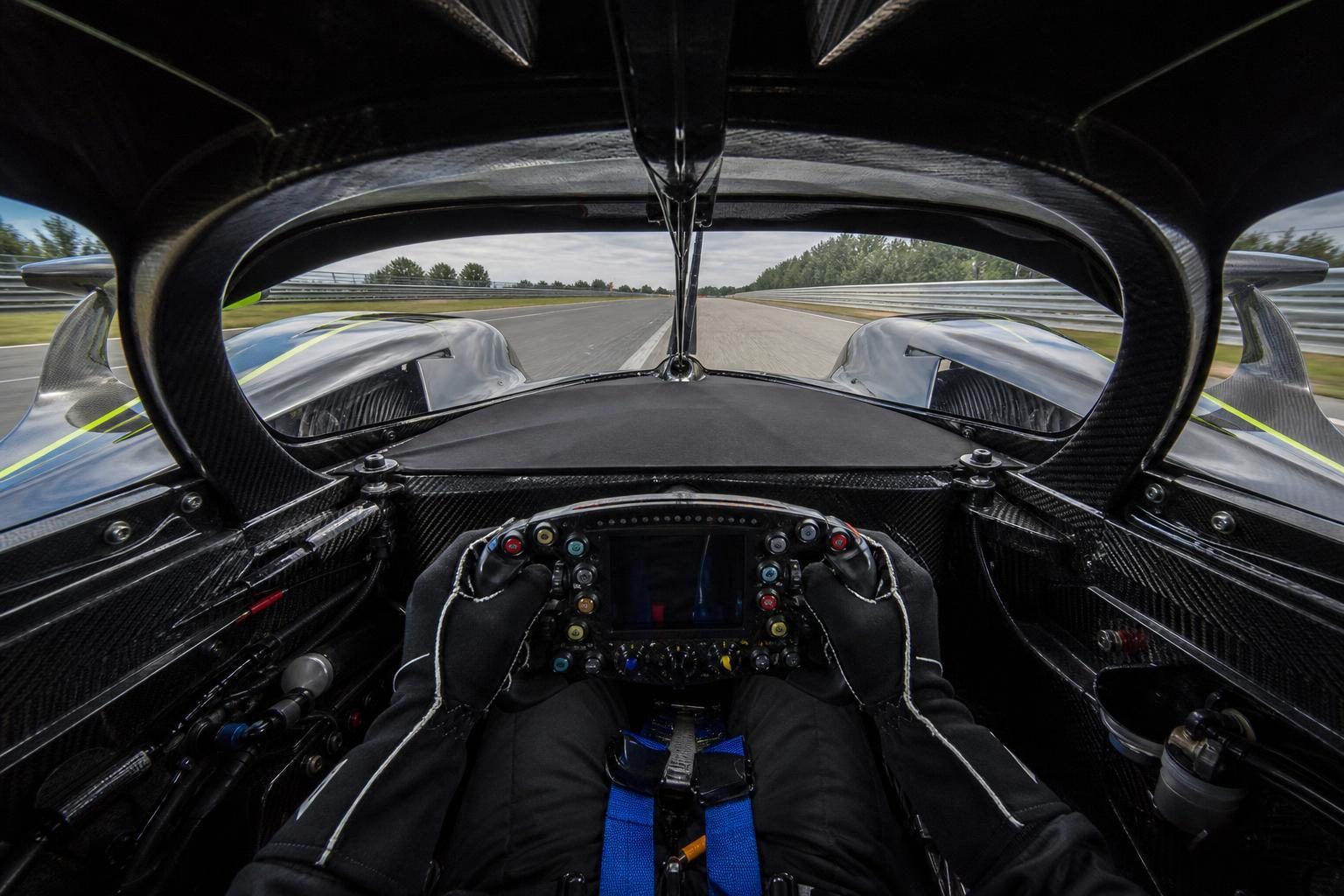
The onboard angle adds another layer of analysis. The in-car camera, particularly on the Mistral straight and through Signes, highlights high-speed stability and how the aero “pins” the car to the ground. Where many road-legal hypercars show movement, this radical barchetta remains unruffled. A signature trait.
Cosworth V12 1,000 PS with no hybrid: what dropping KERS changes on track
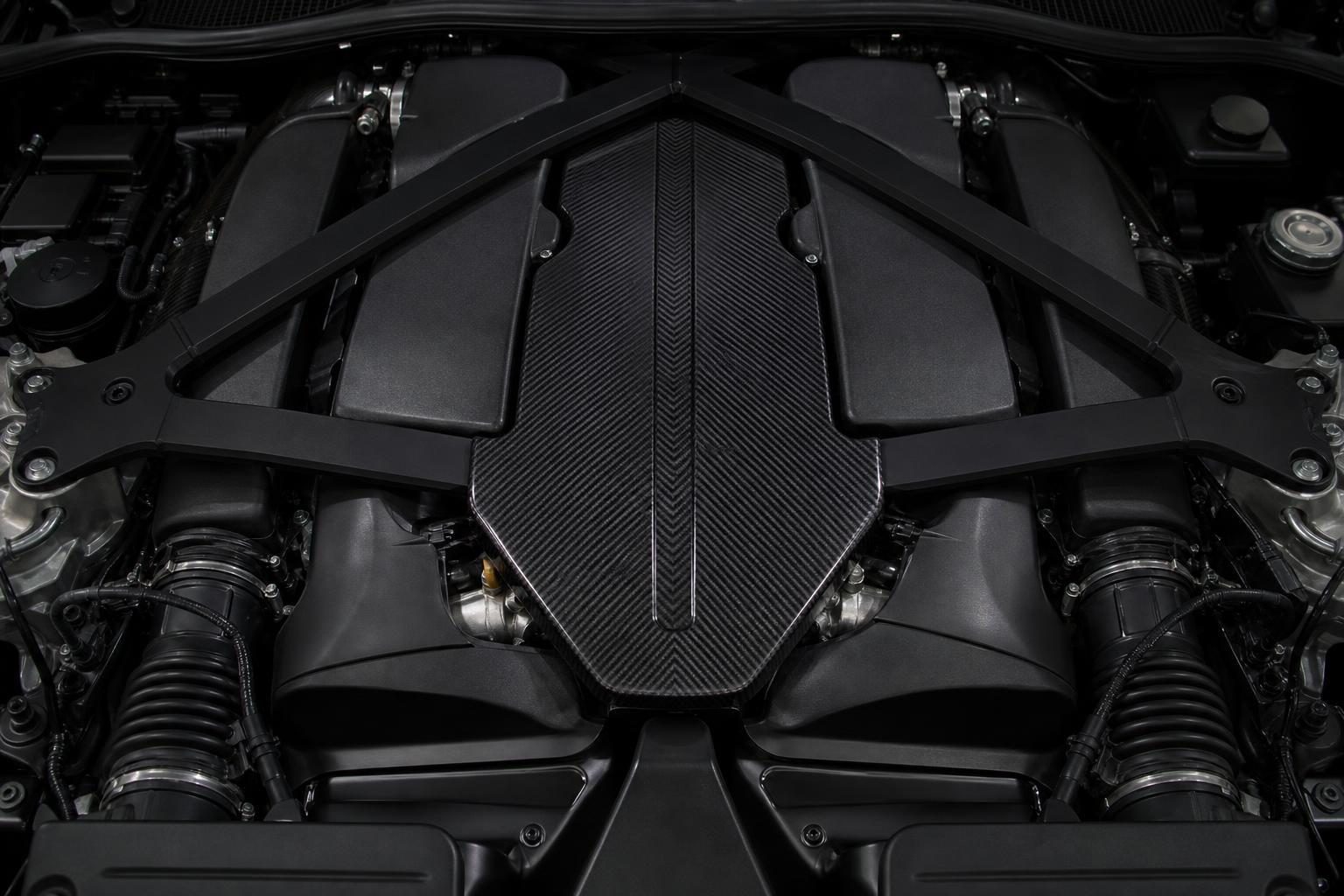
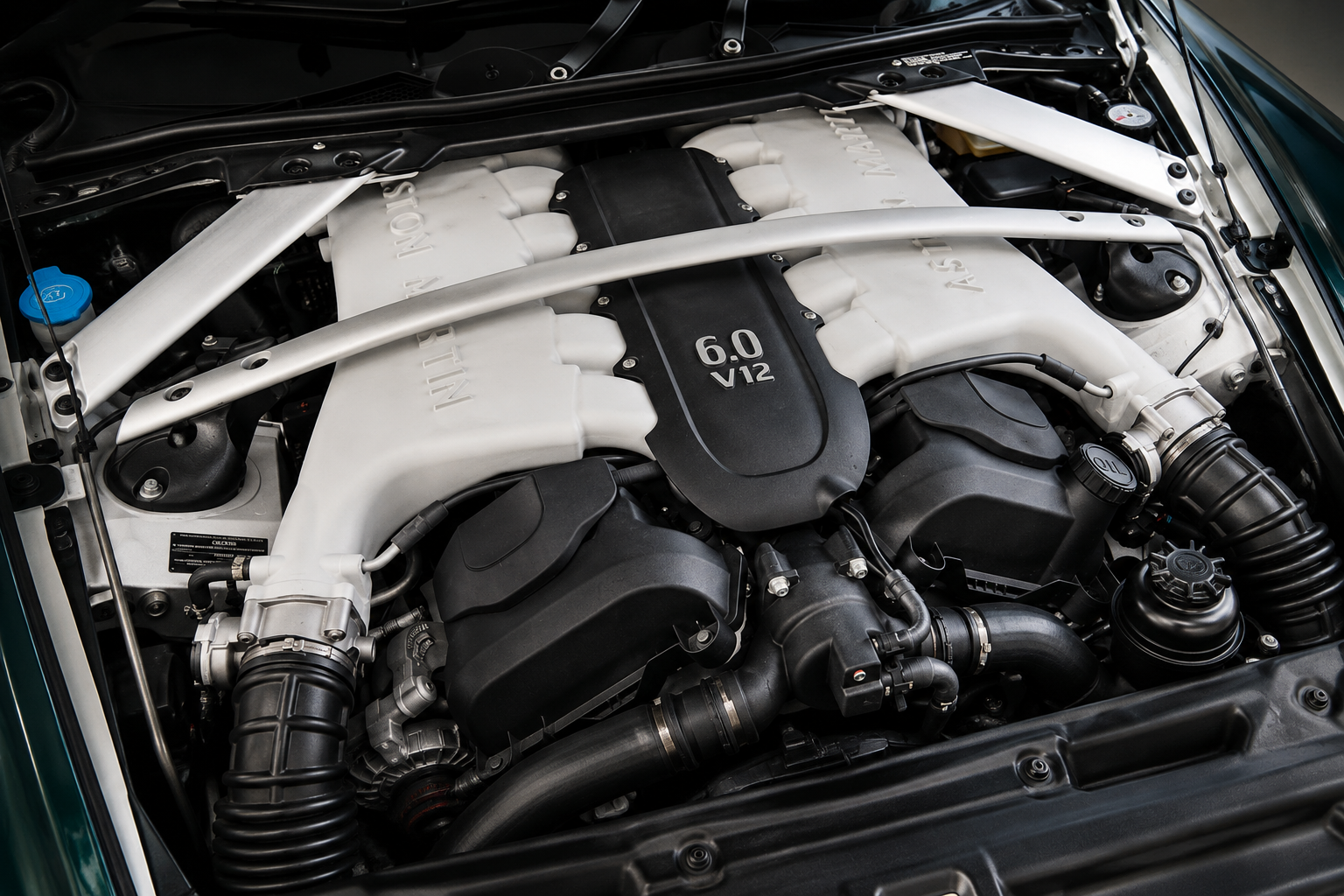
The cardinal point of this radical coupé is the 6.5-litre naturally aspirated Cosworth V12, delivering around 1,000 PS, with public estimates ranging from 820 kW to 1,100 PS. It revs to 11,000 rpm and, crucially, does so without KERS hybrid assistance. Based on information released by Aston Martin and compiled by Wikipedia, this choice lightens the system, simplifies thermal management and gives throttle response a rare clarity at this performance level.
In the onboard, the lack of hybridisation shows in the linear shove and consistent braking. No variable regen at the pedal, no deployment strategy on throttle: the mechanical communication is direct. The driver can place the apex and pick up the throttle without the “step” in torque typical of aggressive hybrid systems. It’s less spectacular in raw numbers, but often more consistent over a clean lap.
The corollary is more demanding management of gears and mechanical grip, especially on exit from medium-speed corners. The very responsive V12 requires fine work on throttle opening to avoid “unsettling” the rear before the aero takes over. On screen, this translates into very progressive pick-up, then an acceleration that stretches to the limiter, almost “British” in style: precise, determined, without bombast.
One body, one aero, 40 built: the numbers that define the AMR Pro
Initially presented at the 2018 Geneva Motor Show, then revealed in production form in 2021, the Valkyrie AMR Pro adopts a specific body, more aggressive than the road-going Valkyrie. It notably features a bi-element rear wing and an LMP1-inspired diffuser, highlighted by Wikipedia and Aston Martin press material. The goal is clear: maximise downforce beyond regulatory constraints.
The spec sheet confirms this intent: wheelbase extended by 380 mm, track widened by 96 mm at the front and 115 mm at the rear versus the standard Valkyrie, according to the maker’s dedicated page. This geometry promotes high-speed stability and allows more committed aero settings, which at trackside translate into a car that’s “planted” in fast sweepers and surprisingly docile under trail braking.
On production, 40 examples were built plus two prototypes, all left-hand drive. The run is both exclusive and coherent, centred on a single brief: circuit performance without road compromise. Aston Martin even announced a 3 min 20 s target lap at Le Mans, indicative of aerodynamic efficiency that exceeds Le Mans Hypercar frameworks (references from the Aston Martin pressroom).
From Paul Ricard UNLEASHED to Valkyrie AMR-LMH: same DNA, two destinies
The Valkyrie AMR Pro forms a bridge to the competition-entered Valkyrie AMR-LMH: according to Wikipedia, the latter is the only LMH hypercar derived from an existing production car. Seeing the AMR Pro at work at Paul Ricard clarifies what this implies: the core aero-mechanical balance, the hunt for downforce efficiency and the confidence it gives the driver are shared.
The UNLEASHED programme, by exposing owners to passenger laps with the test driver, acts as the “experiential chapter” of this kinship. The technical link is visible in the big themes (architecture, downforce philosophy, absence of KERS on the AMR Pro) as much as in behavioural details seen on the onboard: stability under braking, precise turn-in and energy carried through fast corners.
The story unfolds over time. The AMR Pro’s dynamic world debut, in March 2022 at the Bahrain Grand Prix with Dirk Müller for two demonstration laps, set the model’s public grammar (source: Aston Martin pressroom). Overall Valkyrie production concluded in December 2024 (150 coupés, 85 Spiders and 40 AMR Pro, per Wikipedia), closing a rare chapter where track and road faced the same aerodynamic mirror.
What an onboard lap teaches about hypercar dynamics edging towards F1
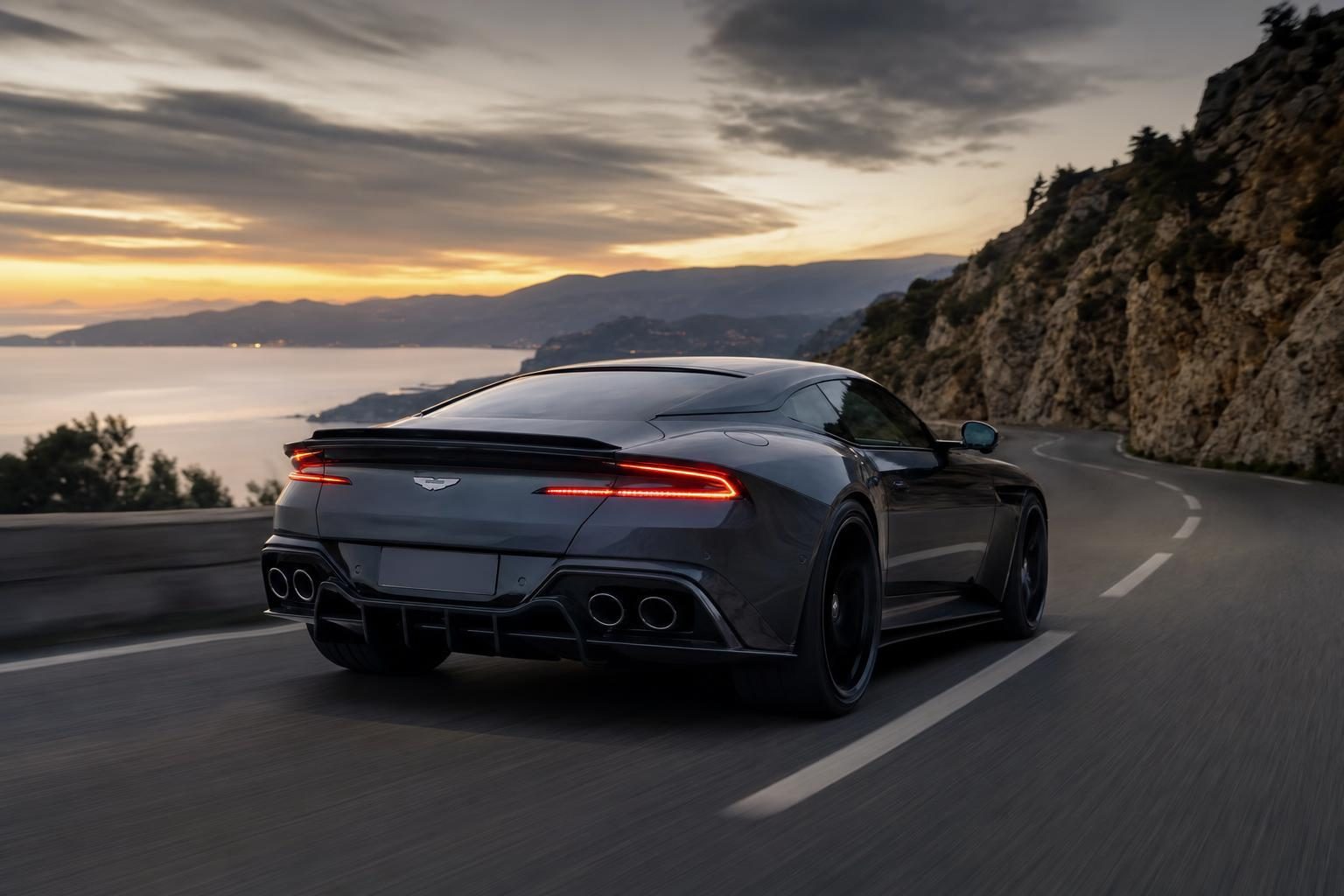
A strong onboard can be worth a long debrief. At Paul Ricard, three key zones let the AMR Pro “speak”: the Mistral straight, Signes and the double-right Beausset. The footage shows a car with a very stable rake, seemingly “nailed down” approaching Vmax; at Signes, entry comes with a very slight lift, then firm commitment and throttle back on with no visible correction. Aero does the heavy lifting; the chassis gives the confidence to push beyond the usual psychological threshold of road-legal hypercars.
At Beausset, you can read the differential between mechanical and aerodynamic grip: the AMR Pro carries mid-corner speed and accepts a progressive load-up to the exit point, where a heavier or less downforce-rich car would tend to smooth its line more. The lack of KERS removes residual torque variables: the throttle becomes a load variator, not a switch for electric boost.
Finally, deceleration illustrates the relationship between widened geometry and stability. The increased tracks and stretched wheelbase translate to a straight, stable brake entry, followed by a slight rotation at apex, without notable “pogoing”. Here you understand the ambition of Aston Martin’s stated 3 min 20 s at Le Mans: not a number tossed in the air, but the consequence of a package conceived outside regulatory constraint. To cross-check these impressions, the Paul Ricard onboard available online is a solid visual reference (Valkyrie AMR Pro onboard at Paul Ricard).
Conclusion — Valkyrie AMR Pro, the track as a revealer of philosophy
At Paul Ricard, the Valkyrie AMR Pro lays its cards on the table: textbook aerodynamics, a naturally aspirated Cosworth V12 with exemplary response and a design freed from road constraints. The onboard isn’t just another flashy clip: it’s a direct reading of the “no-rules” philosophy that fed the Valkyrie AMR-LMH. In brief, this model shows how Aston Martin translated the intuition of a concept shown at Geneva in 2018 into a 40-unit machine capable, in its own way, of brushing reference lap times.
Vanquish V12 2024: 5 Ultimate Tech Innovations That Separate the Third Generation
The 2024 Vanquish V12 resets the counters with a spec sheet that decisively breaks from its forebears, and that is precisely what we will measure: figures, architecture, electronic differential, extended wheelbase and production strategy. Without overstatement, the goal is clear: to place this new chapter against the 2001 and 2012 Vanquish models, using official data and open sources.
From Newport Pagnell 2001 to Gaydon 2024: three generations in numbers
Unveiled in Venice on 2 September 2024, the third generation marks the return of a major Gaydon name to an unprecedented level of performance, according to Aston Martin’s press release. The framework is set: V12, rear‑wheel drive, and a promise of enhanced rigour. This ceremonial launch at the Mostra is no mere society nod; it accompanies a deliberate technical upshift.
By way of reminder, the original 2001 V12 Vanquish claimed 460 PS and a 306 km/h top speed, while the second generation (2012) peaked at 595 PS and 324 km/h in S form, according to Wikipedia. These two milestones are enough to frame the marque’s progression: a continuous curve, with significant power increases and commensurate maximum speeds.
The newcomer claims 835 PS and 1,000 Nm, 0–100 km/h in 3.3 s and 345 km/h, per the model’s official page. HiConsumption cites 823.5 hp and 0–60 mph in 3.2 s: the discrepancy stems from PS/hp conversion and acceleration units, without contradicting the overall positioning. The essence lies in the near‑240 PS gap between the first and third generations, and in a top speed that crosses a new threshold.
Structurally, the 2024 chassis derives from DB12/Vantage underpinnings, with a wheelbase extended by over 80 mm to accommodate the V12, according to official documents and Wikipedia. A measured stretch, dictated by mechanical packaging, that points to increased high‑speed stability and steering that’s less twitchy but more readable.
The 5.2‑litre biturbo V12 of the third‑generation Vanquish V12: what has really changed
The heart of the matter is the 5.2‑litre biturbo V12 in its third in‑house iteration. Aston Martin announces a specific output of 160 PS per litre, a record for a series‑production V12 from the marque, which immediately places this engine at the summit of its lineage. The torque/power curve is not published in detail, but the 1,000 Nm peak indicates a tune aimed both at rev range reach and flexibility.
Versus the naturally aspirated V12s of 2001 and the 2012 evolutions, twin‑turbocharging changes the grammar: thermal management, transient response and traction control must be handled in concert. Here, the official figures (0–100 km/h in 3.3 s, 345 km/h) support the idea of a generous usable band, including at high revs, without sacrificing maximum speed—presumably assisted by aerodynamics and gearing, not detailed in the sources.
The key point is less a race to decimals than overall coherence. With a quoted 835 PS and an extended chassis, the car lays claim to a mechanical maturity the first two generations didn’t need to assume: with higher absolute power, engine‑gearbox‑rear‑axle integration becomes decisive. This is where the new‑generation driver aids step in.
Boost Reserve: a turbo logic borrowed from cutting‑edge engineering
The notion of “Boost Reserve” refers, in the industry, to strategies for managing turbocharger flow that retain energy on tap for roll‑on response, anticipating torque demand. The official sources cited do not detail a system explicitly named as such for the 2024 Vanquish. It is therefore reasonable to recall the principles without speculating on this model’s exact calibration.
In practice, these logics often rely on preserving a favourable turbine speed, optimising bypass operation and mapping the throttle to limit perceived lag. On the road, this translates into crisper roll‑on and continuous acceleration, particularly between gears. The 0–100 km/h in 3.3 s, declared by Aston Martin, is compatible with advanced transient management, but is not proof of it per se.
Against the 2001 and 2012 Vanquish, both naturally aspirated, the challenge lies in mastering the boost: how to deliver 1,000 Nm with measure and repeatability, including on imperfect roads? Whatever the terminology, it is precisely this technical territory—fine control of boost, ignition and traction management—that separates the third generation from its predecessors.
Electronic rear differential: a first for a front‑engined Aston Martin V12
This is the other clean break. The 2024 Vanquish integrates, for the first time on a front‑engined Aston Martin V12, an electronic rear differential (e‑diff). According to the model spec sheet, it can go from fully open to 100% locked in 135 milliseconds. This figure conveys the reactivity available during load transfer in a bend or on throttle application.
On road and track alike, the benefit is twofold: traction and steering. By modulating lock‑up, the e‑diff shapes the rear axle—from discreet stabiliser to rotation partner—according to steering angle, load and torque. Compared with earlier generations, which relied on mechanical differentials and ESP, you gain finesse and continuity of action.
This technical building block aligns with the 2024 Vanquish V12’s philosophy: high power, extended chassis, and the need for proactive torque management. It will likely do as much for driver confidence on corner exit as for outright acceleration numbers, and that is often where the pleasure of a very fast GT is decided.
Production capped below 1,000 units per year: positioning strategy
Aston Martin announces intentionally limited production to fewer than 1,000 units per year. According to the official release and Wikipedia, this is a positioning choice rather than a stated industrial constraint. Organised scarcity supports residual values and protects the halo car within the range.
Compared with the more open cadences of the DB or Vantage, this Vanquish V12 plays another score: focusing attention on a technical showcase and a brand standard‑bearer. Implicitly, it also underscores the level of attention required by a 160 PS‑per‑litre V12 and an actively controlled rear axle—two elements that demand uncompromising tuning and quality control.
This strategy also answers to the badge’s history: the first Vanquish, built at Newport Pagnell, forged its reputation on reasoned exclusivity; the second, at Gaydon, extended it through performance. Limiting volumes in 2024, at the moment the car spectacularly raises its figures, continues this red thread with distinctly British coherence.
Conclusion: where does the Vanquish V12 sit in the lineage?
Let’s recap. With its 835 PS, 1,000 Nm and record specific output, the 2024 Vanquish V12 stands well apart from the 2001 and 2012 milestones. The chassis stretched by over 80 mm, the ultra‑responsive e‑diff, and cutting‑edge turbocharging engineering form an unprecedented triptych at Aston Martin for a front‑engined GT. Without fanfare, the figures and technical choices suffice: this third generation cuts deep, not just in surface.
Grand Tourisme Secrets: 4 Reasons the 1965 DB6 Redefined the Legend
With grand tourisme in its sights, the Aston Martin DB6 unveiled in 1965 shifted the goalposts without raising its voice. We explain, with the evidence to hand, how wind-tunnel-honed aerodynamics, the evolution of the “Superleggera” chassis and the Tadek Marek straight-six redefined the category, while clearly mapping the variants and production figures as reported by their sources. The aim is not to replay the DB5, but to understand why the DB6 traces a different ridgeline for grand tourisme.
Why Aston Martin used the wind tunnel to cure rear lift
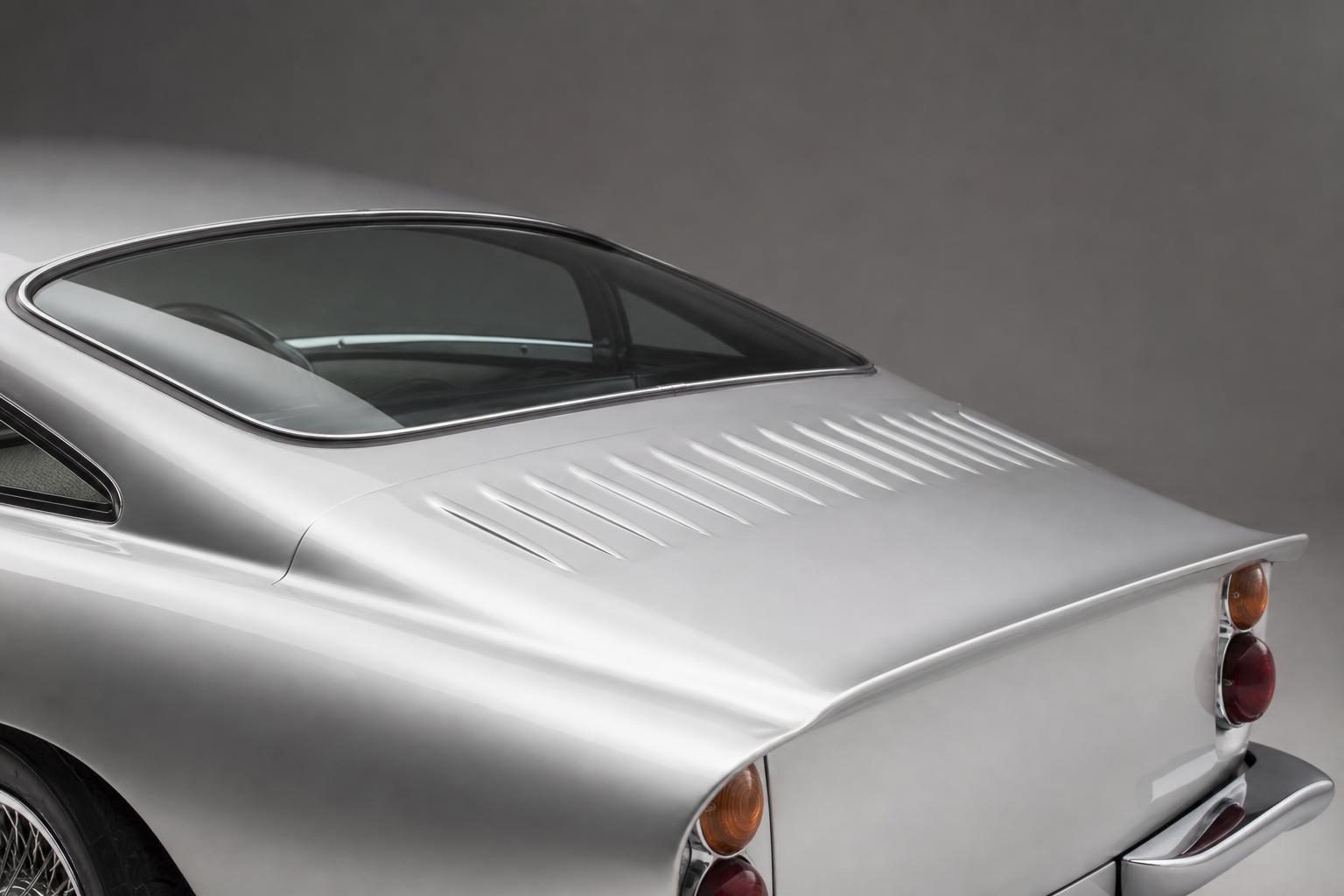
Launched at the London Motor Show in October 1965, the DB6 is the first modern Aston to fully embrace aerodynamics as a development tool. According to official technical documents, the combination of a 95 mm longer wheelbase and a Kamm tail reduced rear-axle lift by more than 30% during wind-tunnel testing. This pragmatic choice, described by the manufacturer, aimed for high-speed stability worthy of a long-distance sporting grand tourer, without sacrificing the elegance of the silhouette.
The truncated “Kamm” tail — more scientific than spectacular — signals an engineer’s approach rather than that of a society coachbuilder. By reducing airflow separation and stabilising the wake, it helps the coupé plant its rear end more securely in fast sweepers. The wheelbase stretch is not only about cabin space: it shifts mass rearwards and calms weight transfer, to the benefit of steadier straight-line poise.
Taken together, these two levers nudge the DB6 towards a more mature definition of rapid travel. Grand tourisme here is no longer measured by top speed alone, but by the consistency and precision of carefully managed aerodynamic load. It is a discreet yet decisive evolution, confirmed by the workshop data published by the marque.
Finally, the DB6 is the first model designed entirely after the move from Feltham to Newport Pagnell. This new industrial context — recalled by encyclopaedic archives — gave the team the environment to systematise wind-tunnel use and rationalise body and chassis iterations.
The Tadek Marek straight-six: 282 PS as standard, 325 PS in Vantage
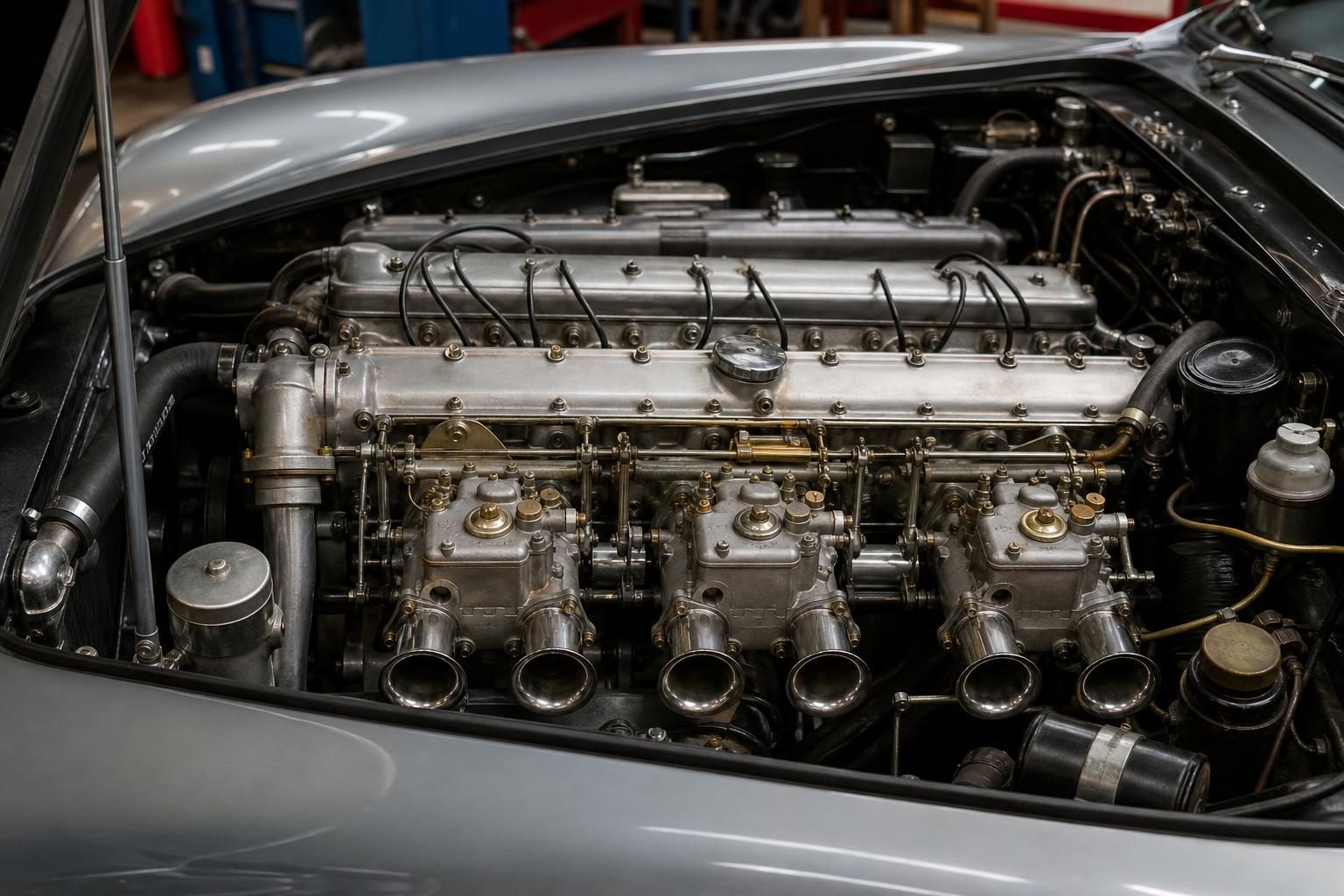
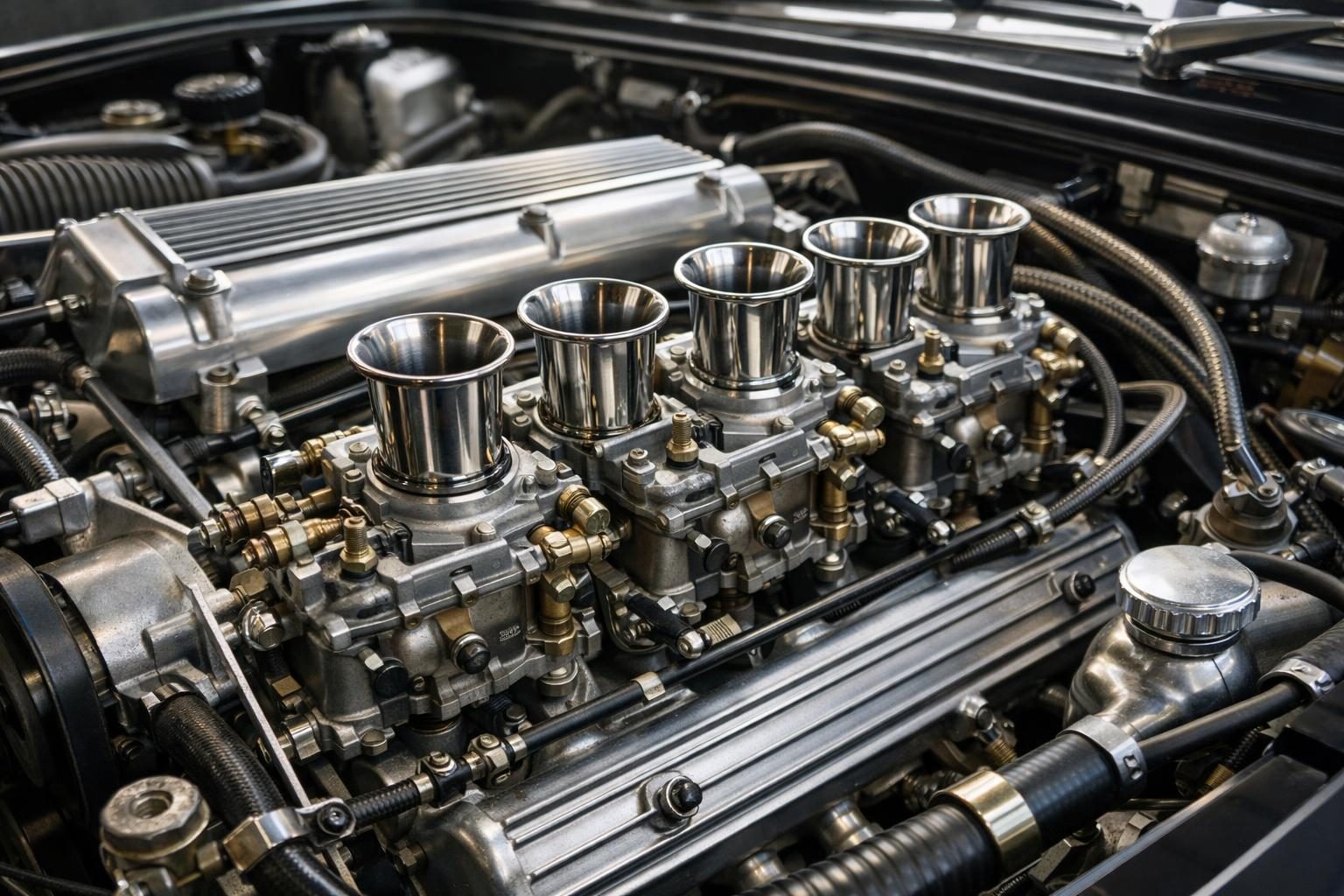
At the heart of the package, the 3,995 cm³ inline six by Tadek Marek delivers 282 PS at 5,500 rpm in standard tune. With the Vantage option, three Weber 45DCOE carburettors and a freer-breathing setup raise output to 325 PS. Figures reported in the reference literature place the DB6 squarely as a long-legged grand tourer with sporting endurance, able to cruise fast for long stretches.
This iron-block, cool-headed engine fits the model’s ambition perfectly: thick torque, measured reach, and the reserve to sustain effort in the mountains as well as on the motorway. Mechanical nobility lies not just in horsepower, but in how it is delivered — regular and composed. The sharper Vantage option shifts the balance towards engaged driving without betraying the coupé’s travelling spirit.
This engine is also a milestone in Aston Martin continuity, from a lineage begun in the early 1950s. To grasp this filiation, you can trace the technical base of the line via our feature on the DB2 and its foundational role, and set it against the maturity reached with the DB6.
Superleggera without Touring: the end of a patent and its consequences
The DB6 carries the Superleggera script, heir to a philosophy mixing a light tubular framework and aluminium panels. But a chapter closed in 1967, when Touring of Milan shut its doors. Until then, Aston Martin paid £5 per vehicle for use of the Superleggera patent; this royalty ceased with the disappearance of the patent holder. It is a discreet tipping point that does not affect the structure’s DNA but clarifies the legal and industrial framework.
In practical terms, the marque retained the accumulated experience and optimised construction method while freeing itself from an old contractual tie. The DB6 period illustrates this handover: the technique still serves a slim body, but one more rational to produce from Newport Pagnell. The end of the royalty does not mean abandoning lightness; rather, it confirms the appropriation of know-how.
This increased autonomy aligns with the ramp-up of the Newport Pagnell factory, the DB6 being the first model conceived entirely after the move. In short, the Superleggera method evolved from a licensed borrowing to an in-house competence, in continuity with the Gran Turismo spirit dear to the marque.
MkI, MkII, Volante, Shooting Brake: mapping the variants produced
DB6 production ran from October 1965 to January 1971. The initial series — often dubbed MkI — accounts for most of the volume, before the MkII was announced on 21 August 1969. According to an Aston Martin heritage specialist, the MkII totals 240 examples, 70 of which with the Vantage option. These figures suggest the relative rarity of this late and sought-after evolution.
The Volante convertible holds a special place. Encyclopaedic sources record 140 units in total, including 29 Vantage Volantes, highly prized by collectors. The model’s renown was further boosted by the enthusiasm of a certain royal owner: Prince Charles, now Charles III, owns a DB6 Volante MkII converted to run on E85 bioethanol, a detail now part of the model’s contemporary legend.
As for Shooting Brakes, these remain workshop or independent coachbuilder conversions carried out from DB6 chassis, not an official mass-production line. Their appeal lies as much in their rarity as in execution, which varies greatly from one commission to another.
To set these variants in the marque’s timeline, it is worth comparing the DB6 with its illustrious predecessor via our page dedicated to the DB5, and consulting the technical dossiers cited above. Each iteration sheds a different light on the company’s ambition for fast, safe travel.
DB6 on today’s market: values, disparities and what drives them
In today’s market, a DB6’s value rests on classic criteria — originality of drivetrain and body, clear provenance, quality of restorations — as well as nuances specific to the model. A true Vantage, correctly specified with its Weber 45DCOEs, commands a notable premium. An authenticated Volante, especially among the 29 Vantage Volantes recorded by encyclopaedic sources, comfortably clears a higher tier.
The MkIIs, produced in 240 examples according to a respected dealer-historian, enjoy added interest for their terminal position in the series. All else being equal, they compare more strongly over the long term, buoyed by their rarity. Conversely, conversions and approximate recreations must be assessed rigorously, as the DB6 has spawned numerous variants and adaptations.
Beyond the badges, the correctness of aerodynamic elements and chassis details weighs in the balance. The Kamm tail, panel fit, and conformity to period specifications influence not only the driving pleasure but also the authenticity sought by connoisseurs. Here again, grand tourisme takes a very concrete form: a coherent, dependable specification, fit to devour miles with unruffled ease.
Conclusion: when grand tourisme takes on a new definition
The DB6 did not merely succeed the DB5; it shifted the foundations of grand tourisme through a sum of concrete improvements. The wind tunnel dictated a Kamm tail and a longer wheelbase, cutting rear lift by more than 30% according to factory data. The Tadek Marek straight-six, from 282 PS to 325 PS in Vantage form, delivered the required endurance and flexibility. And the evolution of the Superleggera framework, freed in 1967 from the Touring royalty, sealed industrial maturity.
At the end of this trajectory, the DB6 makes a quiet truth plain: rapid travel is not a posture; it is a method. In that sense it redefines grand tourisme, English style, through the rightness of its choices and the consistency of their execution — which, in Aston terms, remains perhaps the most enduring signature.
Coulisses WEC 2026 Ultimate: 34 Minutes Inside Aston Martin’s Garage Between Imola and Spa
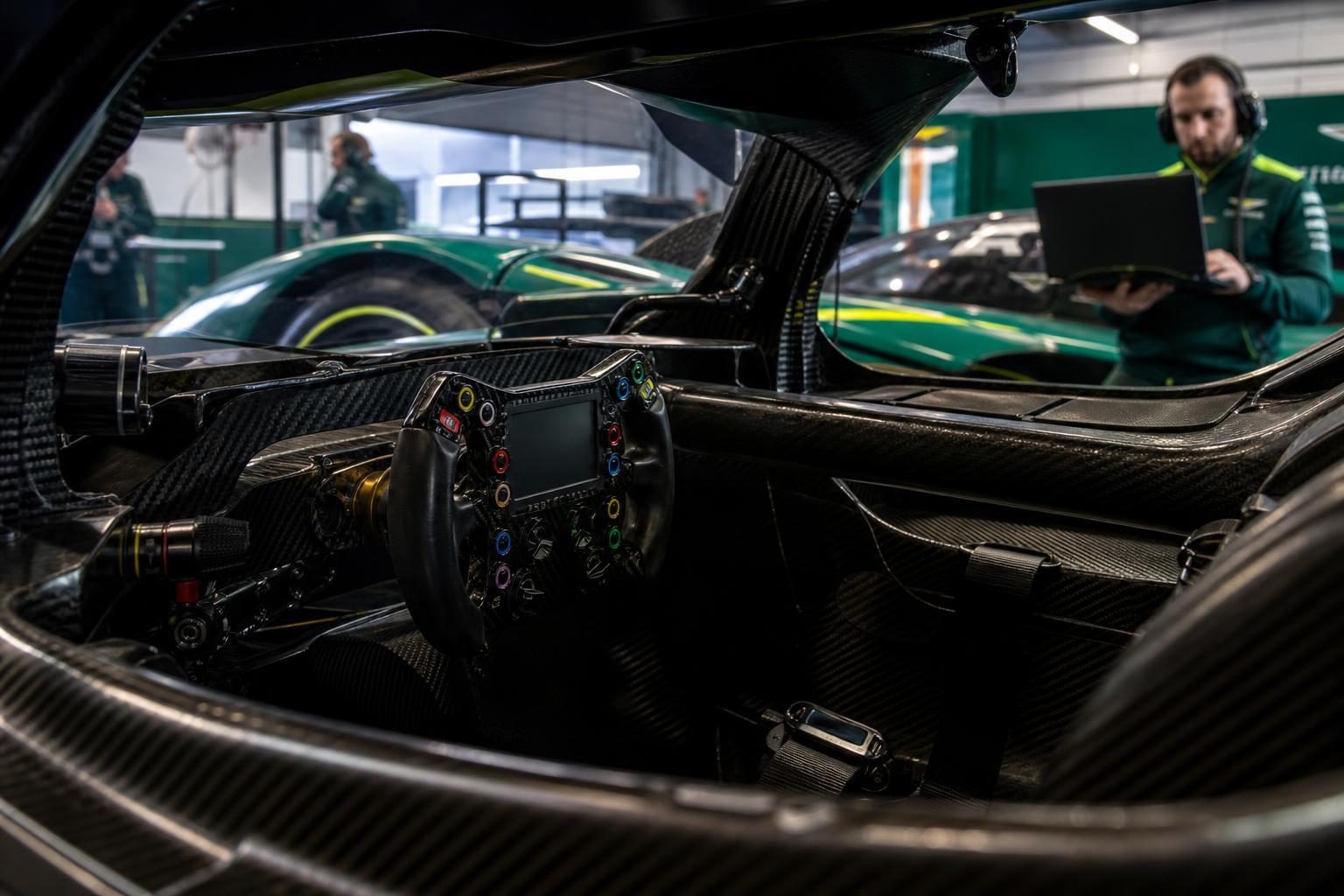
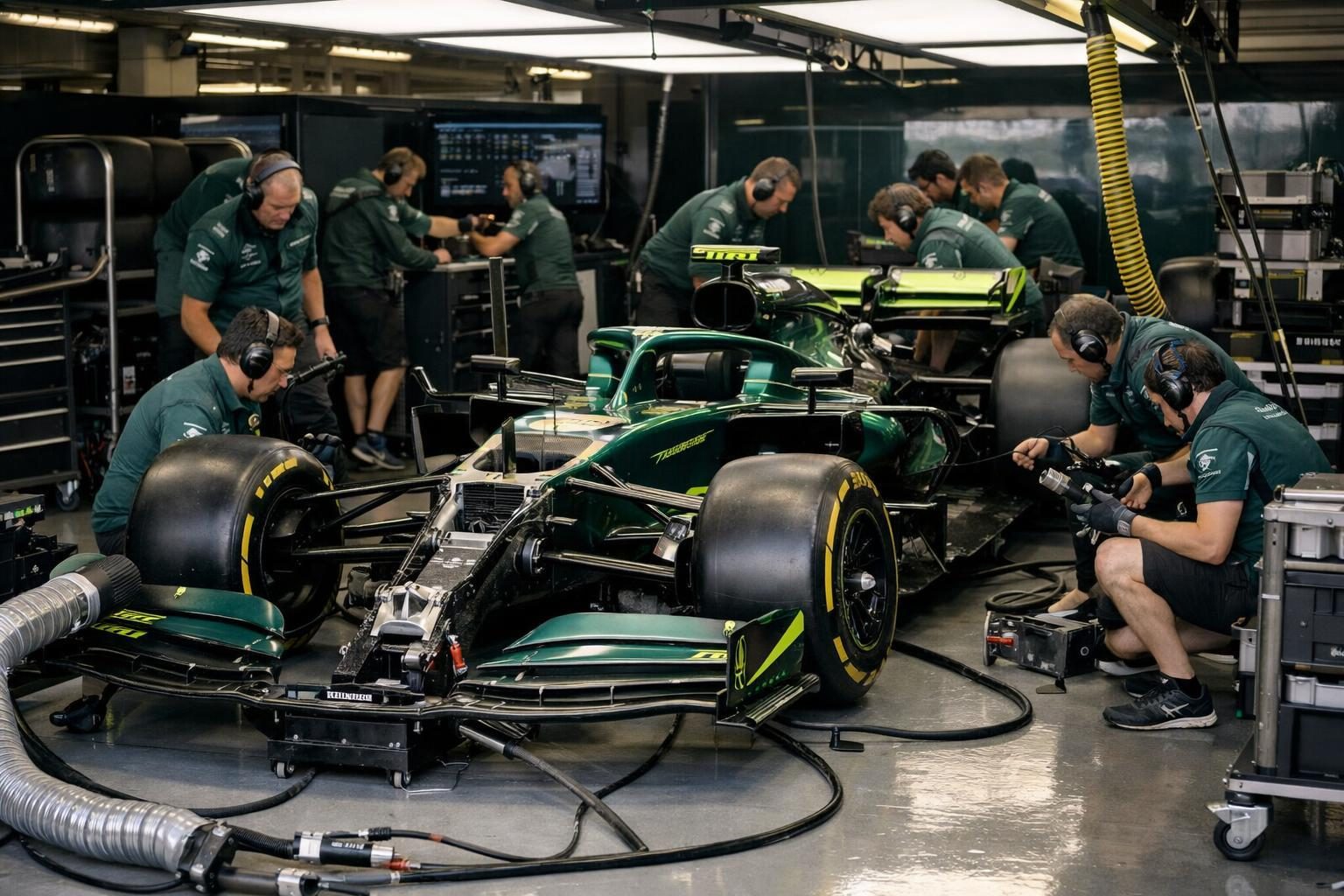
The WEC 2026 behind the scenes take on a very concrete dimension with season 2 of Road to Race, which plunges into the heart of Aston Martin THOR between Imola and Spa. In two acts, the video captures a team in accelerated shakedown mode, a prototype with a strong character, and a rise in performance which, backed by the numbers, reshuffles the deck as Le Mans approaches.
What follows is neither an ode nor a storyboard: it is the snapshot of a pivotal moment. According to the official description on YouTube and information from fiawec.com, the episode covers the 6 Hours of Imola (19 April) and the 6 Hours of Spa (10 May), which became the real opener and the second round of a 2026 campaign capricious in its calendar. Between set-up, strategy and human management, the essentials are decided in the precision of details – and a few deliberate technical choices.
THOR season 2: why Imola and Spa really mattered – WEC 2026 behind the scenes
The geopolitical postponement of the opening round initially planned in Qatar made Imola the gateway to the 2026 World Endurance Championship, according to the page dedicated to the 2026 calendar on Wikipedia. This shift had a simple consequence: in mid-April, everyone was discovering their strengths and blind spots at the same time, under increased pressure. For the Aston Martin THOR team, this meant validating the fundamentals of the Valkyrie AMR-LMH in race conditions before tackling Spa, the reference circuit par excellence.
The documentary Road to Race | Season Two, published on YouTube, frames these stakes precisely. Its rhythm is that of garages and briefings, its narrative that of engineers and drivers. The camera focuses on the muscular routine of the Hypercars more than on track spectacle: useful for gauging the learning curve of a still-young programme, already tested at Le Mans 2025 but facing in 2026 a dense and varied field.
Imola and Spa therefore carry more weight than their six hours apiece: one opens the season in spite of itself, the other serves as a performance thermometer at high speed. In the background, the objective remains unchanged. At Le Mans, everything is decided by a sum of small margins; that is exactly what Road to Race explores, in immersion.
The Valkyrie AMR-LMH under the microscope: a non-hybrid Cosworth V12 against the field
The singularity of the Valkyrie AMR-LMH lies first in its architecture. Powered by a 6.5-litre naturally aspirated Cosworth V12 – an engine capable of revving to 11,000 rpm in road guise – it plays the card of mechanical purity. In WEC Hypercar configuration, output is regulatorily capped at 500 kW (680 PS), remind media.astonmartin.com and the Wikipedia page dedicated to the Valkyrie AMR-LMH. The car entrusts its shifts to a 7-speed Xtrac sequential, an unambiguous racing choice.
More notable still: the total absence of hybridisation. According to Wikipedia, the Valkyrie AMR-LMH is the only current Hypercar racing without a hybrid system in the WEC. This technical choice isolates Aston Martin’s prototype in the field, with very concrete implications for energy management, stints and low-end traction. An advantage in mass and simplicity, a trade-off in recuperation and deployment: a different equation to solve, especially in traffic.
This racing car also remains the only Hypercar directly derived from a homologated road car to line up in both the WEC and IMSA in 2026, notes astonmartin.com. A deliberate bridge to the road lineage, which readers can place via our feature on the Valkyrie model and its origins. This road-to-track dialogue imposes a unique engineering framework, but also a promise of character, which the video captures well.
In this context, Imola and Spa serve as full-scale test benches. The team tunes V12 exploitation, aero and tyre windows to the second. Absolute performance will matter at La Sarthe, but consistency and reliability often make the difference. In this game, the clues accumulated between April and May speak volumes.
Imola, round 0: double finish and first points of the season
Imola wasn’t supposed to open the ball. It did. First rendezvous, first answers. According to the Aston Martin release dated 5 May 2026, Harry Tincknell and Tom Gamble reached the flag in 9th place in the No. 007 Valkyrie, scoring their first shared point in the World Championship. A detail on the results sheet, a major marker for a duo expected to spearhead the programme.
This “round 0” above all validated a method. After a 2025 Le Mans run completed without mechanical trouble – two Valkyries classified 12th and 14th, first Hypercar points in the Constructors’ standings, according to media.astonmartin.com – the 2026 challenge is to convert robustness into race pace. Imola, with its heavy braking and traffic management, offered a frank arena to test exploitation of the non-hybrid V12 over tight stints.
Beyond the result, Road to Race captures the assembly work: refined procedures, pitwall communication, tyre calls. The No. 007 finishes in the points; the team banks clean laps and precise feedback. At this stage you don’t win Le Mans. You mostly avoid losing it in April.
To place this progression in the brand’s recent endurance history, you can revisit our retrospective on the Vantage GTE and Aston Martin’s wins in the WEC and at Le Mans. The move to Hypercar imposes different yardsticks, but the house culture remains the same: method, consistency and execution.
Spa-Francorchamps: fourth place five seconds off BMW, Aston Martin’s best-ever WEC result
A month later, the No. 007 Valkyrie delivered the expected launch ramp at Spa. According to fiawec.com (article by Adam Carter, 9 June 2026), Tom Gamble and Harry Tincknell took 4th place, just five seconds behind the winning No. 20 BMW. It is the best WEC result in Aston Martin THOR’s history, achieved on a circuit that magnifies aero efficiency and high-speed stability.
The video shows the flip side of that result: smooth execution, clean stints, controlled stops. Energy management – without hybridisation on board – imposes a different discipline; Spa confirms the car can sustain a front-running pace over distance. The top five here is no statistical accident. It validates a concrete performance window.
The context enhances the significance of the result. Spa is the traditional barometer before Le Mans. To fight to five seconds of the winner there is to acquire certainties about chassis–aero balance and the tyres’ operating range. The rest of the calendar will say if this trend settles; but on Spa’s evening, the team, for the first time, had a base for measured ambition.
To recontextualise the episode, refer to Adam Carter’s piece on fiawec.com which synthesises the brand’s competitive DNA. You can read the thread that leads from the workshop to the track, precisely illustrated by Road to Race.
Le Mans in sight: what the video doesn’t say but the times reveal
There’s what you see, and what you infer. On 7 June 2026, during the Test Day, Tom Gamble set the outright Hypercar best in 3:26.293 in the No. 007, ahead of Toyota, reports fiawec.com (Test Day wrap). Not a prophecy, but a strong signal: the performance window exists, and the Valkyrie knows how to enter it. Between Imola, Spa and La Sarthe, the thread is coherent.
On the strict technical front, nothing changed in the regulations: 500 kW maximum deployed power, aero constrained by BoP, energy management to be imagined without hybrid. Within this framework, the No. 007 showed it could convert clean stints into consolidated pace. The documentary doesn’t deliver the spreadsheets; the lap times do the talking. And they dovetail with the trajectory laid down since 2025, when both cars reached the flag without hiccups – a not insignificant reserve of confidence.
The progression also fits the broader context: the Valkyrie AMR-LMH is, according to astonmartin.com, the only Hypercar derived from a homologated road car to race in both the WEC and IMSA in 2026. This double programme imposes clear choices in operating correlation. That is precisely what makes these workshop and pitwall images instructive: you can read the method as much as the result.
Conclusion: from WEC 2026 behind the scenes to Le Mans promises
At the end of these WEC 2026 behind the scenes, one truth: Imola and Spa were not mere stages, but revealers. The foundational 9th at Imola, then 4th at Spa just five seconds off the winner, chart a credible path. Add a Test Day topped on the stopwatch, and you have momentum. Without grandiloquence, Aston Martin THOR has turned learning into tangible potential.
The Valkyrie AMR-LMH, with its Cosworth V12, no hybrid and Xtrac ’box, is asserting itself in a heterogeneous field. The Road to Race video shows the method; the times confirm it. To deepen the previous chapter, our look back at Le Mans 2025 for the Valkyrie AMR-LMH sheds light on the origins of this rise in form. What remains, in June, is to convert this capital into 24 useful hours: the ultimate truth of a programme that has chosen its path, and its tone.
As we close these WEC 2026 behind the scenes, a simple note: this model does not need effects to convince. The facts suffice, and here the road truly leads to the race.
Super tourer: 8 Ultimate facts on the DB12 and its S version
Aston Martin’s take on the super tourer is the DB12: a grand touring coupé that the brand positions above the classic GT, with a twin‑turbo V8 that’s both more powerful and sharper, an electronic rear differential and in‑house‑developed infotainment. This buying guide clarifies power figures by market, sets the DB12 against the DB11 which it clearly eclipses, and explains what the new DB12 S brings.
Why does Aston Martin say super tourer rather than GT?
Aston Martin presents the DB12 as the world’s first super tourer, an official label embraced by the brand. The intent is clear: to go beyond the traditional GT brief, targeting top‑tier performance while retaining the versatility and refinement expected of a sporting touring car. According to Aston Martin, this positioning reflects a step up in power and dynamic engagement.
This super tourer designation signals a different balance: more power and response without sacrificing the ability to cover long distances serenely. The quoted top speed of 202 mph, or 325 km/h, and 0–60 mph in 3.5 s (sources: Aston Martin; auto123) back up this ambition. The DB12 thus aims to be more incisive than a traditional GT while remaining usable every day.
Versus the DB11, Aston Martin highlights a leap in performance. The power increase is around 34% compared with the DB11 (source: auto123), illustrating the conceptual shift. In other words, the super tourer addresses those who want an elegant long‑distance car, but with a clear surplus of punch and performance.
The 4.0‑litre twin‑turbo V8: 680 PS and market‑specific figures
At the heart of the super tourer is a 4.0‑litre twin‑turbo V8 rated at 680 PS and 800 Nm by Aston Martin. This output is expressed in metric horsepower (PS). Converted to North American usage, it comes to roughly 671 hp (SAE), an equivalence noted by Aston Martin and echoed by TopSpeed. This dual reading explains why different figures appear across documents and markets, without any technical contradiction.
The stated performance aligns with these values. The brand quotes a top speed of 202 mph (325 km/h) and 0–60 mph in 3.5 s (sources: Aston Martin; auto123), useful markers to place the DB12 among high‑performance coupés. In practice, the variations in homologation from one market to another (expressed in PS or hp) do not change the driving experience: the car delivers the same character, with peak torque of 800 Nm according to Aston Martin.
For buyers comparing spec sheets and international road tests, remembering the expression method is key: 680 PS in Europe, around 671 hp in the United States. Both figures describe the same engine. For an official overview, see the manufacturer’s DB12 page, which outlines this super tourer positioning and its core specifications.
Finally, the ZF 8‑speed automatic gearbox equips the DB12 (source: Aston Martin). It favours smoothness on the motorway while offering rapid shifts when the pace quickens. This engine‑gearbox pairing contributes to the versatility that defines a well‑rounded super tourer.
Chassis, suspension and e‑differential: what changes versus the DB11
The electronic rear differential is among the significant evolutions on this generation (source: Aston Martin). Compared with a more traditional layout, an e‑differential allows finely tuned locking to improve traction under acceleration and stability in loaded corners. On a high‑performance road car, the perceived gain comes as much from the ability to deploy torque as from the agility you feel.
Integrating the e‑differential, combined with the ZF 8‑speed gearbox, steers the DB12 towards a more connected drive without abandoning expected comfort. Aston Martin does not detail damping data or specific geometry here, but the gearbox‑differential package sets the framework for tuning that seeks to reconcile precision and progressiveness, two pillars of a true super tourer.
Versus the DB11, the emphasis on electronic traction control reflects the evolving brief. The roughly 34% power jump (source: auto123) demands more sophisticated torque management, especially on the open road. In this context, the e‑differential emerges as a key tool to put 800 Nm to the ground with greater consistency and confidence, whatever the conditions.
The DB12 S: 690 PS and heightened dynamic edge
The DB12 S pushes the super tourer concept further with 690 PS and 590 lb‑ft of torque, and a quoted 0–60 mph in 3.4 s (source: Aston Martin). This extra power and responsiveness offers headroom to those seeking a sharper version, while retaining the front‑V8, rear‑drive layout.
According to Aston Martin, the DB12 S is the most powerful non‑hybrid, front‑engined V8 in its class. This positioning makes the point: keep grand touring versatility, but with an extra slice of dynamic bite. On paper, the tenth shaved from the 0–60 mph time versus the DB12 and the increased output sketch a more incisive character without breaking with the spirit of the DB line.
From a buying perspective, the DB12 S targets those who want to maximise engagement while staying within the same super tourer philosophy. The technical fundamentals remain, with the ZF 8‑speed transmission and rear e‑differential, ensuring continuity in how performance is delivered.
Interior, in‑house infotainment and personalisation
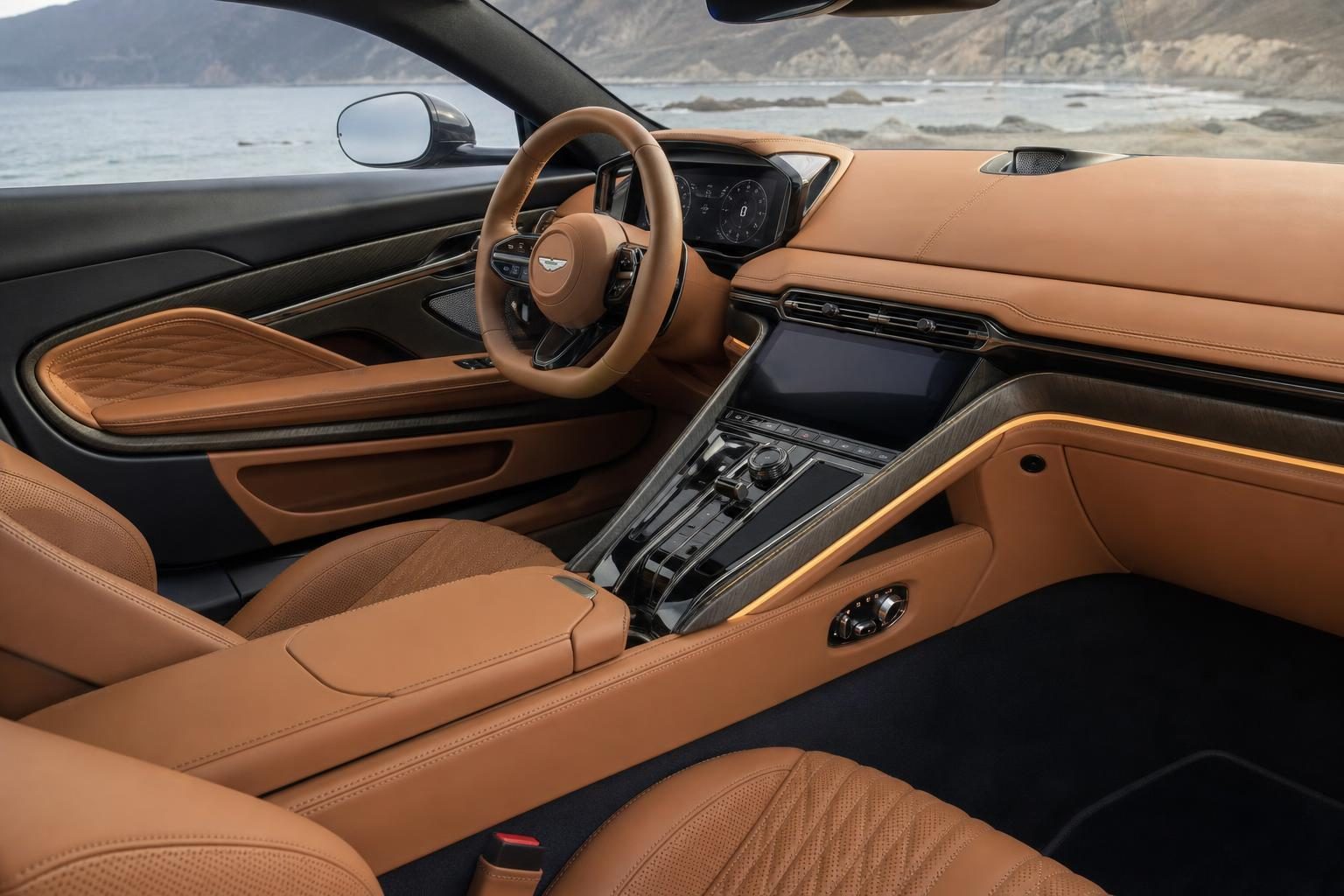
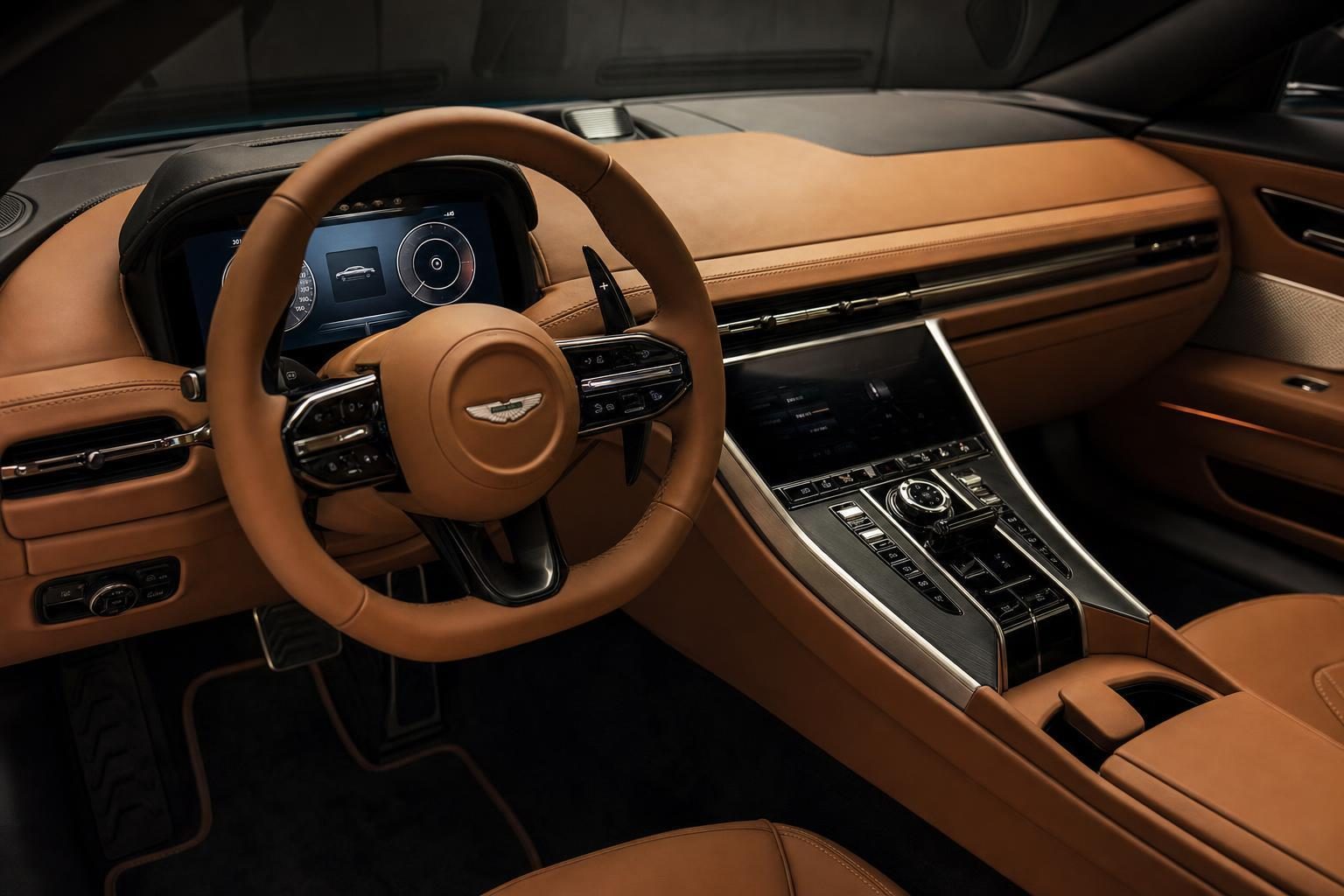
The DB12 debuts infotainment developed in‑house by Aston Martin, with dual 10.25‑inch screens (sources: Aston Martin; TopSpeed). This shift to a home‑grown solution is strategic: control of ergonomics, updates and vehicle‑function integration. For the buyer, the stakes are as much about the modernity of the interface as the coherence between physical and digital controls, an area where Aston Martin claims clear progress.
The adoption of two 10.25‑inch screens modernises presentation and navigation between functions, aiming to reduce latency and simplify access to key settings. Developed by the brand, the system reflects Aston Martin’s visual identity and fits the ambition of a contemporary super tourer that doesn’t sacrifice the on‑board experience.
On personalisation, while each market offers its own configurations, the essence is the ability to tailor the ambience to the intended use: hushed long‑distance cruiser or a more assertive coupé. The continuity of finish between DB12 and DB12 S lets buyers choose first on desired performance level, then on colours, materials and options.
Conclusion: how to choose your DB12 or DB12 S super tourer
To make your choice, first decide between the DB12’s power‑comfort balance and the DB12 S’s extra edge. Both share the super tourer DNA championed by Aston Martin, with the same technical basis — twin‑turbo V8, ZF 8‑speed gearbox, e‑differential — and performance that places the car above a traditional GT.
Next, clarify the numbers: 680 PS corresponds to around 671 hp in American measure (sources: Aston Martin; TopSpeed). The quoted performance — 202 mph and 0–60 mph in 3.5 s for the DB12, 3.4 s for the DB12 S (sources: Aston Martin; auto123) — sets the scale. Finally, validate the on‑board experience: the dual 10.25‑inch, in‑house‑developed infotainment is a differentiator on this generation.
Ultimate British Supercar: 5 Truths About the 1977 V8 Vantage
Upon its launch in 1977, the V8 Vantage was hailed as the ultimate British supercar, and it is this claim that we examine in detail, supported by figures and sources. We clarify the performance data, explain the discrepancies in reported power, trace the evolution to the X-Pack, and revisit the very rare Vantage Volante, including the Sovereign of Wales specification. The aim is to convey why this pivotal model remains too often underestimated.
Why is the V8 Vantage called the ultimate British supercar?
At its launch, the V8 Vantage boasted a top speed of 170 mph, a milestone proudly highlighted by Autopolis and HotCars. At this level of stratospheric performance in the late 1970s, Aston Martin’s coupe ranked among the fastest road cars of the time — a status that justifies the label of ultimate British supercar in both contemporary press and current retrospectives.
In terms of the 0-60 mph sprint, sources Model-Universe and HotCars report a time of around 5.3 seconds, which is one-tenth quicker than the Ferrari Daytona. In the minds of enthusiasts, surpassing the Maranello benchmark on this sprint was an immediate endorsement. This context sheds light on why the V8 Vantage was perceived as a national pioneer in the very exclusive club of supercars.
Beyond the numbers, the symbolic importance lies in its entirely British positioning: an in-house designed engine, styling by William Towns, and limited yet ambitious production. This synthesis of engineering and aesthetics has shaped the model’s aura and reinforced its unofficial title.
What engine and real power lie beneath the bonnet?
The technical specifications feature the 5.3-litre quad-cam V8 developed in-house in the 1960s, a block shared with the Lagonda according to HotCars. This mechanical community expressed Aston Martin’s philosophy: a high-performing, adaptable, in-house heart. In terms of style, William Towns’ signature combined taut lines with an athletic presence, creating an iconic design.
Power figures vary according to sources, and it is important to cite them accurately. Autopolis states 375 bhp for the initial V8 Vantage. Model-Universe and HotCars indicate 390 bhp at 5,800 rpm. This range likely reflects specification differences, measurement protocols, or model years. However, all agree on an X-Pack variant rated at 403 bhp (Model-Universe; HotCars), the pinnacle of the lineage.
Interpreting these discrepancies means recognising that Aston Martin refined its V8 over the years and across markets. The values reported by contemporary media, sometimes conservative or, conversely, optimistic, explain reasonable variances. What does not vary is the performance/use alignment: a top speed of 170 mph and a 0-60 mph time of 5.3 seconds place the V8 Vantage at the summit of its segment by the late 1970s.
From Bolt-on to X-Pack: the evolution over thirteen years
The career spans over a decade, with significant technical milestones. The initial “bolt-on” evolutions aimed to optimise airflow and fuel delivery while refining aerodynamics and chassis, in line with user feedback and regulatory requirements. The goal was to maintain the balance between grand touring and supercar performance.
The technical peak occurs in 1986 with the X-Pack, confirmed at 403 bhp by Model-Universe and HotCars. This version adopts Cosworth pistons and Nimrod-type cylinder heads, according to these same sources, embodying race expertise applied to the road. These choices enhance throttle response and extend the usable range of the V8, without betraying the coupe’s road-going vocation.
Throughout the period, the spirit remains constant: to make the V8 Vantage an ultra-high-performance GT that can be compared with the best Italian cars of its time, without sacrificing comfort and mechanical longevity. This consistency explains why the Vantage name remains a performance label at Aston.
Vantage Volante and Sovereign of Wales version: the rare ones
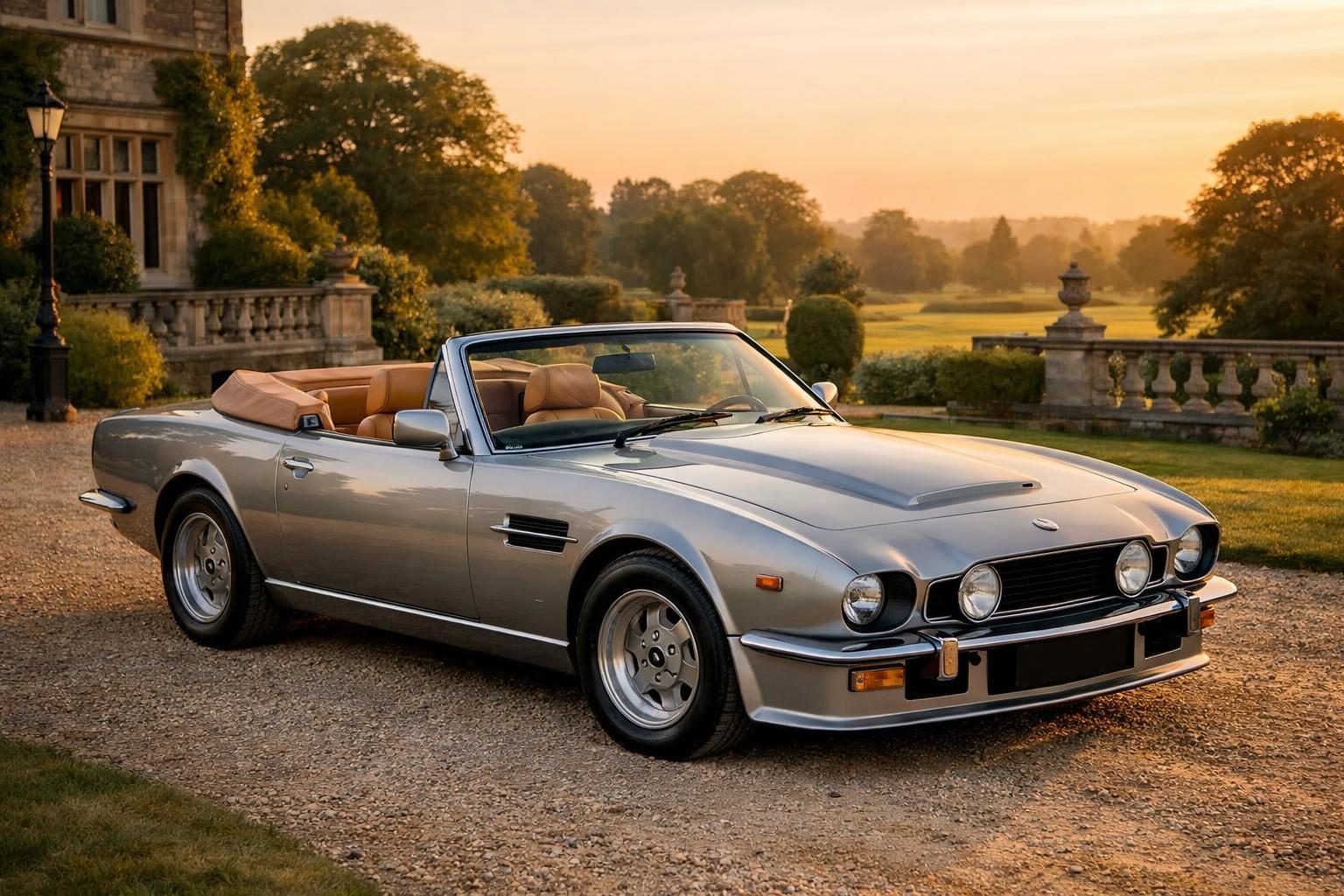
The Vantage Volante adds to the myth the dimension of open-top driving. According to Model-Universe, 192 units of this variant were produced, with the last leaving the factory in December 1989. This limited volume is enough to establish its rarity, further enhanced by a few very specific configurations.
The most famous remains the so-called Sovereign of Wales specification. In 1987, the Prince of Wales received a Vantage Volante without flared arches, a more discreet configuration produced 26 times (source: Model-Universe). This variant, with its refined aesthetics and royal patronage, draws the attention of collectors.
These series demonstrate the platform’s ability to embody multiple characters: the power and allure of a supercar, the elegance of a high-end convertible, and sometimes an assumed visual sobriety. The documented rarity — 192 Volante, 26 Sovereign of Wales — today fuels desirability and heritage value.
What is a V8 Vantage worth today and why it was long undervalued
For a long time, the V8 Vantage suffered from a perception bias. The media omnipresence of Italian supercars may have relegated this Aston to the status of a muscular GT, while its performance data, placed in context, validate its supercar status. The discrepancies in power (375 bhp according to Autopolis, 390 bhp at 5,800 rpm according to Model-Universe and HotCars) have also perpetuated a form of ambiguity, sometimes misinterpreted as a weakness.
Perceptions evolve as documentation improves and collectors value the overall coherence: 5.3 L quad-cam V8 engine designed in-house, William Towns styling, claimed 170 mph and a 0-60 mph time of 5.3 seconds, without sacrificing comfort. Added to this are the appeal of the X-Pack series (403 bhp according to Model-Universe and HotCars) and the rarity of the Volante, including the Sovereign of Wales produced 26 times (Model-Universe).
Within the Aston Martin ecosystem, the 1977 V8 Vantage bridges the tradition of grand touring and very high-level performance. To measure its legacy, one can contextualise its V8 shared with the Lagonda — see our overview on the 1976 Lagonda and its technical audacity — and the stylistic and mechanical evolution towards subsequent generations, notably the Virage and its transition of the 1990s, and then the contemporary Vantage reinterpretations, up to the V12 Vantage and their atmospheric peak.
To place the V8 Vantage in the official history, one can usefully consult the dedicated summary of the Aston Martin V8 on Wikipedia (en) and the Aston Martin Heritage page, valuable for cross-referencing years, variants, and context. Enthusiasts will find complementary milestones to the sources Autopolis, Model-Universe, and HotCars cited in this article.
Conclusion — the V8 Vantage, a milestone of the ultimate British supercar
At the end of this examination, the label of ultimate British supercar is supported by converging facts: 170 mph top speed (Autopolis; HotCars), 0-60 mph in 5.3 seconds (Model-Universe; HotCars), a 5.3 L quad-cam V8 designed in-house, and a design by William Towns. The reported power discrepancies — 375 bhp for Autopolis, 390 bhp at 5,800 rpm for Model-Universe and HotCars, 403 bhp for the X-Pack — reflect distinct specifications and measurements, without undermining the essential: the 1977 V8 Vantage laid the groundwork for Aston Martin for a GT with supercar DNA, rare, demanding, and now fully recognised by history.
Ultimate Lagonda Taraf: 6 Facts About the Million-Dollar Sedan
The Lagonda Taraf is one of the most enigmatic Astons of the last decade, designed as an ultra-exclusive sedan for a select clientele. In this article of documented anecdotes, we revisit the reasons for its resurrection, its technical base, its stratospheric price, and the production figures that are up for debate. The aim: to understand the bold gamble behind the Lagonda Taraf and what this initiative has meant for the brand.
Why Aston Martin Resurrected the Lagonda Name in 2014
The rebirth of the Lagonda Taraf is part of an image strategy: to reactivate a dormant badge to address a micro-market of clients seeking a very high-end sedan, initially in the Middle East. Revealed privately to a few VIPs, the car was conceived as a highly customisable limited series, where exclusivity takes precedence over volume, according to presentations relayed by Motorlegend and auction house Bonhams.
The choice of name is not trivial: “taraf” means “side” in Turkish, a subtle evocation suggesting a distinctive look and a clear orientation towards a clientele from the Arabian Peninsula. In this light, the Lagonda Taraf is not a globally conquering sedan, but a business card affirming Gaydon’s expertise in ultra-luxury bespoke craftsmanship.
By reactivating Lagonda, Aston Martin capitalised on a lineage of prestigious sedans while giving itself the freedom to position the Lagonda Taraf above the fray. The choice of a confidential presentation and targeted distribution has maintained the aura of mystery that continues to surround this model.
A Sedan Derived from the Rapide on an Extended VH Platform
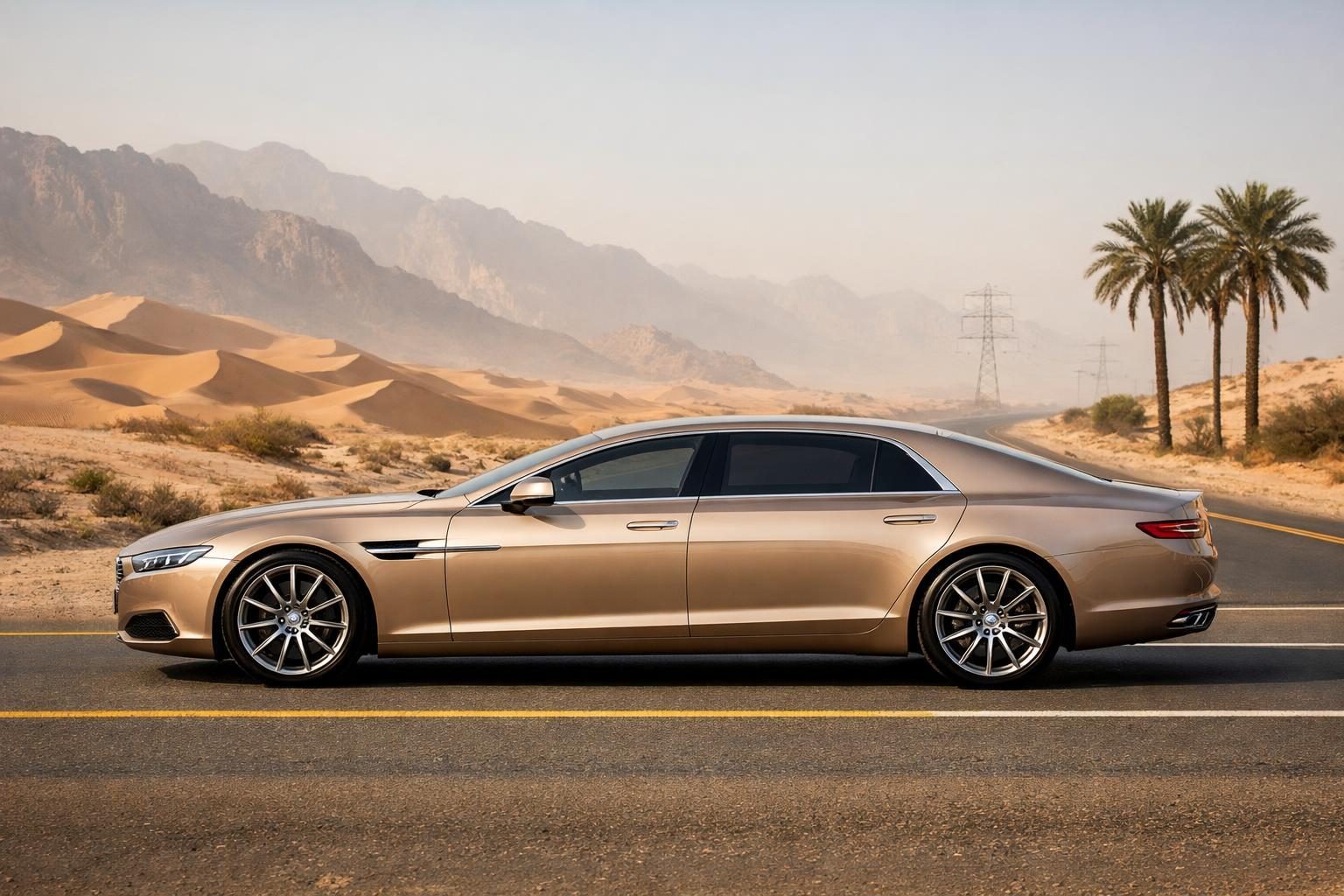
Technically, the Lagonda Taraf is based on an extended evolution of the VH platform, a modular aluminium architecture already shared with the DB9 and the Rapide. This base serves as a backbone while allowing for an increased wheelbase to provide the space and presence expected of a chauffeur-driven limousine. Sources Classic Trader and Motor1 describe this direct lineage with the Rapide, reinterpreted in a much more protocol-oriented manner.
This kinship is strategic: it guarantees known dynamic fundamentals while allowing the Lagonda Taraf to stand out through its presentation and materials. In practice, the sedan adopts a very low and elongated three-volume silhouette, distancing itself from SUV codes or German limousines, to offer a resolutely “Aston” interpretation of the very high-end.
The body of the Lagonda Taraf is made from carbon fibre, a rare choice for a sedan, which lightens the structure and allows for sculpted shapes. According to Classic Trader and Motor1, this composite skin covers the VH framework, combining rigidity with the demands of artisanal assembly. The design is by Marek Reichman, Aston Martin’s chief designer, whose taut lines and surface treatment give the whole a signature that is immediately recognisable.
Under the bonnet, the Lagonda Taraf features a 6.0-litre V12 with 48 valves, rated at 533 hp by Bonhams. It transmits its power to the rear wheels via an 8-speed ZF Touchtronic III automatic gearbox. Aston Martin claimed 0 to 100 km/h in 4.4 seconds and a top speed of 314 km/h (source Bonhams), figures that place the sedan on par with established sports cars, despite its limousine size.
This technical contrast — carbon body, atmospheric V12, and rear-wheel architecture — illustrates the desire to embrace a unique positioning. For those curious about Aston’s craftsmanship, the hand assembly took place in the same workshop as the One-77, a lineage explicitly mentioned by Classic Trader and Motor1. On this subject, our dossier Aston Martin One-77, manufacturing and heritage sheds light on the role of this exceptional workshop.
One Million Dollars: The Price That Sparked Debate
The price of the Lagonda Taraf, unveiled in Geneva, sparked as much discussion as the car itself: around one million dollars, according to Bonhams. The gap was striking, with a price more than five times that of a Mercedes-Maybach S600, a benchmark in the segment. This pricing strategy aimed to sanctify the exclusivity of the project, well beyond the codes of traditional limousines.
In reality, the entry ticket bought not only noble materials and performance but also an ultra-confidential programme, impeccable finishes, and a direct relationship with the workshop. The Lagonda Taraf thus embraced being a technological and artisanal showcase, whose price, alongside the technical specifications, served as a strong signal to the targeted clientele.
The exact production volume of the Lagonda Taraf remains one of its mysteries. Sources differ significantly, and it is essential to cite them. Classic Trader and Bonhams both mention a total of 120 units. Motor1, on the other hand, refers to 150 units. Finally, the media unefilleauvolant speaks of around 200 cars. These inconsistent figures contribute to the legend of the model.
Why such dispersion? Firstly, because the Lagonda Taraf was conceived as a made-to-order series, in a market that was initially regionalised. Secondly, because the artisanal assembly and measured communication around the project have maintained a degree of opacity. In the absence of an official consolidated figure from these sources, the range of 120–150, and possibly up to around 200 units according to unefilleauvolant, frames the exceptional rarity of this sedan.
For collectors, this uncertainty can influence the perception of value. It certainly reinforces the idea of a confidential production, and thus the status of a unique piece that each surviving Lagonda Taraf embodies in the secondary market.
Conclusion: What the Lagonda Taraf Tells Us About Aston Martin
By gathering these facts, the Lagonda Taraf emerges as a manifesto of craftsmanship and strategic boldness: VIP presentation in the Middle East, carbon body, 533 hp V12, and a price of around one million dollars. Sources such as Bonhams, Classic Trader, and Motor1 converge on the technical DNA and ultra-exclusivity approach, while diverging on the exact number of units, proof of the programme’s confidentiality.
Beyond curiosity, the Lagonda Taraf reminds us that Aston Martin knows how to shape extraordinary objects, backed by the VH platform and an exceptional workshop, that of the One-77. To delve deeper, explore our dossiers dedicated to the Lagonda Taraf, history and key data and the Rapide, technical base and heritage. In the Aston universe, the Lagonda Taraf remains a rare, fascinating, and debated milestone — and that is precisely what fuels its legend.
DBX707: 5 Secrets About the Most Powerful SUV
The DBX707 is Aston Martin’s muscular response to the luxury high-performance SUV segment. In this news guide, we highlight what makes this model unique, detail the 2025 overhaul (new interior and in-house infotainment system), position the car against its direct rivals, and open the perspective with the anticipated arrival of the DBX S in 2026. A factual overview, sourced, to understand why this SUV has become one of the flagships of Gaydon.
DBX707: a 4.0-litre V8 biturbo from Mercedes-AMG
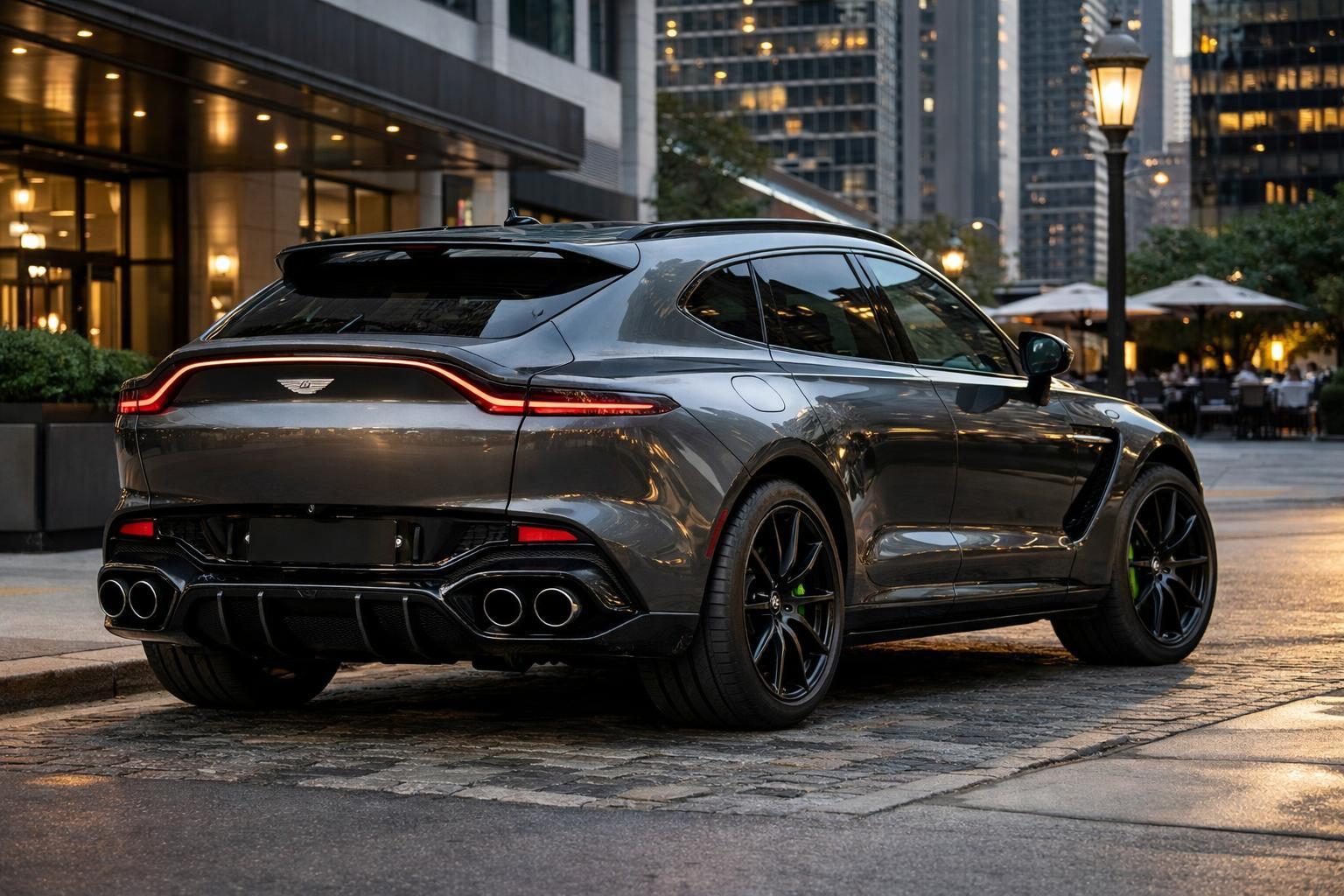
At the heart of the DBX707, Aston Martin installs a 4.0-litre biturbo V8 sourced from Mercedes-AMG. The brand presents it as the most powerful engine ever fitted to a luxury production SUV, with 697 PS (707 PS), as confirmed by official presentations (Aston Martin site) and analysis from MotorAuthority. This block, known for its availability and rev range, anchors the technical specifications at the very top of the market.
According to Aston Martin, the SUV accelerates from 0 to 100 km/h in about 3.3 seconds, a figure that places the DBX707 at the level of the category benchmarks. Some tests mention 3.1 seconds to 60 mph (TopSpeed), a complementary North American measurement that illustrates the launch efficiency. In any case, the promise is clear: straight-line performance is not an option but a foundational attribute.
For 2025, the range has been clarified: the 542 PS version is disappearing in favour of the sole DBX707, according to GuideautoWeb and Cars.com. This refocusing underscores the role of this model as the spearhead and avoids any ambiguity regarding the internal hierarchy. It effectively becomes the Aston Martin SUV, the one considered when seeking the full mechanical intensity of the brand.
The 2025 overhaul: new interior and in-house infotainment
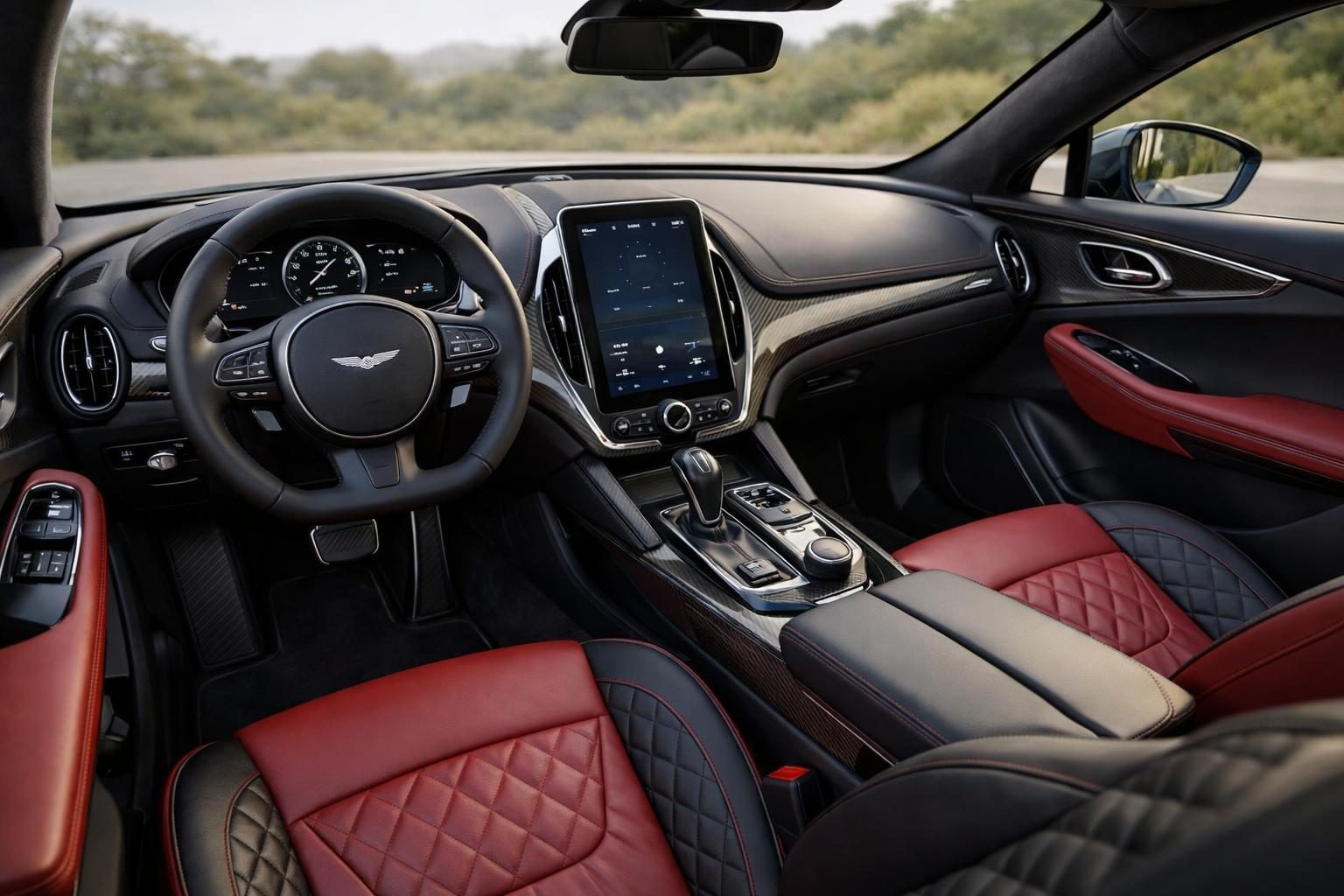
The 2025 update is not limited to cosmetic adjustments: it introduces a new interior and an infotainment system developed in-house by Aston Martin, according to J.D. Power and Autoblog. The objective is twofold: to enhance the perception of quality and regain control over ergonomics and software updates. On this point, the DBX707 aligns with the latest standards from Gaydon, featuring an interface designed by and for the brand.
In addition to the screen and menu logic, the revision touches on controls, materials, and connectivity, for a more coherent experience with the manufacturer’s DNA. Owners expect seamless integration of key functions from an SUV of this rank: navigation, audio, driving aids. This is precisely what this evolution of the DBX707’s interior aims for, prioritising clarity and responsiveness.
The 2025 overhaul also comes with revised suspension settings (according to J.D. Power and Autoblog). Without disrupting the chassis architecture, Aston Martin refines the damping and motion control to better reconcile ride comfort and dynamic precision. The expected benefit: a car that is more readable on the road and more resistant to fatigue on long journeys.
Aluminium chassis and electric anti-roll: the dynamics
Built on a dedicated aluminium structure, the SUV prioritises relative lightness and rigidity, two key qualities for a vehicle of this power. The DBX707, relying on an electrically actuated anti-roll system, seeks to contain body movements without sacrificing everyday ease. This approach sets a standard in the segment and helps maintain stance during high lateral loads.
Endurance is another trump card: the DBX707 comes standard with the largest carbon-ceramic brakes ever fitted to an Aston Martin, according to the brand and Cars.com. Besides reducing unsprung masses, these discs resist fading better and tolerate repeated intensive use. For an SUV exceeding 600 horsepower, consistent braking becomes an essential factor of confidence.
Validation in extreme conditions is not theoretical. A DBX707 has served as a medical car in Formula 1 (Aston Martin Brand Story and J.D. Power), a role that demands responsiveness, stability, and reliability. Without extrapolating beyond the facts, this exposure highlights the platform’s ability to withstand very high rhythms, which reflects on demanding road use.
Against the Purosangue, Urus, and Cayenne Turbo GT
The positioning of the DBX707 fits into a fiercely contested triangle alongside the Ferrari Purosangue, Lamborghini Urus, and Porsche Cayenne Turbo GT. Aston Martin highlights, with official sources backing it up, the title of “most powerful engine in any luxury production SUV,” a strategic claim to distinguish itself in this arena. In clear terms, power is not just a number: it is the competitive standard.
Beyond the specification sheets, the personality of this model lies in its tuning: electric anti-roll, carbon-ceramic brakes, and 2025 suspension calibration to marry precision and smoothness. While some rivals adopt a radical approach, the Aston claims a form of grand touring balance while delivering supercar acceleration. This unique blend is at the heart of the DBX707’s argument.
The comparison also plays out in the onboard experience: the in-house interface introduced in 2025 offers Aston Martin a digital coherence that meets the expectations of segment customers. For those hesitating between these exceptional machines, the British DNA — and how it translates into presentation and ergonomics — constitutes a differentiating criterion. Readers wishing to explore the range context can consult our dedicated DBX page, as well as the DB12 sheet to position the SUV against the brand’s grand tourer.
The arrival of the DBX S in 2026: even more power
Aston Martin has confirmed the expansion of the family with the DBX S for 2026: lighter and more powerful, it boasts 717 PS, according to GuideautoWeb. This evolution creates a new performance tier above the DBX707, without any other technical details officially developed in the cited sources. The message is nonetheless clear: the escalation continues.
This future model plays a strategic role. On one hand, it consolidates the attractiveness of the SUV range over an extended product cycle. On the other hand, it leaves the DBX707 with a logical space, that of the “core high-performance range,” while the DBX S pushes the envelope. Design enthusiasts can also place this trajectory within the brand’s culture via our portrait of Marek Reichman, to understand the aesthetic ambition underlying these evolutions.
In practice, the arrival of the DBX S offers an expanded choice: retain the already proven balance of the DBX707, rich with its 2025 overhaul, or aim for the maximum expression of performance with the S. In both cases, Aston Martin’s strategy aims to maintain a prominent presence against Italian and German rivals.
Conclusion: why the DBX707 stands out today
In summary, the DBX707 combines a 697 PS biturbo V8 validated by road and F1 (medical car), a 2025 overhaul that profoundly modernises the interior and infotainment, and a dynamic refined by an aluminium chassis assisted by an electric anti-roll system and very large carbon-ceramic brakes. Against the Purosangue, Urus, and Cayenne Turbo GT, it asserts itself through the power claimed by the brand and a grand touring temperament. For official specifications, consult the Aston Martin site, and for a test insight, the analysis from MotorAuthority. With the horizon of the DBX S announced for 2026, the trajectory of Aston Martin’s SUV remains clearly upward.
AMR26: 5 Secrets of Aston Martin’s Tough Start
The AMR26 marks a new era for Aston Martin, and this article explains why its start to 2026 is so challenging. We review the technical factors — Honda engine, battery management, vibrations, and reliability — drawing on statements and specialist sources to distinguish between teething problems and genuine structural weaknesses.
The AMR26: Aston Martin’s First F1 Designed by Adrian Newey
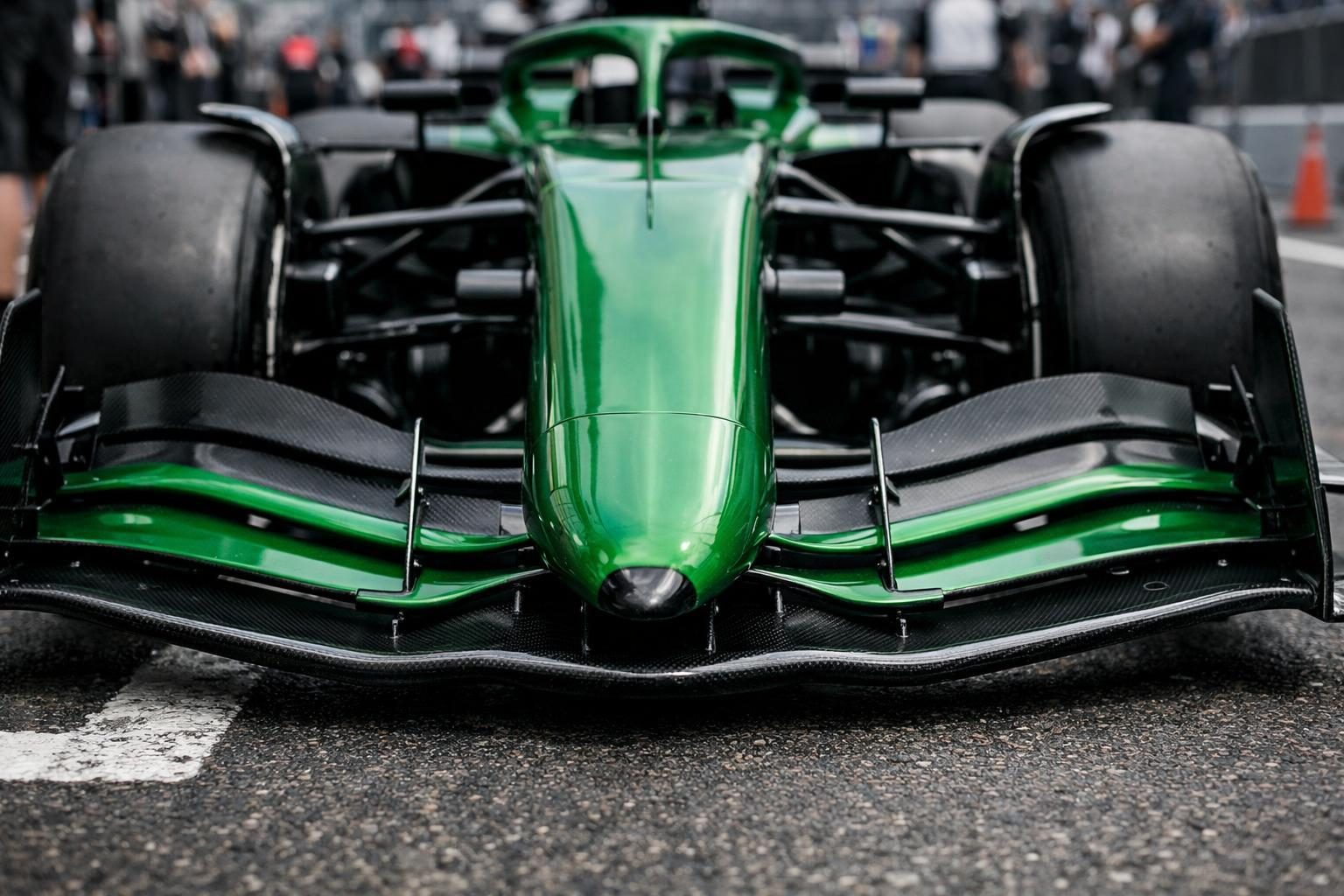
According to Wikipedia AMR26 and f1oversteer, the AMR26 is Aston Martin’s first Formula 1 designed by Adrian Newey, a significant arrival for a team looking to step up. The British designer brings his systemic approach to the chassis-aero coupling, but such a conceptual leap involves a learning curve, especially in a regulatory context that has been profoundly reshaped for 2026.
The car is entrusted to Fernando Alonso, a double world champion, and Lance Stroll (Wikipedia AMR26). Their combined experience aids in analysing the correlations between the track and the wind tunnel, but the initial runs have exposed glaring limitations. During the winter tests in Bahrain, f1oversteer and gpfans reported reliability and pace difficulties, revealing that the AMR26 is not yet expressing the expected potential.
At this stage, the priority has often been to understand the overall architecture rather than pursue raw performance. This is consistent with a chassis completely rethought around a new power unit. To measure the scope of this challenge, it is worth noting that Aston Martin had not fielded an F1 truly shaped by an aerodynamic guru for decades, a shift comparable to that which led to hypercars like the Valkyrie designed with Adrian Newey, in another category.
The Return of Honda as Exclusive Engine Supplier in 2026
The first Aston Martin powered by Honda, the AMR26 seals an exclusive partnership in a pivotal year. According to fr.motorsport, Adrian Newey indicated that Aston Martin overlooked a crucial element at the time of signing: the lack of experience of the newly reformed Honda engine department. This organisational reality partly explains the delicate tuning of the power unit, despite the historical pedigree of the Japanese manufacturer.
The 2026 regulations disrupt the balance of the powertrain: the removal of the MGU-H, 100% renewable fuels, and a distribution of around 50/50 between thermal and electric power (gpfans, fr.motorsport). This impacts aerodynamics, cooling, and battery-inverter integration. The AMR26 must navigate these trade-offs while discovering the unique dynamics of the Honda V6 and its revised hybrid system.
This new era imposes unprecedented compromises on gearbox ratios, energy recovery, and management of electric deployments. In short, even a quality chassis-aero base can be hampered if the power unit mappings and battery strategy are not perfectly harmonised. This is one of the recurring themes of the AMR26 at the start of the season.
To delve deeper into the engine angle, consult the analysis from fr.motorsport on the Aston Martin–Honda agreement and the missing information at the time of signing: a partnership under learning constraints. The main technical outlines of the car are also compiled on the dedicated Wikipedia page.
Vibrations, Battery, and Reliability: The Early Season Ailments
Engine vibrations have been a major issue. Wikipedia AMR26 and paddock-gp report that Fernando Alonso deemed them “unbearable”, to the point of being considered a risk for the drivers. The AMR26 had to reduce certain operating levels to preserve reliability and avoid excessive mechanical stress, which inevitably curtailed pure performance.
On the energy front, the 50/50 logic between thermal and electric requires a high-flow battery and very fine ERS calibrations. During the Bahrain tests, f1oversteer and gpfans pointed out reliability issues, while Lance Stroll mentioned a gap of about four seconds per lap. Such a margin cannot be explained solely by aerodynamics: energy management and limits on electric deployment are plausible suspects in the 2026 context.
The first corrective measures focused on mitigating vibrations and enhancing robustness, with tangible progress. Wikipedia AMR26 specifies that Alonso achieved the team’s first 2026 finish by placing 18th in the Japanese Grand Prix, after a reduction in these vibrations. This raw result does not satisfy anyone, but it validates a step in the right direction: running, collecting data, and ensuring reliability.
The challenge now is to eliminate survival compromises to unlock the car’s balance. Otherwise, the AMR26 will remain under-tuned, with a cumulative deficit between aerodynamic efficiency, traction, and electric deployment.
Alonso and Stroll Facing Performance Delays
The drivers have been candid. Lance Stroll, quoted by gpfans, spoke of a delta of about four seconds per lap during the winter tests. Such a gap immediately alters the roadmap: instead of polishing the details of the AMR26, the team had to secure the fundamentals and prioritise critical areas (vibrations, thermal stability, ERS mapping).
Fernando Alonso, a two-time champion, has brought a clear methodology to de-risk the technical base. His first chequered flag of 2026, 18th in Japan (Wikipedia AMR26), reflects pragmatic small steps rather than spectacular breakthroughs. The priority is to establish a healthy operating window before pushing the limits.
At this stage, the combined feedback from Alonso and Stroll offers a valuable reference to reconnect simulation and reality. Their experiences feed into the evolution plan for the AMR26 — not just in aero parts, but also in energy strategies and system rigidity to contain residual vibrations.
To situate these recent difficulties within the broader history of the brand, our dossier traces the DNA of Aston Martin and its cycles of rebirth, useful for putting a challenging period into perspective: history, brand, and legend of Aston Martin.
What Are the Prospects for Recovery for Aston Martin?
The first lever is reliability. As long as the AMR26 remains constrained by safeguards to contain vibrations and teething incidents, performance is capped. The Bahrain–Japan sequence has nonetheless shown a tangible improvement in vibrations (Wikipedia AMR26), signalling that the validation loops are beginning to pay off.
The second lever is energy optimisation. With the abolition of the MGU-H and the electric share raised to around 50%, the art lies in recovery and deployment without harming the chassis balance. This is an area where Honda and Aston Martin must accelerate their joint maturation. Newey’s initial observation regarding the lack of experience in the reformed engine department (fr.motorsport) highlights the importance of time and technical stability.
Finally, aerodynamics must converge with engine mapping. A car designed by Newey is meant to be efficient overall, but only if the powertrain allows it to exploit its promises. The insights gained by Alonso and Stroll should guide an iterative roadmap, from suspension to brake-by-wire and cooling, to broaden the operating window of the AMR26.
To follow the overall evolution of the road range and the in-house technical know-how, our analysis of recent product dynamics can shed light on Aston Martin’s engineering culture: Vantage and DB12, the return to the top.
Conclusion — Where Is the AMR26 Headed by Mid-Season?
The picture of the 2026 start is clear: the AMR26 is paying the price of a double gamble — new regulatory architecture and the first year with Honda — against a backdrop of vibrations, imperfect battery management, and developing reliability. However, the progress seen between the tests and Japan shows a credible recovery trajectory. If reliability locks in and the hybrid system reaches its optimal window, the car may finally reveal the benefits of the Newey touch. For further facts and references, consult the Wikipedia summary of AMR26 as well as the analysis from fr.motorsport on the Aston Martin–Honda relationship.
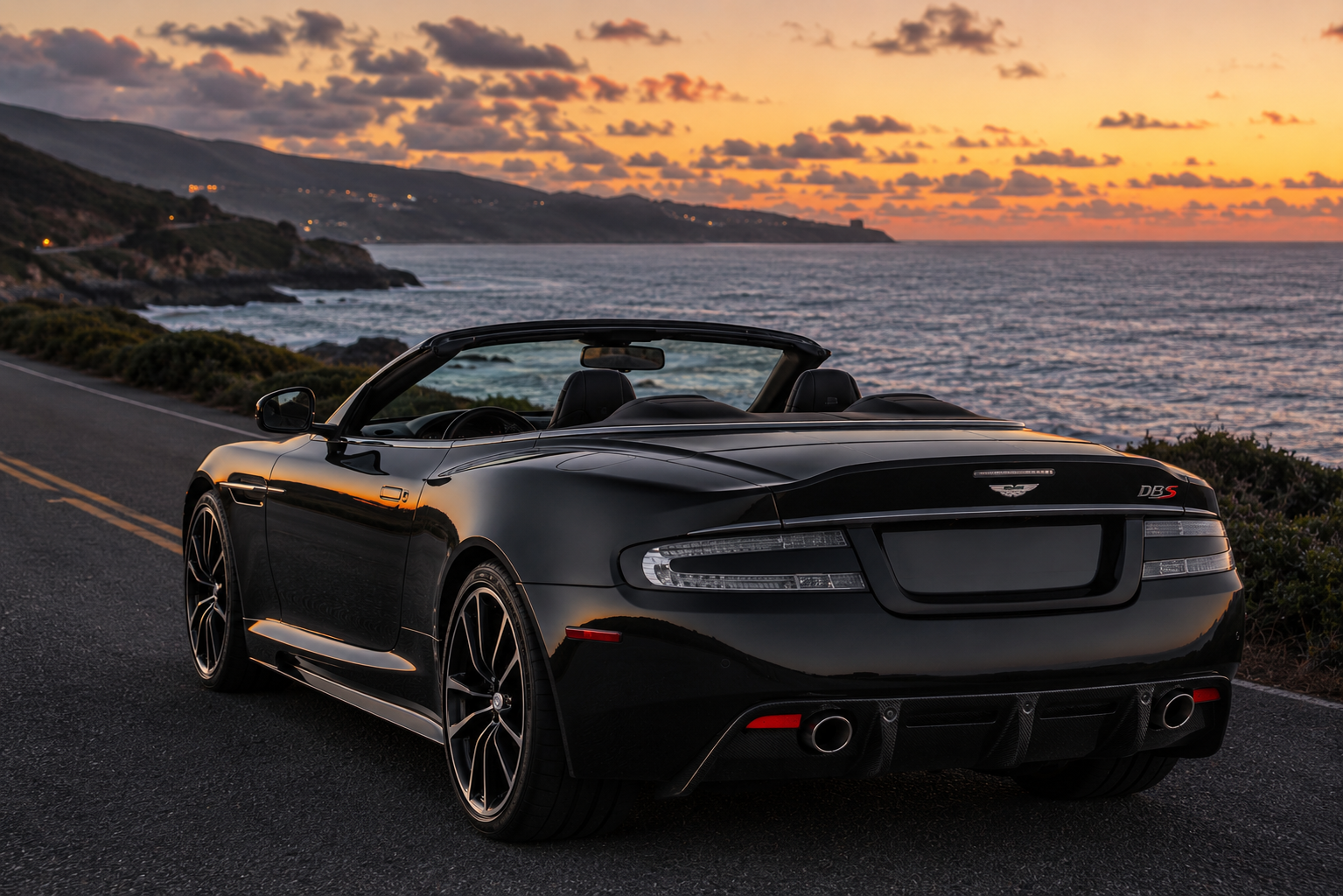
Ultimate DBS: 6 Secrets of the Last DBS V12 from 2012
Ultimate DBS marks the precise farewell of the DBS V12 in 2012: a series that is mainly cosmetic and very limited, often confused with the recent 770 Ultimate. Here, in six key points, is what you need to differentiate the two “ultimates”, understand why the Aston faded away that year, what the edition truly offered, and to situate its rarity and valuation among collectors.
Ultimate DBS or DBS 770 Ultimate: two farewells not to confuse
First clarification: the Ultimate DBS of 2012 and the DBS 770 Ultimate of 2023 are not the same car. The former concludes the cycle of the naturally aspirated 5.9-litre DBS V12 launched in 2007; the latter marks the run-out of the modern DBS Superleggera, equipped with a 5.2-litre twin-turbo V12. According to astonmartins.com, the 2012 edition corresponds to the last 100 units produced in June-July 2012, while the 2023 770 Ultimate was manufactured in 300 coupes and 199 Volantes.
The confusion arises from the nickname “Ultimate” reused ten years apart, but the content differs profoundly. In 2012, the edition is essentially aesthetic on an unchanged mechanical basis. In 2023, the 770 Ultimate is a technical evolution of the end of the series, derived from the DBS Superleggera, not to be confused with the DBS from 2007-2012. To place the context of succession, the first generation DBS makes way for the second generation Vanquish in 2012, while the 770 Ultimate closes the Superleggera chapter.
Finally, the total production of the “first era” DBS is estimated at around 3,400 units (2,534 coupes and 845 Volantes) according to Nicholas Mee, distinctly separate from the volumes of the Superleggera lineage. This precision helps to correctly interpret advertisements and catalogues, where “Ultimate” can mask two very different realities.
Why the DBS V12 took its bow in 2012
The DBS V12 (2007-2012) is built on the VH modular platform, derived from the DB9 and inspired by the DBR9 race car. Lower by 25 mm and wider by 40 mm than the DB9 (sources: en.aston-martin-club.com; astonmartins.com), it imposes a more radical stance from its launch. After five years of production, the arrival of the second-generation Vanquish in 2012 reshuffles the stylistic and technical cards, justifying the model’s discontinuation.
Commercially, Aston’s product cycle was reaching maturity, and the brand was preparing for the next step. The DBS Ultimate edition then acts as a “last hurrah” very much controlled, focused on appearance and rarity, without mechanical evolution. This end-of-series strategy, classic at Aston Martin, enhances the last examples and marks the transition to the successor.
The Volante was introduced at the Geneva Motor Show in March 2009, with deliveries in the third quarter of 2009 and a kerb weight of around 1,810 kg (source: Wikipedia EN). In 2012, with the range being reshaped, the brand orchestrates the release of the coupe and convertible on a final batch with specific styling: the DBS Ultimate.
What the Ultimate trim really added (and what it did not change)
According to Supercars.net, Exotic Car Hacks, and Nicholas Mee, the DBS Ultimate is primarily a cosmetic trim. It is recognisable by a carbon element and dark accents pack: carbon fibre boot spoiler and diffuser, carbon mirror caps, blackened grille, smoked rear lights, Zircotec-treated exhaust outlets, and specific badges with a numbered plate. The calipers could be painted in yellow, black, or red.
The chosen colour palette tightens the visual identity: Carbon Black II, Quantum Silver, and Silver Fox. Inside, the ambience follows the same logic of sporty sobriety, with “DBS Ultimate” markings. The goal is clear: to sign the ultimate batch with an immediately identifiable aesthetic without touching the major components.
On the technical side, sources agree: the mechanics remain identical to that of the standard DBS at the end of production. No increase in power, no specific reworked chassis for the edition; the appeal lies in the combination of the final specification and rarity.
The 5.9-litre V12 and standard carbon-ceramic brakes
The heart of the model, common to the 2012 edition, is the naturally aspirated 5.9-litre V12 (marketed as 6.0 litres) hand-assembled in Cologne. According to Nicholas Mee, Exotic Car Hacks, and astonmartins.com, it develops 510 hp (517 PS) at 6,500 rpm and 569 Nm at 5,750 rpm. An isolated source (Supercars.net) mentions 572 hp from 2011, a figure not confirmed by specialist guides, which only mention a single mechanical specification.
The advertised performance hovers around 4.2 to 4.3 s on the 0-60 mph and a top speed of 191 mph (307 km/h) (Nicholas Mee; Exotic Car Hacks; auto-data.net). This places the car among the fastest GTs of its time, with a naturally aspirated character and a very distinctive tone.
The coupe introduces two firsts for a road Aston: standard carbon-ceramic brakes (398 mm six-piston at the front, 360 mm four-piston at the rear) and 20-inch wheels (sources: astonmartins.com; Nicholas Mee). These components, already present on the standard DBS, are carried over unchanged on the DBS Ultimate, the keystone of its driving pleasure and braking endurance.
How many examples, at what price, and what is the current valuation
On the volume, sources vary slightly. Astonmartins.com states that there are 100 last DBS produced (June-July 2012). Exotic Car Hacks speaks of a limited edition of 100 units worldwide, available in coupe and Volante, with manual or Touchtronic 2 gearbox. The consensus: the order of magnitude is around 100 units, placing the series among the rarest of road DBS.
For the new price, Exotic Car Hacks cites a price around $280,576 US for the 2012 coupe, to be taken with caution and not presented as certain. The market reality varied according to specifications (gearbox, body) and geographical areas. However, this figure provides a benchmark for the high-end positioning of the farewell edition.
Regarding current valuation, rarity, condition, history, and configuration (colour, type of gearbox, coupe or Volante) weigh heavily. Specialist dealers like Nicholas Mee remind us of the low overall volume of the model (around 3,400 units) and the desirability of late specifications. The numbered edition adds a collector’s premium compared to a standard DBS, especially if the configuration matches the triptych of official shades and the original details preserved.
To read an advertisement correctly, check the correspondence of specific elements (badges, plates, carbon finishes, exhaust treatments, and colours) with the period documentation, and clearly distinguish a DBS Ultimate 2012 from a DBS Superleggera 2019-2023, including its 770 Ultimate. This vigilance avoids costly confusions and protects the heritage value of the model.
Conclusion — DBS Ultimate, the swan song that deserves to be identified
The DBS Ultimate of 2012 condenses the essence of the DBS V12: a GT based on the VH platform, lower and wider than the DB9, powered by a 5.9-litre naturally aspirated engine with 510 hp and standard carbon-ceramic brakes. The farewell edition stands out with specific styling and a production limited to around 100 units, without mechanical evolution.
In an era of confusion with the 770 Ultimate of 2023, retaining these key points allows for informed purchasing, collecting, or simply admiring. To delve deeper into the historical and technical context, consult the Aston Martin DBS 2007 page and the specialist guide from Nicholas Mee, not forgetting the dedicated summary of the edition on astonmartins.com. Finally, follow the lineage by discovering the direct successor, the Vanquish Mk2, and related models like the DB9 and the DBS Superleggera to precisely situate this final series within the Aston Martin legacy.