DBS V8 marks the anticipated yet delayed shift that opens the era of V8 engines at Aston Martin. This article sheds light, with supporting sources, on the gap between the expectation of a V8 promised as early as 1967 and its realisation in 1969, deciphers what the car changes technically and stylistically, and confronts the divergent production figures. A guide to understanding why this 2+2 coupe, presented at the time as the fastest four-seater in the world, is a true pivot in Aston’s history.
Why Aston Martin Replaced the DB6 with the DBS in 1967
The DBS was unveiled on 25 September 1967 at Blenheim Palace. According to Auto-Forever and Voiture-de-Film, it initially retains the 4.0-litre six-cylinder engine from the DB6 in its final years. This launch reflects the desire to modernise the image and offer a more spacious size, without immediately breaking away from the proven mechanics. Meanwhile, the brand is preparing a new V8 intended to support performance in line with the competition of the late sixties.
This two-step choice responds to a clear industrial constraint: the new all-aluminium engine designed by Tadek Marek is not yet ready in 1967. The grand touring coupe must therefore begin its career with the six-cylinder block from the DB6 to occupy the market. The strategy is evident in the total production of the lineage: around 787 DBS across all versions in five years, according to CarJager, compared to nearly 1,800 DB6 during the same period. The transition is gradual but crucial for the future of the range.
For the public, the gap between the completely renewed design and the familiar mechanics creates growing anticipation. This impatience is the backdrop to the birth of the DBS V8, destined to embody technological renewal and reposition the brand in the market for very fast four-seater GTs.
The Long-Awaited Tadek Marek V8 Engine Finally Installed in 1969
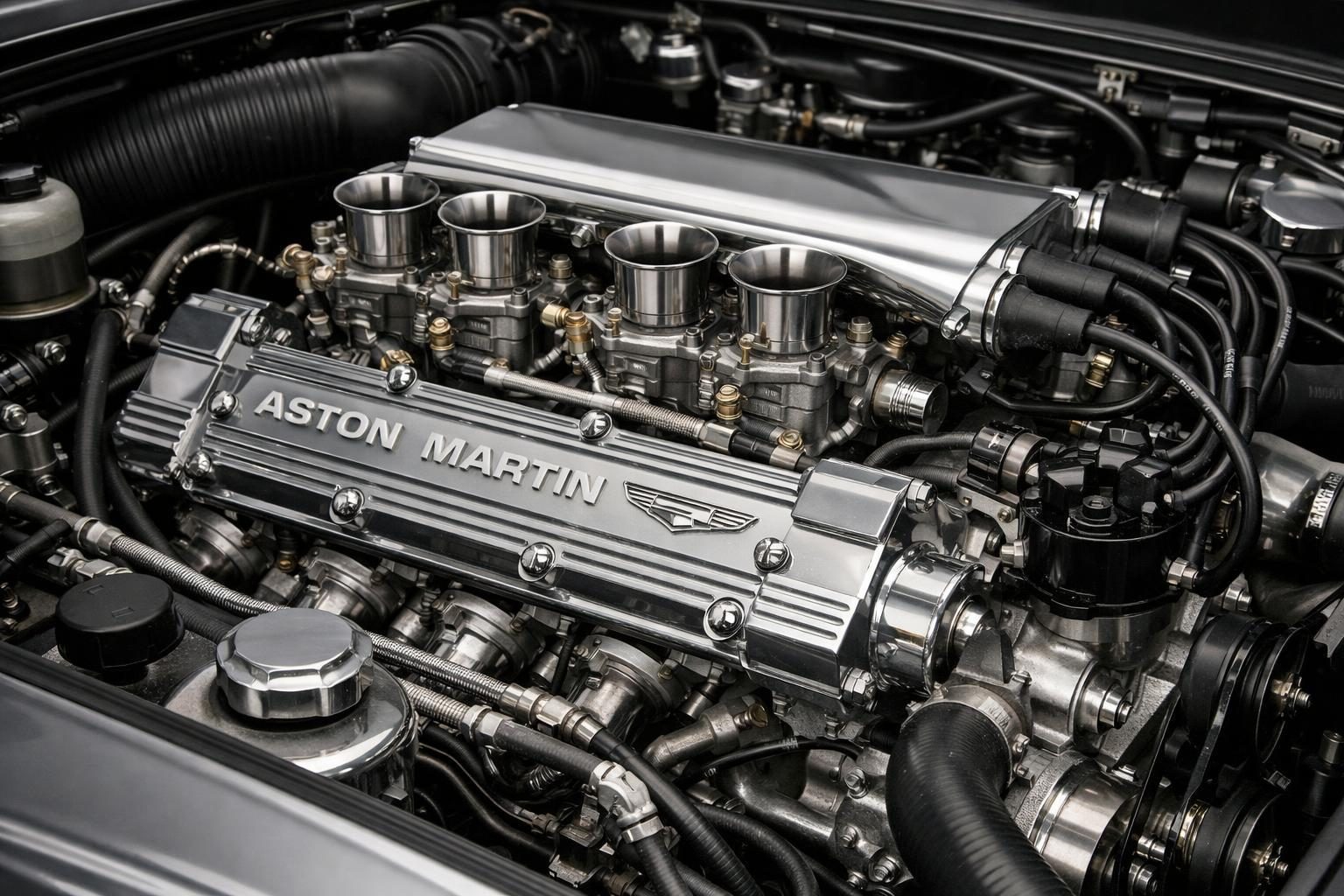
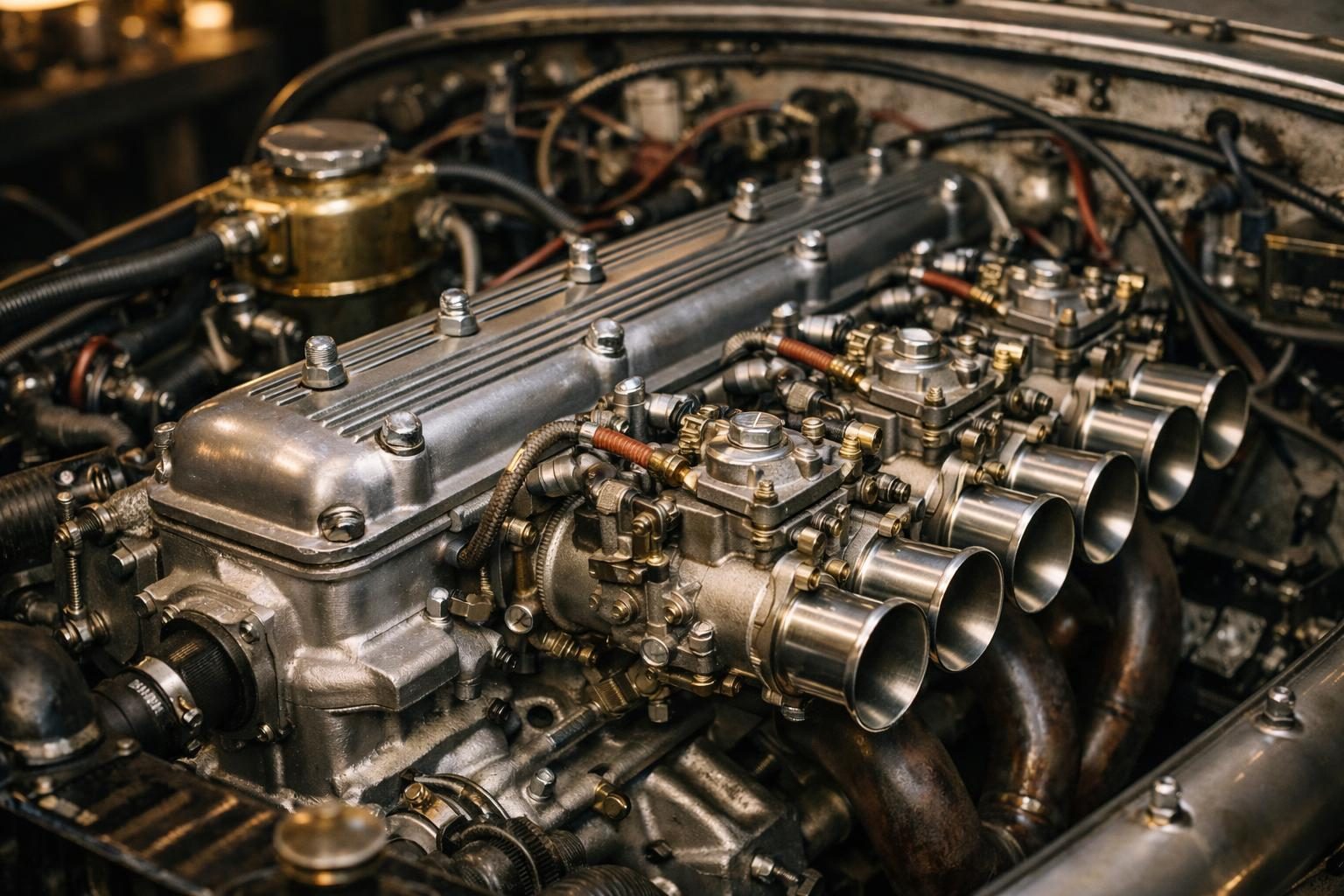
The V8 designed by Tadek Marek, all-aluminium and with double overhead camshafts, is only ready in September 1969. AutoEvolution, Voiture-de-Film, and Classic-Trader converge on this timeline. This is when the DBS V8 officially comes to life, transforming the promise into reality and giving the muscular silhouette the engine it demanded.
At its launch, this version is presented as the fastest four-seater car in the world, claim AutoEvolution and Classic-Trader. This positioning solidifies the contribution of the new V8 and legitimises Aston’s technical shift towards more modern and powerful mechanics. For immediate historical context, see the dedicated page on the DBS on Wikipedia (Aston Martin DBS) and the analysis of the V8 lineage published by AutoEvolution on the V8 era (1969–1990).
This late arrival of the eight-cylinder engine is not a detail: it reshuffles the cards of the range and foreshadows decades of V8 GTs. The DBS V8 thus serves as a template for the models that will follow, including well-known later evolutions like the V8-engined Virage, a distant heir to this architecture.
A William Towns Style Inspired by American Muscle Cars
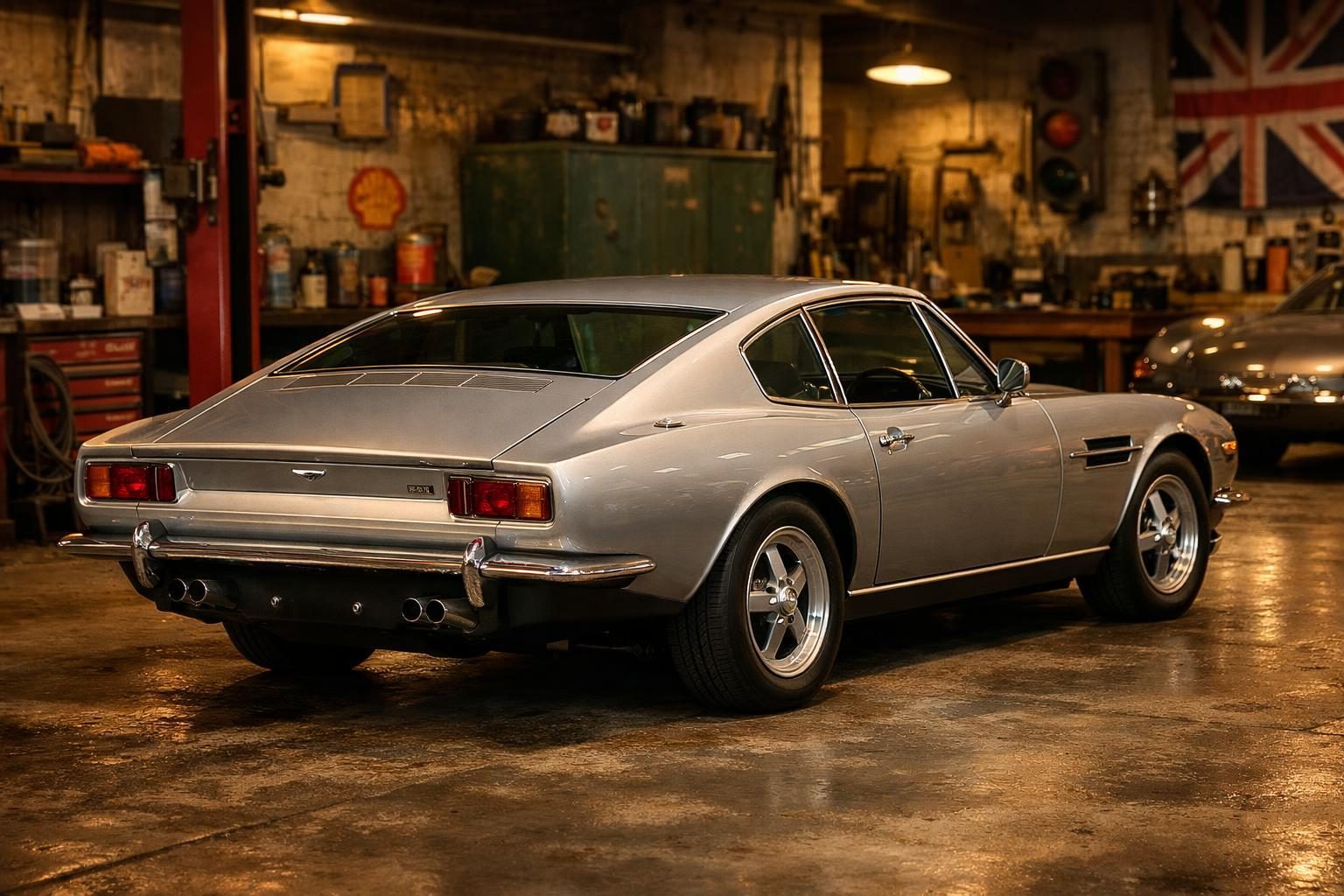
The design is by William Towns, after the abandonment of the project initially entrusted to Touring, according to Auto-Forever and Mécanicus. The design contrasts with previous DBs: long bonnet, taut surfaces, full volumes, and a widened grille. The result evokes, without copying, certain stances of American muscle cars, with a wide stance and a more assertive visual temperament.
This new visual identity is not arbitrary. It anticipates the power increase of the V8 and aims to give the GT a presence in line with its dynamic ambitions. The squared-off look, pronounced arches, and full rear end give the car an authority that complements the traditional sleekness of six-cylinder Astons. Once it arrives, the DBS V8 appears in perfect continuity with this formal language.
The message is clear: Aston Martin embraces a more contemporary and international aesthetic. In this respect, the bodywork designed by Towns serves as the setting for a major technical reorientation. One does not go without the other in the perception of customers and media at the end of the 1960s.
Ventilated Brakes and First Techniques: What Really Changes
Beyond the engine, the DBS introduces real engineering innovations. Auto-Forever highlights that it is the first Aston Martin equipped with four ventilated disc brakes. This technical advancement improves braking endurance, essential for a heavy and fast GT, and confirms the ambition for sustained performance over long distances.
These technical choices validate the expected increase in power with the switch to the V8. On the road, the better thermal dissipation of the ventilated discs contributes to the consistency of handling, a crucial point for a high-performance four-seater. On a brand scale, this is a further step towards a more methodical industrialisation of high-performance components.
The addition of these evolutions makes the DBS V8 not only a motorised iteration but a coherent whole. Assertive design, modern powertrain, and capable braking lay the foundations for future V8 Astons, which will remain in the catalogue and in the brand’s imagination for years to come.
How Many DBS V8s Were Produced: What the Sources Say
Production figures for the DBS V8 vary according to sources. AutoEvolution and Guide-Autosport suggest 402 units, while Classic-Trader and Voiture-de-Film mention 405 units. This slight discrepancy may be due to counting parameters (completed cars, chassis produced, prototypes included or not), but no absolute consensus emerges from the cited references.
What is established is the order of magnitude: a limited volume, reflective of a transitional period and artisanal production. Meanwhile, CarJager estimates the total production of the DBS, across all versions, at around 787 units over five years, compared to nearly 1,800 DB6 during the same period. The DBS V8 therefore represents a significant but minority fraction of the total, and its rarity today fuels its appeal to collectors.
This statistical debate does not diminish the model’s influence. Whether one counts 402 or 405, the contribution of the DBS V8 is qualitative: it places the V8 at the heart of the offering and paves the way for iconic V8 lineages, extending the legacy begun by the DB6 and deepened over the decades. To place this milestone in the overall trajectory, see our summary on the history of Aston Martin and its breakthroughs.
Conclusion — What the DBS V8 Changed
In summary, the DBS V8 is the moment when intention becomes reality. Unveiled in 1967 with a six-cylinder from the DB6 out of necessity, it receives the Tadek Marek V8 in 1969, fulfilling the promise and propelling the GT to the rank of the fastest four-seater of its time according to the cited sources. Its bodywork designed by William Towns, its ventilated brakes unprecedented at Aston, and its limited production — 402 or 405 according to references — make it a pivotal model both technically and symbolically.
This shift to the eight-cylinder shapes the brand durably, heralds the upcoming V8 lineages, and redefines the balance between style, performance, and endurance. In this sense, the DBS V8 is not just a transitional model: it is the starting point of an entire segment of Aston Martin’s modern DNA.
James Bond: The Ultimate 4 Aston Martin Cars of Daniel Craig
James Bond, during the Daniel Craig era, reconnected with Aston Martin by intelligently articulating the legacy of the DB5 and contemporary models, from the DBS coupe to the DB10. This article dissects this cultural and visual shift: why these cars, how they were filmed, and what this choice says about the DNA of 007 as well as Aston Martin’s strategy. Drawing on specialised sources (ScreenRant, The Conversation, jamesbondlifestyle), we analyse the heritage continuity and modern momentum initiated as early as Casino Royale, leading to the strong return of classics in No Time To Die.
Casino Royale 2006: The DBS V12 and the Record Roll
In Casino Royale (2006), Daniel Craig takes the wheel of a contemporary Aston Martin DBS V12. According to ScreenRant, this appearance is famous for a stunt where the agent brakes sharply to avoid Vesper, triggering a spectacular roll. The staging reaffirms a more physical, vulnerable Bond, anchoring the character in an era of raw action, with a supercar that matches this choice.
This technical and aesthetic choice is significant: the DBS embodies the stylistic and mechanical language of the mid-2000s, more angular and athletic than the British GTs of previous decades. In terms of imagery, the Aston is an extension of the transformation of 007 brought about by the reboot: strong, fast, without superfluous ostentation. The association becomes organic again, without pastiche.
The roll scene also fits into the iconography of the “realistic” stunts of the Craig era. Rather than multiplying implausible gadgets, the staging relies on visual impact and mechanical credibility. In this respect, the DBS becomes a character in its own right: a contemporary sports car used to the limit, without distorting its primary function.
The DB5 Won in Poker, a Nod to Goldfinger
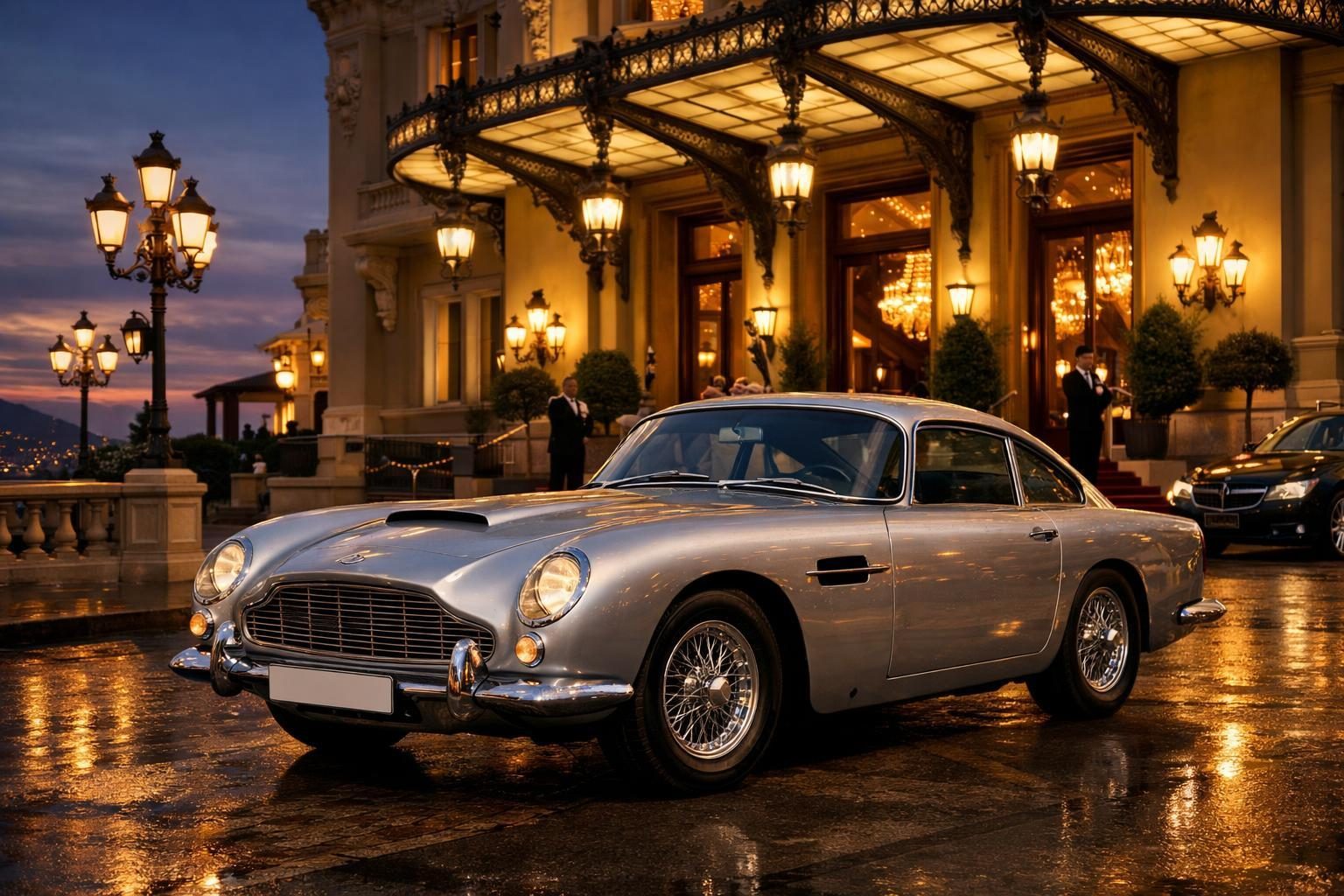
Casino Royale also features a classic DB5, won by Bond in a game, as a direct homage to Goldfinger (sources: ScreenRant, The Conversation). This dual register – a contemporary Aston for action, a heritage DB5 for memory – seals the visual grammar of the Craig era. The tension between modernity and heritage makes the nod effective without freezing the narrative in nostalgia.
The DB5 is not just a relic: it is a cultural totem. The Conversation and jamesbondlifestyle remind us that it has appeared in eight films: Goldfinger, Thunderball, GoldenEye, Tomorrow Never Dies, Casino Royale, Skyfall, Spectre, and No Time To Die. This record grants the car a unique status in pop culture, beyond just the automobile.
In Skyfall, The Conversation highlights that the DB5 receives iconic equipment – integrated machine guns in the front bumpers and an ejector seat – before being destroyed by Silva’s men. The sequence, designed as an emotional shock, demonstrates the narrative power of this object: striking the DB5 is to touch the legend of Bond. It will later be reborn, reminding us of the resilience of the 007 mythology as well as that of Aston Martin.
Spectre: The DB10 Designed Specifically for the Film
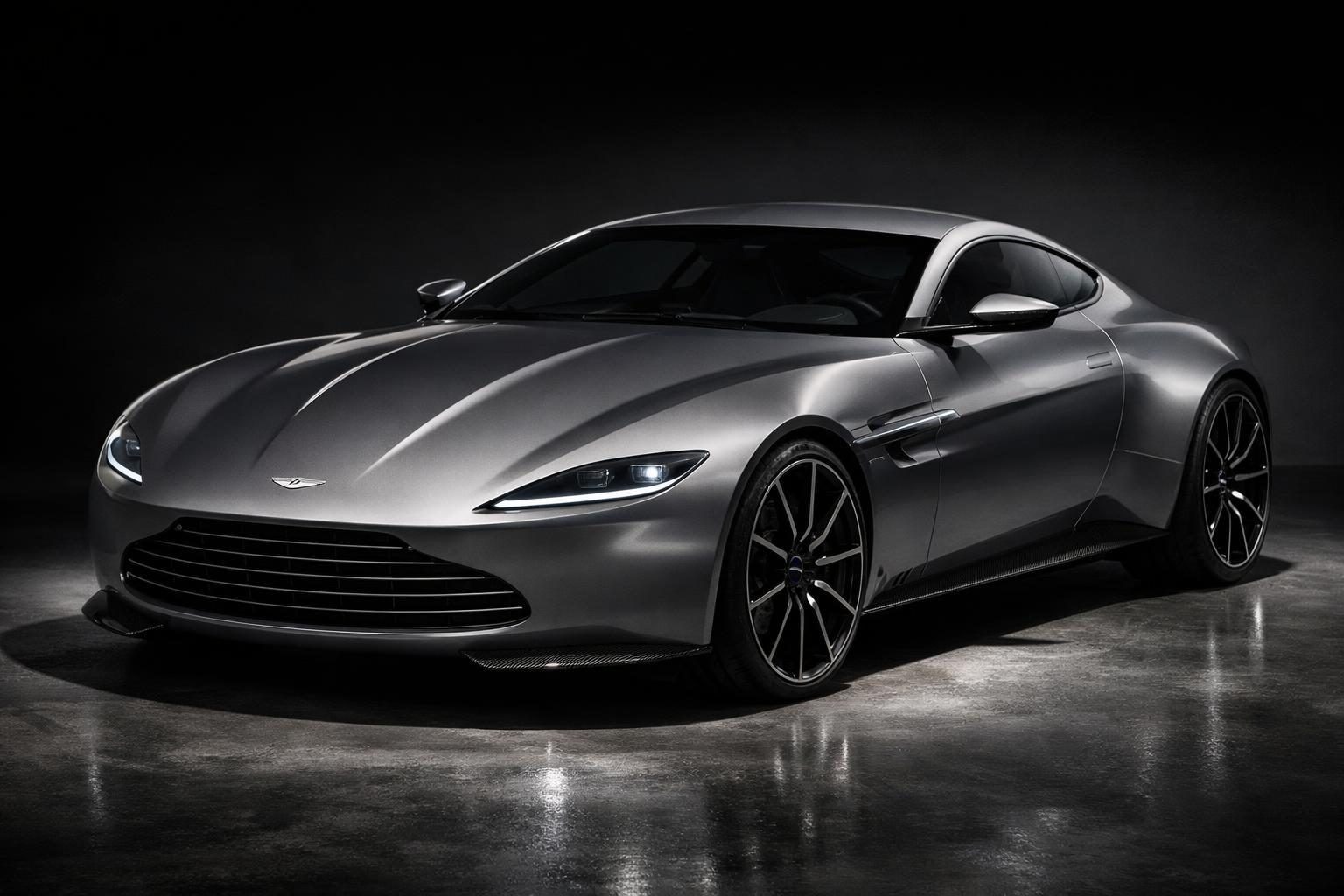
In Spectre (2015), Bond drives a DB10 designed specifically for the film, before reuniting with his DB5 repaired by Q (source: ScreenRant). The DB10 is not a production model: it is a silhouette crafted for the screen, externalising the idea of a cinematic concept car. With this gesture, Aston Martin signs a unique piece tailored to the dramatic needs of 007, while extending the brand’s DNA.
The DB10/DB5 duo condenses the visual strategy of the Craig era. The former symbolises avant-garde and bespoke design, while the latter recalls the founding icon. The secret agent literally moves between future and past, as if his own identity plays out at the junction of these two poles. For Aston Martin, it is an opportunity to showcase design expertise while capitalising on collective memory.
This back-and-forth nourishes a cultural reading: the DB10 asserts the role of cinema as a laboratory of images for the brand, while the DB5 guarantees heritage anchoring. Together, they establish a credible continuum between innovation and tradition – a dialectic at the heart of the enduring appeal of the franchise and the manufacturer.
No Time To Die: The Grand Return of Classics and the DB5
No Time To Die reaffirms this dual movement by bringing the DB5 back to the forefront. According to jamesbondlifestyle and The Conversation, the 1963 GT appears again, extending a screen presence that began with Goldfinger. The car plays an emotional landmark role in the final chapter of the Craig era, re-inscribing 007 in a narrative of transmission and closure.
The return of the classics occurs in a context where the historical object becomes a vector of narrative. The DB5 is not just a beautiful body: it is a narrative thread that the audience follows from film to film. This continuity allows the saga to resonate with multiple generations, while offering Aston Martin visibility that transcends time.
The restoration dynamic illustrated by the DB5 “repaired by Q” (ScreenRant) extends this logic. It shows that the icon can be damaged, lost, and then reborn, like a living heritage. It is a powerful language for a brand that values historical pieces, including through specific programmes.
Why Aston Martin and 007 Make the Ideal Product Placement
The link between Aston Martin and 007 rests on a match between character, design, and narrative. The DB5, appearing in eight films (The Conversation, jamesbondlifestyle), acts as a transferable symbol from one actor to another: beyond the interpreter, the car embodies the continuity of James Bond. This rare transferability makes the GT an exceptional brand amplifier.
At the same time, the Craig era has proven that a modern model can coexist with the icon. The DBS from Casino Royale and the DB10 from Spectre demonstrate, according to ScreenRant, the franchise’s ability to integrate a contemporary car into a muscular narrative, without distorting the grammar of 007. The brand then benefits from exposure that combines heritage prestige and current desirability.
The cultural impact extends beyond the screen. The Conversation and jamesbondlifestyle remind us that in 2020, Aston Martin produced 25 DB5 Goldfinger Continuation models, sold for around £2.75 million and not road-legal. This programme illustrates the monetisation of a shared imagination: creating a “functional legend” for collectors, nourished by screen appearances. The loop between cinema, myth, and product is embraced.
To better follow the heritage/modern duality, return to the model sheets. Our page dedicated to the DB5, the timeless icon of Aston Martin, gathers key points to understand why this GT embodies the essence of British elegance on screen as well as on the road.
In contrast, the DB10, created specifically for Spectre, sheds light on the conceptual dimension of the movie car. Even without a commercial career, it crystallises a specific design intention and dramatic role unique to the Craig saga.
DB5 on Screen (8 films) — Goldfinger, Thunderball, GoldenEye, Tomorrow Never Dies, Casino Royale, Skyfall, Spectre, No Time To Die (The Conversation, jamesbondlifestyle).
Skyfall — Machine guns in the front bumpers and ejector seat, before destruction by Silva’s men (The Conversation).
Continuation 2020 — 25 DB5 Goldfinger Continuation models, ~£2.75 million, not road-legal (jamesbondlifestyle, The Conversation).
Conclusion: James Bond, Between DB5 Heritage and Mastered Modernity
Throughout the Daniel Craig era, James Bond has redefined his duo with Aston Martin by layering two registers: the DB5 icon, an emotional landmark cited by The Conversation and jamesbondlifestyle, and contemporary creations (DBS, DB10) highlighted by ScreenRant. This articulation has revived the myth without freezing it, offering the franchise visual coherence and the brand a unique narrative setting.
Ultimately, James Bond functions as a revealer: the classic GT measures the heritage, while the recent sports car embodies the momentum of the present. Between the two, the saga traces a rare continuity, transforming each appearance of Aston Martin into a chapter of a shared story, both cinematic and automotive.
The Ultimate DBR9: 2 Victories That Revived Aston Martin
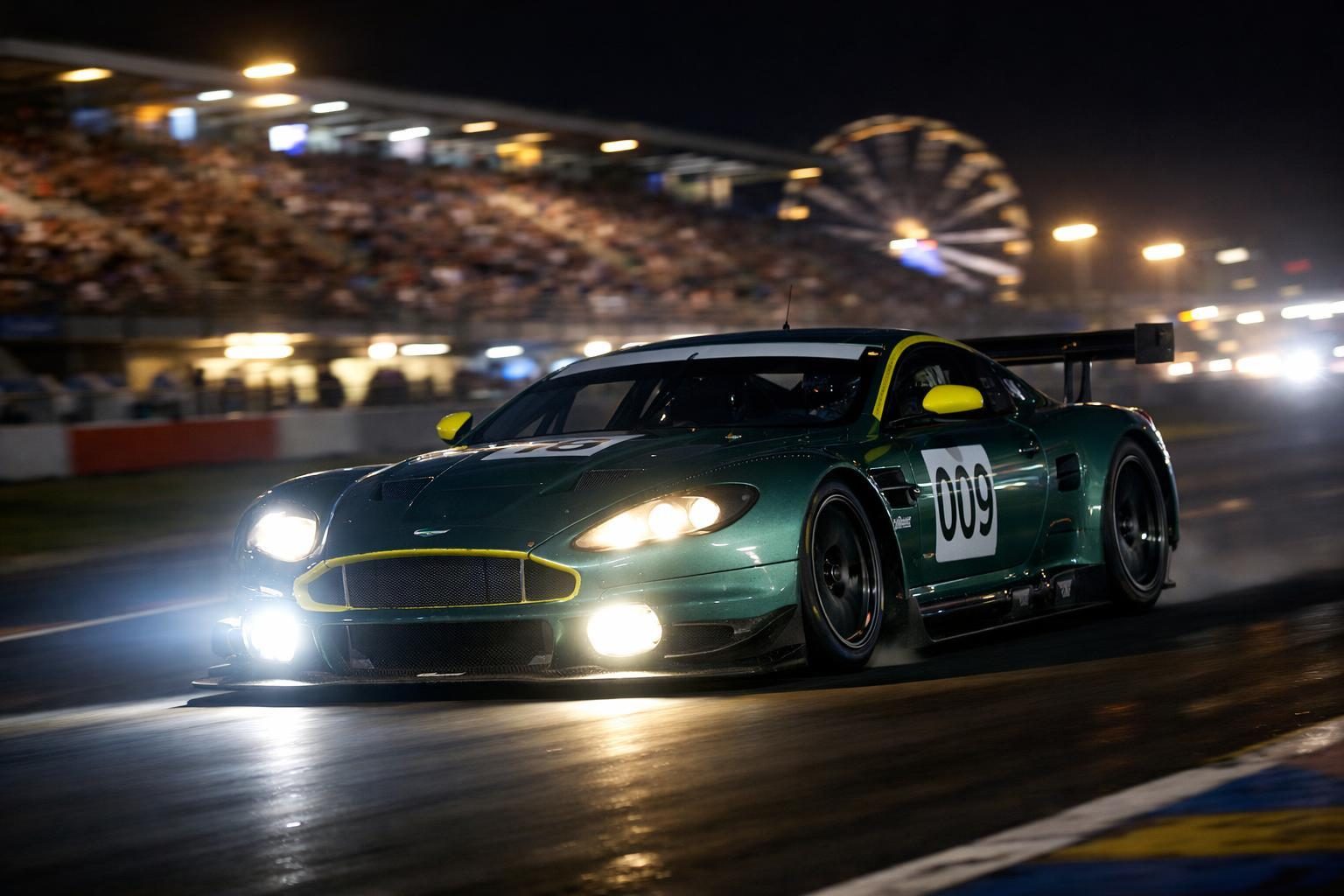
DBR9 is the name that brought Aston Martin back to glory at Le Mans in the mid-2000s. This article traces the homage paid to the victorious DBR1 of 1959, explains how a road-going GT was transformed for the GT1 category by Prodrive, and places the rivalry against Corvette in the context of the 2005-2008 campaigns. We revisit the two class victories at the 24 Hours of Le Mans in 2007 and 2008, focusing on the numbers 007 and 009 carried by the factory cars, and the sometimes divergent production figures according to sources.
Why the DBR9 Pays Tribute to the Victorious DBR1 of 1959
The choice of name is not trivial: according to Wikipedia and prestigeandperformancecar, the name DBR9 explicitly pays homage to the DBR1, which won the 24 Hours of Le Mans and the world title in 1959. By bringing the three letters DBR to the forefront, Aston Martin recalls the lineage of victorious prototypes from the late 1950s and reaffirms a clear sporting ambition.
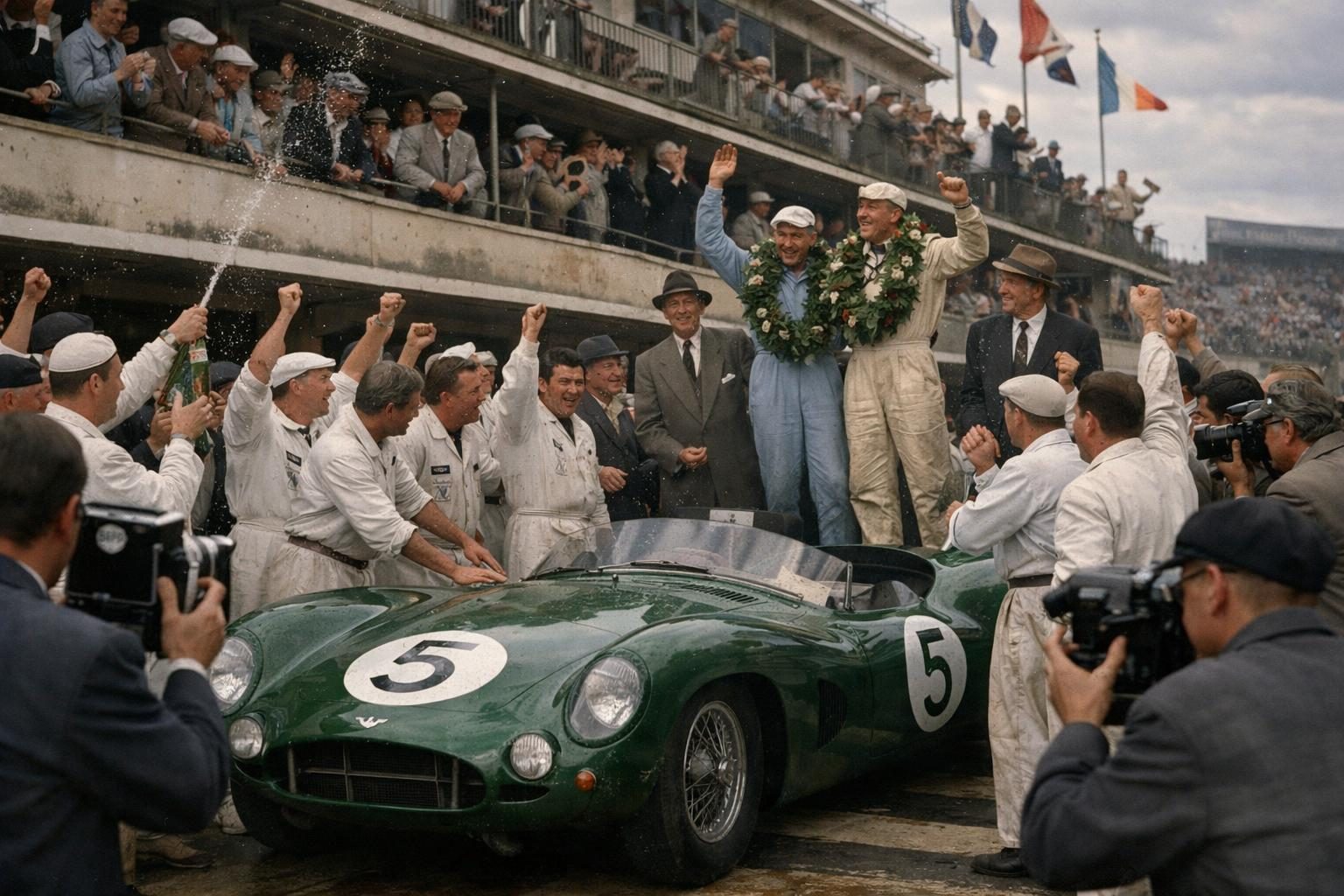
Symbolically, this echo to 1959 serves as a common thread. In 2007, the factory team triumphed in GT1 and secured a 5th place overall, Aston’s first top 5 at Le Mans in 48 years, as indicated by ROFGO, prestigeandperformancecar, and Gran Turismo wiki. The time gap highlights the significance of the nod: the modern car extends a legacy left hanging since the achievement of the victorious DBR1 of 1959.
Beyond the badge, the endurance DNA flows through this coupe derived from the series. The strategy of entering a production-based GT—while deeply transforming it—fits within the house tradition: to let the road shine through racing, and vice versa, in the category that matters for the brand’s international image.
A GT1 Based on the DB9 but Completely Re-engineered by Prodrive
The technical recipe is precisely documented by Wikipedia and ROFGO: the car takes the chassis from the DB9, as well as the block and cylinder heads from its road-going V12, while the rest is re-engineered for competition by Prodrive. This involves extensive work on aerodynamics, structure, transmission, braking, and engine management, transforming a grand tourer into a true GT1 category weapon.
This hybrid approach—series base, race execution—maximises mechanical familiarity while meeting endurance requirements. The original DB9 V12, prepared, benefits from proven robustness and performance potential usable over 12 or 24 hours. Specific body and downforce elements, combined with significant weight reduction, provide the sports car with the balance and consistency essential over time.
From an industrial and sporting perspective, Prodrive’s involvement is central. The British partner, recognised for its mastery of customer and factory programmes, ensured the design and development of the GT1. As for the number of chassis produced, sources diverge: Wikipedia states 16 units, while RM Sotheby’s and Classic Driver mention around 18 cars (10 factory and 8 customer). This discrepancy illustrates the complexity of tracking constructions and updates in endurance programmes.
To measure the gap with the base car, one only needs to revisit the road-going DB9, its platform, and its V12, before their track transformation. Our dossier on the road-going DB9 and its architecture provides a useful counterpoint to the transformation by Prodrive.
From Sebring 2005 to Defeat Against Corvette in 2006
The baptism of fire took place at the 12 Hours of Sebring 2005, a notoriously engine-breaking event that reveals weaknesses. Right from the start, the car triumphed in GT1 in its first race, according to ROFGO and Gran Turismo wiki. This inaugural success speaks volumes about the quality of the development and the immediate competitiveness of the chassis-engine package against the benchmarks of the time.
The mid-2000s saw factory and customer GT1s of exceptional calibre face off. The rival American brand then constituted the benchmark of the category, and each confrontation highlighted the stakes of reliability, pure speed, and tyre management. In this context, the Aston Martin Racing programme refined its endurance procedures and relay management, capitalising on the experience gained race after race.
Over the 2005-2006 seasons, the team built the foundations for its future successes at Le Mans. The increasing power was reflected in a better rhythm consistency and a fine understanding of the operating windows of the V12 and aerodynamics during long night stints. This methodical progression, a cornerstone of endurance, directly prepared the campaigns of 2007 and 2008.
Class Victories at Le Mans 2007 and 2008 Against Corvette
The climax occurred at Le Mans, with two LMGT1 class victories in 2007 and 2008 for the Aston Martin Racing factory team, as reported by Wikipedia, ROFGO, and prestigeandperformancecar. In 2007, the trio of David Brabham, Darren Turner, and Rickard Rydell triumphed in GT1 and finished 5th overall. According to ROFGO, prestigeandperformancecar, and Gran Turismo wiki, this was Aston’s first top 5 at the 24 Hours of Le Mans in 48 years—a symbolic milestone in light of 1959.
These successes were forged after a sustained rivalry with the American competitor, particularly robust in reliability and neutralisation management. The British sports car, with its series-derived V12 and optimised aerodynamics, found at Le Mans the ideal ground to convert its potential into results. The efficiency of pit stops, the discipline of relays, and the night/day strategy made the difference in a category where mistakes are costly.
The ultimate validation of an endurance GT lies in its ability to repeat performance. By doing so again in 2008, the team confirmed that the window of competitiveness and reliability was not merely circumstantial. This continuity credibly solidifies Aston Martin Racing’s endurance lineage and prepares the brand for the next era in GTE.
To extend the analysis, the dedicated page on the official 24 Hours website revisits the career of the 2007 class-winning example, with details of its engagement and achievements. Read more via the profile of the 2007 class winner, and complement it with the technical sheet and history in English on the Wikipedia page dedicated to the DBR9.
Numbers 007 and 009: The James Bond Legacy on the Grid
According to Wikipedia, the factory cars bore the numbers 007 and 009 in homage to James Bond. Beyond the nod, these numbers contribute to forging an immediately recognisable visual identity in the hustle of major endurance races, while cultivating a powerful cultural link between the brand and the most famous agent in cinema.
In communication as in sport, the consistency of symbols matters. The numbers 007 and 009, associated with a striking livery, a distinctive V12 sound, and top results create a memorable narrative. In a particularly competitive GT1 grid, this signature enhances the media visibility of the factory programme without compromising performance demands.
This symbolic capital is part of the continuity of Aston Martin’s endurance commitments. It also flows into the post-GT1 era, as seen in subsequent campaigns in GTE. For a broader perspective, our retrospective on the history of the Vantage GTE in WEC and Le Mans shows how the brand has capitalised on the experience and notoriety built during the GT1 era.
Conclusion — DBR9, the Milestone That Revived Aston at Le Mans
The DBR9 checked all the boxes of a successful GT1 programme: a name that connects to the glory of 1959, a road-going DB9 transformed by Prodrive, an immediate victory at Sebring 2005, and, most importantly, two class triumphs at Le Mans in 2007 and 2008. The sources—Wikipedia, ROFGO, prestigeandperformancecar, and Gran Turismo wiki—converge on these milestones, while the volume of chassis produced remains a subject of divergence (16 according to Wikipedia, around 18 according to RM Sotheby’s and Classic Driver).
In a GT1 era dominated by intense transatlantic rivalry, the DBR9 placed Aston Martin back at the centre of the game, even achieving a historic top 5 overall in 2007 after 48 years of waiting. Heir to the DBR1 in spirit and letter, the factory car with numbers 007 and 009 sealed Aston’s return to Le Mans and paved the way for future campaigns. To delve deeper into the brand’s universe and technology, the official Aston Martin website and specialised documentation provide useful insights to complete this overview.
Ultimate VH Platform: 3 Reasons That Saved Aston Martin
The VH platform is the foundational innovation that revitalised Aston Martin in the early 2000s by offering a common, lightweight, and rigid base for the entire range born in Gaydon. In this article, we explain why the company needed a new architecture, how the Vertical/Horizontal principle worked in practice, and how the DB9 validated this strategy before it was adapted from the Vantage to the Rapide. Finally, we review the evolution through generations up to 2016, relying exclusively on identified sources.
Why Aston Martin Needed a New Architecture in 2000
At the turn of the 2000s, Aston Martin emerged from a period where the DB7 played the saviour, but on heterogeneous and outdated technical bases. The arrival of Ulrich Bez as CEO in July 2000 (source cited: Wikipedia VH) marked a strategic turning point. The stated goal was clear: to create a unique structure for several cars, capable of reducing costs, accelerating development, and ensuring high-level dynamic quality.
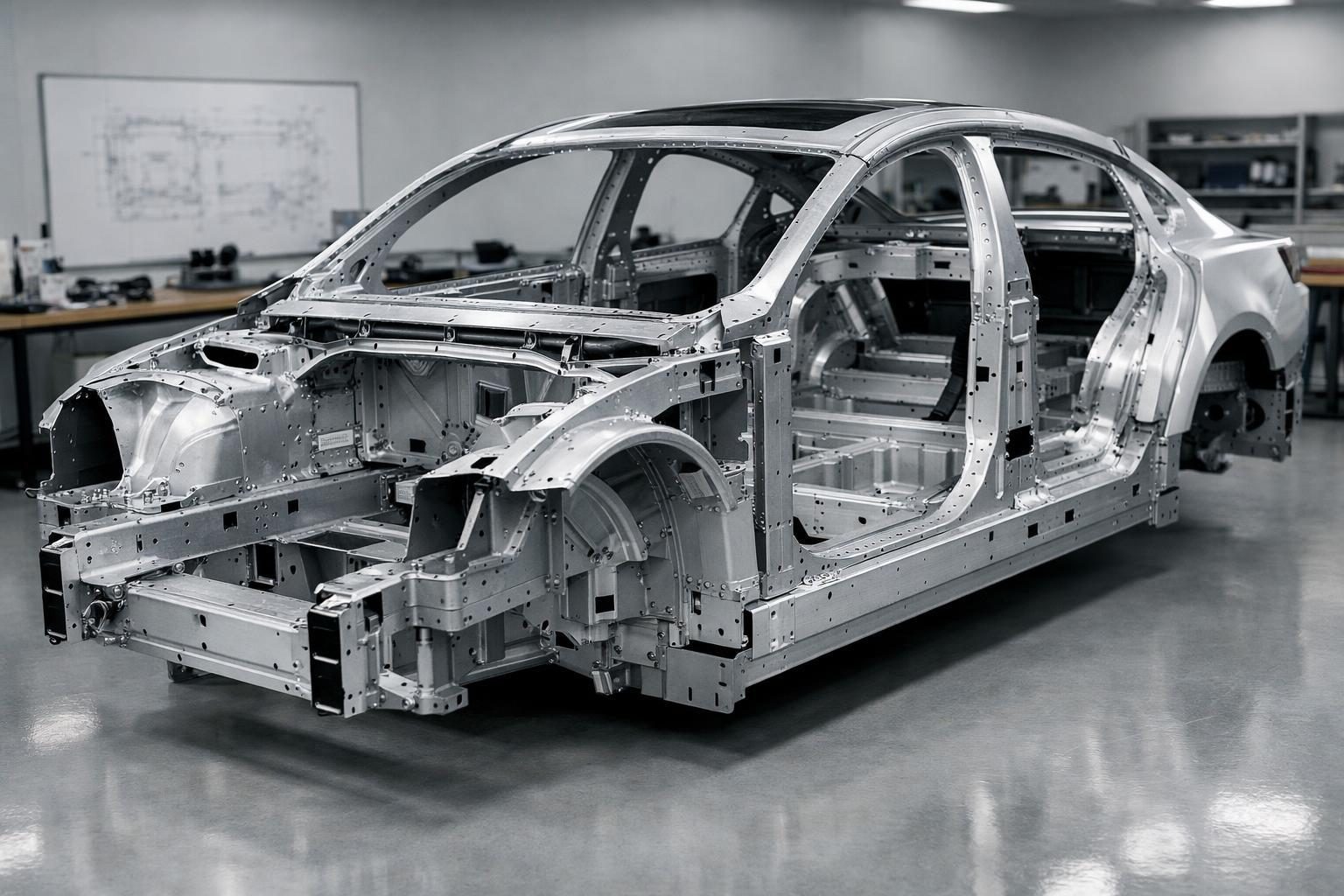
To succeed, it was necessary to break away from the stacking of specific platforms and favour a modular solution. According to sources compiled in the FACTS (Wikipedia VH, supercars.net), the answer was the glued and riveted aluminium VH platform. This choice of materials and processes aimed to reconcile rigidity, lightness, and industrialisation, three prerequisites for sustainably reviving the brand.
The promised gains were decisive. According to Silodrome and Grokipedia, the new structure offered torsional rigidity about twice that of the DB7 while reducing the weight of the shell by approximately 25%. Such a margin for improvement changes the game for road behaviour, refinement, and performance, while helping to contain emissions and consumption.
In the background, there was also the desire to build a strong product identity. A unique architecture allows for a coherent design language, controlled proportions, and a clear positioning, without sacrificing the necessary variations (coupé, convertible, grand tourer 2+2, sports, etc.). The VH platform was to be this foundation.
Vertical and Horizontal: The Principle of the VH Platform
The acronym VH, for Vertical/Horizontal, describes a principle of modularity. According to Wikipedia VH, the VH platform relies on “vertical” modules (by range segments) and “horizontal” modules (by cross-functional roles) that combine to create different models. In practice, glued-riveted aluminium sub-assemblies — side members, cross members, floors, cradles — are combined with common stacks of suspensions, electronics, and powertrains.
This modular mesh offered several benefits. First, the standardisation of critical components (fixing points, electrical architectures) reduced development times. Next, the flexibility of the sub-assemblies allowed for variable wheelbases and tracks. Finally, the use of glued and riveted aluminium guaranteed, according to Silodrome and Grokipedia, a rare combination of rigidity and contained mass, superior to what Aston Martin had previously offered.
The VH platform thus served as the basis for most Aston Martins produced between 2003 and 2016 (Wikipedia VH, supercars.net). It enabled a modern range “at scale”: a single structure, calibrated variations, and the ability to evolve through iterations without reinventing everything. Ulrich Bez’s gamble was precisely to engrave this method into the DNA of Gaydon.
It is worth noting that the VH platform does not mean uniformity. Chassis settings, power, aerodynamics, and body styles vary significantly between a 2+2 GT and a more extreme sports model. The strength of the approach is to preserve the individuality of each model while capitalising on a common technical base.
The DB9, First Car Built on the VH at Gaydon
Unveiled at the Frankfurt Motor Show in 2003 and produced from 2004, the DB9 is the first Aston Martin built on the VH platform (astonmartin.com, supercars.net, Silodrome). It inaugurates a new industrial era at Gaydon. The philosophy is clear: an elegant, high-performing 2+2 GT that is more refined dynamically than the DB7 it indirectly replaces.
The DB9 was powered by a 6.0-litre V12 derived from the Vanquish, announced at 450 PS at launch (aston-martin-club, Silodrome). This engine pairs perfectly with a lighter and significantly stiffer shell. The result is a GT with more precise reactions, superior filtering, and enhanced performance — everything a modern glued-riveted aluminium architecture promised.
The commercial success validates the strategy of a common base. Over approximately twelve years of production, about 16,500 units of the DB9 were produced, making it the best-selling model of Aston Martin at the time (aston-martin-club, Silodrome). This longevity and volume can be attributed to the scalability of the VH platform, which allowed for technical and stylistic updates without disruption.
To delve deeper into the technical and commercial history of this pillar, see our detailed file on the complete genealogy of the DB9. From launch to special editions, the career of the DB9 illustrates what modularity makes possible when executed well.
From Vantage to Rapide: All Models Derived from the VH
According to Wikipedia VH, the architecture has underpinned a wide family: Vantage, DBS, Rapide, Vanquish, but also Virage, DB10, and the rare Lagonda Taraf. Each exploits the same base with different ambitions, from the more compact and sporty coupé to the large GTs and the 4-door saloon.
This range has been the true demonstration of strength of the VH platform. Once the DB9 was established, Aston Martin was able to quickly expand its range, capitalising on the shared engineering. To take an emblematic example, the Rapide transposes the GT philosophy into a four-door silhouette, proof of the dimensional flexibility of the aluminium chassis.
Dynamically, the intrinsic rigidity reported by Silodrome and Grokipedia serves as the basis for contrasting settings. A Vantage prioritises agility and the power-to-weight ratio, while a DBS or Vanquish aims for very high-speed grand touring. The shared benefit lies in the precision of the running gear, vibration filtering, and passive safety, aspects supported by the VH skeleton.
Finally, the common structure has allowed for ambitious limited series, such as the DB10, while preserving the identity of each silhouette. To place these models in the chronology of the brand, our dedicated page on the DB7, the matrix of the 1990s, sheds light on the transition to Gaydon and the rise of the VH platform.
Four Generations of Evolution up to 2016
The period covered by the VH platform extends from 2003 to 2016 (Wikipedia VH, supercars.net). According to Wikipedia VH, the architecture evolved through successive generations until the end of its cycle, to accommodate performance increases, the integration of more complex electronics, and growing regulatory demands. The basic principle — glued and riveted aluminium, vertical and horizontal modularity — remained constant, but the modules were refined.
This incremental progression illustrates the value of a common base: each iteration benefits current and future models. Whether adjusting the wheelbase, reinforcing anchor points, or optimising unsprung masses, the VH platform has constituted a field for continuous improvement without compromising the personality of the cars.
The 2016 milestone marks the end of the platform’s central role in the range, paving the way for a new generation. However, the technical and industrial legacy of the approach remains intact: it allowed for the assembly of a complete family of GTs and sports cars sharing a common DNA, without falling into uniformity. It is this continuity that has anchored Gaydon’s credibility on a global scale.
Conclusion – Why the VH Platform Saved Aston Martin
At the turn of the 2000s, the VH platform offered Aston Martin a backbone: a lightweight structure twice as rigid as the DB7, unified for almost the entire 2003-2016 range, and validated by the success of the DB9. By centralising engineering and intelligently multiplying derivatives, the VH platform aligned the Vantage, DBS, Rapide, Vanquish, Virage, DB10, and Lagonda Taraf without dispersing. Thus, a unique architecture secured the growth of Gaydon and consolidated the brand’s image.
To measure the impact of this strategy, rediscover the career of the DB9, a commercial and technical pivot of the era, and the transition from the DB7 to a range entirely built on the VH platform — even to singular derivatives like the four-door Rapide. The lesson is clear: with the VH platform, Aston Martin built a lasting foundation that simply saved the company.
Vulcan: 7 Secrets of the Ultimate 820 PS Aston Martin
The Vulcan is not just a legendary name at Aston Martin: it is the most radical creation from Gaydon, a machine exclusively dedicated to the track that combines the DNA of the One-77 and the V12 GT3. In this article, we reveal seven keys to understanding this extreme coupe: its name, its gestation, its atmospheric V12 increased to 7.0 litres, its carbon structure, its limited production of 24 units, the AMR Pro pack, and the unique road-legal version. Cited sources and acknowledged numerical discrepancies aim to enlighten the most demanding enthusiasts.
Where the name Vulcan comes from and the project’s genesis at Gaydon
The name Vulcan pays homage to the British strategic bomber Avro Vulcan, an icon of the Royal Air Force’s aeronautics. This lineage, highlighted by Autoevolution and the enthusiast registry astonmartins, sheds light on the project’s intention: to express spectacular power, a unique visual presence, and a bold technical aura. By adopting it, Aston Martin places its track car in a lineage of exceptional machines, leaving no ambiguity about its purpose.
The revelation took place at the Geneva Motor Show in March 2015, according to several consistent sources (astondriving, evo, and Gran Turismo wiki). The context is clear: to offer a no-compromise Aston Martin, designed for the track, above the road supercars of the time. The Vulcan arrives as a technological showcase and a stylistic manifesto, aimed at collector-drivers capable of exploiting a machine with a resolutely track-focused manual.
Part of the halo car strategy, the vehicle combines technical elements already proven by the brand, but taken further. The choice of a carbon chassis and body, along with a highly tuned atmospheric V12, illustrates this approach. The Vulcan thus becomes a rolling laboratory, leveraging Gaydon’s experience in hypercars and GT racing.
A 7.0-litre atmospheric V12 developed with Aston Martin Racing
At the heart of the Vulcan, a 7.0-litre atmospheric V12 delivers 820 PS (611 kW) at 7,750 rpm and 780 Nm at 6,500 rpm. These figures, reported by Wikipedia and Top Gear, place it in the exclusive club of high-powered front-engine track cars, with a rev range and throttle response typical of a naturally aspirated block.
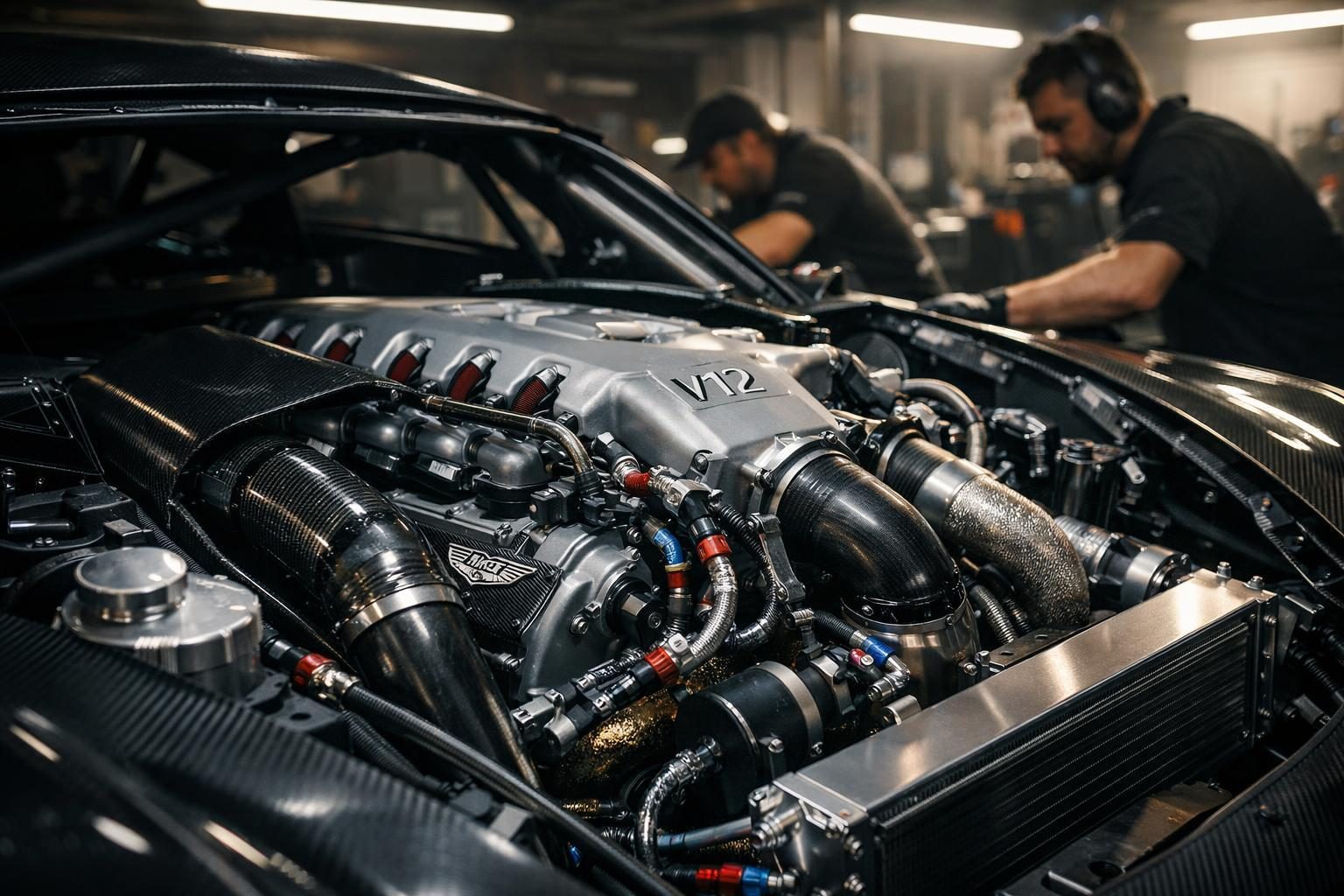
The origin of this engine reinforces the project’s coherence: it comes from the Aston Martin Racing V12 GT3, bored and prepared to achieve the announced displacement and power (Top Gear, supervettura). The collaboration with AMR ensures a direct lineage with GT competition, where mechanical robustness, cooling, and endurance are as important as maximum power.
This technical choice explains the very “track” personality of the Vulcan: thermal management designed for sustained laps, a torque curve exploited over a wide range, and the sound of a naturally aspirated V12. The mechanics become an essential part of the experience, both for performance and the emotional engagement sought by owner-drivers.
Carbon chassis derived from the One-77 and extreme aerodynamic downforce
The carbon fibre chassis and body are derived from the One-77, as indicated by Top Gear and the specialist dealer Supervettura. This structural heritage brings rigidity, mass reduction, and freedom of form to optimise airflow. The chosen architecture echoes the expertise developed for the road-going hypercar, transposed here for pure track use.
Visually, the car displays marked downforce elements, reflecting its exclusive brief. While no confirmed downforce values are provided, the intention is clear: to maximise stability at high speeds and consistency over long laps. The connection to the One-77 is not merely aesthetic; it reflects a carbon platform strategy serving aggressive aerodynamics.
This technical foundation clarifies the purpose of the Vulcan: to offer an Aston Martin that pushes the dynamic envelope further than any road car. The vehicle exploits the rigidity of the carbon monocoque to withstand aerodynamic loads and harmonise the racing V12 civilised for the occasion. The result is a finely tuned track car, consistent with its ambition.
Only 24 units: price, driver programme, and exclusivity
The series is strictly limited to 24 units, a number chosen in homage to Aston Martin’s commitments in 24-hour races, according to evo. This explicit reference to the double clock round anchors the Vulcan in the endurance imagination and highlights the importance of competition in the model’s identity.
The announced price varied according to sources: evo mentions £1.5 million, while Top Gear talks about £1.8 million. This range reflects the specifics of configuration and, above all, the extreme exclusivity of the project. At this level of investment, the clientele seeks a rare experience, aligned with the “track-only” spirit and the technical lineage with the V12 GT3.
As for the programme surrounding the car, public information mainly converges on its non-homologated track car vocation, supplied in a very limited batch to carefully selected owners. Exclusivity is evident both in the volume produced and in access to an Aston Martin whose use is, by definition, confined to circuits.
The AMR Pro pack and the unique Vulcan made road-legal
The career of the Vulcan has been marked by the introduction of an AMR Pro pack, highlighting Aston Martin Racing’s involvement in the evolution of this track car. While it follows the competition-client logic, its interest is to further enhance the track dimension of the car, in line with the engine derived from the V12 GT3 and the carbon base inherited from the One-77. The existence of this pack, as reported by specialised media, illustrates the ongoing support for the car within the AMR ecosystem.
Notably, only one Vulcan has been made road-legal after 18 months of modifications carried out by the British group RML, according to Wikipedia. This exception confirms the rule: the car was born for the track. The homologation of this unique road-legal Vulcan should not overshadow the original intention, but it demonstrates the adaptability of an ultra-serious technical base when entrusted to a capable preparer.
This singular transformation provides interesting insight: even though the car was designed for the paddock arsenal, its structural and mechanical DNA can, with thorough work, cross the boundary of homologation. A curiosity that does not detract from the rarity of the model and the heritage value of the units that remained in strict track configuration.
Conclusion – why the Vulcan still matters
The Vulcan remains an essential milestone in Aston Martin’s chronology: a manifesto of carbon technology and high-performance atmospheric engine, presented in Geneva in 2015, limited to 24 units in homage to the 24 hours, and rooted in AMR expertise. Between power figures validated by Wikipedia and Top Gear, structural heritage from the One-77, and an engine derived from the V12 GT3, it synthesises Gaydon’s obsession with unfiltered performance.
The contrast between the AMR Pro pack and the unique example homologated by RML illustrates its duality: a car designed for the track, with a margin adaptable to the road, without ever renouncing its identity. For the collector as well as the motorsport enthusiast, the Vulcan embodies a clear and rare proposition, whose exclusivity and technical coherence explain the lasting fascination it exerts.
Ultimate Vanquish Mk1: 5 Secrets of the Last Aston Martin from Newport Pagnell
The Vanquish Mk1 represents a major transition for Aston Martin: an iconic GT that connects the workshop in Newport Pagnell to the industrial era of Gaydon. Here are five sourced and sometimes surprising anecdotes to understand how this V12 has shaped the modern identity of the brand, from style to technology, and even Hollywood.
Geneva Motor Show 2001: an Ian Callum design inspired by the DB4 GT Zagato
The unveiling of the V12 Vanquish at the Geneva Motor Show in March 2001 marked a turning point. According to Aston Martin and Wikipedia, it was at this moment that the taut silhouette, muscular haunches, and fastback coupe profile designed by Ian Callum established themselves as the new formal language of Aston Martin. The homage to the DB4 GT Zagato is explicit in the proportions and certain curves, while modernising the brand’s codes.
Callum’s design, devoid of superfluous ornamentation, serves both performance and presence. Aluminium body, precise fittings, endless bonnet, and compact rear: the goal is clear, to reconnect with the aura of historic GTs while embracing contemporary execution. This stylistic coherence would help solidify Aston Martin’s image in the 2000s, preparing the shift to Gaydon without renouncing Newport Pagnell.
To place this design in the genealogy of the brand’s icons, one can revisit the brand’s dossier dedicated to the Vanquish lineage, rich in visuals and historical context. It shows how the barrier between tradition and modernity was crossed as early as 2001 by this pivotal model.
A V12 born from two Ford Duratec V6s: unpretentious mechanics
The heart of the Vanquish Mk1 is a 5.9-litre V12 designed without taboos: Motorlegend explains that it derives from the assembly of two Ford Duratec V6s. This industrial lineage does not detract from its character. On the contrary, it allowed for robust development and a relevant compromise between smoothness and power delivery, with an immediately recognisable tone.
Figures vary according to sources: astonmartin.com states 460 PS, Wikipedia details 460 hp (343 kW) at 6,500 rpm, while Motorlegend cites 456 PS. This slight divergence illustrates the discrepancies in homologation and communication, without altering the essence: a GT that is both powerful and usable, built on a rational technical foundation.
This mechanical choice fits into Aston Martin’s strategy at the time: to capitalise on proven technological blocks to accelerate product revival. It is precisely this hybrid approach – artisanal in assembly, methodical in engineering – that makes the Vanquish Mk1 a major milestone of the post-DB7 era.
The Magneti-Marelli robotic gearbox: the acknowledged Achilles’ heel
While the V12 is enticing, the transmission divides opinion. The Vanquish Mk1 adopts a 6-speed manual gearbox with a robotic actuation developed with Magneti-Marelli and Ford. According to powerracing.fr, gear shifts occur in about 250 ms: quick for the time, but not always smooth at low speeds, with noticeable jolts during manoeuvres or urban driving.
This calibration has long embodied its perceived weak point: brilliant in spirited driving, more demanding in daily use. Criticism crystallised further as competitors refined their sequential gearboxes, while traditional automatics gained responsiveness. In Aston Martin’s history, this compromise reminds us that the Vanquish Mk1 is a pioneer, ahead in some aspects and improvable in others.
For enthusiasts, this is part of the charm and authenticity of the model: a GT that demands engaged and anticipatory driving, and whose technology reflects the ambitions of a brand in transition. In this sense, the Vanquish Mk1 remains a time capsule of early 2000s innovation.
To place this in our brand panorama: 5 unusual anecdotes about Aston Martin, where one can measure how these technical choices shape the perception of an entire generation.
Die Another Day and Pierce Brosnan: the Vanquish enters Bond legend
Pop culture recognition came in November 2002, when the Vanquish appeared in Die Another Day. This placement sealed its status as a public icon: menacing silhouette, nobility of the V12, British spy allure. According to largus.fr, Pierce Brosnan even acquired a personal example, further proof of his attachment to this totem role.
In the 007 saga, the lineage with the DB5 is acknowledged: an Aston becomes a character in its own right. The Bond-Aston Martin association, recounted in our archives, illuminates how the Vanquish Mk1 reconnects with the imagery of the DB5 while imposing a contemporary vocabulary.
To delve deeper into the cinematic legacy, one can compare the codes of the DB5 and their modern reinterpretation through this useful resource on the mythical 1964 car. It helps explain why the Vanquish so quickly established itself on screen and in memory.
Newport Pagnell closes in July 2007: 2,578 units and the end of an era
The production of the V12 ceased on 19 July 2007, a symbolic date that coincides with the closure of the Newport Pagnell factory after 49 years of operation, according to Wikipedia. The historic workshop gave way to modern facilities in Gaydon: a logistical and cultural break embraced by the brand to support increased production rates and quality standards.
On a quantitative level, carjager.com and Wikipedia converge: 2,578 units produced between 2001 and 2007. A volume that preserves rarity without slipping into obscurity, and which today contributes to the stability of the market value, while allowing for specialised maintenance thanks to a sufficient base of parts and expertise.
This transition seals the mission of the Vanquish Mk1: to gracefully close the Newport Pagnell chapter while preparing for the next era. It embodies the culmination of controlled craftsmanship and the outline of managed industrialisation, a precious link in the continuity of style and brand image.
To place this milestone in the overall history of Aston Martin, one can cross-reference the brand’s institutional data and available historical summaries, starting with the official presentation of Aston Martin and the reference page on the DB5 for the heritage aspect.
Conclusion — Vanquish Mk1, the acknowledged bridge between craftsmanship and the modern era
Through its style signed by Ian Callum, its V12 derived from two Duratec V6s, its imperfect yet pioneering Magneti-Marelli robotic gearbox, and its recognition in Bond, the Vanquish Mk1 encapsulates the paradoxes of a brand in transformation. The key figures – unveiling in Geneva 2001, 2,578 units until 19 July 2007, closure of Newport Pagnell – precisely situate this transition. For those interested in the genealogy of Aston Martin, the Vanquish Mk1 remains the most eloquent bridge between heritage and modernity.
DBR1: 5 Secrets of Aston Martin’s Unique Victory at Le Mans in 1959
The DBR1 is the culmination of a quiet obsession: to see Aston Martin triumph at Le Mans and in the world championship in the same year. This article revisits, with supporting sources, the context that made the DBR1 possible, the night of 1959 and its strategy, the world title wrested from Ferrari, the power figures that differ according to authors, and the fate of the five DBR1 chassis, along with their current value.
Why David Brown Wanted to Win Le Mans Since 1949
If the DBR1 embodies Aston Martin’s only outright victory at the 24 Hours of Le Mans, achieved in 1959, it is because it synthesises years of effort to cross this symbolic threshold. Sources agree that the DBR1, designed by Ted Cutting from 1956, was developed with a clear vision: to triumph in the Sarthe event and at the world summit in the same season, a historically rare objective. According to Wikipedia (Aston Martin DBR1) and communications from Aston Martin, the 1959 edition realised this quest and remains, to this day, the only total success of the brand at Le Mans.
The DBR1 is part of an era where only a few models have achieved the Le Mans + world championship double in the same year. Wikipedia notes that only the Ferrari 375 Plus (1954), the Ferrari 250 TR (1958), and the DBR1 (1959) managed this feat in the 1950s. This rarity highlights the magnitude of the challenge and the historical value of the DBR1 in Aston Martin’s record. In this sense, the car was conceived as a total victory tool, rather than just a mere prototype of circumstance.
Technically, Cutting opted for a tubular chassis and a transverse gearbox, aiming to optimise compactness, weight distribution, and reliability. Sources such as Roarington and HWM (Aston Martin) indicate a weight of around 800 kg, a key figure that, combined with the development of the 3-litre six-cylinder engine, positions the DBR1 among the sharpest prototypes of its time. Thus, the DBR1 was born from a clear roadmap: reduce weight, ensure reliable transmission, and unleash enough power to dominate over 24 hours.
The 1959 Race: The Shelby-Salvadori Double and Moss’s Strategy
The 1959 edition of the 24 Hours remains the moment of truth for the DBR1: Carroll Shelby and Roy Salvadori gave Aston Martin its only outright victory at Le Mans. Official sources from Aston Martin and Wikipedia converge on this crucial fact. Beyond the chequered flag, this victory reflects the coherence of a technical and sporting project matured over several seasons, and the execution of a team strategy adapted to endurance.
The presence of Stirling Moss plays a strategic role. Information from Wikipedia (Aston Martin DBR1) and the “1959 Le Mans” dossier highlights the specification of Moss’s car, credited with around 255 PS that year. Without extrapolating, this figure can be read as an indicator of the pursuit of absolute performance to control the race pace, protect the reliability of the other DBR1s lined up, and exert pressure on the competition. The DBR1 did not just win on the track; it set a tempo.
The strength of the DBR1 in 1959 lies as much in its technical balance as in crew management. The Shelby–Salvadori tandem, referenced by Wikipedia and Aston Martin media, transformed meticulous preparation into a full result. This ability to convert a platform designed as early as 1956 into a prestigious victory illustrates the robustness of the tubular chassis, the relevance of the transverse gearbox, and the tuning of the 3-litre six-cylinder for long races.
Even today, the 1959 DBR1 remains a foundational milestone. It shaped the perception of Aston Martin as a manufacturer capable of reaching the pinnacle of endurance with its own technical means. Our follow-up on modern ambitions, including the in-house hypercar, can be discovered in the dedicated analysis of the Valkyrie AMR LMH engaged at Le Mans, which reactivates the echo of the DBR1 in the current era.
The 1959 World Championship Snatched from Ferrari at the Tourist Trophy
The 1959 season is not limited to the victorious DBR1 at Le Mans. It culminates at the Goodwood Tourist Trophy, the final stone in a world title snatched from Ferrari. The account from Goodwood GRR and Wikipedia (DBR1) highlights a key episode: a fire in the pits nearly jeopardised everything, before the privateer Graham Whitehead lent his pit to the official team. This decisive gesture allowed Aston Martin to continue and ultimately secure the title.
This world championship of 1959, coupled with the victory at Le Mans, places the DBR1 in a very select circle of cars from the 1950s to achieve this double, alongside the Ferrari 375 Plus (1954) and 250 TR (1958) mentioned by Wikipedia. The DBR1 thus earns its status as a reference: the pinnacle of a programme initiated in 1956 around a lightweight architecture, a compact transmission, and a six-cylinder engine calibrated for endurance.
The seasonal dynamics recounted by Goodwood GRR underline a reality of sports prototypes: the title is contested as much in the workshops as on the track. The 1959 DBR1 converted its technical cohesion into points capital, and it was by surviving the unexpected that the campaign concluded at the summit. The example of the Tourist Trophy is, in this respect, inseparable from the legend of the DBR1.
To place this triumph in the broader history of the brand and championships, our thematic dossier Aston Martin in Competition draws parallels between eras, from the DBR1 to contemporary challenges. It shows how the lessons of 1959 still inform the brand’s racing philosophy.
How Much Power for the Six-Cylinder: Diverging Figures
The DBR1 is also a case study in technical literature where figures vary according to sources. Several reputable authors propose different values for the 3.0-litre six-cylinder. According to HWM (Aston Martin), the DBR1 1957 evolves around 250 PS. The 1959 Le Mans dossier on Wikipedia credits Moss’s car with around 255 PS in 1959. Finally, Sports Car Digest suggests a figure of “up to 268 PS”. Taken together, these references illustrate the variability of measurements and configurations, without a definitive conclusion.
Why these discrepancies? The sources do not detail the test benches, fuels, or exact stages of evolution here. But the body of evidence remains coherent: a DBR1 around 250–268 PS, backed by a weight of approximately 800 kg (Roarington, HWM). The mass/power equation, combined with the tubular chassis and transverse gearbox, explains competitiveness over 24 hours. In endurance, the reliability margin counts as much as peak power, and the 1959 DBR1 exemplifies this.
To sort the information, it is important to attribute the figures precisely. We therefore retain: 250 PS (HWM, 1957), 255 PS (Wikipedia, Moss’s car 1959), up to 268 PS (Sports Car Digest). This transparency is an editorial strength: acknowledging divergences, rather than concealing them, does justice to the living character of the technical history of the DBR1.
Beyond the watts, the coherence of the platform matters. Designed by Ted Cutting from 1956, the DBR1 relies on a clear architectural principle. The 1959 results (Le Mans + championship) confirm that, regardless of the exact value retained, the DBR1 delivered the “sufficient” power where it matters: over time, in race.
The Fate of the Five DBR1 Chassis and Their Current Value
The DBR1 does not exist in singular: five chassis have borne this name and design, each with its own trajectory. The sources gathered here do not detail, chassis by chassis, their careers or changes of hands, but they allow for a clear line to be drawn: the DBR1 occupies, in the market and in the imagination, a rare place for a British endurance car from the 1950s.
A valuation milestone stands as proof. In 2017, a DBR1 became the most expensive British car sold at auction, at 22.55 million dollars, according to Roarington. This figure situates the heritage value of the DBR1 at the summit, among competition icons. It reflects the dual sporting capital (Le Mans + world championship 1959) and the technical pedigree (tubular chassis, transverse gearbox, around 800 kg) that fuel demand.
Rarity plays a central role: with five DBR1 chassis, the supply is inherently narrow. Aston Martin’s only outright victory at Le Mans in 1959, recalled by Wikipedia and the media from Aston Martin, confers upon these cars a status of “rolling pieces of history”. The DBR1 thus concentrates a legacy that enthusiasts and collectors perceive as irreplaceable.
Through these five DBR1s, an entire Aston Martin philosophy endures: to triumph through engineering, balance, and consistency, rather than through sheer brute force. For readers wishing to broaden the perspective towards the foundational road models of the post-war era, our study on the DB2 and its derivatives draws a connection between the technical thread linking road and track at Aston Martin.
Conclusion: What the DBR1 Changed
The DBR1 set a compass: that of a manufacturer capable of aiming for and achieving a rare double, Le Mans 1959 + World Championship 1959. The concordant sources from Wikipedia and Aston Martin establish this fact, which the account from Goodwood GRR illuminates through the episode of the Tourist Trophy and the fire overcome. At the scale of Aston Martin, the DBR1 remains a matrix reference: unique outright victory at Le Mans, but above all a model of strategy and technical coherence.
On a mechanical level, the DBR1 serves as a useful reminder: figures can diverge, and it is in the rigorous attribution of sources that understanding is built. Between 250 PS (HWM, 1957), 255 PS (Wikipedia, Moss’s car 1959), and up to 268 PS (Sports Car Digest), the DBR1 remains credible because it proves, in race, that the sum of tubular chassis + transverse gearbox + approx. 800 kg outweighs the mere technical specification.
Finally, the DBR1 lives in the present through its market: only five chassis, and a record value of 22.55 M$ (2017) according to Roarington, which consecrate the icon. It also resonates in the current affairs of Aston Martin, between heritage and ambition. The trajectory towards Le Mans remains relevant, as shown by the official communication surrounding the brand’s hypercar; read in light of the lessons from the DBR1, this ambition is part of a continuity. To follow this lineage and its modern stakes, our dossier Valkyrie AMR LMH at Le Mans reminds us how the DBR1 remains a technical and strategic beacon.
In conclusion, the DBR1 is not just a line in the record books: it is a manual. It reminds us that Le Mans is won by aligning a clear architecture, flawless execution, and the ability to overcome the unexpected. In this respect, the DBR1 remains the threshold to cross — and the inspiration — for every future Aston Martin in competition.
DB4 GT: 5 Secrets of the 75 Exemplars That Faced Ferrari
DB4 GT: from its first public appearance in 1959, this British competition berlinetta claimed a radical approach characterised by lightness, power, and aerodynamic efficiency, with the young GT category of the early 1960s as its stage. By relying on a shortened chassis, a stiffened inline six-cylinder engine, and a track-focused setup, the DB4 GT quickly forged a solid reputation, supported by top-tier performance and limited production that today grants it the status of a rare icon.
1. Birth in 1959: the recipe for lightness and power
Introduced in September 1959, the DB4 GT is based on the road-going DB4 but distinguishes itself through a pursuit of agility and performance gains. Its wheelbase is shortened by 127 mm compared to the standard DB4, a decisive choice to sharpen chassis responses and aim for structural lightness. This sporty orientation is accompanied by dedicated engine tuning, while the whole retains the refinement that has built the reputation of the DB4 lineage.
These technical choices translate into measured and documented performance: the DB4 GT reaches a top speed of 153 mph, or 246 km/h according to Wikipedia, and achieves 0 to 60 mph in 6.1 seconds. These figures, placed in the context of the late 1950s, illustrate the ambition of the DB4 GT and explain its central place in Aston Martin’s history. For a perspective on the original model, our dedicated file on the DB4 road car sheds light on the evolution that led to this sharpened version.
2. Tadek Marek engine with dual ignition and three Weber carbs: the technique
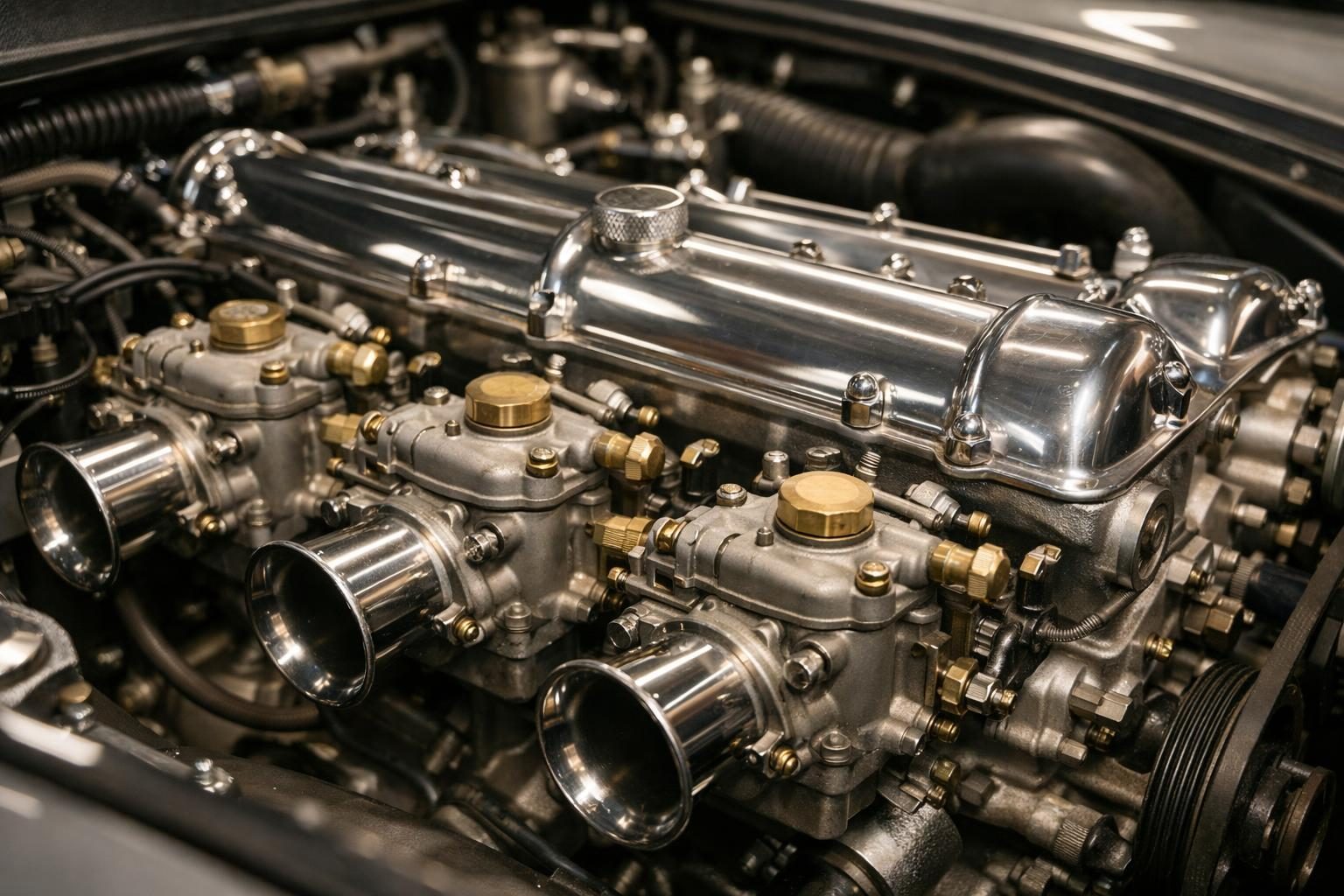
At the heart of the DB4 GT lies the 3.7-litre inline six-cylinder engine designed by Tadek Marek, here producing 302 PS at 6,000 rpm. This substantial gain is explained by two major axes: a dual ignition system, with two spark plugs per cylinder, and the adoption of three twin-choke Weber carburettors. This setup enhances combustion, mechanical breathing, and throttle response, all essential assets for a GT engaged in customer competition.
These specifications, established by consistent sources (Wikipedia and Artcurial), outline the mechanical identity of the DB4 GT. They mirror the timed performance figures mentioned above and align with the shortened chassis to deliver a coherent package. To delve deeper into the technical sheet and history, the dedicated page on Wikipedia for the DB4 GT and the detailed entry from Artcurial on the DB4 GT are useful references.
3. Silverstone 1959, Tourist Trophy 1960: the highlights in racing
The first strong signal comes even before the official introduction: on May 2, 1959, the DB4 GT prototype wins its first race at Silverstone in the hands of Stirling Moss, according to Wikipedia. This founding moment anchors the DB4 GT in a credible sporting trajectory, immediately demonstrating the relevance of the shortened chassis and the optimised Marek mechanics. The DB4 GT, from its inception, thus validates its design on the track.
The title of this section also references the 1960 Tourist Trophy, but the information provided here does not offer quantified details or documented results for this event. In this context, it is more rigorous to stick to the verified elements: the victory of the prototype at Silverstone in 1959. To place 1959 within the Aston Martin competition ecosystem, one can consult our thematic file dedicated to the DBR1 in 1959, keeping in mind that this article focuses on the specific trajectory of the DB4 GT.
4. DB4 GT Zagato: 19 exemplars even above the GT
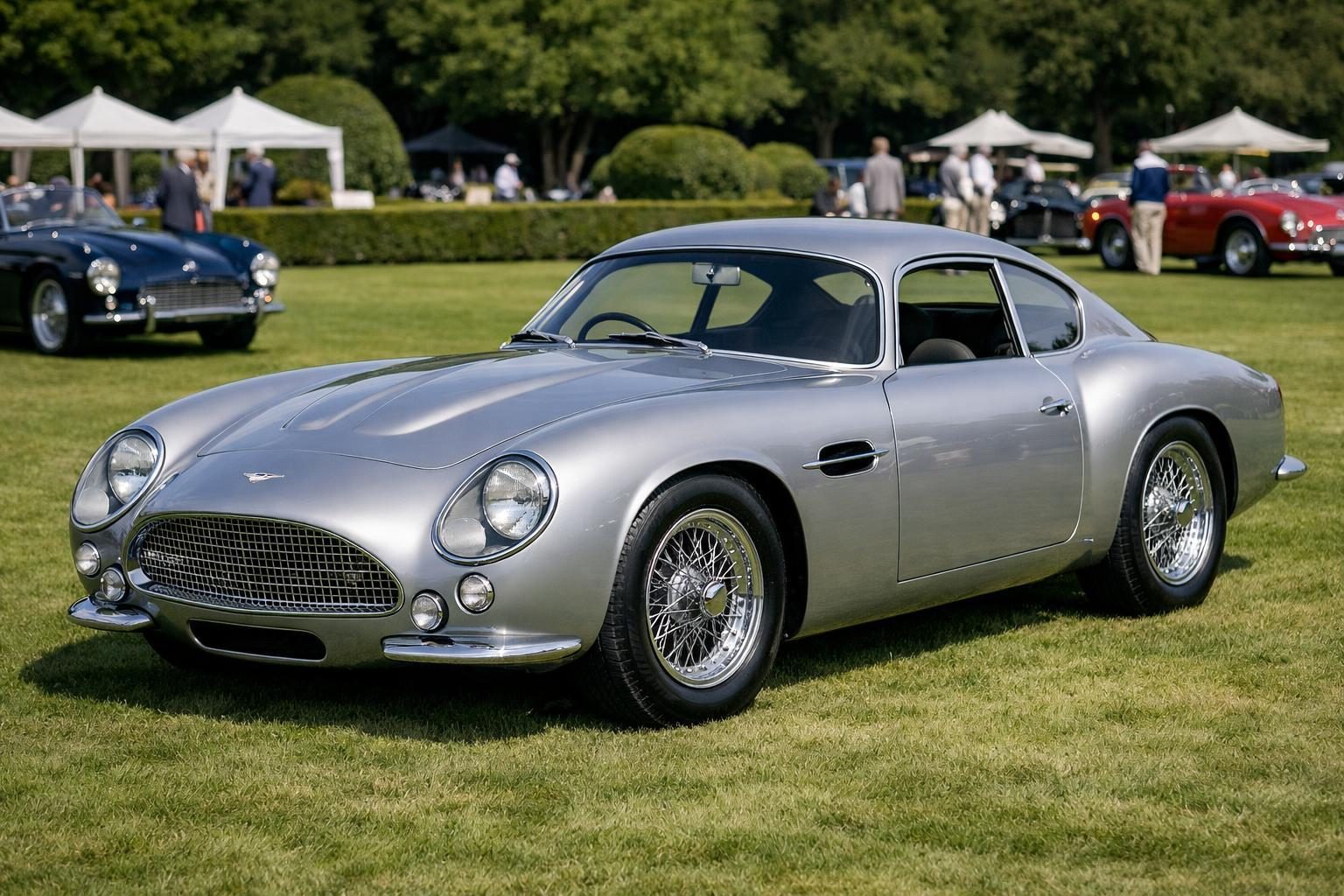
Above the DB4 GT, history notes the extreme rarity of the DB4 GT Zagato: only 19 original exemplars were produced between 1960 and 1963, according to Wikipedia. This very limited series, styled by Zagato, reflects an even more exclusive approach, in line with the spirit of customer competition and the demand for efficiency of the time. Again, the figures are clear and convergent: 19 pieces that set the historical value of this pinnacle of the lineage.
To explore this exceptional variant in detail, our comprehensive guide on DB4 GT Zagato revisits the essential milestones and specifics of these 19 cars. The lineage with the DB4 GT, which amplifies its rarity and aura, contributes to making the entire DB4 programme a major pivot in the Aston Martin landscape of the turn of the 1960s.
5. 75 exemplars and the Continuation series: an almost living lineage
The confirmed production volumes position the DB4 GT among the most desirable Aston Martins of the era: 75 exemplars were produced between 1959 and 1963. On this point, sources converge, whether it be the English Wikipedia page dedicated to the DB4, the Artcurial sheet, or the notice from Video-auto.com mentioned in the literature: all refer to the figure of 75. It combines rarity with a burgeoning record from 1959, a duo of factors that explains its status.
Proof of the model’s enduring aura, Aston Martin Works announced in 2016 a Continuation series of 25 exemplars, based on the lightweight specification of 1959, with deliveries planned for late 2017, according to the English Wikipedia sheet on the DB4. This structured reinterpretation extends the DNA of the DB4 GT, reminding us of the technical coherence of the original concept. For historical context and cross-referenced data, one can also consult the English Wikipedia sheet for the DB4 and the analysis from Artcurial dedicated to a DB4 GT exemplar.
Conclusion — DB4 GT, the essence of the GT spirit according to Aston Martin
By combining a shortened chassis of 127 mm, a 3.7-litre Tadek Marek six-cylinder engine boosted to 302 PS through dual ignition and three Weber carbs, and performance figures of 246 km/h and 6.1 seconds for 0-60 mph, the DB4 GT emerges as a brilliant synthesis of the GT requirements of the late 1950s. Its inaugural victory on May 2, 1959, at Silverstone, in the hands of Stirling Moss, grants the model immediate sporting legitimacy, in line with its positioning as a customer competition car.
The rarity of the DB4 GT (75 exemplars produced between 1959 and 1963), the pinnacle embodied by the 19 Zagato, and the modern revival through the Continuation series in 2016, reinforce a legacy that is both precise and alive. To complete this overview, the resources from Wikipedia on the DB4 GT and our overview of the origins of the DB4 will help trace, step by step, the thread of a story where the DB4 GT remains one of the most iconic Aston Martins of its time.
Valhalla: The 6 Technical Breakthroughs of Aston Martin’s First Hybrid Supercar
Valhalla stands as the greatest engineering breakthrough of modern Aston Martin, a manifesto that unites plug-in hybridisation, active aerodynamics, and expertise derived from F1. This Valhalla concentrates sharp technical choices — a thoroughly revised engine, dual electrification of the front axle, and a very lightweight carbon monocoque — and opens a new chapter for the brand. To follow the genesis and specifics of the Valhalla through updates, also check out our dedicated page on the Valhalla.
From the AM-RB 003 V6 to the Hybrid AMG V8: A Long Path to Production
First presented in 2019 as the AM-RB 003 concept with a hybrid V6, the Valhalla underwent a major reorientation of its powertrain. According to public sources, this shift occurred in the summer of 2021, when the project adopted a 4.0-litre twin-turbo Mercedes-AMG V8, marking a crucial step towards a credible and industrialisable production model. This transition reflects Aston Martin’s desire to anchor the Valhalla in a proven technical framework while maintaining an experimental spirit.
The switch from the in-house V6 to the hybrid AMG V8 is reported by Wikipedia and confirmed by specialist press, which highlights the role of the July 2021 revision. The challenge for the Valhalla is twofold: to secure very high-level performance and to ensure reliable production. Overall coherence takes precedence over mechanical originality, without sacrificing the technological ambition of the original concept.
Aston Martin Performance Technologies, the brand’s F1 division, participates in the development, a contribution cited by several specialist publications. Through the Valhalla, this transfer of skills is expressed as much in aerodynamics and simulations as in architectural choices. The result is a hybrid supercar that embraces its prototype roots while aiming for the road.
The PHEV Powertrain: Power, Divergences, and Architecture
The Valhalla adopts a PHEV architecture that combines the 4.0-litre twin-turbo V8 with an advanced electric component. Total power figures vary according to sources: L’Argus mentions 1,079 PS (828 PS for the V8 + 251 PS electric), while other media such as hellobiz.fr and bmw-actu.com mention 1,065 PS (816 PS for the V8 + electric motors). According to available facts, the official site has not yet published a definitive homologation, which explains these discrepancies. This plurality of figures does not prevent the Valhalla from positioning itself very high in the hierarchy of hybrid supercars.
Two electric motors positioned on the front axle ensure torque vectoring and reverse gear. This is a key uniqueness of the Valhalla, as the DCT gearbox with 8 speeds does not feature a mechanical reverse. This configuration optimises traction, paves the way for fine stability adjustments, and contributes to agility on throttle response. It confirms the choice of an “intelligent” front axle, designed for both efficiency and driving precision.
This hybrid chain is integrated into a total weight of 1,655 kg (according to L’Argus), a figure that is contained given the sophistication of the system. The balance between the power of a twin-turbo V8 and electric immediacy promises an explosive yet adaptable Valhalla, capable of alternating between power phases and consumption control. Underlying this is the goal of harnessing the best of both worlds without compromising the experience of a high-intensity Aston Martin.
Active Aerodynamics and 600 kg of Downforce: The F1 Heritage
The active aerodynamics of the Valhalla embodies the transfer of know-how from F1. The movable elements and fine management of airflow contribute to generating over 600 kg of downforce at 240 km/h, a figure cited by fr.motor1.com and by the manufacturer. This colossal downforce aims to maintain the widest possible performance window, ensuring stability and grip as loads increase.
Beyond the figure, the interest lies in variability: the Valhalla adapts its downforce level according to conditions, maximising efficiency in a straight line while enhancing grip in fast corners. This philosophy, derived from the tools and methods of Aston Martin Performance Technologies, allows for aerodynamic tuning that does not sacrifice versatility on the road. It is one of the major breakthroughs that distinguishes the Valhalla from traditional GTs.
The manufacturer highlights these choices on its dedicated page, where one can perceive the coherence between style and function. To delve deeper into the official knowledge of the model, explore the Aston Martin Valhalla presentation, which summarises the technical approach and aerodynamic choices of this hybrid supercar.
Carbon Monocoque and Chassis: References to the Valkyrie
The structural core of the Valhalla is a carbon fibre monocoque announced at 120 kg (L’Argus). This lightweight and ultra-rigid base serves as an anchor point for the entire mechanical system and active aerodynamics. By combining body rigidity and weight reduction, the Valhalla prepares the ground for more precise steering and better-calibrated suspensions, while containing the inherent masses of the PHEV architecture.
This approach echoes methods already proven on the Valkyrie, the ultimate reference of the brand in terms of radicality. The technical similarities are not coincidental: the Valhalla adopts the idea of an optimised chassis from the outset, with integrated aerodynamics. To measure the common DNA, refer to our dedicated page on the Aston Martin Valkyrie, which illuminates the connections and differences between hypercar and hybrid supercar at Aston Martin.
In line with the brand’s icons, this Valhalla fits into a timeline of breakthrough innovations. To put this engineering quest into perspective, our dossier on an emblematic predecessor can usefully complement the reading: technical history of the Aston Martin One-77. Without being redundant, it recalls how structural weight reduction and functional design have shaped the character of exceptional models.
999 Units and Position in the Range: Between Valkyrie and DB12
The Valhalla will be produced in 999 units, a volume announced by the manufacturer and relayed by L’Argus. This limited series gives the Valhalla an assumed rarity, consistent with its status as a technological showcase and collector’s item. In the Aston Martin ecosystem, it is a way to ensure exclusivity while mastering the phases of industrialisation and development of a high-performance PHEV.
In the brand hierarchy, the Valhalla positions itself between the radical hypercar Valkyrie and the GTs in the range, embodying a bridge between extreme technology and road use. This positioning confirms the Valhalla’s vocation: to embody a technological breakthrough that remains usable, with plug-in hybridisation, active aerodynamics, and a lightweight carbon base. It becomes the flagship of an era where efficiency, downforce, and control electronics go hand in hand.
For a documented overview of the data made public and the power estimates that still surround the Valhalla, you can consult the summary page of the Valhalla on the official site as well as the synthesis made by L’Argus. These resources reflect the current status of a project where the definitive homologation of figures has not yet been communicated by the manufacturer.
Conclusion – Why Valhalla Marks a Turning Point for Aston Martin
By aligning sophisticated plug-in hybridisation, active aerodynamics capable of over 600 kg of downforce at 240 km/h, and a 120 kg carbon monocoque, the Valhalla represents a concentration of breakthroughs. The shift from the initial V6 to the hybrid AMG V8, the electrified front axle for vectoring, and the absence of mechanical reverse in the DCT 8, replaced by the electric function, illustrate a taboo-free approach. The Valhalla embodies this new mindset, nourished by the contribution of Aston Martin Performance Technologies.
Limited to 999 units, the Valhalla rises as the flagship of a transitioning range, putting technology at the service of controlled performance. To follow the evolution of the Valhalla and its final specifications, keep an eye on the official presentation and the dedicated encyclopaedic page, which gather the essential milestones of this programme.
DB7: 7 Secrets of the Greatest Aston Martin Model
The DB7, often caricatured for its Jaguar genes, deserves a solid rehabilitation: behind the anecdotes, the facts show a car designed intelligently, presented on time, and produced in the right place, which initiated an unprecedented dynamic for Aston Martin. Through seven sourced truths, we recall how the DB7 was conceived as part of Project XX by Ford and TWR, revealed in Geneva in 1993, powered by a credible supercharged six-cylinder engine, and then elevated in 1999 by the DB7 Vantage V12, before becoming, with over 7,000 units, the bridge between two eras. For more in-depth specifications and variants, also check our dedicated page on the DB7 in detail.
1. Project XX: How Ford and TWR Designed an Aston Martin from a Jaguar
At the heart of the DB7’s story is the internal “XX” project, led under Ford’s aegis with the support of TWR. According to sources (Wikipedia and autoencyclopedie.com), the car was built by TWR at the Bloxham factory (Oxfordshire), a site previously mobilised for the Jaguar XJ220. The DB7 thus embodies a pragmatic approach: using available resources and proven expertise to create a credible Aston Martin, while managing the timeline and industrial tool.
This pragmatic lineage with Jaguar is also expressed in the architecture: the DB7 is the only Aston Martin with a semi-monocoque steel structure inherited from Jaguar, while all subsequent models will adopt aluminium (Wikipedia). Far from being a mere compromise, this structural choice allowed the Project XX to be realised within realistic timelines and with immediately mobilisable know-how from TWR, benefiting a DB7 ready for series production.
2. Geneva 1993: The Revelation and Immediate Success of Orders
The prototype of the DB7 was completed in November 1992, then unveiled at the Geneva Motor Show in March 1993 (Wikipedia DB7). This narrow and effective window allowed Aston Martin to quickly showcase the results of Project XX. The reception generated by this revelation paved the way for a commercial dynamic that would materialise into a solid industrial start.
Production of the DB7 began in September 1994 and ended in December 2004 (Wikipedia DB7). Between these two milestones, the DB7 played a leading role in the Bloxham workshop managed by TWR, confirming that the Geneva presentation in 1993 was not a flash in the pan but the starting point of an unprecedented production cycle for the brand.
The coherence between the public appearance of the DB7 in Geneva and the rapid production launch illustrates a controlled execution: prototype, revelation, then industrialisation in the TWR factory in Bloxham. This continuum reflects the relevance of Project XX, both in terms of product and organisation, and explains why the DB7 has firmly established itself in the range.
3. Technology: The Supercharged Six-Cylinder and Manual or Auto Gearbox
At launch, the DB7 adopts a 3.2-litre supercharged six-cylinder engine by Eaton. The exact power figures vary according to sources: motorsdb.com indicates 335 PS at 5,750 rpm, while autoencyclopedie.com mentions 340 PS. This divergence highlights the importance of citing references; in any case, the DB7 relies on a powertrain consistent with its positioning, with supercharging providing the expected enjoyment and availability.
This engine finds a unique technical setting: the semi-monocoque steel structure inherited from Jaguar, a unique feature of the DB7 in Aston Martin’s history (Wikipedia). In fact, all subsequent Aston Martins will switch to aluminium, but the DB7 demonstrates that the steel solution, well exploited by TWR at Bloxham, allowed for a level of manufacturing maturity that mattered more than the nobility of materials at this stage.
In practice, this combination of Eaton supercharger + steel semi-monocoque gave the DB7 a distinct technical identity, capable of appealing to a broad audience. Regardless of the transmission considered by buyers, the signature of the supercharged six-cylinder remains the heart of the experience and represents the initial DNA that the DB7 inscribed in the decade following the Geneva revelation in 1993.
4. 1999: The DB7 Vantage V12, Aston Martin’s First Series Twelve-Cylinder
In 1999, the DB7 Vantage V12 marks a decisive milestone: it is the first series Aston Martin equipped with a V12. According to Motorlegend, this 6.0-litre was developed in cooperation with Ford Research and Cosworth, by combining two Ford Duratec V6 engines. The DB7 thus anchors, at the turn of 1999, a new mechanical ambition in the brand’s lineage.
This upgrade fully fits within the trajectory of the DB7: starting from a precise and well-calibrated supercharged six-cylinder, the range rises to the V12 with the DB7 Vantage, offering a strong technical symbol for Aston Martin. The transition illustrates a clear strategy: to capitalise on the foundations of Project XX and on the Bloxham tool to bring an exceptional engine to series production.
The transition to the V12 does not deny the initial DNA of the DB7; it amplifies it. By placing itself at the intersection of Ford/Cosworth engineering (Motorlegend) and TWR’s assembly experience, the DB7 Vantage V12 sealed the model’s relevance as a vector of innovation, paving the way for subsequent generations of Aston Martin.
5. 7,092 Units: The DB7 as a Bridge Between Two Eras
The DB7 was, in its time, the most produced model in Aston Martin’s history. On this point, the published figures differ slightly: Wikipedia mentions “over 7,000 units” while autoencyclopedie.com specifies 7,092 units. Regardless of the source chosen, the order of magnitude is clear and historic for the brand, a tangible sign of the impact the DB7 left on the 1994–2004 decade.
This longevity spans from September 1994 (start of production) to December 2004 (end of production), giving the DB7 a role as an industrial and technical bridge. The only Aston Martin with a semi-monocoque steel structure inherited from Jaguar (Wikipedia), the DB7 prepared the shift to aluminium for all subsequent models. It thus served as a concrete bridge: a steel base to initiate momentum, then aluminium to deploy it.
This bridging status is also measured by the influence exerted on the subsequent range. To understand the continuity of the product narrative beyond the DB7, you can explore our file dedicated to the DB9, which illustrates the next era, and more broadly, the recent evolution of the Gaydon sports car via our analysis of the Vantage/DB12 2025. The DB7 thus occupies a central place, both as the culmination of a pragmatic project and as a springboard for contemporary platforms.
Conclusion: Why the DB7 Matters Beyond the Clichés
Returning to the facts places the DB7 at the centre of the game. Designed as part of the Project XX, industrialised by TWR at Bloxham (former site of the Jaguar XJ220), revealed in Geneva in March 1993 after a prototype completed in November 1992, the DB7 followed with continuous production from September 1994 to December 2004. Its 3.2-litre supercharged six-cylinder engine by Eaton laid solid mechanical foundations (335 PS according to motorsdb.com, 340 PS according to autoencyclopedie.com), before the DB7 Vantage V12 (1999) inscribed the first series V12 of Aston Martin, the result of a Ford Research/Cosworth collaboration (Motorlegend).
In total, with over 7,000 units (Wikipedia) and a specified figure of 7,092 units (autoencyclopedie.com), the DB7 achieved unprecedented distribution for the brand. The only Aston with a semi-monocoque steel structure inherited from Jaguar while all subsequent models adopted aluminium, the DB7 played a role as a bridge whose importance is measurable in duration and volume. This bundle of factual elements rehabilitates the DB7: beyond the clichés, it provided Aston Martin with an industrial and technical base that paved the way for subsequent generations.
To continue the discovery, find our DB7 file and the official presentation of the DB7 by Aston Martin, complemented by the encyclopaedic summary (en). In tracing these seven truths, it appears that the DB7 is much more than a “hybrid” Aston of influences: it is a foundational DB7, which opened — and embraced — the transition to the modern era.